production
/viewbook/list/all/?page=1258
/
/static/
None

B-85 RULER
Authors:
Not Available
Publisher:
Not available
Publication Date:
Not available
ISBN:
Not available
BA 2 PLUS PROFESSIONAL CFA APPROVED
Authors:
Not Available
Publisher:
Not available
Publication Date:
Not available
ISBN:
Not available
BA 321L (20129) HARVARD BUSINESS CASES Ed: 1ST
Authors:
Not Available
Publisher:
Not available
Publication Date:
Not available
ISBN:
Not available
BA 616 BUS.ETHICS W/ADD.MAT. ]CUSTOM[
Authors:
Not Available
Publisher:
Not available
Publication Date:
Not available
ISBN:
Not available

Baader-Meinhof: The Inside Story of the RAF
Authors:
Stefan Aust
Publisher:
Oxford University Press, USA
Publication Date:
Not available
ISBN:
0195372751
Book Description The Baader-Meinhof Group--later known as the Red Army Faction (RAF)--was a violent urban guerilla group which terrorized Germany in the... 1970s and '80s, killing 47 people, wounding 93, taking 162 hostages, and robbing 35 banks--all in an attempt to bring revolution to the Federal Republic. Stefan Aust's masterful history of the Group presents the definitive account, capturing a highly complex story both accurately and colorfully. Much new information has surfaced since the mass suicide of the Groups' leaders in the 1980s. Some RAF members have come forward to testify in new investigations and formerly classified Stasi documents have been made public since the fall of the Berlin Wall, all contributing to a fuller picture of the RAF and the events surrounding their demise. Aust presents the complete history of the RAF, from the creation in 1970 to the breakup in 1998, incorporating all of the new information. For instance, there is growing evidence that the German secret service eavesdropped on Baader, Meinhof, and the other RAF members imprisoned in Stammheim and that they knew that the terrorists planned a mass suicide, but did nothing to prevent it. Also, there is new information about the role of the RAF lawyers (among them Otto Schily who later was Minister of the Interior in Gerhard Schroder's cabinet), and the roles of the different RAF members and the rivalry between them. The volume will also contain numerous photos. Terrorism today is never far from most people's thoughts. Baader-Meinhof offers a gripping account of one of the most violent terrorist groups of the late twentieth century, in a compelling look at what they did, why they did it, and how they were brought to justice. Questions for Stefan Aust Q: Given your background as an editor of Konkret and your previous friendship with Ulrike Meinhof, how was the original version of your book received by the left when it first came out? Though you did not explicitly state it at the time, your book very conclusively seemed to demonstrate that the strange deaths in Stammheim prison were in fact suicides, yet it seems to be an article of faith amongst leftists that Baader, Ensslin, and Raspe were murdered. How was your book received by the left at the time? And has that changed with the new edition, especially now that you clearly state that their deaths were suicides? A: When the book first came out in 1985, a lot of copies were being bought by RAF members who were sitting in jail. Some of them learned about the first generation of the group mainly by reading the book. But that didn’t stop them--or their sympathizers--from being very critical of it. On a talk show, Hans Christian Ströbele, who was a former RAF lawyer and later a member of parliament (Green Party) said that Baader and Meinhof would roll over in their graves if they read the book...After more than twenty years, I now have the feeling that even people from the left see the book as a rather fair and correct work of journalism. Now their main argument is that the book has the Deutungshoheit about the subject--which means something like opinion leadership about the subject of RAF-Terrorism. Q: There are many of people who romanticize the leaders of the RAF without understanding the devastation that they wrought. The Baader-Meinhof Complex, the Oscar-Nominee movie that you wrote last year, was accused of glorifying terrorism. What are your thoughts about those criticisms? Is there even a way to portray the Baader-Meinhof saga without being accused of glorifying or romanticizing terrorism? A: The moment you write or make films about groups like the RAF you support their immorality. I wanted to portray this group as accurately as possible. It would be impossible for a book reader or film viewer to understand why so many people followed them if they were portrayed only as villains and criminals. It was their charisma that made them so dangerous. One of the reasons why we showed the group’s bombings and killings in such detail was that we wanted to explain what terrorism really is: the terror and killing of people--of human beings--not of lifeless character masks. The aim was to make viewers understand why people of such high moral standards turned into ruthless killers, how hyper moral turned into immorality. Q: Do you see any homegrown, leftwing terrorist movements taking root in Europe or America again? One of the reasons that the Baader-Meinhof Group was able to rise to prominence early in the 70’s was partially because of ineffective police work. It seems that in the modern climate, particularly since 9/11, it would be extremely hard for any band of urban revolutionaries to wage a similar war without being quickly caught. Do you agree? What kind of left-wing radical movement COULD succeed? A: Any kind of terrorist activity is always a part of a bigger radical movement. A terrorist group can evolve only when a bigger radical movement of any kind exists--left, right, nationalist or religious. Organizations like al Qaeda can only function from inside a global Islamist movement. Similarly the RAF was a part of the radical left in Germany, at least in the beginning. And only if this terrorist group is imbedded in a major movement can it have enough supporters to operate for a longer period of time. The members of the RAF were mainly arrested because normal people--even leftists--called the police. The enormous buildup of the police and the security agencies in Germany could not have been as effective without the cooperation of the people. The only way for a left-wing radical movement to succeed is by using the power of convincing the people rather than employing violence of any kind. Q: The single hardest concept for an American living in the early 21st century is to understand is the notion that the members of the RAF felt that by attacking the state and having the state respond with massive retaliation, that there would be an enormous number of German people who would then take up their cause and overthrow the state. It just seems utterly delusional, especially coming from clearly intelligent people. How could they get to the point where this seemed rational? A: I can only quote Ulrike Meinhof who often said “wie kommt die Dummheit in die Intelligenz?” which means “how can stupidity invade intelligence?” The first mistake the RAF made was not seeing reality. For me the whole struggle from the very beginning of my research was to realizing that the RAF had a quasi-religious character more than a rational political character. To think that in Germany the masses would overthrow the capitalist system was completely irrational. I cannot believe that they really believed that. Rather, they acted like political or religious martyrs to show that the state was as brutal as they thought it was. It was an experiment with their own--and others’--lives. Q: What was Ulrike Meinhof like as a person before going underground? Reading her Konkret essays in chronological order, one is struck by how much more hardened, desperate, and humorless she became in her later columns. Was she like that in her personal life? Did she have fun and socialize? Did she seem like she had an internal conflict? A: Ulrike was a very impressive person. She was well-educated and could get her point across very convincingly. At the same time she was quite an intolerant individual who thought she knew things better than others... However, people of the liberal movement adored her, and she socialized a lot during her time in Hamburg and with Konkret, where at this time she wrote about the poor, about people in sweat shops and in prison. In the end she could not live in these two worlds. When she went to Berlin she grew more and more depressed. Ultimately, I think her involvement in the RAF was due to many personal and psychological reasons. Read more

Baal, A Man's a Man, and the Elephant Calf (Brecht, Bertolt)
Authors:
Bertolt Brecht
Publisher:
Grove Press
Publication Date:
Not available
ISBN:
080213159X
Stanislavski's groundbreaking acting system, developed from his work in the Moscow Art Theater and acknowledged the world over, found its greatest... success in America where its methods have been used for over fifty years by the Actor's Studio in New York. Building a Character, the second volume in Stanislavski's acclaimed trilogy, continues the total immersion in technique and class scenarios begun in An Actor Prepares. The work unfolds in a drama school with a group of young actors: the argumentative Grisha; the pretty, vain Sonia; her admirer, the clowning Vanya; and Kostya, the diarist who records the daily lessons. The teacher and director Tortsov is modeled on Stanislavski.The emphasis in the second book is to continue to challenge the imagination of the actors, encouraging them to act out the deepest expressions of human nature and find their highest potential. Here, a new range of physical exercises is practiced with the goals of plasticity of motion, restraint and control, and making the body expressive. Stanislavski also delves into stage charm and character-building by focusing on diction and singing, intonation and pauses, and tempo-rhythm.Stanislavski's aim is to help actors fill out their roles to the proportion of whole human beings, "characters who will have the power to move the public to laughter, to tears, to unforgettable emotions."
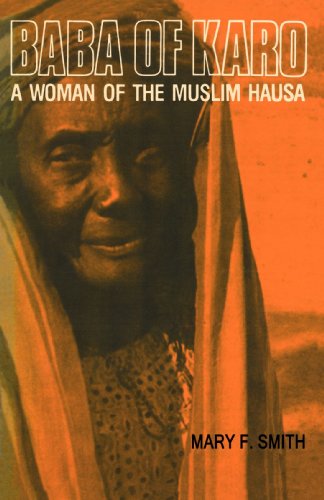
Baba of Karo: A Woman of the Muslim Hausa
Authors:
Mary F Smith
Publisher:
Yale University Press
Publication Date:
Not available
ISBN:
0300027419
First published in 1954 and now reissued with a new foreword by Hilda Kuper, this autobiography of a shrewd, humorous and courageous personality remains... a classic in the field of African studies and a uniquely valuable account of a Muslim society in West Africa.

Babbitt
Authors:
Sinclair / Parry, Sally E. (INT) Lewis
Publisher:
Signet Classic 2007-08-07
Publication Date:
Not available
ISBN:
0451530616
Since the 1922 publication of Babbitt, its eponymous anti-hero-a real estate broker and relentless social climber inhabiting a Midwestern town called... Zenith-has become a symbol of stultifying values and middle class hypocrisy.

Babbitt (Bantam Classics)
Authors:
Sinclair Lewis
Publisher:
Bantam Classics
Publication Date:
Not available
ISBN:
0553214861
When Babbitt was first published in 1922, fans gleefully hailed its scathing portrait of a crass, materialistic nation; critics denounced it as an... unfair skewering of the American businessman. Sparking heated literary debate, Babbitt became a controversial classic, securing Sinclair Lewis’s place as one of America’s preeminent social commentators.Businessman George F. Babbitt loves the latest appliances, brand names, and the Republican Party. In fact, he loves being a solid citizen even more than he loves his wife. But Babbitt comes to resent the middle-class trappings he has worked so hard to acquire. Realizing that his life is devoid of meaning, he grows determined to transcend his trivial existence and search for greater purpose. Raising thought-provoking questions while yielding hilarious consequences, and just as relevant today as ever, Babbitt’s quest for meaning forces us to confront the Babbitt in ourselves—and ponder what it truly means to be an American.

Babbitt (Dover Thrift Editions)
Authors:
Sinclair Lewis
Publisher:
Dover Publications
Publication Date:
Not available
ISBN:
0486431673
Prosperous and socially prominent, George Babbitt appears to have everything. But when a personal crisis forces the middle-aged real estate agent to... reexamine his life, Babbitt mounts a rebellion that jeopardizes everything he values. Widely considered Sinclair Lewis' greatest novel, this satire remains an ever-relevant tale of an individual caught in the machinery of modern life.
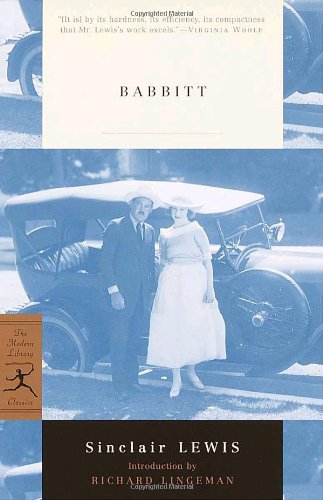
Babbitt (Modern Library Classics)
Authors:
Sinclair Lewis
Publisher:
Modern Library
Publication Date:
Not available
ISBN:
0375759255
In the fall of 1920, Sinclair Lewis began a novel set in a fast-growing city with the heart and mind of a small town. For the center of his cutting... satire of American business he created the bustling, shallow, and myopic George F. Babbitt, the epitome of middle-class mediocrity. The novel cemented Lewis’s prominence as a social commentator. Babbitt basks in his pedestrian success and the popularity it has brought him. He demands high moral standards from those around him while flirting with women, and he yearns to have rich friends while shunning those less fortunate than he. But Babbitt’s secure complacency is shattered when his best friend is sent to prison, and he struggles to find meaning in his hollow life. He revolts, but finds that his former routine is not so easily thrown over.

Babbitt (Oxford World's Classics)
Authors:
Sinclair Lewis
Publisher:
Oxford University Press, USA
Publication Date:
Not available
ISBN:
0199567697
Amusing and tragic by turn, Sinclair Lewis's classic novel is a biting satire of middle-American values whose title has entered the language as a byword... for smug complacency, conformity, and materialism, and whose suburban targets are still much in evidence. A successful real estate agent, George F. Babbitt is a member of all the right clubs, and unquestioningly shares the same aspirations and ideas as his friends and fellow Boosters. Yet even Babbitt dreams of romance and escape, and when his best friend does something to throw his world upside down, he rebels, and tries to find fulfillment in romantic adventures and liberal thinking. Hilarious and poignant, Babbitt turns the spotlight on middle America and strips bare the hypocrisy of business practice, social mores, politics, and religious institutions. In his introduction and notes Gordon Hutner explores the novel's historical and literary contexts, and highlights its rich cultural and social references. The book also features an up-to-date bibliography and explanatory notes that document and gloss the rich social history of the period.About the Series: For over 100 years Oxford World's Classics has made available the broadest spectrum of literature from around the globe. Each affordable volume reflects Oxford's commitment to scholarship, providing the most accurate text plus a wealth of other valuable features, including expert introductions by leading authorities, voluminous notes to clarify the text, up-to-date bibliographies for further study, and much more.

Babbitt (Penguin Twentieth-Century Classics)
Authors:
Sinclair Lewis
Publisher:
Penguin Classics
Publication Date:
Not available
ISBN:
0140189025
George F. Babbitt, a conniving, prosperous real estate man from Zenith, Ohio, revels in his popularity, his success, and, especially, in the material... rewards they bring. He bullies his wife, flirts with other women, and patronizes the less successful. But when his best friend is sent to prison for killing his wife, Babbitt's middle-class complacency is shattered, and he rebels, seeking a more "meaningful" life. His small revolt is quickly defeated, however, by public opinion and his own need for acceptance. Babbitt captures the flavor of America during the economic boom years of the 1920's, and its protagonist has become the symbol of middle-class mediocrity, his name an enduring part of the American lexicon. "The equal of any novel written in English in the present century." —Virginia Woolf in The Saturday Review

Babel-17/Empire Star
Authors:
Samuel R. Delany
Publisher:
Vintage
Publication Date:
Not available
ISBN:
0375706690
Author of the bestselling Dhalgren and winner of four Nebulas and one Hugo, Samuel R. Delany is one of the most acclaimed writers of speculative... fiction. Babel-17, winner of the Nebula Award for best novel of the year, is a fascinating tale of a famous poet bent on deciphering a secret language that is the key to the enemy’s deadly force, a task that requires she travel with a splendidly improbable crew to the site of the next attack. For the first time, Babel-17 is published as the author intended with the short novel Empire Star, the tale of Comet Jo, a simple-minded teen thrust into a complex galaxy when he’s entrusted to carry a vital message to a distant world. Spellbinding and smart, both novels are testimony to Delany’s vast and singular talent.

Babel and Babylon: Spectatorship in American Silent Film
Authors:
Miriam Hansen
Publisher:
Harvard University Press
Publication Date:
Not available
ISBN:
0674058313
Although cinema was invented in the mid-1890s, it was a decade more before the concept of a "film spectator" emerged. As the cinema began to separate... itself from the commercial entertainments in whose context films initially had been shown--vaudeville, dime museums, fairgrounds--a particular concept of its spectator was developed on the level of film style, as a means of predicting the reception of films on a mass scale. In Babel and Babylon Miriam Hansen offers an original perspective on American film by tying the emergence of spectatorship to the historical transformation of the public sphere. Hansen builds a critical framework for understanding the cultural formation of spectatorship, drawing on the Frankfurt School's debates on mass culture and the public sphere. Focusing on exemplary moments in the American silent era, she explains how the concept of the spectator evolved as a crucial part of the classical Hollywood paradigm--as one of the new industry's strategies to integrate ethnically, socially, and sexually differentiated audiences into a modern culture of consumption. In this process, Hansen argues, the cinema might also have provided the conditions of an alternative public sphere for particular social groups, such as recent immigrants and women, by furnishing an intersubjective context in which they could recognize fragments of their own experience. After tracing the emergence of spectatorship as an institution, Hansen pursues the question of reception through detailed readings of a single film, D. W. Griffith's Intolerance (1916), and of the cult surrounding a single star, Rudolph Valentino. In each case the classical construction of spectatorship is complicated by factors of gender and sexuality, crystallizing around the fear and desire of the female consumer. Babel and Babylon recasts the debate on early American cinema--and by implication on American film as a whole. It is a model study in the field of Cinema Studies, mediating the concerns of recent film theory with those of recent film history.
 '
'