production
/viewbook/list/all/?page=1265
/
/static/
None
Backstage Forms
Authors:
Paul Carter
Publisher:
Broadway Press
Publication Date:
Not available
ISBN:
0911747354
Over 100 examples of backstage paperwork ready for photocopying--forms like hanging schedules, costume fitting sheets, lighting circuit schedules, prop... preset lists, sound cues, to name only a few.
Back Stage Guide to Working in Regional Theater: Jobs for Actors...
Authors:
Jim Volz
Publisher:
Back Stage Books
Publication Date:
Not available
ISBN:
0823078809
Every acting student and working actor needs a copy of this book! Here’s the essential guide to surviving and thriving as an actor in regional... theaters. The thousands and thousands of students in the hundreds and hundreds of acting programs all over the country would all love to become stars right out of school—but the reality of a career in acting usually means honing the craft at regional theaters. The Back Stage Guide to Working in Regional Theater includes a history of the movement and a description of each of the League of Regional Theater (LORT) houses in the U.S, plus sections on personal marketing for the actor, the business of acting, strategies and career planning. Essential web sites, a sample organizational chart, contact names, a guide to theater unions, and listings of more than 100 theaters across the country make The Back Stage Guide to Regional Theater a must-have for every actor who’s working or wants to be.

BACKSTAGE HANDBOOK
Authors:
Not Available
Publisher:
Not available
Publication Date:
Not available
ISBN:
Not available

Backstage Handbook: An Illustrated Almanac of Technical Information
Authors:
Paul Carter
Publisher:
Broadway Press
Publication Date:
Not available
ISBN:
091174729X
First published in 1988, Backstage Handbook is one of the most widely used stagecraft textbooks in the United States, with about 10,000 copies sold... every year.This handy reference book brings together under one cover an incredible variety of information useful to designers, technicians and students who work behind the scenes in theatre, film and television. Its sturdy leatherette binding will stand up to years of constant use.The third edition updates this popular reference book with new terminology and materials, and adds dozens of new illustrations of grip hardware, film lighting equipment and painting tools. Backstage Handbook includes chapters on Tools, Hardware, Materials, Electrics, Shop Math, Architecture and Theatre. There are hundreds of illustrations, tables and charts which cover everything from the stock sizes and specs of wood screws, to safe working loads for several kinds of rope, to illustrations of twenty-two types of standard lamp bases.
Backstage Handbook: An Illustrated Handbook of Technical Information
Authors:
Chiang George
Publisher:
Broadway Press
Publication Date:
Not available
ISBN:
0911747141
First published in 1988, Backstage Handbook is one of the most widely used stagecraft textbooks in the United States, with about 10,000 copies sold... every year.This handy reference book brings together under one cover an incredible variety of information useful to designers, technicians and students who work behind the scenes in theatre, film and television. Its sturdy leatherette binding will stand up to years of constant use.The third edition updates this popular reference book with new terminology and materials, and adds dozens of new illustrations of grip hardware, film lighting equipment and painting tools. Backstage Handbook includes chapters on Tools, Hardware, Materials, Electrics, Shop Math, Architecture and Theatre. There are hundreds of illustrations, tables and charts which cover everything from the stock sizes and specs of wood screws, to safe working loads for several kinds of rope, to illustrations of twenty-two types of standard lamp bases.
BACKSTAGE PASS (CUSTOM)
Authors:
Not Available
Publisher:
Kendall Hunt Publishing
Publication Date:
Not available
ISBN:
1465201424

Backstory 5: Interviews with Screenwriters of the 1990s
Authors:
Not Available
Publisher:
University of California Press
Publication Date:
Not available
ISBN:
0520260392
Patrick McGilligan continues his celebrated interviews with exceptional screenwriters in Backstory 5, focusing on the 1990s. The thirteen featured... writers--Albert Brooks, Jean-Claude Carrière, Nora Ephron, Ronald Harwood, John Hughes, David Koepp, Richard LaGravenese, Barry Levinson, Eric Roth, John Sayles, Tom Stoppard, Barbara Turner, and Rudy Wurlitzer--are not confined to the 1990s, but their engrossing, detailed, and richly personal stories create, in McGilligan's words, "a snapshot of a profession in motion." Emphasizing the craft of writing and the process of collaboration, this new volume looks at how Hollywood is changing to meet new economic and creative challenges. Backstory 5 explores how these writers come up with their ideas, how they go about adapting a stage play or work of fiction, how they organize and structure their work, and much more.
Back Talk from Appalachia: Confronting Stereotypes
Authors:
Not Available
Publisher:
The University Press of Kentucky
Publication Date:
Not available
ISBN:
0813190010
Appalachia has long been stereotyped as a region of feuds, moonshine stills, mine wars, environmental destruction, joblessness, and hopelessness. Robert... Schenkkan's 1992 Pulitzer-Prize winning play The Kentucky Cycle once again adopted these stereotypes, recasting the American myth as a story of repeated failure and poverty--the failure of the American spirit and the poverty of the American soul. Dismayed by national critics' lack of attention to the negative depictions of mountain people in the play, a group of Appalachian scholars rallied against the stereotypical representations of the region's people. In Back Talk from Appalachia, these writers talk back to the American mainstream, confronting head-on those who view their home region one-dimensionally. The essays, written by historians, literary scholars, sociologists, creative writers, and activists, provide a variety of responses. Some examine the sources of Appalachian mythology in nineteenth- and early twentieth-century literature. Others reveal personal experiences and examples of grassroots activism that confound and contradict accepted images of ""hillbillies."" The volume ends with a series of critiques aimed directly at The Kentucky Cycle and similar contemporary works that highlight the sociological, political, and cultural assumptions about Appalachia fueling today's false stereotypes.
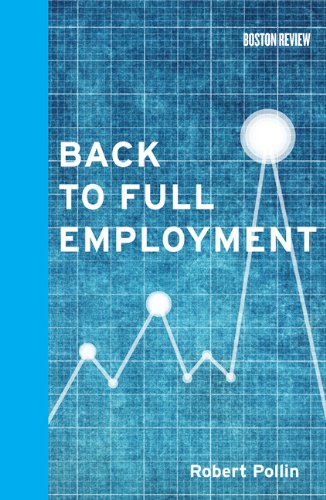
Back to Full Employment (Boston Review Books)
Authors:
Robert Pollin
Publisher:
The MIT Press
Publication Date:
Not available
ISBN:
0262017571
Full employment used to be an explicit goal of economic policy in most of the industrialized world. Some countries even achieved it. In Back to Full... Employment, economist Robert Pollin argues that the United States--today faced with its highest level of unemployment since the Great Depression--should put full employment back on the agenda.There are good reasons to seek full employment, Pollin writes. Full employment will help individuals, families, and the economy as a whole, while promoting equality and social stability. Equally important, creating a full-employment economy can be joined effectively with two other fundamental policy aims: ending our dependence on fossil fuels and creating an economy powered by clean energy.Explaining views on full employment in macroeconomic theory from Marx to Keynes to Friedman, Pollin argues that the policy was abandoned in the United States in the 1970s for the wrong reasons, and he shows how it can be achieved today despite the serious challenges of inflation and globalization. Pollin believes the biggest obstacle to creating a full-employment economy is politics. Putting an end to the prevailing neoliberal opposition to full employment will require nothing less than an epoch-defining reallocation of political power away from the interests of big business and Wall Street and toward the middle class, working people, and the poor, while mounting a strong defense of the environment. In the end, achieving full employment will be a matter of political will: Can the United States make having a decent job a fundamental right?

Back to Nature: The Arcadian Myth in Urban America
Authors:
Peter J. Schmitt
Publisher:
The Johns Hopkins University Press
Publication Date:
Not available
ISBN:
0801840139
Many of us go "back to nature" to get away from civilization. But as often as not, our expectations and actions are shaped by idealized notions of... natural order, purity, and even neatness that are in fact impositions of civilization on nature. This is a highly insightful, sometimes ironic study of the influence of such paradoxes in the early 20th-century love affair with nature: anthropomorphized animal stories, summer camps, wildlife protection, landscaped cemeteries, wilderness novels and scenic turnoffs that imposed an industrial ethic of order, neatness, and regularity on natural systems. Recommended.
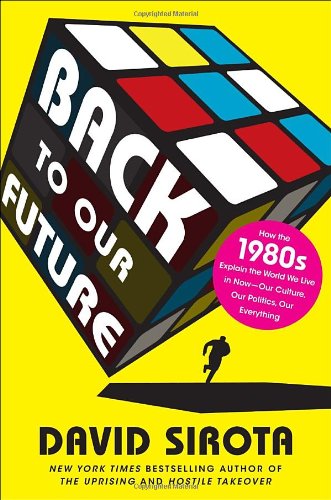
Back to Our Future: How the 1980s Explain the World We Live in...
Authors:
David Sirota
Publisher:
Ballantine Books
Publication Date:
Not available
ISBN:
0345518780
Wall Street scandals. Fights over taxes. Racial resentments. A Lakers-Celtics championship. The Karate Kid topping the box-office charts. Bon Jovi... touring the country. These words could describe our current moment—or the vaunted iconography of three decades past. In this wide-ranging and wickedly entertaining book, New York Times bestselling journalist David Sirota takes readers on a rollicking DeLorean ride back in time to reveal how so many of our present-day conflicts are rooted in the larger-than-life pop culture of the 1980s—from the “Greed is good” ethos of Gordon Gekko (and Bernie Madoff) to the “Make my day” foreign policy of Ronald Reagan (and George W. Bush) to the “transcendence” of Cliff Huxtable (and Barack Obama). Today’s mindless militarism and hypernarcissism, Sirota argues, first became the norm when an ’80s generation weaned on Rambo one-liners and “Just Do It” exhortations embraced a new religion—with comic books, cartoons, sneaker commercials, videogames, and even children’s toys serving as the key instruments of cultural indoctrination. Meanwhile, in productions such as Back to the Future, Family Ties, and The Big Chill, a campaign was launched to reimagine the 1950s as America’s lost golden age and vilify the 1960s as the source of all our troubles. That 1980s revisionism, Sirota shows, still rages today, with Barack Obama cast as the 60s hippie being assailed by Alex P. Keaton–esque Republicans who long for a return to Eisenhower-era conservatism. “The past is never dead,” William Faulkner wrote. “It’s not even past.” The 1980s—even more so. With the native dexterity only a child of the Atari Age could possess, David Sirota twists and turns this multicolored Rubik’s Cube of a decade, exposing it as a warning for our own troubled present—and possible future.
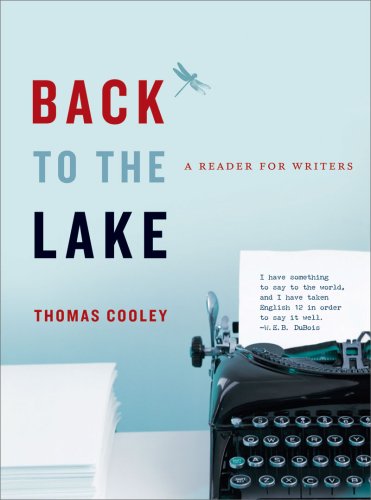
Back to the Lake: A Reader for Writers (New Rhetoric Reader)
Authors:
Not Available
Publisher:
W. W. Norton & Company
Publication Date:
Not available
ISBN:
0393925080
A fresh take on the modes, showing that they are used in texts of all kinds, not just in essays written for first-year composition—and that they are... central to all the writing, speaking, and thinking that we do.Taking its title from “Once More to the Lake,” the classic essay by E. B. White found in all rhetorically arranged readers, Back to the Lake offers much that is new, from 40 readings never before anthologized in a composition reader to templates to help students get started.

Back to the Lake: A Reader for Writers (Second Edition)
Authors:
Not Available
Publisher:
W. W. Norton & Company
Publication Date:
Not available
ISBN:
039391268X
A fresh take on the traditional modes, showing how they are used in texts of all kinds, and that they are central to all the writing, speaking, and... thinking that we do.The Second Edition contains 34 new readings that teachers will want to teach and students will like to read, from Steven Pinker’s “Mind Over Mass Media” to Alex Horton’s “Advice for College-bound Vets,” as well as a chapter on academic writing, and editorial apparatus that explicitly links the readings to the writing instruction, with notes in the margins leading students from the text to specific examples in the readings—and the reverse.

Back To The Sources
Authors:
Barry W. Holtz
Publisher:
Simon & Schuster
Publication Date:
Not available
ISBN:
0671605968
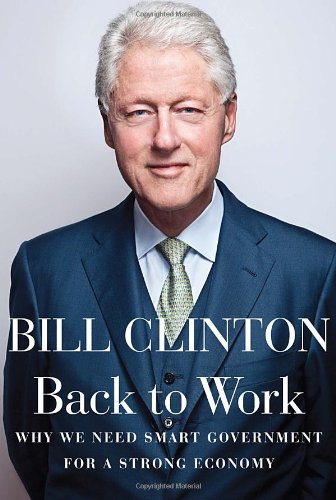
Back to Work: Why We Need Smart Government for a Strong Economy
Authors:
Bill Clinton
Publisher:
Knopf
Publication Date:
Not available
ISBN:
0307959759
President Bill Clinton gives us his views on the challenges facing the United States today and why government matters—presenting his ideas on... restoring economic growth, job creation, financial responsibility, resolving the mortgage crisis, and pursuing a strategy to get us "back in the future business.” He explains how we got into the current economic crisis, and offers specific recommendations on how we can put people back to work, increase bank lending and corporate investment, double our exports, restore our manufacturing base, and create new businesses. He supports President Obama’s emphasis on green technology, saying that changing the way we produce and consume energy is the strategy most likely to spark a fast-growing economy while enhancing our national security.Clinton also stresses that we need a strong private sector and a smart government working together to restore prosperity and progress, demonstrating that whenever we’ve given in to the temptation to blame government for all our problems, we’ve lost our ability to produce sustained economic growth and shared prosperity.Clinton writes, “There is simply no evidence that we can succeed in the twenty-first century with an antigovernment strategy,” based on “a philosophy grounded in ‘you’re on your own’ rather than ‘we’re all in this together.’ ” He believes that conflict between government and the private sector has proved to be good politics but has produced bad policies, giving us a weak economy with not enough jobs, growing income inequality and poverty, and a decline in our competitive position. In the real world, cooperation works much better than conflict, and “Americans need victories in real life.”
 '
'