production
/viewbook/list/all/?page=1384
/
/static/
None
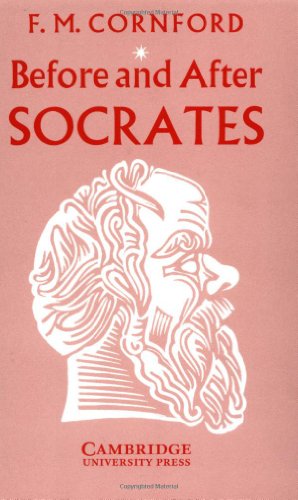
Before and after Socrates
Authors:
F. M. Cornford
Publisher:
Cambridge University Press
Publication Date:
Not available
ISBN:
0521091136
In this book, F.M. Cornford explains why the life and work of Socrates stand out as marking a turning-point in the history of thought. He shows how... Socrates revolutionized the concept of philosophy, converting it from the study of Nature to the study of the human soul, the meaning of right and wrong, and the ends for which we ought to live. This is, in fact, the story of the whole creative period of Greek philosophy - the Ionian nature of science before Socrates, Socrates himself, and his chief followers, Plato and his pupil Aristotle. It tells of the different contributions each made, and shows how within three centuries the Greek tradition grew to maturity and the fullness of intellectual power.
Before and After Zachariah
Authors:
Fern Kupfer
Publisher:
Academy Chicago Publishers
Publication Date:
Not available
ISBN:
0897333039

Before and Beyond Divergence: The Politics of Economic Change in...
Authors:
Jean-Laurent Rosenthal
Publisher:
Harvard University Press
Publication Date:
Not available
ISBN:
0674057910
China has reemerged as a powerhouse in the global economy, reviving a classic question in economic history: why did sustained economic growth arise in... Europe rather than in China?Many favor cultural and environmental explanations of the nineteenth-century economic divergence between Europe and the rest of the world. This book, the product of over twenty years of research, takes a sharply different tack. It argues that political differences which crystallized well before 1800 were responsible both for China’s early and more recent prosperity and for Europe’s difficulties after the fall of the Roman Empire and during early industrialization.Rosenthal and Wong show that relative prices matter to how economies evolve; institutions can have a large effect on relative prices; and the spatial scale of polities can affect the choices of institutions in the long run. Their historical perspective on institutional change has surprising implications for understanding modern transformations in China and Europe and for future expectations. It also yields insights in comparative economic history, essential to any larger social science account of modern world history.

Before/Beyond Borders: An Anthology of Chicano/a Literature
Authors:
HERRERA SPENCER
Publisher:
Kendall Hunt Publishing
Publication Date:
Not available
ISBN:
075757159X
This book, the first full-length study of its kind, dares to probe the biggest taboo in contemporary Arab culture with scholarly intent and integrity -... female homosexuality. Habib argues that female homosexuality has a long history in Arabic literature and scholarship, beginning in the ninth century, and she traces the destruction of Medieval discourses on female homosexuality and the replacement of these with a new religious orthodoxy that is no longer permissive of a variety of sexual behaviours. Habib also engages with recent "gay" historiography in the West and challenges institutionalized constructionist notions of sexuality.
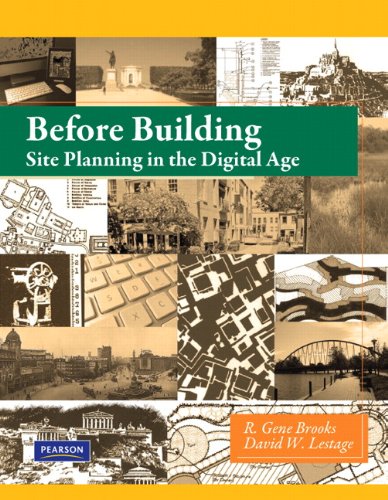
Before Building: Site Planning in the Digital Age (2nd Edition)
Authors:
R. Gene Brooks
Publisher:
Prentice Hall
Publication Date:
Not available
ISBN:
013508069X
BEFORE BUILDING: SITE PLANNING IN THE DIGITAL AGE, 1/e is a comprehensive, up-to-date text that will help both students and practitioners... thoroughly understand the current issues and technologies surrounding the process of site planning. It covers every topic required for a course in site planning, including land use controls and the history behind the law. It also presents detailed coverage of the role of computer technologies in supporting site planning, including up-to-date hardware, software, and applications. This is an ideal resource for third-year students in architecture, landscape architecture, civil engineering, and urban planning; others preparing for state architecture or landscape architecture board examinations, and professionals in the field.

Before Confucius: Studies in the Creation of the Chinese Classics...
Authors:
Edward L. Shaughnessy
Publisher:
State University of New York Press
Publication Date:
Not available
ISBN:
0791433781
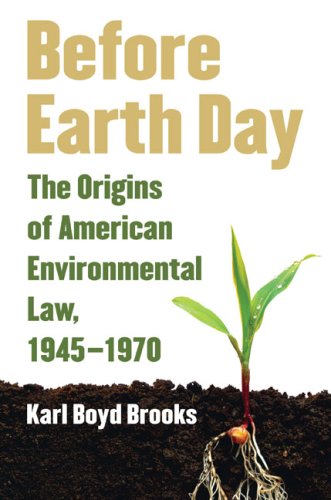
Before Earth Day: The Origins of American Environmental Law, 1945-1970
Authors:
Karl Boyd Brooks
Publisher:
Not available
Publication Date:
Not available
ISBN:
0700616276
Most Americans--even environmentalists--date the emergence of laws protecting nature to the early 1970s. But Karl Boyd Brooks shows that, far from being... a product of that activist decade, American environmental law emerged well before the first Earth Day, often in unexpected places far from Capitol Hill. Surveying the landscape from the end of World War II to Earth Day 1970, Brooks traces a dramatic shift in Americans' relationship to the environment and the emergence of new environmental statutes. He takes readers into legislative hearing rooms, lawyers' conferences, and administrators' offices to describe how Americans forged a new body of law that reflected their hopes for rescuing the land from air pollution, deforestation, and other potential threats. For while previous law had treated nature as a commodity, more and more Americans had come to see it as a national treasure worth preserving. Brooks explores the way key features of the New Deal's legal legacy influenced environmental law. This path-breaking environmental history examines how cultural, intellectual, and economic changes in postwar America brought about new solutions to environmental problems that threatened public health and degraded natural aesthetics. Visiting riverbanks and freeways, duck blinds and airsheds, Before Earth Day reveals the new strategies and efforts by which the unceasing process of legal change created environmental law. And through real-world examples--how Los Angelenos pressed cases about water and air quality, how an Idaho lawyer helped clients pursue new environmental regulations, how citizens challenged government and corporate plans to dam rivers--Brooks demonstrates that key changes in property, procedure, contract, and other legal rules in those early years stimulated the national environmental laws to come. Gracefully written and meticulously researched, Brooks's work dramatically updates our understanding of the origins of environmental law. By taking the postwar years more seriously, he shows that earlier actions across the country played a central role in shaping the structure and goals of well-known federal laws passed during the "environmental decade" of the seventies. Before Earth Day describes nothing less than an entirely new way of thinking, as environmental law emerged from local jurisdictions to reshape national agendas, firing the popular imagination and only then remodeling law school curricula.
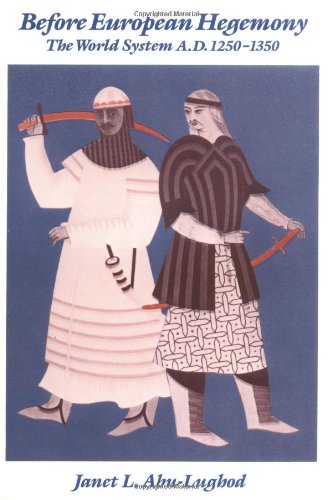
Before European Hegemony: The World System A.D. 1250-1350
Authors:
Janet L. Abu-Lughod
Publisher:
Oxford University Press, USA
Publication Date:
Not available
ISBN:
0195067746
In this important study, Abu-Lughod presents a groundbreaking reinterpretation of global economic evolution, arguing that the modern world economy had... its roots not in the sixteenth century, as is widely supposed, but in the thirteenth century economy--a system far different from the European world system which emerged from it. Using the city as the working unit of analysis, Before European Hegemony provides a new paradigm for understanding the evolution of world systems by tracing the rise of a system that, at its peak in the opening decades of the 14th century, involved a vast region stretching between northwest Europe and China. Writing in a clear and lively style, Abu-Lughod explores the reasons for the eventual decay of this system and the rise of European hegemony.
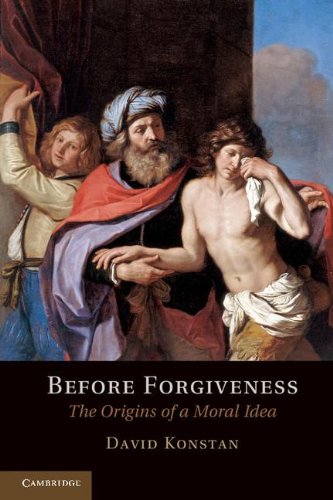
Before Forgiveness: The Origins of a Moral Idea
Authors:
David Konstan
Publisher:
Cambridge University Press
Publication Date:
Not available
ISBN:
1107680204
In this book, David Konstan argues that the modern concept of interpersonal forgiveness, in the full sense of the term, did not exist in ancient Greece... and Rome. Even more startlingly, it is not fully present in the Hebrew Bible, nor again in the New Testament, or in the early Jewish and Christian commentaries on the Holy Scriptures. It would still be centuries-- many centuries-- before the idea of interpersonal forgiveness, with its accompanying ideas of apology, remorse, and a change of heart on the part of the wrongdoer, would emerge. For all its vast importance today in religion, law, politics, and psychotherapy, interpersonal forgiveness is creation of the 18th and 19th centuries, when the Christian concept of divine forgiveness was finally secularized. Forgiveness was God's province, and it took a revolution in thought to bring it to earth and make it a human trait.
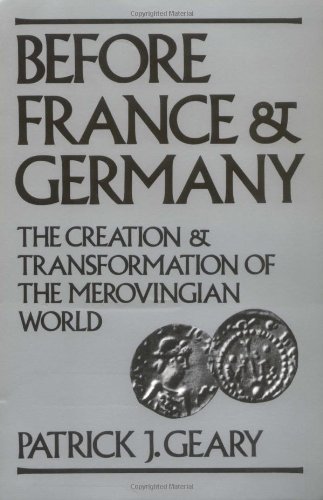
Before France and Germany: The Creation and Transformation of the...
Authors:
Patrick J. Geary
Publisher:
Oxford University Press, USA
Publication Date:
Not available
ISBN:
0195044584
From the twilight of the Roman Empire emerged the kingdoms of Merovingian Europe (c. 400-700 AD), which were, in turn, the basis for the nations of... medieval and modern Europe. Professor Geary draws on the latest archaeological and historical findings to elucidate one of the least understood periods of European history. This text is aimed at both survey and graduate courses on medieval history, which invariably take the Merovingian period as their starting point. The other available works on this subject are widely acknowledged to be either inadequate or out of date. This concise synthesis of the latest scholarship of Merovingian specialists, whose work appears almost exclusively in highly specialized German or French monographs, will also be welcomed by scholars seeking to keep abreast of the current historiography of this important transitional period in European history.
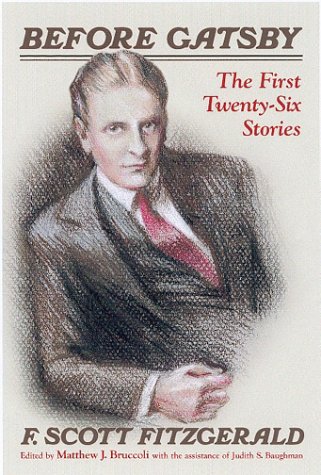
Before Gatsby: The First Twenty-Six Stories
Authors:
F. Scott Fitzgerald
Publisher:
University of South Carolina Press
Publication Date:
Not available
ISBN:
1570033714
Edited and with an Introduction by Bryant MangumForeword by Roxana RobinsonBenediction • Head and Shoulders • Bernice Bobs Her Hair • The Ice... Palace • The Offshore Pirate • May Day • The Jelly Bean • The Diamond as Big as the Ritz • Winter Dreams • AbsolutionIn the euphoric months before and after the publication of This Side of Paradise, F. Scott Fitzgerald, the flapper’s historian and poet laureate of the Jazz Age, wrote the ten stories that appear in this unique collection. Exploring characters and themes that would appear in his later works, such as The Beautiful and Damned and The Great Gatsby, these early selections are among the very best of Fitzgerald’s many short stories. This Modern Library Paperback Classic includes notes, an appendix of nonfiction essays by Scott and Zelda Fitzgerald and their contemporaries, and vintage magazine illustrations.
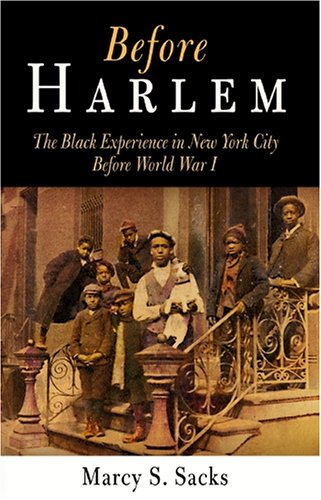
Before Harlem: The Black Experience in New York City Before World...
Authors:
Marcy S. Sacks
Publisher:
University of Pennsylvania Press
Publication Date:
Not available
ISBN:
081223961X
In the years between 1880 and 1915, New York City and its environs underwent a tremendous demographic transformation with the arrival of millions of... European immigrants, native whites from the rural countryside, and people of African descent from both the American South and the Caribbean. While all groups faced challenges in their adjustment to the city, hardening racial prejudices set the black experience apart from that of other newcomers. Through encounters with each other, blacks and whites, both together and in opposition, forged the contours of race relations that would affect the city for decades to come.Before Harlem reveals how black migrants and immigrants to New York entered a world far less welcoming than the one they had expected to find. White police officers, urban reformers, and neighbors faced off in a hostile environment that threatened black families in multiple ways. Unlike European immigrants, who typically struggled with low-paying jobs but who often saw their children move up the economic ladder, black people had limited employment opportunities that left them with almost no prospects of upward mobility. Their poverty and the vagaries of a restrictive job market forced unprecedented numbers of black women into the labor force, fundamentally affecting child-rearing practices and marital relationships.Despite hostile conditions, black people nevertheless claimed New York City as their own. Within their neighborhoods and their churches, their night clubs and their fraternal organizations, they forged discrete ethnic, regional, and religious communities. Diverse in their backgrounds, languages, and customs, black New Yorkers cultivated connections to others similar to themselves, forming organizations, support networks, and bonds of friendship with former strangers. In doing so, Marcy S. Sacks argues, they established a dynamic world that eventually sparked the Harlem Renaissance. By the 1920s, Harlem had become both a tragedy and a triumph—undeniably a ghetto replete with problems of poverty, overcrowding, and crime, but also a refuge and a haven, a physical place whose very name became legendary.
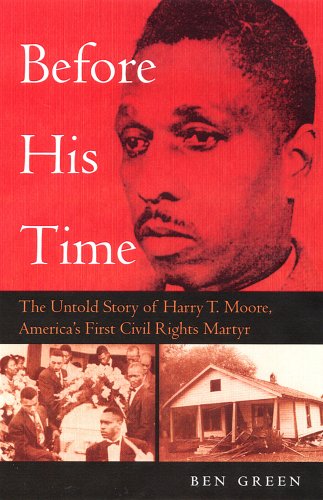
Before His Time: The Untold Story of Harry T. Moore, America's...
Authors:
Ben Green
Publisher:
University Press of Florida
Publication Date:
Not available
ISBN:
081302837X
In Jim Crow Florida, a young black man’s courageous fight to obtain equal rights for blacks ends in a personal tragedy that remains unsolved to this... day. This is his story. Before Martin Luther King Jr. began to preach from his pulpit in Montgomery, before the landmark Brown v. Board of Education decision, and before Rosa Parks' famous bus ride, a man named Harry T. Moore toiled in Jim Crow Florida on behalf of the NAACP and the Progressive Voters’ League. For seventeen years, in an era of official indifference and outright hostility, the soft-spoken but resolute Moore traveled the back roads of the state on a mission to educate, evangelize, and organize. On Christmas night in 1951, in Mims, Florida, a bomb placed under his bed ended Harry Moore’s life. His wife, Harriette, died of her wounds a week later. Although Florida’s governor reopened the case in 1991, no one was ever convicted of this crime. Using previously unavailable FBI files, Green introduces his readers to the good and the bad, the villainous and the virtuous, in Jim Crow Florida. In doing so, he offers a poignant and gripping memorial to the pioneering work of Harry T. Moore, one of the earliest martyrs of the modern civil rights movement.
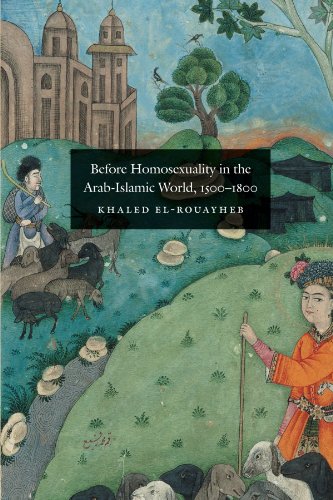
Before Homosexuality in the Arab-Islamic World, 1500-1800
Authors:
Khaled El-Rouayheb
Publisher:
University Of Chicago Press
Publication Date:
Not available
ISBN:
0226729893
Attitudes toward homosexuality in the pre-modern Arab-Islamic world are commonly depicted as schizophrenic—visible and tolerated on one hand,... prohibited by Islam on the other. Khaled El-Rouayheb argues that this apparent paradox is based on the anachronistic assumption that homosexuality is a timeless, self-evident fact to which a particular culture reacts with some degree of tolerance or intolerance. Drawing on poetry, biographical literature, medicine, dream interpretation, and Islamic texts, he shows that the culture of the period lacked the concept of homosexuality. “Meticulously researched, lucidly written, nuanced, and brilliantly conceived, [the book] forthrightly takes on complex issues surrounding the culture of same-sex eroticism that existed in the Arabic-speaking lands of the early modern Ottoman Empire. . . . An important book by an excellent scholar.”—Journal of Religion “Rectifies many . . . prejudices and misinterpretations in a masterly fashion.”—Bulletin of the School of Oriental and African Studies

Before I Fall
Authors:
Lauren Oliver
Publisher:
HarperCollins
Publication Date:
Not available
ISBN:
0061726818
What if you only had one day to live? What would you do? Who would you kiss? And how far would you go to save your own life? Samantha Kingston has it... all: looks, popularity, the perfect boyfriend. Friday, February 12, should be just another day in her charmed life. Instead, it turns out to be her last. The catch: Samantha still wakes up the next morning. Living the last day of her life seven times during one miraculous week, she will untangle the mystery surrounding her death—and discover the true value of everything she is in danger of losing.
 '
'