production
/viewbook/list/all/?page=1414
/
/static/
None

Behind the Headlines: A History of Investigative Journalism in Canada
Authors:
Cecil Rosner
Publisher:
Oxford University Press, USA
Publication Date:
Not available
ISBN:
019542994X
Canadian investigative journalism has brought down governments, held powerful interests to account, infiltrated criminal networks, and exonerated the... wrongly accused. Behind the Headlines presents the exciting history of investigative journalism in Canada in an account spanning from the nation's earliest newspapers through to the present day. Drawing on numerous case studies and examples, Cecil Rosner, a journalist with more than 35 years of experience, analyzes the evolution of investigative journalism in Canada and explores the development of specific practices within the context of changing social and historical forces. Rather than working through a straightforward chronology, Rosner uses a topic-based approach exploring wide-ranging and thought-provoking issues such as public broadcasting, commercialization of the press, alternative media, ethics, and the impact of technology. Highlighting key players and stories such as the sponsorship scandal and the Mulroney "Airbus Affair," Behind the Headlines provides fresh insight into this previously undocumented history.A new Preface to the paperback edition brings the book up to date, offering a current perspective on the shift from old to new media and ongoing efforts for media outlets to find financially sustainable revenue models. After the collapse of the Canwest empire and the rise of ProPulica and WikiLeaks, the turbulent media landscape is taking on a new form. What implications does this have for investigative journalism, not just in Canada, but around the world?

Behind the Invasion of Iraq
Authors:
The Research Unit for Political Economy The Research Unit fo
Publisher:
Monthly Review Press
Publication Date:
Not available
ISBN:
1583670939
"This book contributes significantly ot the conversation seeking to understand the international forces at play in the threatening war on... Iraq."—Nelson Mandela "Behind the Invasion of Iraq . . .synthesizes the seemingly disparate threads of the U.S. war drive in a blistering indictment of American foreign policy . . .The effect is of puzzle pieces clicking into place."—Counterpunch Since September 11, 2001, there have been many accounts of the ways in which the alignment of global power is changing or will be changed by the U.S.'s "war on terrorism." Most of them take as their starting point the options facing the wealthy and powerful nations of the world seeking to control an ever larger share of the world's resources. Behind the Invasion of Iraq is written from a different perspective, and one that makes possible a far more comprehensive point of view. Its authors, Research Unit for Political Economy, are rooted in the politics of a Third World country—India—which has long been on the receiving end of imperialist power. As a consequence, they have a more sober view of the workings of global power. In clear and accessible prose, weighing the evidence carefully and tracing events to their root causes, they move beyond moral outrage to a clear view of the process being set in motion by the U.S.-led invasion of Iraq. They show that the invasion of Iraq is a desperate gamble by a section of the U.S. ruling elite to preserve their power, driven by the wish to stave off economic crisis through military means. Their efforts will not end with Iraq, but will require the recolonization of the middle East. Behind the Invasion of Iraq exposes the idea that war will bring democracy to the Middle East as so much propaganda. In a context where so many rulers are themselves clients of the United States, the war is aimed not at the rulers but at the masses of ordinary people whose hostility to imperialism has not been broken even by corrupt and autocratic rulers. This book describes the remaking of global power with a truly global awareness of what is at stake.

Behind the Label: Inequality in the Los Angeles Apparel Industry
Authors:
Edna Bonacich
Publisher:
University of California Press
Publication Date:
Not available
ISBN:
0520225066
In a study crucial to our understanding of American social inequality, Edna Bonacich and Richard Appelbaum investigate the return of sweatshops to the... apparel industry, especially in Los Angeles. The "new" sweatshops, they say, need to be understood in terms of the decline in the American welfare state and its strong unions and the rise in global and flexible production. Apparel manufacturers now have the incentive to move production to wherever low-wage labor can be found, while maintaining arm's-length contractual relations that protect them from responsibility. The flight of the industry has led to a huge rise in apparel imports to the United States and to a decline in employment.Los Angeles, however, remains a puzzling exception in that its industry employment has continued to grow, to the point where L.A. is the largest center of apparel production in the nation. Not only the availability of low-wage immigrant (often undocumented) workers but also the focus on moderately priced, fashion-sensitive women's wear makes this possible. Behind the Label examines the players in the L.A. apparel industry, including manufacturers, retailers, contractors, and workers, evaluating the maldistribution of wealth and power. The authors explore government and union efforts to eradicate sweatshops while limiting the flight to Mexico and elsewhere, and they conclude with a description of the growing antisweatshop movement.Los Angeles Times Best Nonfiction Book of 2000
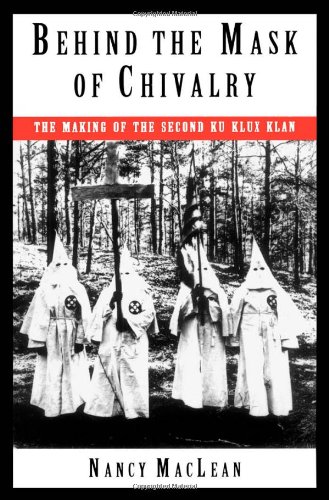
Behind the Mask of Chivalry: The Making of the Second Ku Klux Klan
Authors:
Nancy K. MacLean
Publisher:
Oxford University Press, USA
Publication Date:
Not available
ISBN:
0195098366
On Thanksgiving night, 1915, a small band of hooded men gathered atop Stone Mountain, an imposing granite butte just outside Atlanta. With a flag... fluttering in the wind beside them, a Bible open to the twelfth chapter of Romans, and a flaming cross to light the night sky above, William Joseph Simmons and his disciples proclaimed themselves the new Knights of the Ku Klux Klan, named for the infamous secret order in which many of their fathers had served after the Civil War. Unsure of their footing in the New South and longing for the provincial, patriarchal world of the past, the men of the second Klan saw themselves as an army in training for a war between the races. They boasted that they had bonded into "an invisible phalanx...to stand as impregnable as a tower against every encroachment upon the white man's liberty...in the white man's country, under the white man's flag." Behind the Mask of Chivalry brings the "invisible phalanx" into broad daylight, culling from history the names, the life stories, and the driving passions of the anonymous Klansmen beneath the white hoods and robes. Using an unusual and rich cache of internal Klan records from Athens, Georgia, to anchor her observations, author Nancy MacLean combines a fine-grained portrait of a local Klan world with a penetrating analysis of the second Klan's ideas and politics nationwide. No other right-wing movement has ever achieved as much power as the Ku Klux Klan of the 1920s, and this book shows how and why it did. MacLean reveals that the movement mobilized its millions of American followers largely through campaigns waged over issues that today would be called "family values": Prohibition violation, premarital sex, lewd movies, anxieties about women's changing roles, and worries over waning parental authority. Neither elites nor "poor white trash," most of the Klan rank and file were married, middle-aged, and middle class. Local meetings, or klonklaves, featured readings of the minutes, plans for recruitment campaigns and Klan barbecues, and distribution of educational materials--Christ and Other Klansmen was one popular tome. Nonetheless, as mundane as proceedings often were at the local level, crusades over "morals" always operated in the service of the Klan's larger agenda of virulent racial hatred and middle-class revanchism. The men who deplored sex among young people and sought to restore the power of husbands and fathers were also sworn to reclaim the "white man's country," striving to take the vote from blacks and bar immigrants. Comparing the Klan to the European fascist movements that grew out of the crucible of the first World War, MacLean maintains that the remarkable scope and frenzy of the movement reflected less on members' power within their communities than on the challenges to that power posed by African Americans, Jews, Catholics, immigrants, and white women and youth who did not obey the Klan's canon of appropriate conduct. In vigilante terror, the Klan's night riders acted out their movement's brutal determination to maintain inherited hierarchies of race, class, and gender. Compellingly readable and impeccably researched, The Mask of Chivalry is an unforgettable investigation of a crucial era in American history, and the social conditions, cultural currents, and ordinary men that built this archetypal American reactionary movement.
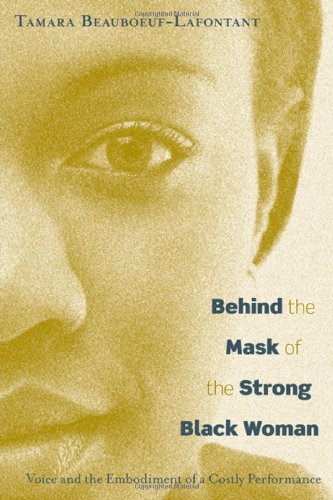
Behind the Mask of the Strong Black Woman: Voice and the Embodiment...
Authors:
Tamara Beauboeuf-Lafontant
Publisher:
Temple University Press
Publication Date:
Not available
ISBN:
1592136680
The defining quality of Black womanhood is strength, states Tamara Beauboeuf-Lafontant in "Behind the Mask of the Strong Black Woman". But, she argues,... the idea of strength undermines its real function: to defend and maintain a stratified social order by obscuring Black women's experiences of suffering, acts of desperation, and anger. This provocative book lays bare the common perception that strength is an exemplary or defining quality of 'authentic' Black womanhood. The author, a noted sociologist, interviews 58 Black women about being strong and proud, to illustrate their 'performance' of invulnerability. Beauboeuf-Lafontant explains how such behavior leads to serious symptoms for these women, many of whom suffer from eating disorders and depression. Drawing on Black feminist scholarship, cultural studies, and women's history, "Behind the Mask of the Strong Black Woman" traces the historical and social influences of normative Black femininity, looking at how notions of self-image and strength create a distraction from broader forces of discrimination and power.

Behind the Message: Information Strategies for Communicators
Authors:
Kathleen A. Hansen
Publisher:
Allyn & Bacon
Publication Date:
Not available
ISBN:
0205386806
This successor to the successful Search Strategies in Mass Communication provides a conceptual approach to information-gathering and practical methods... for navigating through information tools and techniques.

Behind the Mountains (First Person Fiction)
Authors:
Edwidge Danticat
Publisher:
Scholastic Paperbacks
Publication Date:
Not available
ISBN:
043937300X
First Person Fiction is dedicated to the immigrant experience in modern America. In "Behind the Mountains" Edwidge Danticat tells the story of Celiane... and her family's struggles in Haiti and New York.It is election time in Haiti, and bombs are going off in the capital city of Port-au-Prince. During a visit from her home in rural Haiti, Celiane Espérance and her mother are nearly killed. Looking at her country with new eyes, Celiane gains a fresh resolve to be reunited with her father in Brooklyn, New York. The harsh winter and concrete landscape of her new home are a shock to Celiane, who witnesses her parents' struggle to earn a living, her brother's uneasy adjustment to American society, and her own encounters with learning difficulties and school violence.
Behind the Mule: Race and Class in African-American Politics
Authors:
Michael C. Dawson
Publisher:
Princeton University Press
Publication Date:
Not available
ISBN:
0691025436
Political scientists and social choice theorists often assume that economic diversification within a group produces divergent political beliefs and... behaviors. Michael Dawson demonstrates, however, that the growth of a black middle class has left race as the dominant influence on African- American politics. Why have African Americans remained so united in most of their political attitudes? To account for this phenomenon, Dawson develops a new theory of group interests that emphasizes perceptions of "linked fates" and black economic subordination.

Behind the Red Mist: Short Fiction by Ho Anh Thai (Voices from...
Authors:
Ho Anh Thai
Publisher:
Curbstone Books
Publication Date:
Not available
ISBN:
1880684543
Behind the Red Mist gives us for the first time in English a wide range of stories from the most important writer of the post-war generation in Vietnam.... The characters range from a party official who turns into a goat while watching porno movies, to an Indian who carries his mother's bones in his knapsack, to a war widow trying desperately to piece together her life through the fragments of debris she collects from her back yard. The title novella "Behind the Red Mist" is a Vietnamese "Back To the Future", a social satire in which a young man in the Hanoi of the eighties receives an electric shock and is transported back to his same apartment block in 1967 wartime Vietnam during the American bombing. He not only witnesses the war with the eyes of someone who knows its outcome, but participates in his parents' courtship and discovers some truths about the generation held up to his own as a role model.

Behind The Scenes At The Museum
Authors:
Kate Atkinson
Publisher:
Picador Usa
Publication Date:
Not available
ISBN:
0312150601
Kate Atkinson's dazzling debut novel is a deeply moving story of family heartbreak and happiness.
Ruby Lennox begins narrating her life at the moment... of conception, and from there takes us on a whirlwind tour of the twentieth century as seen through the eyes of an English girl determined to learn about her family and its secrets.
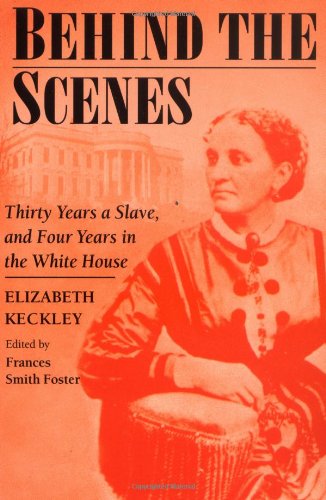
Behind the Scenes: Formerly a slave, but more recently modiste, and...
Authors:
Elizabeth Keckley
Publisher:
University of Illinois Press
Publication Date:
Not available
ISBN:
0252070208
Born into slavery, Elizabeth Hobbs Keckley (ca. 1824-1907) rose to a position of respect as a talented dressmaker and designer to the political elite of... Washington, D.C., and a confidante of First Lady, Mary Todd Lincoln. In this unusual memoir, Keckley offers a rare, behind-the-scenes view of the formal and informal networks that African Americans established among themselves, as well as an insider's perspective of the men who made Civil War politics and the women who influenced them.As an enslaved young woman, Keckley was moved to the rough frontier city of St. Louis, where she began working as a modiste, or dress designer. She eventually was able to buy her freedom and went to Washington, D.C., where she established herself as modiste to some of the wives and daughters of high-level politicians and officers. Before long, she was supplying not only beautiful clothing but also a sympathetic ear to Mary Todd Lincoln. Keckley's descriptions of the Lincolns at home reveal touching, unguarded moments of laughter, discussion, and affection. She witnessed the grief of both parents at the death of their son Willie, and Mary Todd's prostration after the president's assassination. In dire financial straits, Mary Todd turned to Keckley, who spent several months in New York helping the former First Lady sell her elegant clothing.President of the Contraband Relief Association and a friend of Frederick Douglass and other prominent African-American leaders, Keckley emerges as a remarkable, resourceful, and principled woman who helped mediate between black and white communities. Frances Smith Foster's introduction traces the book's reception history and fills in biographical gaps in the text.

Behind the Scenes in American Government: Personalities and...
Authors:
Woll
Publisher:
Pearson
Publication Date:
Not available
ISBN:
067352325X
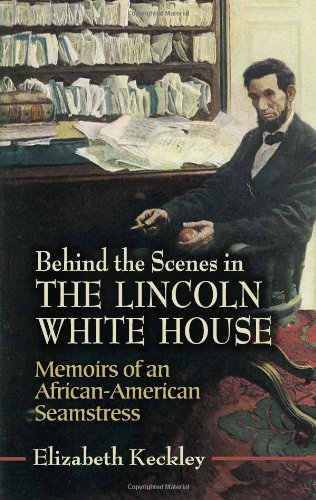
Behind the Scenes in the Lincoln White House: Memoirs of an...
Authors:
Elizabeth Keckley
Publisher:
Dover Publications
Publication Date:
Not available
ISBN:
0486451224
Keckley was a former slave who became a successful Washington, D.C., dressmaker — and a confidante of Mary Todd Lincoln. This intimate bond allowed... her to witness the happy times as well as the tragic events that unfolded within the Lincoln White House. A remarkable firsthand narrative of both African-American and Civil War history.

Behind the Scenes: or, Thirty Years a Slave, and Four Years in the...
Authors:
Elizabeth Keckley
Publisher:
Penguin Classics
Publication Date:
Not available
ISBN:
0143039245
Originally published in 1868—when it was attacked as an “indecent book” authored by a “traitorous eavesdropper”—Behind the Scenes is the... story of Elizabeth Keckley, who began her life as a slave and became a privileged witness to the presidency of Abraham Lincoln. Keckley bought her freedom at the age of thirty-seven and set up a successful dressmaking business in Washington, D.C. She became modiste to Mary Todd Lincoln and in time her friend and confidante, a relationship that continued after Lincoln’s assassination. In documenting that friendship—often using the First Lady’s own letters—Behind the Scenes fuses the slave narrative with the political memoir. It remains extraordinary for its poignancy, candor, and historical perspective. First time in Penguin Classics

Behind the Scenes: Or, Thirty Years a Slave, and Four Years in the...
Authors:
Elizabeth Keckley
Publisher:
Oxford University Press, USA
Publication Date:
Not available
ISBN:
0195060849
Part slave narrative, part memoir, and part sentimental fiction, Behind the Scenes depicts Elizabeth Keckley's years as a slave and subsequent four... years in Abraham Lincoln's White House during the Civil War. As public drama privately experienced, Keckley's work presents Jefferson Davis and his wife, Abraham Lincoln and Mary Todd Lincoln, and even Stephen Douglas and "Mrs. Senator Douglas" in the foreground, with the war, and slavery as the issue that precipitated it, in the background. Through the eyes of this black woman--an ex-slave, seamstress, and dressmaker--we see a wide range of historical figures and events of the antebellum South, the Washington of the Civil War years, and the final stages of the war.
 '
'