production
/viewbook/list/all/?page=1692
/
/static/
None
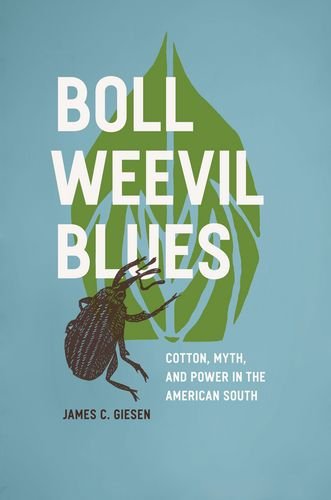
Boll Weevil Blues: Cotton, Myth, and Power in the American South
Authors:
James C. Giesen
Publisher:
University Of Chicago Press
Publication Date:
Not available
ISBN:
0226292878
Between the 1890s and the early 1920s, the boll weevil slowly ate its way across the Cotton South from Texas to the Atlantic Ocean. At the turn of the... century, some Texas counties were reporting crop losses of over 70 percent, as were areas of Louisiana, Arkansas, and Mississippi. By the time the boll weevil reached the limits of the cotton belt, it had destroyed much of the region’s chief cash crop—tens of billions of pounds of cotton, worth nearly a trillion dollars. As staggering as these numbers may seem, James C. Giesen demonstrates that it was the very idea of the boll weevil and the struggle over its meanings that most profoundly changed the South—as different groups, from policymakers to blues singers, projected onto this natural disaster the consequences they feared and the outcomes they sought. Giesen asks how the myth of the boll weevil’s lasting impact helped obscure the real problems of the region—those caused not by insects, but by landowning patterns, antiquated credit systems, white supremacist ideology, and declining soil fertility. Boll Weevil Blues brings together these cultural, environmental, and agricultural narratives in a novel and important way that allows us to reconsider the making of the modern American South.
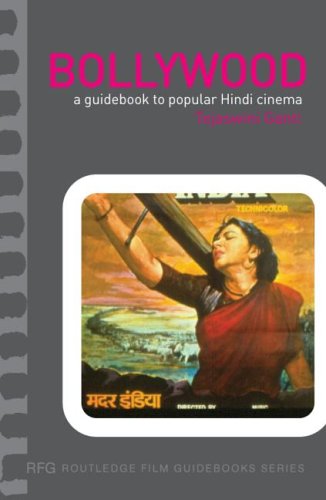
Bollywood: A Guidebook to Popular Hindi Cinema (Routledge Film...
Authors:
Tejaswini Ganti
Publisher:
Routledge
Publication Date:
Not available
ISBN:
0415288541
In Bollywood, anthropologist and film scholar Tejaswini Ganti provides a guide to the cultural, social and political significance of Hindi cinema,... outlining the history and structure of the Bombay film industry, and the development of popular Hindi filmmaking since the 1930s. Providing information and commentary on the key players in Bollywood, including composers, directors and stars, as well as material from current filmmakers themselves, the areas covered in Bollywood include: history of Indian cinema main themes and characteristics of Hindi cinema significant films, directors and stars production and distribution of Bollywood films interviews with actors, directors and screenwriters. Anyone interested in, or studying Bollywood cinema will find this a valuable purchase.
Bollywood and Globalization: Indian Popular Cinema, Nation, and...
Authors:
Not Available
Publisher:
Anthem Press
Publication Date:
Not available
ISBN:
0857287826
Commercial cinema has always been one of the biggest indigenous industries in India, and remains so in the post-globalization era, when Indian economy... has entered a new phase of global participation, liberalization and expansion. Issues of community, gender, society, social and economic justice, bourgeois-liberal individualism, secular nationhood and ethnic identity are nowhere more explored in the Indian cultural mainstream than in commercial cinema. As Indian economy and policy have gone through a sea-change after the end of the Cold War and the commencement of the Global Capital, the largest cultural industry has followed suit. This book is a significant addition to the study of post-Global Indian culture. The articles represent a variety of theoretical and pedagogical approaches, and the collection will be appreciated by beginners and scholars alike.
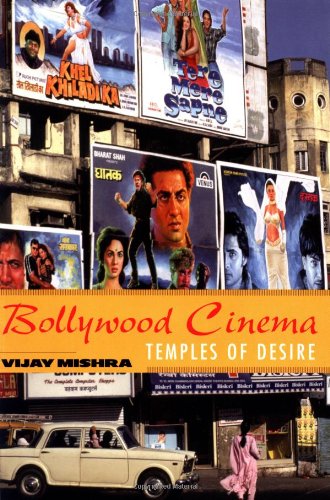
Bollywood Cinema: Temples of Desire
Authors:
Vijay Mishra
Publisher:
Routledge
Publication Date:
Not available
ISBN:
0415930154
India is home to Bollywood - the largest film industry in the world. Movie theaters are said to be the "temples of modern India," with Bombay producing... nearly 800 films per year that are viewed by roughly 11 million people per day. In Bollywood Cinema, Vijay Mishra argues that Indian film production and reception is shaped by the desire for national community and a pan-Indian popular culture. Seeking to understand Bollywood according to its own narrative and aesthetic principles and in relation to a global film industry, he views Indian cinema through the dual methodologies of postcolonial studies and film theory. Mishra discusses classics such as Mother India (1957) and Devdas (1935) and recent films including Ram Lakhan (1989) and Khalnayak (1993), linking their form and content to broader issues of national identity, epic tradition, popular culture, history, and the implications of diaspora.
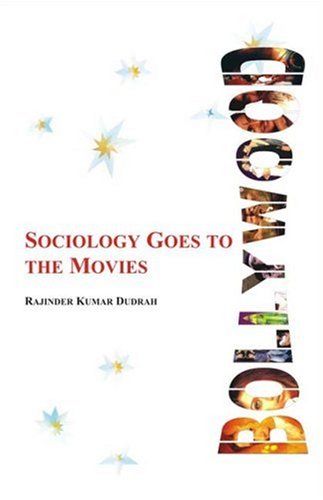
Bollywood: Sociology Goes to the Movies
Authors:
Rajinder Dudrah
Publisher:
SAGE Publications
Publication Date:
Not available
ISBN:
0761934618
Bollywood: Sociology Goes to the Movies rejuvenates a dormant dialogue within sociology about understanding the possible relationships between cinema,... culture, and society. This is done through an interdisciplinary conversation with studies of the cinema drawn from film and media, and cultural studies.
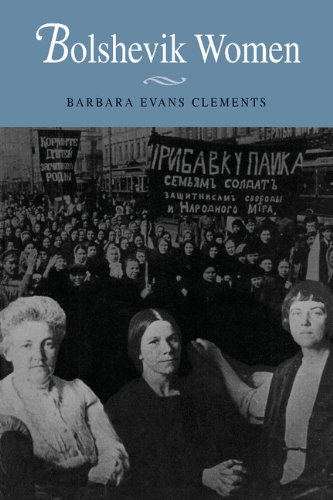
Bolshevik Women
Authors:
Barbara Evans Clements
Publisher:
Cambridge University Press
Publication Date:
Not available
ISBN:
0521599202
Bolshevik Women is a history of the women who joined the Soviet Communist Party before 1921. Drawing on a database of more than five hundred individuals... as well as on intensive research into the lives of the most prominent female Bolsheviks, Barbara Clements tells the fascinating story of the female Reds who survived imprisonment, built bombs, led armies into battle, and struggled to survive under Stalin. The study argues that women were important members of the Communist Party during its formative years.
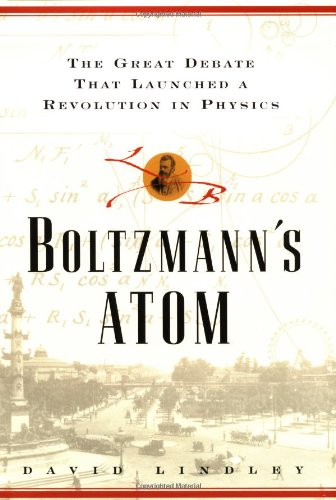
Boltzmanns Atom: The Great Debate That Launched A Revolution In...
Authors:
David Lindley
Publisher:
Free Press
Publication Date:
Not available
ISBN:
0684851865
BOLTZMANN'S ATOM tells the story of the crucial scientific struggle over the existence of the atom during the second half of the 19th century. This... struggle was a turning point in the history of the modern world. It would never have happened without the forgotten genius of Ludwig Boltzmann, a 19th century Austrian theoretical physicist who had a string of deeply profound insights primarily into the physical nature of heat, but also gas, matter, and, in fact, literally everything. In 1850 no university taught such a subject as theoretical physics, but by 1900 it was a fully fledged discipline with whole institutes devoted to it. This burgeoning scientific movement led within just a few years to the discovery of quantum mechanics by Max Planck, radioactivity by Marie Curie, general relativity by Albert Einstein, the uncertainty principle by Werner Heisenberg, and more recently quantum electodynamics by Richard Feynman, the quark by Murray Gell-Mann, and even up-to-the minute developments in chaos and superstring theory. Indeed, as David Lindley shows, Boltzman's brilliant insights brought about the golden age of physics that we continue to live in today. David Lindley frames his story with the long running debate between Boltzmann and Ernst Mach who held that theoretical physics was completely misguided. Mach's memorable line in 1900 "I don't believe atoms exist" is where the book begins.
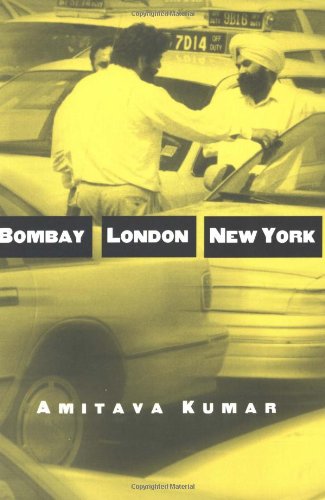
Bombay--London--New York (Routledge Studies in Health and Social...
Authors:
Amitava Kumar
Publisher:
Routledge
Publication Date:
Not available
ISBN:
0143028960
When Amitava Kumar left Patna, India, he envisioned himself as an up-and-coming citizen of the world, leaving behind the confines of Indian traditions. ... Yet like the wave of exiles that preceded him, he found that once we leave our past, we are defined by it: in the U.S. he is pigeonholed by his appearance and quizzed about saris and arranged marriages. "There is no beginning that is a blank page," writes Kumar. Circling the three capitals of the Indian diaspora, Bombay-London-New York captures the contours of the expatriate experience, touching on the themes of abandonment, nostalgia, and exile that have powered some of the most prominent Indian writers today -- Naipaul, Rushdie, Roy, Kureishi, as well as E.M. Forster and Gandhi. With resonant, poetic language and a storyteller's sensibility, Kumar explores the works of these writers through the lens of his own life as an immigrant and writer. As their fiction reveals, the past of the expatriate is mythical,shaped by memory and loss. With tales of life in India and London and meditations on the form Indian fiction gives to the lives of those who read about it, this is a sweeping, passionate search to find one's own story in the stories of others.
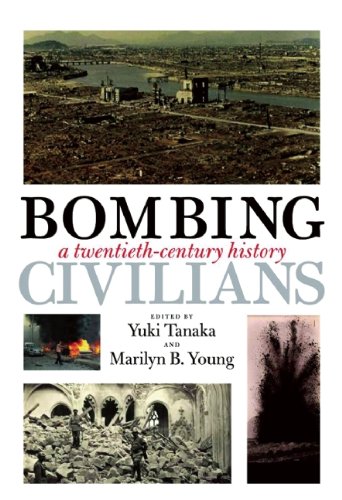
Bombing Civilians: A Twentieth-Century History (New Press)
Authors:
Not Available
Publisher:
New Press, The
Publication Date:
Not available
ISBN:
1595585478
Bombing Civilians examines a crucial question: why did military planning in the early twentieth century shift its focus from bombing military targets to... bombing civilians? From the British bombing of Iraq in the early 1920s to the most recent policies in Kosovo, Afghanistan, Iraq, and Lebanon, Bombing Civilians analyzes in detail the history of indiscriminate bombing, examining the fundamental questions of how this theory justifying mass killing originated and why it was employed as a compelling military strategy for decades, both before and since the bombing of Hiroshima and Nagasaki.
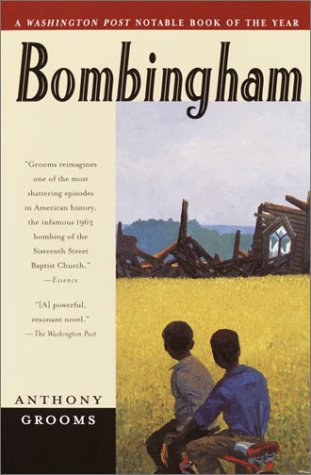
Bombingham
Authors:
Anthony Grooms
Publisher:
One World/Ballantine
Publication Date:
Not available
ISBN:
0345452933
In his barracks, Walter Burke is trying to write a letter to the parents of a fallen soldier, an Alabama man who died in a muddy rice paddy. But all he... can think of is his childhood friend Lamar, the friend with whom he first experienced the fury of violence, on the streets of Birmingham, at the height of the Civil Rights Movement. The juxtaposition is so powerful—between war-torn Vietnam and terror-filled “Bombingham”—that he is drawn back to the summer that would see his transition from childish wonder at the world to his certain knowledge of his place in it.Walter and Lamar were always aware of the terms of segregation—the horrendous rules and stifling reality. Their paper route never took them to the white areas of town. But that year, everything exploded. And so did Walter’s family. As the great movement swelled around them, the Burkes faced tremendous obstacles of their own. From a tortured past lingered questions of faith, and a terrible family crisis found its climax as the city did the same. In the streets of Birmingham, ordinary citizens risked their lives to change America. And for Walter, the war was just beginning.
Bombingham: A Novel
Authors:
Anthony Grooms
Publisher:
Free Press
Publication Date:
Not available
ISBN:
0743205588
From the war-torn rice fields of Vietnam to the riot-filled streets of Birmingham, Alabama, "Bombingham is the affecting story of a middle-class black... family riven by its personal chaos. When Walter Burke is faced with writing a letter to the parents of a fallen friend and fellow soldier, he is taken back to his childhood amidst the Civil Rights Movement. From it, he recalls the segregated city, the fledgling movement, and the momentous responsibility to act. Walter reflects on how he and his family were challenged by the swelling resistance to the horrific realities of segregation in a city where little girls could be bombed in church and their fathers jailed for just looking at a white person in the wrong way. The parents' sense of security is increasingly threatened, while the children are forced to make moral decisions that portend grave consequences. As Walter struggles to make sense of his presence in Vietnam, he wonders if the victory of the movement meant nothing more than being sent into a battlefield of another kind. Joining two pivotal periods in the American experience, this beautifully written novel from the winner of the 1996 Lillian Smith Award for Fiction makes an important contribution to our understanding of the period. With wry humor and haunting description, it is a portrait of the wonder and the terror of childhood in a time when ordinary citizens risked their lives to change America. By turns both reflective and dramatic, Grooms chronicles the events of the Civil Rights Movement and the Vietnam War through the heightened perspective of a narrator who struggles to find the meaning of his role in both events. "Bombingham is a moving testament to thepower of responsibility and faith in the face of tragedy.
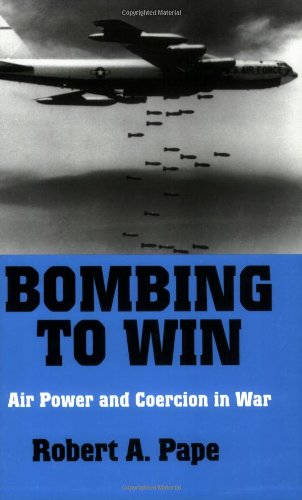
Bombing to Win: Air Power and Coercion in War (Cornell Studies in...
Authors:
Robert Pape
Publisher:
Cornell University Press
Publication Date:
Not available
ISBN:
0801483115
From Iraq to Bosnia to North Korea, the first question in American foreign policy debates is increasingly: Can air power alone do the job? Robert A.... Pape provides a systematic answer. Analyzing the results of over thirty air campaigns, including a detailed reconstruction of the Gulf War, he argues that the key to success is attacking the enemy's military strategy, not its economy, people, or leaders. Coercive air power can succeed, but not as cheaply as air enthusiasts would like to believe.Pape examines the air raids on Germany, Japan, Korea, Vietnam, and Iraq as well as those of Israel versus Egypt, providing details of bombing and governmental decision making. His detailed narratives of the strategic effectiveness of bombing range from the classical cases of World War II to an extraordinary reconstruction of airpower use in the Gulf War, based on recently declassified documents.In the first major book since the Vietnam War on the theory and practice of airpower and its political effects, Robert A. Pape helps policy makers judge the purpose of various air strategies, and helps general readers understand the policy debates.
Bomb Power: The Modern Presidency and the National Security State
Authors:
Garry Wills
Publisher:
Penguin Press HC, The
Publication Date:
Not available
ISBN:
1594202400
From Pulitzer Prize-winning historian Garry Wills, a groundbreaking examination of how the atomic bomb profoundly altered the nature of American... democracy and has left us in a state of war alert ever since. In Bomb Power, Garry Wills reveals how the atomic bomb transformed our nation down to its deepest constitutional roots-by dramatically increasing the power of the modern presidency and redefining the government as a national security state-in ways still felt today. A masterful reckoning from one of America's preeminent historians, Bomb Power draws a direct line from the Manhattan Project to the usurpations of George W. Bush. The invention of the atomic bomb was a triumph of official secrecy and military discipline-the project was covertly funded at the behest of the president and, despite its massive scale, never discovered by Congress or the press. This concealment was perhaps to be expected in wartime, but Wills persuasively argues that the Manhattan Project then became a model for the covert operations and overt authority that have defined American government in the nuclear era. The wartime emergency put in place during World War II extended into the Cold War and finally the war on terror, leaving us in a state of continuous war alert for sixty-eight years and counting. The bomb forever changed the institution of the presidency since only the president controls "the button" and, by extension, the fate of the world. Wills underscores how radical a break this was from the division of powers established by our founding fathers and how it in turn has enfeebled Congress and the courts. The bomb also placed new emphasis on the president's military role, creating a cult around the commander in chief. The tendency of modern presidents to flaunt military airs, Wills points out, is entirely a postbomb phenomenon. Finally, the Manhattan Project inspired the vast secretive apparatus of the national security state, including intelligence agencies such as the CIA and NSA, which remain largely unaccountable to Congress and the American people. Wills recounts how, following World War II, presidential power increased decade by decade until reaching its stunning apogee with the Bush administration. Both provocative and illuminating, Bomb Power casts the history of the postwar period in a new light and sounds an alarm about the continued threat to our Constitution.
Bomb Power: The Modern Presidency and the National Security State
Authors:
Garry Wills
Publisher:
Penguin Books
Publication Date:
Not available
ISBN:
0143118684
A groundbreaking examination of how the atomic bomb profoundly altered the nature of American democracy. In Bomb Power, bestselling author Garry Wills... presents a blistering critique of excessive executive power and official secrecy, drawing a direct line from the Manhattan Project to the usurpations of George W. Bush. He reveals how the atomic bomb transformed our nation down to its deepest constitutional roots-by dramatically increasing the power of the modern presidency and redefining the government as a national security state-leaving us in a state of continuous war alert for nearly seven decades. Bold and incisive, Bomb Power casts the history of the postwar period in a new light and sounds an alarm about the continued threat to our Constitution.
Bomb Scare: The History and Future of Nuclear Weapons
Authors:
Joseph Cirincione
Publisher:
Columbia University Press
Publication Date:
Not available
ISBN:
0231135114
Since their inception, nuclear weapons have multiplied at an alarming rate, leaving everyone from policymakers to concerned citizens wondering what it... will take to slow, stop, or even reverse their spread. With clarity and expertise, Joseph Cirincione presents an even-handed look at the history of nuclear proliferation and an optimistic vision of its future, providing a comprehensive survey of the wide range of critical perspectives.Cirincione begins with the first atomic discoveries of the 1930s and covers the history of their growth all the way to current crisis with Iran. He unravels the science, strategy, and politics that have fueled the development of nuclear stockpiles and increased the chance of a nuclear terrorist attack. He also explains why many nations choose not to pursue nuclear weapons and pulls from this the outlines of a solution to the world's proliferation problem: a balance of force and diplomacy, enforcement and engagement that yields a steady decrease in these deadly arsenals. Though nuclear weapons have not been used in war since August 1945, there is no guarantee this good fortune will continue. A unique blend of history, theory, and security analysis, Bomb Scare is an engaging text that not only supplies the general reader and student with a clear understanding of this issue but also provides a set of tools policymakers and scholars can use to prevent the cataclysmic consequences of another nuclear attack.
 '
'