production
/viewbook/list/all/?page=1753
/
/static/
None
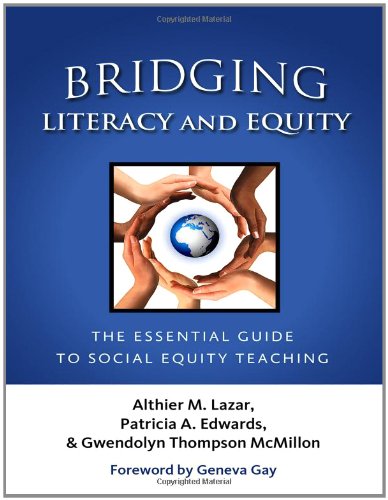
Bridging Literacy and Equity: The Essential Guide to Social Equity...
Authors:
Althier M. Lazar
Publisher:
Teachers College Press
Publication Date:
Not available
ISBN:
0807753475
Bridging Literacy and Equity synthesizes the essential research and practice of social equity literacy teaching in one succinct, user-friendly volume.... Chapters identify six key dimensions of social equity teaching that can help teachers see their students' potential and create conditions that will support their literacy development. Serving students well depends on understanding relationships between race, class, culture, and literacy; the complexity and significance of culture; and the culturally situated nature of literacy. It also requires knowledge of culturally responsive practices, such as collaborating with and learning from caregivers, using cultural referents, enacting critical and transformative literacy practices, and seeing the capacities of English Language Learners and children who speak African American Language.
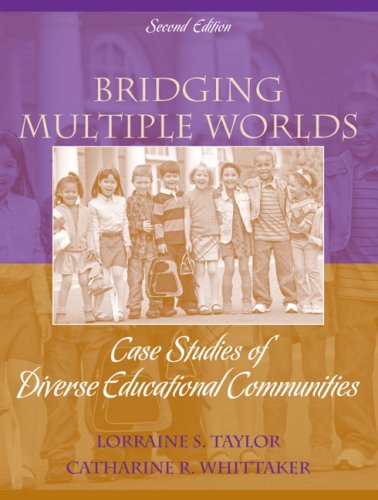
Bridging Multiple Worlds: Case Studies of Diverse Educational...
Authors:
Lorraine S. Taylor
Publisher:
Pearson
Publication Date:
Not available
ISBN:
0205582516
This text offers “real world” case studies involving educational staff, students, and families from diverse backgrounds in a variety of dynamic... school settings. Bridging Multiple Worldsemphasizes long-term, comprehensive solutions that promote school, home, and community partnership to meet challenges in educational settings. The text provides foundational information about diversity in the US, multicultural education, and family-school-community partnership in Part I; moves on to explore the use of cases in teacher education and how to analyze cases using a “decision making scaffold” in Part II; and delves deeply into specific cases and the issues surrounding them on a wide range of diversity topics in the seven chapters in Part III.
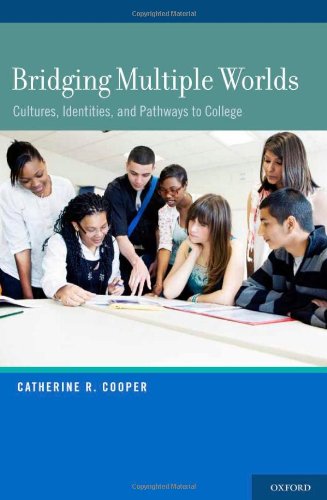
Bridging Multiple Worlds: Cultures, Identities, and Pathways to...
Authors:
Catherine R. Cooper
Publisher:
Oxford University Press, USA
Publication Date:
Not available
ISBN:
0195080203
In every cultural group and in regions worldwide, education is strongly linked to children and adolescents' life opportunities and choices. Many... societies embrace the ideals that their children will have equal access to education, and can advance through their merit. However, in many nations, as children move through primary and secondary school towards higher education, the number of immigrant, minority, and low-income youth who finish secondary school and attend college shrinks, signifying a global dilemma.Drawing on theories and research from across the social sciences, Bridging Multiple Worlds invites readers to compare core viewpoints and ask their own questions about the roots of and remedies for this academic pipeline problem. Considering research, practice, and policies on opening pathways and pipelines, this book provides new quantitative and qualitative evidence to introduce a theory on how youth draw on their cultural worlds to navigate their pathways to college. Chapters address cultural and developmental issues involving academic and cultural identities, and how communities define success for youth. Tools for advancing research with culturally diverse students are also provided. The result is a must-have volume for researchers, educators, policymakers, and students, brimming with fresh and creative syntheses of theory, research, and policy."A theoretically rich examination of the development of identity and educational pathways for ethnically diverse youth in American society. This is a book to be savored for its unique perspective on one of the great challenges of our times-finding ways to successfully integrate diverse youth into an increasingly unforgiving educational and social structure."--Patricia Gándara, Ph.D., Professor of Education, UCLA"Bridging Multiple Worlds is a magnificent book! Its conceptual location on the nexus of research, practice, and policy makes the volume extremely important. Cooper deftly embraces all perspectives, speaks effectively to all, and uses the synergies to great effect. She demonstrates that approaching the work with an expectation for success is both highly engaging for all involved, and increases the likelihood that solutions will be found for inevitable challenges - through effective design and implementation. Cooper has much to teach us, and has provided a clear and comprehensive guide for pursuing effective work to help all students obtain high achievement and college degrees."--Anne C. Petersen, Ph.D., Research Professor, University of Michigan, CHGD Founder and President, Global Philanthropy Alliance "This volume represents a significant advance to our understanding of the deep socialization and cross-institutional processes that underlie higher education access among members of communities underserved by formal education systems. Its most important contribution is its theory-based overview of concrete collaborative programs and strategies attuned to the unique cultural, linguistic, and social values of participants from diverse backgrounds and life circumstances."--Richard Durán, Ph.D., Gevirtz Graduate School of Education, University of California, Santa Barbara"As the world becomes global and borders easier to cross, issues of migration, minorities and cultural diversity become more relevant. Catherine Cooper and her colleagues developed a dialogue across theory, research, and community action and constructed tools for helping minority adolescents take their place on the academic pathway. Of value to psychologists, educationalists, community workers, policy makers, or anyone concerned with the future of education, this book offers strategies for building bridges of understanding across cultures to provide equal educational opportunities for all."--Rachel Seginer, Ph.D., Emeritus Professor of Human Development and Education, University of Haifa, Israel"This is a superb book. Cooper deconstructs the concept of 'disadvantage' - the emphasis falls on culture and identities instead of deficits and poor academic skills alone. Yielded is a rich review of studies - and refreshing alternatives to many standard assumptions. These approaches and concepts are relevant to other social groups and other 'pipeline' progressions, making the book a richly rewarding source for several audiences."--Professor Jacqueline Goodnow, Ph.D., Emeritus Professor, Macquarie University

Bridging National Borders in North America: Transnational and...
Authors:
Not Available
Publisher:
Duke University Press Books
Publication Date:
Not available
ISBN:
0822346990
Despite a shared interest in using borders to explore the paradoxes of state-making and national histories, historians of the U.S.-Canada border region... and those focused on the U.S.-Mexico borderlands have generally worked in isolation from one another. A timely and important addition to borderlands history, Bridging National Borders in North America initiates a conversation between scholars of the continent’s northern and southern borderlands. The historians in this collection examine borderlands events and phenomena from the mid-nineteenth century through the mid-twentieth. Some consider the U.S.-Canada border, others concentrate on the U.S.-Mexico border, and still others take both regions into account.The contributors engage topics such as how mixed-race groups living on the peripheries of national societies dealt with the creation of borders in the nineteenth century, how medical inspections and public-health knowledge came to be used to differentiate among bodies, and how practices designed to channel livestock and prevent cattle smuggling became the model for regulating the movement of narcotics and undocumented people. They explore the ways that U.S. immigration authorities mediated between the desires for unimpeded boundary-crossings for day laborers, tourists, casual visitors, and businessmen, and the restrictions imposed by measures such as the Chinese Exclusion Act of 1882 and the 1924 Immigration Act. Turning to the realm of culture, they analyze the history of tourist travel to Mexico from the United States and depictions of the borderlands in early-twentieth-century Hollywood movies. The concluding essay suggests that historians have obscured non-national forms of territoriality and community that preceded the creation of national borders and sometimes persisted afterwards. This collection signals new directions for continental dialogue about issues such as state-building, national expansion, territoriality, and migration.Contributors: Dominique Brégent-Heald, Catherine Cocks, Andrea Geiger, Miguel Ángel González Quiroga, Andrew R. Graybill, Michel Hogue, Benjamin H. Johnson, S. Deborah Kang, Carolyn Podruchny, Bethel Saler, Jennifer Seltz, Rachel St. John, Lissa WadewitzPublished in cooperation with the William P. Clements Center for Southwest Studies, Southern Methodist University.
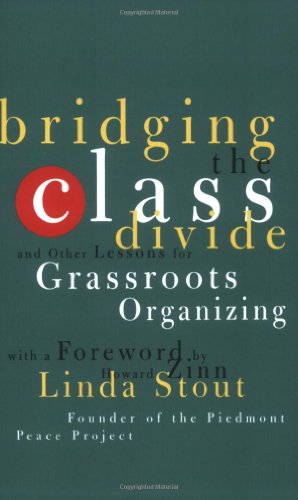
Bridging the Class Divide: And Other Lessons for Grassroots Organizing
Authors:
Linda Stout
Publisher:
Beacon Press
Publication Date:
Not available
ISBN:
0807043095
Again and again social change movements--on matter s from the environment to women's rights--have been run by middle-class leaders. But in order to make... real progress toward economic and social change, poor people--those most affected by social problems--must be the ones to speak up and lead.It can be done. Linda Stout herself grew up in poverty in rural North Carolina and went on to found one of this country's most successful and innovative grassroots organizations, the Piedmont Peace Project. Working for peace, jobs, health care, and basic social services in North Carolina's conservative Piedmont region, the project has attracted national attention for its success in drawing leadership from within a working-class community, actively encouraging diversity, and empowering people who have never had a voice in policy decisions to speak up for their own interests. The Piedmont Peace Project demonstrates that new ways of organizing can really work.Bridging the Class Divide tells the inspiring story of Linda Stout's life as the daughter of a tenant farmer, as a self-taught activist, and as a leader in the progressive movement. It also gives practical lessons on how to build real working relationships between people of different income levels, races, and genders. This book will inspire and enrich anyone who works for change in our society.

BRIDGING THE CURRICULUM THROUGH ART
Authors:
Not Available
Publisher:
Not available
Publication Date:
Not available
ISBN:
Not available

Bridging the Gap Between College and Law School
Authors:
Ruta K. Stropus
Publisher:
Carolina Academic Press
Publication Date:
Not available
ISBN:
159460603X
This popular book helps students make the transition from their undergraduate experience to law school learning. Unlike other "introduction to law... school" texts, Bridging the Gap offers a different approach because it: Explains the "why" of law, providing students with the context necessary to understand why law school is taught in a certain manner. Explains the "how" of the law, setting out a step-by-step process that will help students adapt to the law school setting. Explains the "what" of the law, giving students the opportunity to practice the problem-solving process by providing numerous exercises in a variety of subject matter areas. Rather than giving only general advice, or black letter law and some practice problems for a specific subject, Bridging the Gap provides the context, the process, and the problems. Written by two former law school professors who used these techniques with thousands of students, Bridging the Gap is a guide to what really works in law school.

Bridging the Gap between Theory and Practice in Educational...
Authors:
Not Available
Publisher:
Palgrave Macmillan
Publication Date:
Not available
ISBN:
0230610722
This book provides new ways of thinking about educational processes, using quantitative and qualitative methodologies. Concrete examples of research... techniques are provided for those conducting research with marginalized populations or about marginalized ideas. This volume asserts theoretical models related to research methods and the study of underrepresented groups. Ultimately, it aims at expanding knowledge itself - altering the center by allowing the margins to inform it - allowing it to be created and extended to include those ways of knowing that have historically been unexplored or ignored.
BRIDGING THE GAP COLLEGE RDG&MYSKILLSLAB PK
Authors:
Not Available
Publisher:
Not available
Publication Date:
Not available
ISBN:
Not available
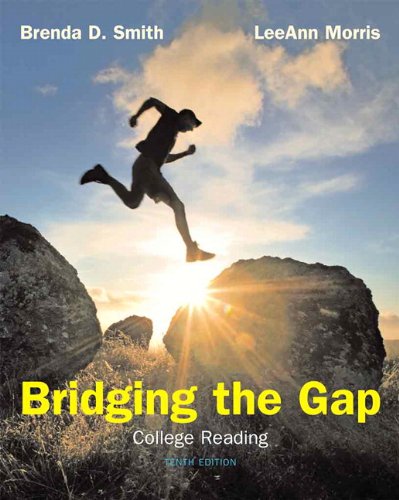
Bridging The Gap: College Reading (10th Edition)
Authors:
Brenda Deutsch Smith
Publisher:
Longman
Publication Date:
Not available
ISBN:
0205748007
Brenda Smith’s Bridging the Gap continues to be the #1 textbook choice of developmental reading educators. To improve students’ reading,... Bridging the Gap offers comprehensive skill instruction, dependable exercises and examples, vocabulary development, and wealth of high-interest readings that provide meaningful practice. To prepare students for the demands of college reading, Brenda helping provides strategies for connecting previous experience(s) to what is being learned. The combination of Bridging the Gap and Pearson's MyReadingLab (www.myreadinglab.com) offers unparalleled instruction and practice to improve students' reading.
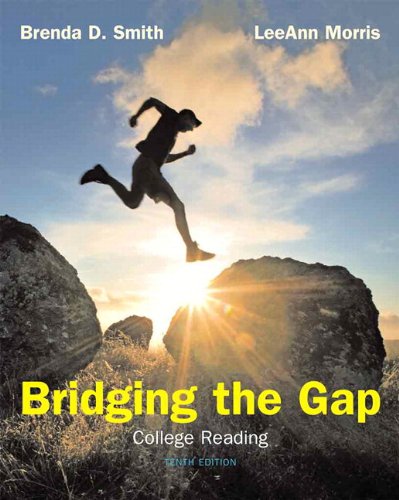
Bridging The Gap: College Reading (with MyReadingLab Student Access...
Authors:
Brenda Deutsch Smith
Publisher:
Longman
Publication Date:
Not available
ISBN:
0205784313
Brenda Smith’s Bridging the Gap continues to be the #1 textbook choice of developmental reading educators. To improve students’ reading,... Bridging the Gap offers comprehensive skill instruction, dependable exercises and examples, vocabulary development, and wealth of high-interest readings that provide meaningful practice. To prepare students for the demands of college reading, Brenda helping provides strategies for connecting previous experience(s) to what is being learned. The combination of Bridging the Gap and Pearson's MyReadingLab (www.myreadinglab.com) offers unparalleled instruction and practice to improve students' reading.
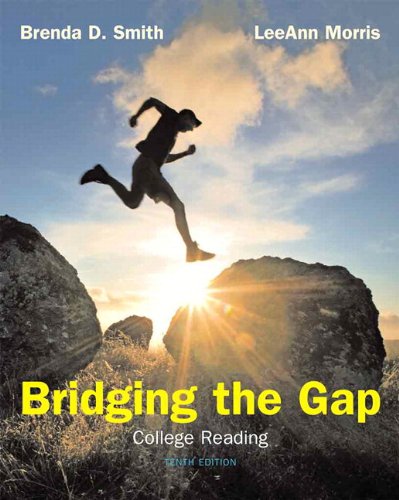
Bridging The Gap: College Reading (with MyReadingLab with Pearson...
Authors:
Brenda Deutsch Smith
Publisher:
Longman
Publication Date:
Not available
ISBN:
0205784305
Brenda Smith’s Bridging the Gap continues to be the #1 textbook choice of developmental reading educators. To improve students’ reading,... Bridging the Gap offers comprehensive skill instruction, dependable exercises and examples, vocabulary development, and wealth of high-interest readings that provide meaningful practice. To prepare students for the demands of college reading, Brenda helping provides strategies for connecting previous experience(s) to what is being learned. The combination of Bridging the Gap and Pearson's MyReadingLab (www.myreadinglab.com) offers unparalleled instruction and practice to improve students' reading.
Bridging the Gap:learning to Write Effectively
Authors:
DELMA MCLEOD-PORTER
Publisher:
Not available
Publication Date:
Not available
ISBN:
1598710095
BRIDGING THE GAP (MSU CUSTOM)
Authors:
Not Available
Publisher:
Not available
Publication Date:
Not available
ISBN:
Not available
BRIDGING THE GAP PACKAGE WILLIAM PATERSON UNIVERSITY
Authors:
Not Available
Publisher:
Not available
Publication Date:
Not available
ISBN:
Not available
 '
'