production
/viewbook/list/all/?page=1835
/
/static/
None
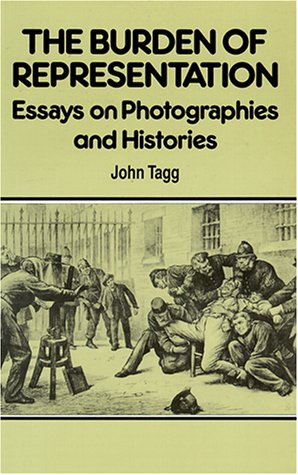
Burden Of Representation: Essays on Photographies and Histories
Authors:
John Tagg
Publisher:
Univ Of Minnesota Press
Publication Date:
Not available
ISBN:
0816624054
Photographs are used as documents, records and evidence every day in courtrooms and hospitals, on passports and driving licences. But how did... photographs come to be established and accepted, what sort of agencies and institutions have the power to enforce this status and, more generally, what concept of photographic representation is entailed and what are its consequences? In addressing such issues, John Tagg traces a previously unexamined history which has profound implications not only for the theory and practice of conventionally separated areas of amateur, professional, technical, documentary and art photography, but also for the understanding of the role of photography in processes of modern social regulation.

Burdens of History: British Feminists, Indian Women, and Imperial...
Authors:
Antoinette Burton
Publisher:
The University of North Carolina Press
Publication Date:
Not available
ISBN:
0807844713
In this study of British middle-class feminism in the late nineteenth and early twentieth centuries, Antoinette Burton explores an important but... neglected historical dimension of the relationship between feminism and imperialism. Demonstrating how feminists in the United Kingdom appropriated imperialistic ideology and rhetoric to justify their own right to equality, she reveals a variety of feminisms grounded in notions of moral and racial superiority.According to Burton, Victorian and Edwardian feminists such as Josephine Butler, Millicent Garrett Fawcett, and Mary Carpenter believed that the native women of colonial India constituted a special 'white woman's burden.' Although there were a number of prominent Indian women in Britain as well as in India working toward some of the same goals of equality, British feminists relied on images of an enslaved and primitive 'Oriental womanhood' in need of liberation at the hands of their emancipated British 'sisters.' Burton argues that this unquestioning acceptance of Britain's imperial status and of Anglo-Saxon racial superiority created a set of imperial feminist ideologies, the legacy of which must be recognized and understood by contemporary feminists.
Bureaucracy
Authors:
Not Available
Publisher:
Libertarian Press
Publication Date:
Not available
ISBN:
091088434X
Professor von Mises addressed himself to a particular issue: what is the essential difference between bureaucratic management by government and market... management in a system based on private ownership of the means of production? Mises does not discuss bureaus or bureaucrats, but inexorable principles of human action. He does not condemn bureaucracy, which is the appropriate technique for the conduct of government agencies such as courts of law, police departments, and the Internal Revenue Service; however, in economic production and distribution, the bureaucratic method is shown to be an abomination that spells universal ruin and disaster.
Bureaucracy and Democracy: Accountability and Performance
Authors:
William T Gormley
Publisher:
CQ Press
Publication Date:
Not available
ISBN:
0872893472
It is nearly impossible to look at the implementation of any policy from testing at an elementary school to testing of a pharmaceutical drug and avoid... seeing the impact and influence of public bureaucracies. Given the importance of their work, and the accountability they owe to the American public, the performance of public bureaucracies must be assessed in a systematic manner. Working through four key perspectives bounded rationality, principal-agent theory, interest group mobilization, and network theory Gormley and Balla give students the analytic power needed to comprehensively evaluate performance, or the give-and-take between decision makers, managers, elected officials, organized interests, and individuals. In addition to updating the book to account for recent developments and new scholarship from the No Child Left Behind Act and presidential appointments to the Program Assessment Rating Tool and changes to the rulemaking process the authors apply their working theories in a new chapter on the politics of disaster. With in-depth coverage of 9/11, Hurricane Katrina, and the avian flu, students can learn important lessons from looking at similar events and crises through the same analytical lenses.
Bureaucracy and Democracy: Accountability and Performance, 3rd Edition
Authors:
William T Gormley
Publisher:
CQ Press College
Publication Date:
Not available
ISBN:
1608717178
Given the influence and impact of public bureaucracies in policy implementation, and the accountability they owe to the American public, their... performance must be assessed in a systematic manner. With this new edition, Gormley and Balla revisit their four key perspectives bounded rationality, principal-agent theory, interest group mobilization, and network theory to help students develop an analytic framework for comprehensively evaluating bureaucratic performance. Thoroughly updated, the third edition includes: new sections on education reform, the response to the financial crisis, and Obama's support for "evidence-based" decision making; new cases of government intervention in crisis with the H1N1 pandemic and the recent tornadoes in the Midwest; new material on public opinion and perceptions of government employees; expanded discussion of networks and their increasingly important role in exchanging information and delivering public services; and a new case study on the BP oil spill that systematically applies the book's four perspectives.
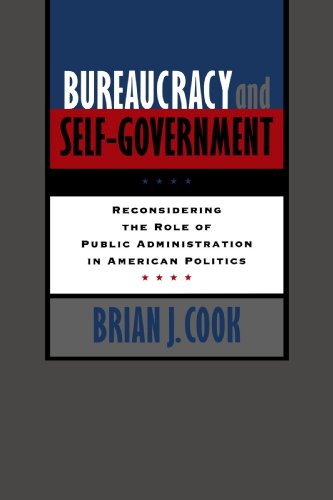
Bureaucracy and Self-Government: Reconsidering the Role of Public...
Authors:
Brian J. Cook
Publisher:
The Johns Hopkins University Press
Publication Date:
Not available
ISBN:
0801854105
For more than two centuries, argues Brian J. Cook in Bureaucracy and Self-Government, two conceptions of public administration have coexisted in... American politics: the "instrumental" (bureaucracy's job is to carry out the orders of elected officials) and the "constitutive" (bureaucracy shapes public policy and thus the character of the political community). Through an examination of key conflicts in American political development—from the debates of 1789 through the Jacksonian era controversies and the confrontations of the New Deal—Cook shows how these two views of public administration have been in constant tension, with the instrumental view eventually dominating public discourse.
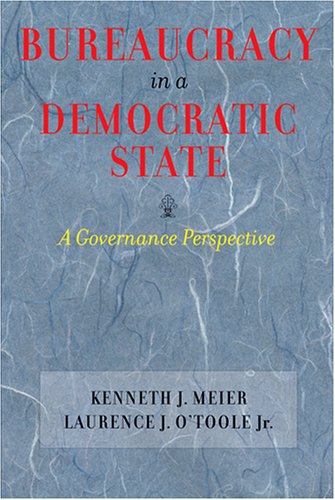
Bureaucracy in a Democratic State: A Governance Perspective
Authors:
Kenneth J. Meier
Publisher:
The Johns Hopkins University Press
Publication Date:
Not available
ISBN:
0801883571
Here, Kenneth J. Meier and Laurence J. O'Toole Jr. present a timely analysis of working democracy, arguing that bureaucracy—often considered... antithetical to fundamental democratic principles—can actually promote democracy. Drawing from both the empirical work of political scientists and the qualitative work of public administration scholars, the authors employ a "governance approach" that considers broad, institutionally complex systems of governance as well as the nitty-gritty details of bureaucracy management. They examine the results of bureaucratic and political interactions in specific government settings, locally and nationally, to determine whether bureaucratic systems strengthen or weaken the connections between public preferences and actual policies. They find that bureaucracies are part of complex intergovernmental and interorganizational networks that limit a single bureaucracy's institutional control over the implementation of public policy. Further, they conclude that top-down political control of bureaucracy has only modest impact on the activities of bureaucracy in the U.S. and that shared values and commitments to democratic norms, along with political control, produce a bureaucracy that is responsive to the American people.
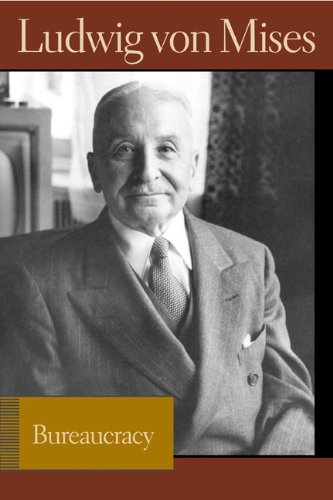
Bureaucracy (Lib Works Ludwig Von Mises PB)
Authors:
Ludwig von Mises
Publisher:
Liberty Fund
Publication Date:
Not available
ISBN:
0865976643
Originally published by Yale University Press in 1944, Bureaucracy is a classic fundamental examination of the nature of bureaucracies and free markets... in juxtaposition to various political systems. Bureaucracy contrasts the two forms of economic managementthat of a free market economy and that of a bureaucracy. In the market economy entrepreneurs are driven to serve consumers by their desire to earn profits and to avoid losses. In a bureaucracy, the managers must comply with orders issued by the legislative body under which they operate; they may not spend without authorization and they may not deviate from the path prescribed by law.Writing in an age of exuberant socialism, Ludwig von Mises here lucidly demonstrates how the efficiencies of private ownership and control of public good production ultimately trump the guesswork of publicly administered planning” through codes and officialdom.” Although Mises aptly critiques bureaucracy and expounds thoroughly upon the immense power of law-like codes of commissions and administrations, he does not condemn nor dismiss bureaucracy but rather frames its proper bounds within constitutional democratic governments.Ludwig von Mises (18811973) was the leading spokesman of the Austrian School of Economics throughout most of the twentieth century. He earned his doctorate in law and economics from the University of Vienna in 1906. In 1926, Mises founded the Austrian Institute for Business Cycle Research. From 1909 to 1934, he was an economist for the Vienna Chamber of Commerce. Before the Anschluss, in 1934 Mises left for Geneva, where he was a professor at the Graduate Institute of International Studies until 1940, when he emigrated to New York City. From 1948 to 1969, he was a visiting professor at New York University.Bettina Bien Greaves is a former resident scholar, trustee, and longtime staff member of the Foundation for Economic Education. She has written and lectured extensively on topics of free market economics. Her articles have appeared in such journals as Human Events, Reason, and The Freeman: Ideas on Liberty. A student of Mises, Greaves has become an expert on his work in particular and that of the Austrian School of economics in general. She has translated several Mises monographs, compiled an annotated bibliography of his work, and edited collections of papers by Mises and other members of the Austrian School.
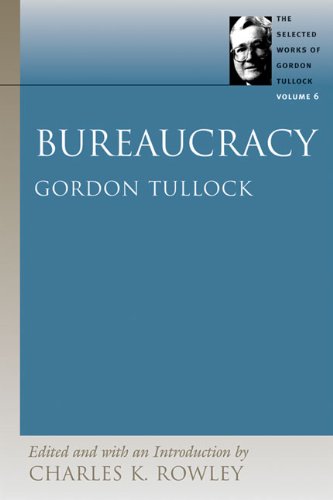
Bureaucracy (Selected Works of Gordon Tullock, The) (v. 6)
Authors:
Gordon Tullock
Publisher:
Liberty Fund
Publication Date:
Not available
ISBN:
0865975361
Bureaucracy provides access to two important and influential books on bureaucracy by Gordon Tullock: The Politics of Bureaucracy (1965) and Economic... Hierarchies, Organization and the Structure of Production (1992). When The Politics of Bureaucracy was published in 1965, bureaucracy was viewed by many people as benign—serving the public good with objectivity and omniscience. In Economic Hierarchies, Organization and the Structure of Production, Tullock looks at bureaucracy in a different but related way, basing his new book on developments in the theory of the firm that had occurred during the intervening period. By comparing the politics of bureaucracy with the economics of industrial organization, Tullock demonstrates that corporations perform with greater economic efficiency than do government bureaus. Charles K. Rowley is Duncan Black Professor of Economics at George Mason University and a Senior Fellow of the James M. Buchanan Center for Political Economy at George Mason University. He is also General Director of the Locke Institute. The entire series includes: Volume 1: Virginia Political Economy Volume 2: The Calculus of Consent Volume 3: The Organization of Inquiry (November 2004) Volume 4: The Economics of Politics (February 2005) Volume 5: The Rent-Seeking Society (March 2005) Volume 6: Bureaucracy (June 2005) Volume 7: The Economics and Politics of Wealth Redistribution (July 2005) Volume 8: The Social Dilemma: Of Autocracy, Revolution, Coup d'Etat, and War (December 2005) Volume 9: Law and Economics (December 2005) Volume 10: Economics without Frontiers (January 2006)

Bureaucracy: What Government Agencies Do And Why They Do It (Basic...
Authors:
James Wilson
Publisher:
Basic Books
Publication Date:
Not available
ISBN:
0465007856
Bureaucracy is the classic study of the way American government agencies work and how they can be made to work better. Examining a wide range of... bureaucracies, including the Army, the FBI, the FCC, and the Social Security Administration, James Q. Wilson provides the first comprehensive, in-depth analysis of what government agencies do, why they function as they do, and how they might become more responsible and effective. With a new introduction by the author.

Bureaucratic Entrepreneur, The
Authors:
Richard N. Haass
Publisher:
Brookings Institution Press
Publication Date:
Not available
ISBN:
0815733534
How do you figure out what to do in a job? How do you get it done? How should you deal with demanding bosses? How can you get the most out of... subordinates? What should you do to get along with difficult colleagues and handle powerful interest groups and the media? Just how can you succeed in a world where persuasion rather than direct command is the rule? Using a compass as his operating metaphor - your boss is north of you, your staff is south, colleagues are east and so on - Richard Haass provides clear, practical guidelines for setting goals and translating goals into results. The result is a lively, useful book for the tens of millions of Americans working in complex and unruly organizations of every sort and for students of both public administration and business. The "Bureaucratic Entrepreneur" is a new and updated edition of Haass's 1994 book, "The Power to Persuade". Richard N. Haass was a special assistant to President Bush and a senior director on the National Security Council staff, where he received the Presidential Citizens Medal. Director of Foreign Policy Studies at the Brookings Institution, he has held posts in the Departments of Defense and State, and is a consultant for NBC News.
Bureaucratic Politics and Foreign Policy; Second Edition
Authors:
Priscilla Clapp
Publisher:
Brookings Institution Press
Publication Date:
Not available
ISBN:
0815734093
The first edition of Bureaucratic Politics and Foreign Policy is one of the most successful Brookings titles of all time. This thoroughly revised... version updates that classic analysis of the role played by the federal bureaucracy --civilian career officials, political appointees, and military officers --and Congress in formulating U.S. national security policy, illustrating how policy decisions are actually made. Government agencies, departments, and individuals all have certain interests to preserve and promote. Those priorities, and the conflicts they sometimes spark, heavily influence the formulation and implementation of foreign policy. A decision that looks like an orchestrated attempt to influence another country may in fact represent a shaky compromise between rival elements within the U.S. government. The authors provide numerous examples of bureaucratic maneuvering and reveal how they have influenced our international relations. The revised edition includes new examples of bureaucratic politics from the past three decades, from Jimmy Carter's view of the State Department to conflicts between George W. Bush and the bureaucracy regarding Iraq. The second edition also includes a new analysis of Congress's role in the politics of foreign policymaking.
Bureaucrats in Business: The Economics and Politics of Government...
Authors:
World Bank
Publisher:
Oxford University Press, USA
Publication Date:
Not available
ISBN:
0195211065
Despite more than a decade of privatization, state-owned enterprises account for nearly as large a share of developing countries' economies today as... twenty years ago. Often inefficient government firms and the resulting deficits hinder growth, making it harder for people to escape poverty. Drawing on extensive data and detailed case studies, this report shows students how divestiture and other reforms can improve the economy, and why politics often impedes reform. It also focuses on how successfully reformed countries have overcome such obstacles. The authors analyze three types of company contracts: performance contracts between a government and a public manager, management contracts between a government and the private manager of a government firm, and regulatory contracts between a government and a privatized, regulated monopoly. The authors then study the reasons why so few countries have reformed, and conclude with a final chapter that draws on these findings to present detailed guidance on how to reform state-owned enterprises successfully.
Bureau Men, Settlement Women: Constructing Public Administration in...
Authors:
Camilla M. Stivers
Publisher:
University Press Of Kansas
Publication Date:
Not available
ISBN:
070061222X
During the first two decades of the twentieth century in cities across America, both men and women struggled for urban reform but in distinctively... different ways. Adhering to gender roles of the time, men working for independent research bureaus sought to apply scientific and business practices to corrupt city governments, while women in the settlement house movement labored to improve the lives of the urban poor by testing new services and then getting governments to adopt them. Although the two intertwined at first, the contributions of these "settlement women" to the development of the administrative state have been largely lost as the new field of public administration evolved from the research bureaus and diverged from social work. Camilla Stivers now shows how public administration came to be dominated not just by science and business but also by masculinity, calling into question much that is taken for granted about the profession and creating an alternative vision of public service. Bureau Men, Settlement Women offers a rare look at the early intellectual history of public administration and is the only book to examine the subject from a gender perspective. It recovers the forgotten contributions of women-their engagement in public life, concern about the proper aims of government, and commitment to citizenship and community-to show that they were ultimately more successful than their male counterparts in enlarging the work and moral scope of government. Stivers's study helps explain public administration's longstanding "identity crisis" by showing why the separation of male and female roles restricted public administration to an unnecessary instrumentalism. It also provides the most detailed examination in half a century of the New York Bureau of Municipal Research and its role in the development of twentieth-century public administration. By reconsidering the origins of the field and calling for a new sense of purpose in public service, Stivers suggests that public administrators need not rigidly emulate business practices but should instead strive to improve the ways in which they deal with people. Her well-researched critique will help students and professionals better understand their calling and challenge them to reconsider how they think about, educate for, and perform government service.

Burgermeister's Daughter
Authors:
Steve Ozment
Publisher:
Harper Perennial
Publication Date:
Not available
ISBN:
0060977213
In an era when women were supposed to be disciplined and obedient, Anna proved to be neither. Defying 16th-century social mores, she was the frequent... subject of gossip because of her immodest dress and flirtatious behavior. When her wealthy father discovered that she was having secret, simultaneous affairs with a young nobleman and a cavalryman, he turned her out of the house in rage, but when she sued him for financial support, he had her captured, returned home and chained to a table as punishment. Anna eventually escaped and continued her suit against her father, her siblings and her home town in a bitter legal battle that was to last 30 years and end only upon her death. Drawn from her surviving love letters and court records, The Burgermeister's Daughter is a fascinating examination of the politics of sexuality, gender and family in the 16th century, and a powerful testament to the courage and tenacity of a woman who defied the inequalities of this distant age.
 '
'