production
/viewbook/list/all/?page=1976
/
/static/
None
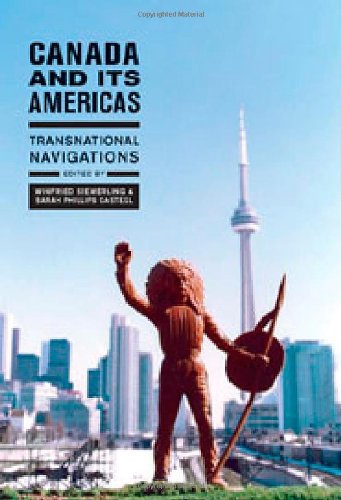
Canada and Its Americas: Transnational Navigations
Authors:
Winfried Siemerling
Publisher:
Mcgill Queens Univ Pr
Publication Date:
Not available
ISBN:
0773536841
In the last few decades, Canadian and Quebecois literatures have been catapulted onto the global stage, gaining international readership and... recognition. "Canada and Its Americas" challenges the convention that study of this literature should be limited to its place within national borders, arguing that these works should be examined from the perspective of their place and influence within the Americas as a whole. The essays in this volume, a groundbreaking work in the burgeoning field of hemispheric American studies, expand the horizons of Canadian and Quebecois literatures, suggest alternative approaches to models centred on the United States, and analyse the risks and benefits of hemispheric approaches to Canada and Quebec. Revealing the connections among a broad range of Canadian, Quebecois, American, Caribbean, Latin American, and diasporic literatures, the contributors critique the neglect of Canadian works in Hemispheric studies and show how such writing can be successfully integrated into an emerging area of literary inquiry. An important development in understanding the diversity of literatures throughout the western hemisphere, "Canada and Its Americas" reveals exciting new ways for thinking about transnationalism, regionalism, border cultures, and the literatures they produce.
Canada and Quebec: One Country, Two Histories
Authors:
Robert Bothwell
Publisher:
UBC Press
Publication Date:
Not available
ISBN:
0774806532
Relations between Canada and Quebec have never been easy. Beginning with the Conquest and working through the many political permutations before... Confederation and since, there has always been conflict between the two governments and, in particular, between two points of view. The rebellions of 1837-8, conscription, the Quiet Revolution, language laws, the FLQ crisis and endless constitutional wrangles such as Meech Lake are just a sampling of the issues that have divided the nation. The cast of characters has been fascinating, too: Pierre Trudeau, Brian Mulroney, Robert Bourassa, and Rene Levesque have all played centre stage. In the wake of a razor-thin majority for federalist forces in the referendum of 1995, the issue of separation continues to be complicated by the division of the huge national debt, the possibility of further territorial partition within a separate Quebec, the rights of First Nations people, and the spectre of separatist movements in Eastern Europe in recent years. Through interviews with a wide variety of politicians, journalists, and academics, Robert Bothwell skilfully weaves together a coherent account of the relationship between Canada and Quebec. We hear from Jean Chretien, Sharon Carstairs and Ovide Mercredi; Lise Bissonnette and Graham Fraser; Michael Bliss and Ramsay Cook; and many more. The text is an absorbing collage of personal accounts and considered opinions, one that acquaints us with the many different facets of this complicated yet crucial question: how did Canada and Quebec get to this impasse, and where do we go from here?

Canada and Quebec: The NAFTA question (Pew case studies in...
Authors:
John M Kline
Publisher:
Institute for the Study of Diplomacy, Sc
Publication Date:
Not available
ISBN:
1569277249

Canada and the New World Economic Order: Strategic Briefings for...
Authors:
Not Available
Publisher:
Captus Press
Publication Date:
Not available
ISBN:
1553220633
Real-world cases and thoughtful discussion questions are a hallmark of this authoritative text. This new edition is up to date on coverage of... organizational behaviour research, theory, and applications, earning it the reputation as the most respected resource in business studies. Organizational Behaviour takes a rigorous approach to OB, while maintaining its readability and engaging approach.

Canada and the United States: Ambivalent Allies
Authors:
John Herd Thompson
Publisher:
U of Georgia, Paperback(2008)
Publication Date:
Not available
ISBN:
0773533982
Rebellious youth, the Cold War, New Left radicalism, Pierre Trudeau, Red Power, Quebec's call for Revolution, Marshall McLuhan: these are just some of... the major forces and figures that come to mind at the slightest mention of the 1960s in Canada. Focusing on the major movements and personalities of the time, as well as the lasting influence of the period, Canada's 1960s examines the legacy of this rebellious decade's impact on contemporary notions of Canadian identity. Bryan D. Palmer demonstrates how after massive postwar immigration, new political movements, and at times violent protest, Canada could no longer be viewed in the old ways. National identity, long rooted in notions of Canada as a white settler Dominion of the North, marked profoundly by its origins as part of the British Empire, had become unsettled. Concerned with how Canadians entered the Sixties relatively secure in their national identities, Palmer explores the forces that contributed to the post-1970 uncertainty about what it is to be Canadian. Tracing the significance of dissent and upheaval among youth, trade unionists, university students, Native peoples, and Quebecois, Palmer shows how the Sixties ended the entrenched, nineteenth-century notions of Canada. The irony of this rebellious era, however, was that while it promised so much in the way of change, it failed to provide a new understanding of Canadian national identity. A compelling and highly accessible work of interpretive history, Canada's 1960s is the book of the decade about an era many regard as the most turbulent and significant since the years of the Great Depression and World War II.

Canada and the United States: Ambivalent Allies (The United States...
Authors:
John Herd Thompson
Publisher:
University of Georgia Press
Publication Date:
Not available
ISBN:
0820331139
The book Foreign Affairs called an "impartial and authoritative" survey of Canadian-American relations--now in a new, completely updated edition The... United States and Canada have the world's largest trading relationship and the longest shared border. Spanning the period from the American Revolution to post-9/11 debates over shared security, Canada and the United States offers a current, thoughtful assessment of relations between the two countries. Distilling a mass of detail concerning cultural, economic, and political developments of mutual importance over more than two centuries, this survey enables readers to grasp quickly the essence of the shared experience of these two countries. This edition of Canada and the United States has been extensively rewritten and updated throughout to reflect new scholarly arguments, emphases, and discoveries. In addition, there is new material on such topics as energy, the environment, cultural and economic integration, the wars in Iraq and Afghanistan, border security, missile defense, and the second Bush administration. "A judicious overview of the 'asymmetrical' and 'essentially one-sided' relationship between the United States and Canada."--Foreign Affairs
Canada and the United States: Differences that Count, Third Edition
Authors:
Not Available
Publisher:
University of Toronto Press, Higher Education Division
Publication Date:
Not available
ISBN:
1551117126
This thoroughly revised edition of Canada and the United States: Differences that Count continues to address, in a timely way, key institutions and... policy areas, adding new chapters on welfare, race and public policy, values, demography, crime, the environment, conflict resolution, and federalism. Data sources for further research have also been included. As in the previous editions, the book does not assume that differences are increasing or decreasing or that one country is "better" than the other. In a straightforward and readable manner, the book looks at the Canadian way and the American way of doing things. From health care to crime (and punishment); from immigration to race and public policy; from tax regulations to the environment; from values to prime ministers and presidents there are as many differences as there are similarities in the way the two countries do things, and not infrequently it turns out that the similarities and differences are not as we have assumed them to be. In Canada and the United States: Differences that Count, Third Edition, leading authorities compare and contrast the Canadian and the American experiences. They do so in the hope of creating a better understanding of the similarities and differences so that policy-makers, students, and ordinary citizens in each of the two countries may learn from the experiences of the other.

Canada Before Confederation: A Study on Historical Geography
Authors:
Cole Harris
Publisher:
Mcgill Queens Univ Pr
Publication Date:
Not available
ISBN:
0773521275
This classic study in modern historical geography reflects the changing regional character of that part of North America that was to become Canada. "A... pioneering bench-mark for future researchers, recognized for its scholarly as well as its literary qualities." Journal of Historical Geography.

CANADA BUSINESS CORPORATIONS ACT & COMM
Authors:
Not Available
Publisher:
Not available
Publication Date:
Not available
ISBN:
Not available

Can a Darwinian be a Christian?: The Relationship between Science...
Authors:
Michael Ruse
Publisher:
Cambridge University Press
Publication Date:
Not available
ISBN:
0521637163
Can someone who accepts Darwin's theory of natural selection subscribe at the same time to the basic tenets of Christianity? Adopting a balanced... perspective on the subject, Michael Ruse argues that, although it is at times difficult for a Darwinian to embrace Christian belief, it is not inconceivable. Ruse has produced an important contribution to a sometimes overheated debate for anyone interested in seeking an informed and judicious guide to these issues. Michael Ruse is professor of philosophy and zoology at the University of Guelph in Ontario, Canada. He is the author of many books on evolutionary biology. In addition, he has published several hundred articles and many book reviews. He is the editor of the Cambridge Series in the Philosophy of Biology and founding editor of the journal IBiology & Philosophy. Hb ISBN (2000): 0-521-63144-0

Canada's 1960s: The Ironies of Identity in a Rebellious Era
Authors:
Bryan Palmer
Publisher:
University of Toronto Press, Scholarly Publishing Division
Publication Date:
Not available
ISBN:
080209659X
Rebellious youth, the Cold War, New Left radicalism, Pierre Trudeau, Red Power, Quebec's call for Revolution, Marshall McLuhan: these are just some of... the major forces and figures that come to mind at the slightest mention of the 1960s in Canada. Focusing on the major movements and personalities of the time, as well as the lasting influence of the period, Canada's 1960s examines the legacy of this rebellious decade's impact on contemporary notions of Canadian identity. Bryan D. Palmer demonstrates how after massive postwar immigration, new political movements, and at times violent protest, Canada could no longer be viewed in the old ways. National identity, long rooted in notions of Canada as a white settler Dominion of the North, marked profoundly by its origins as part of the British Empire, had become unsettled. Concerned with how Canadians entered the Sixties relatively secure in their national identities, Palmer explores the forces that contributed to the post-1970 uncertainty about what it is to be Canadian. Tracing the significance of dissent and upheaval among youth, trade unionists, university students, Native peoples, and Quebecois, Palmer shows how the Sixties ended the entrenched, nineteenth-century notions of Canada. The irony of this rebellious era, however, was that while it promised so much in the way of change, it failed to provide a new understanding of Canadian national identity. A compelling and highly accessible work of interpretive history, Canada's 1960s is the book of the decade about an era many regard as the most turbulent and significant since the years of the Great Depression and World War II.

Canada's Game: Hockey and Identity
Authors:
Andrew C. Holman
Publisher:
McGill-Queens University Press
Publication Date:
Not available
ISBN:
0773535985
Almost every Canadian can hum the original Hockey Night in Canada theme - even those who don't think of themselves as hockey fans. For more than a... century, Canadians have seen something of themselves in the sport of hockey. "Canada's Game" explores the critical aspects of this relationship. Contributors address a broad range of themes in hockey, past and present, including spectacle and spectator ship, the multiple meanings of hockey in Canadian fiction, and the shaping influences of violence, anti-Americanism, and regional rivalry. From the Gardens to the Forum, from the 1936 Olympics to the 1972 Summit Series, from the imagined depictions in Canadian fiction to the fan's-eye view, Canada's Game looks at hockey's ability to reflect Canadian identity. Contributors include Julian Ammirante (Laurentian University at Georgian), Jason Blake (University of Ljubljana, Slovenia), Robert Dennis (Queen's University), Jamie Dopp (University of Victoria), Russell Field (University of Manitoba), Greg Gillespie (Brock University), Richard Harrison (Mount Royal College), Craig Hyatt (Brock University), Brian Kennedy (Pasadena City College), Karen E.H. Skinazi (University of Alberta), and Julie Stevens (Brock University). From the book: The Giller Prize-winning author, David Adams Richards, tells a humorous anecdote from his days as a writer-in-residence at the University of New Brunswick - Fredericton. It was in 1984, on the day after Team Canada had defeated the hated Soviet national team 3 to 2 in overtime and, a committed hockey fan, he was dying to chat with someone, anyone, about the great victory the night before. The first person he encountered was a young English professor, a good but perhaps pretentious scholar who had once been overheard saying that she could not see how anyone could live without reading Henry James. Despite her erudition, like Richards she was from small-town New Brunswick, and because of this, he thought, she must be a hockey fan. 'Did you see the game last night?' No, she replied, 'we don't have a television don't approve of it', but continued on saying that her husband had been eager to find out the result that morning on the radio. 'He's heartbroken', she said. 'We were going for the Russians'. Richards' face displayed his bewilderment at her treasonous statement'. 'Well we both hate Gretzky, you see'. Her accent now turned slightly British he's just such a Canadian. She smiled. He paused, uncomfortably, and then asked her: 'You hate greatness or just Canadian greatness?'
Canada's Population in a Global Context: An Introduction to Social...
Authors:
Frank Trovato
Publisher:
Oxford University Press, USA
Publication Date:
Not available
ISBN:
0195419073
This text will be a core text on Canadian demography. It situates Canada's population in a global context, providing Canadian students with a more... balanced and complete picture of population dynamics. Each chapter identifies and explores core issues and concerns. Technical matters are kept to the bare essentials and emphasis is placed on conceptual and theoretical frameworks for the analysis of population phenomena. Age and sex compositions are thoroughly profiled in a global context, as is mortality. Mortality change in a historical perspective, epidemiological transition of the West versus that of developing nations, inequalities in mortality and health, and the future course of mortality are investigated. Also discussed are fertility and the determinants of fertility, such as biology, culture, and society; theories of fertility change in both Western and developing nations; and the cost and values of children to parents. Nuptuality and marriage patterns are explored alongside contemporary patterns of marriage, divorce, and cohabitation in developing nations and the Western world, and theoretical perspectives on marriage and family change are featured. Central topics include mobility and migration, internal migration and its relationship to urbanization, cities and their components of growth, urban systems in developing and industrialized nations, and explanations for migration. Key issues include human migration in historical perspective; social, economic, and political interrelationships in international migration; globalization; theories of international migration; as well as immigrant adaptation and integration in host nations. Lastly, population policy and public policy in Canada, policy responses to low fertility, policy responses to rapid population growth, and policy successes and failures are examined.

Canadian Advertising in Action, Ninth Edition
Authors:
Keith J. Tuckwell
Publisher:
Pearson Education Canada
Publication Date:
Not available
ISBN:
0137060637
Praised for its clear writing style and solid Canadian examples, Advertising in Action provides a clear picture of the advertising industry. Thoroughly... updated to reflect the rapid pace of change in the digital media world, this new edition incorporates new and emerging social media, such as Facebook and Twitter, and its impact on advertising.
Canadian Business and Society: Ethics & Responsibilities
Authors:
Robert Sexty
Publisher:
Not available
Publication Date:
Not available
ISBN:
Not available
 '
'