production
/viewbook/list/all/?page=1997
/
/static/
None

Capitalism, Socialism, and Democracy
Authors:
Joseph A. Schumpeter
Publisher:
Harper Perennial
Publication Date:
Not available
ISBN:
0061330086
2011 Reprint of 1947 Second Edition. Joseph Alois Schumpeter (1883 - 1950) was an Austrian-American economist and political scientist. He popularized... the term "creative destruction" in economics. Schumpeter's most popular book in English is probably Capitalism, Socialism and Democracy. This book opens with a treatment of Karl Marx. While he is sympathetic to Marx's theory that capitalism will collapse and will be replaced by socialism, Schumpeter concludes that this will not come about in the way Marx predicted. To describe it he borrowed the phrase "creative destruction", and made it famous by using it to describe a process in which the old ways of doing things are endogenously destroyed and replaced by new ways.
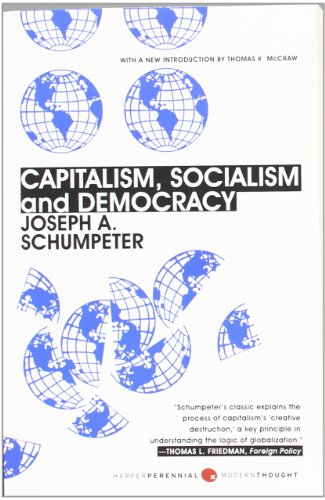
Capitalism, Socialism, and Democracy: Third Edition
Authors:
Joseph A. Schumpeter
Publisher:
Harper Perennial Modern Classics
Publication Date:
Not available
ISBN:
0061561614
In this definitive third and final edition (1950) of his masterwork, Joseph A. Schumpeter introduced the world to the concept of “creative... destruction,” which forever altered how global economics is approached and perceived. Now featuring a new introduction by Schumpeter biographer Thomas K. McCraw, Capitalism, Socialism and Democracy is essential reading for anyone who seeks to understand where the world economy is headed.

Capitalism Takes Command: The Social Transformation of...
Authors:
Not Available
Publisher:
University Of Chicago Press
Publication Date:
Not available
ISBN:
0226451100
Most scholarship on nineteenth-century America’s transformation into a market society has focused on consumption, romanticized visions of workers, and... analysis of firms and factories. Building on but moving past these studies, Capitalism Takes Command presents a history of family farming, general incorporation laws, mortgage payments, inheritance practices, office systems, and risk management—an inventory of the means by which capitalism became America’s new revolutionary tradition.This multidisciplinary collection of essays argues not only that capitalism reached far beyond the purview of the economy, but also that the revolution was not confined to the destruction of an agrarian past. As business ceaselessly revised its own practices, a new demographic of private bankers, insurance brokers, investors in securities, and start-up manufacturers, among many others, assumed center stage, displacing older elites and forms of property. Explaining how capital became an “ism” and how business became a political philosophy, Capitalism Takes Command brings the economy back into American social and cultural history.
Capitalism: The Unknown Ideal
Authors:
Ayn Rand
Publisher:
Signet
Publication Date:
Not available
ISBN:
0451147952
The foundations of capitalism are being battered by a flood of altruism, which is the cause of the modern world's collapse. This is the view of Ayn... Rand, a view so radically opposed to prevailing attitudes that it constitutes a major philosophic revolution. In this series of essays, she presents her stand on the persecution of big business, the causes of war, the default of conservatism, and the evils of altruism. Here is a challenging new look at modern society by one of the most provocative intellectuals on the American scene. This edition includes two articles by Ayn Rand which did not appear in the hardcover edition: The Wreckage of the Consensus," which presents the Objectivists views on Vietnam and the draft; and Requiem for Man," an answer to the Papal encyclical Progresso Populorum.

Capitalism Unleashed: Finance, Globalization, and Welfare
Authors:
Andrew Glyn
Publisher:
Oxford University Press, USA
Publication Date:
Not available
ISBN:
0199226792
This accessible and persuasive book challenges the notion of our capitalist destiny. It provides a clear and concise history of the problems facing the... economies of Europe, Japan, and the US during the latter half of the twentieth century and questions whether capitalism has really brought the levels of economic growth and prosperity that were hoped for. Andrew Glyn then looks at the impact that the rapidly developing economies of China and the South are likely to have on the older economies of the North. As the race is on to maintain growth and protect competitive advantage, Glyn asks: is the "race-to-the bottom" inevitable as the anti-globalizers predict, with welfare states being dismantled to meet competitive demands? Or is there an alternative model, which sees a strong commitment to welfare provision as essential to economic growth? Can we afford not to tackle inequality at home as well as abroad?
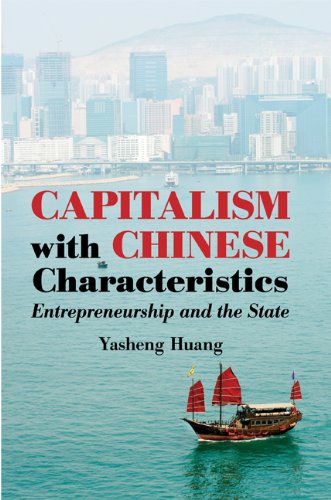
Capitalism with Chinese Characteristics: Entrepreneurship and the...
Authors:
Yasheng Huang
Publisher:
Cambridge University Press
Publication Date:
Not available
ISBN:
0521898102
An Economist Book of the Year, 2008 This book presents a story of two Chinas - an entrepreneurial rural China and a state-controlled urban China. In... the 1980s, rural China gained the upper hand, and the result was rapid as well as broad-based growth. In the 1990s, urban China triumphed. In the 1990s, the Chinese state reversed many of its productive rural experiments, with long-lasting damage to the economy and society. A weak financial sector, income disparity, rising illiteracy, productivity slowdowns, and reduced personal income growth are the product of the capitalism with Chinese characteristics of the 1990s and beyond. While GDP grew quickly in both decades, the welfare implications of growth differed substantially. The book uses the emerging Indian miracle to debunk the widespread notion that democracy is automatically anti-growth. The single biggest obstacle to sustainable growth and financial stability in China today is its poor political governance. As the country marks its 30th anniversary of reforms in 2008, China faces some of its toughest economic challenges and substantial vulnerabilities that require fundamental institutional reforms.
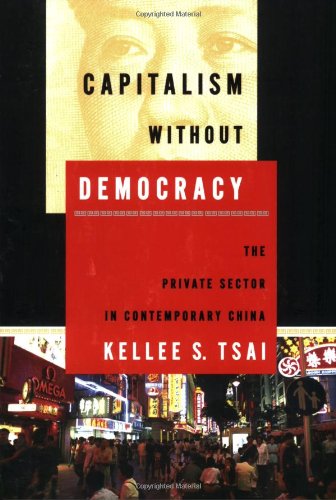
Capitalism without Democracy: The Private Sector in Contemporary China
Authors:
Kellee S. Tsai
Publisher:
Cornell University Press
Publication Date:
Not available
ISBN:
0801473268
Over the past three decades, China has undergone a historic transformation. Once illegal, its private business sector now comprises 30 million... businesses employing more than 200 million people and accounting for half of China's Gross Domestic Product. Yet despite the optimistic predictions of political observers and global business leaders, the triumph of capitalism has not led to substantial democratic reforms.In Capitalism without Democracy, Kellee S. Tsai focuses on the activities and aspirations of the private entrepreneurs who are driving China's economic growth. The famous images from 1989 of China's new capitalists supporting the students in Tiananmen Square are, Tsai finds, outdated and misleading. Chinese entrepreneurs are not agitating for democracy. Most are working eighteen-hour days to stay in business, while others are saving for their one child's education or planning to leave the country. Many are Communist Party members. "Remarkably," Tsai writes, "most entrepreneurs feel that the system generally works for them."Tsai regards the quotidian activities of Chinese entrepreneurs as subtler and possibly more effective than voting, lobbying, and protesting in the streets. Indeed, major reforms in China's formal institutions have enhanced the private sector's legitimacy and security in the absence of mobilization by business owners. In discreet collaboration with local officials, entrepreneurs have created a range of adaptive informal institutions, which in turn, have fundamentally altered China's political and regulatory landscape. Based on years of research, hundreds of field interviews, and a sweeping nationwide survey of private entrepreneurs funded by the National Science Foundation, Capitalism without Democracy explodes the conventional wisdom about the relationship between economic liberalism and political freedom.

Capitalist Development and Democracy
Authors:
Dietrich Rueschemeyer
Publisher:
University Of Chicago Press
Publication Date:
Not available
ISBN:
0226731448
It is a commonplace claim of Western political discourse that capitalist development and democracy go hand in hand. Cross-national statistical research... on political democracy supports this claim. By contrast, comparative historical studies carried out within a political economy approach argue that economic development was and is compatible with multiple political forms.The authors offer a fresh and persuasive resolution to the controversy arising out of these contrasting traditions. Focusing on advanced industrial countries, Latin America, and the Caribbean, they find that the rise and persistence of democracy cannot be explained either by an overall structural correspondence between capitalism and democracy or by the role of the bourgeoisie as the agent of democratic reform. Rather, capitalist development is associated with democracy because it transforms the class structure, enlarging the working and middle classes, facilitating their self-organization, and thus making it more difficult for elites to exclude them. Simultaneously, development weakens the landed upper class, democracy's most consistent opponent.The relationship of capitalist development to democracy, however, is not mechanical. As the authors show, it depends on a complex interplay of three clusters of power: the balance of power among social classes, power relations between the state and society, and transnational structures of economic and political power. Looking to the future, the book concludes with some reflections on current prospects for the development of stable democracy in Latin America and Eastern Europe.

Capitalist Realism: Is there no alternative? (Zero Books)
Authors:
Mark Fisher
Publisher:
John Hunt Publishing
Publication Date:
Not available
ISBN:
1846943175
After 1989, capitalism has successfully presented itself as the only realistic political-economic system - a situation that the bank crisis of 2008, far... from ending, actually compounded. The book analyses the development and principal features of this capitalist realism as a lived ideological framework. Using examples from politics, films, fiction, work and education, it argues that capitalist realism colours all areas of contemporary experience. But it will also show that, because of a number of inconsistencies and glitches internal to the capitalist reality program capitalism in fact is anything but realistic.

Capitalist Rising: The Short History of a Long Insurgency
Authors:
A J Poitras
Publisher:
Vantage Press
Publication Date:
Not available
ISBN:
0533156084
Whether you are a newcomer to fusing and slumping or an experienced glass artist, CONTEMPORARY FUSED GLASS is an invaluable guide to developing and... improving your ability to work with glass in a kiln. CONTEMPORARY FUSED GLASS, a revised and expanded edition of Brad Walker s CONTEMPORARY WARM GLASS, contains up-to-date information on all aspects of fusing and slumping, featuring techniques and processes for: Basic fusing and slumping projects, such as making coasters, tiles, bowls, and platters; Information on materials for fusing and slumping, from kilns to molds to types of glass and essential safety equipment; Instructions for compatibility testing and annealing, including numerous firing schedules for fusing, slumping, and kiln casting; Information about more advanced techniques, such as inclusions, pattern bars, reactive glass, pot and wire melts, combing, and using drop rings and floral formers; An introduction to kiln casting, using recycled glass, coldworking, and finishing. CONTEMPORARY FUSED GLASS includes hundreds of tips and suggestions, from troubleshooting to health and safety to making your own supplies, stringer, and confetti.

Capitalist Sorcery: Breaking the Spell
Authors:
Isabella Stengers
Publisher:
Palgrave Macmillan
Publication Date:
Not available
ISBN:
0230237622
An English translation of La Sorcellerie Capitaliste - a passionate but pragmatic critique in political philosophy. It diagnoses capitalism as a 'system... of sorcery without sorcerers'. Capitalism paralyses us in ways that resembles sorcery and the book is concerned to look at ways we might defend ourselves against such a system.
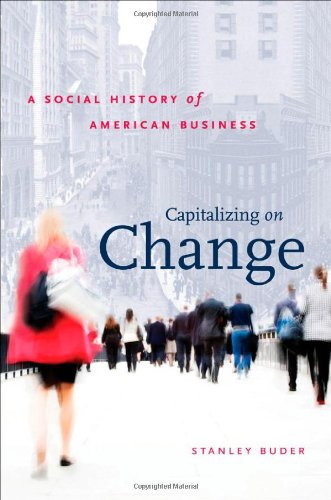
Capitalizing on Change: A Social History of American Business (The...
Authors:
Stanley Buder
Publisher:
The University of North Carolina Press
Publication Date:
Not available
ISBN:
0807832316
Americans love "this year's model," relying on the "new" to be always "improved." Enthusiasm for the new, says Stanley Buder, is essential to American... business, where innovation and change stoke the engines of economic energy. To really understand the history of business in America, he argues, we must understand the intertwining dynamics of social and business values. In a history spanning over three hundred years, Buder examines the enveloping expansion of the market economy, the laggardly use of government to modify or control market forces, the rise of consumerism, the shifting role of small business, and much more. He concludes with the explosive development of business in the 1990s and its aftermath of crises and scandal. Along the way, he analyzes the ways American social values foster an entrepreneurial ethos and why the identification of change with progress provides a distinctive and provocative theme in American life. Buder studies American business as not only an engine of wealth accumulation but also an important generator and reflector of American values. Capitalizing on Change is the first full-length business history in recent years to make this relationship clear.
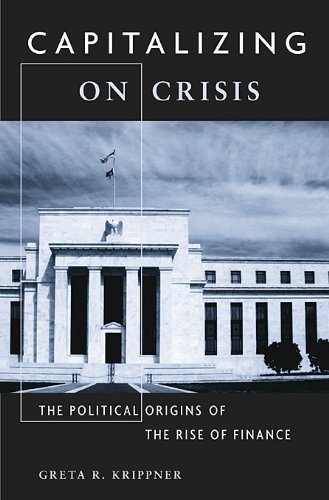
Capitalizing on Crisis: The Political Origins of the Rise of Finance
Authors:
Greta R. Krippner
Publisher:
Harvard University Press
Publication Date:
Not available
ISBN:
0674066197
In the context of the recent financial crisis, the extent to which the U.S. economy has become dependent on financial activities has been made... abundantly clear. In Capitalizing on Crisis, Greta Krippner traces the longer-term historical evolution that made the rise of finance possible, arguing that this development rested on a broader transformation of the U.S. economy than is suggested by the current preoccupation with financial speculation. Krippner argues that state policies that created conditions conducive to financialization allowed the state to avoid a series of economic, social, and political dilemmas that confronted policymakers as postwar prosperity stalled beginning in the late 1960s and 1970s. In this regard, the financialization of the economy was not a deliberate outcome sought by policymakers, but rather an inadvertent result of the state’s attempts to solve other problems. The book focuses on deregulation of financial markets during the 1970s and 1980s, encouragement of foreign capital into the U.S. economy in the context of large fiscal imbalances in the early 1980s, and changes in monetary policy following the shift to high interest rates in 1979. Exhaustively researched, the book brings extensive new empirical evidence to bear on debates regarding recent developments in financial markets and the broader turn to the market that has characterized U.S. society over the last several decades.
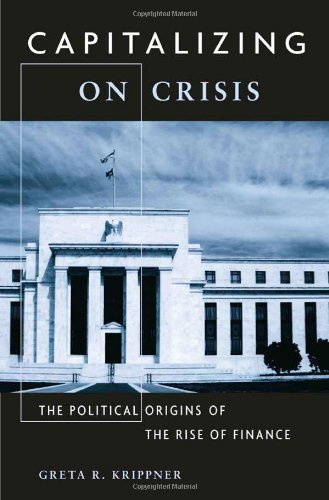
Capitalizing on Crisis: The Political Origins of the Rise of Finance
Authors:
Greta R. Krippner
Publisher:
Harvard University Press
Publication Date:
Not available
ISBN:
0674050843
In the context of the recent financial crisis, the extent to which the U.S. economy has become dependent on financial activities has been made... abundantly clear. In Capitalizing on Crisis, Greta Krippner traces the longer-term historical evolution that made the rise of finance possible, arguing that this development rested on a broader transformation of the U.S. economy than is suggested by the current preoccupation with financial speculation. Krippner argues that state policies that created conditions conducive to financialization allowed the state to avoid a series of economic, social, and political dilemmas that confronted policymakers as postwar prosperity stalled beginning in the late 1960s and 1970s. In this regard, the financialization of the economy was not a deliberate outcome sought by policymakers, but rather an inadvertent result of the state’s attempts to solve other problems. The book focuses on deregulation of financial markets during the 1970s and 1980s, encouragement of foreign capital into the U.S. economy in the context of large fiscal imbalances in the early 1980s, and changes in monetary policy following the shift to high interest rates in 1979. Exhaustively researched, the book brings extensive new empirical evidence to bear on debates regarding recent developments in financial markets and the broader turn to the market that has characterized U.S. society over the last several decades.

Capitalizing on Nature: Ecosystems as Natural Assets
Authors:
Edward B. Barbier
Publisher:
Cambridge University Press
Publication Date:
Not available
ISBN:
0521189276
The basic unit of nature - the ecosystem - is a special form of wealth, which we can think of as a stock of natural capital. However, perhaps because... this capital is free, we have tended to view it as limitless, abundant and always available for our use, exploitation and conversion. Capitalizing on Nature shows how modeling ecosystems as natural capital can help us to analyze the economic behavior that has led to the overuse of so much ecological wealth. It explains how this concept of ecosystem as natural capital sheds light on a number of important issues, including landscape conversion, ecological restoration, ecosystem resilience and collapse, spatial benefits and payments for ecosystem services. The book concludes by focusing on major policy challenges that need to be overcome in order to avert the worsening problem of ecological scarcity and how we can fund novel financing mechanisms for global conservation.
 '
'