production
/viewbook/list/all/?page=2022
/
/static/
None
Cartas Marruecas
Authors:
J. Cadalso
Publisher:
Espasa-Calpe SA
Publication Date:
Not available
ISBN:
8423918947
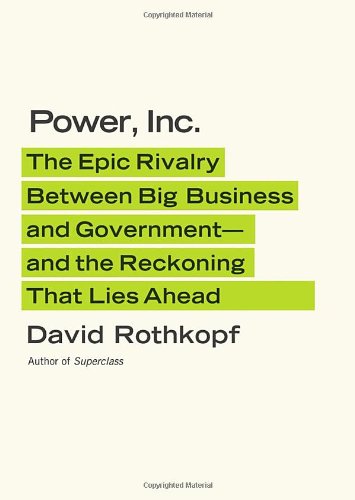
The world’s largest company, Wal-Mart Stores, has revenues higher than the GDP of all but twenty-five of the world’s countries. Its employees... outnumber the populations of almost a hundred nations. The world’s largest asset manager, a secretive New York company called Black Rock, controls assets greater than the national reserves of any country on the planet. A private philanthropy, the Bill and Melinda Gates Foundation, spends as much worldwide on health care as the World Health Organization. The rise of private power may be the most important and least understood trend of our time. David Rothkopf provides a fresh, timely look at how we have reached a point where thousands of companies have greater power than all but a handful of states. Beginning with the story of an inquisitive Swedish goat wandering off from his master and inadvertently triggering the birth of the oldest company still in existence, Power, Inc. follows the rise and fall of kings and empires, the making of great fortunes, and the chaos of bloody revolutions. A fast-paced tale in which champions of liberty are revealed to be paid pamphleteers of moneyed interests and greedy scoundrels trigger changes that lift billions from deprivation, Power, Inc. traces the bruising jockeying for influence right up to today’s financial crises, growing inequality, broken international system, and battles over the proper role of government and markets.Rothkopf argues that these recent developments, coupled with the rise of powers like China and India, may not lead to the triumph of American capitalism that was celebrated just a few years ago. Instead, he considers an unexpected scenario, a contest among competing capitalisms offering different visions for how the world should work, a global ideological struggle in which European and Asian models may have advantages. An important look at the power struggle that is defining our times, Power, Inc. also offers critical insights into how to navigate the tumultous years ahead.

Cartas marruecas; Noches lugubres (COLECCION LETRAS HISPANICAS)...
Authors:
Cadalso
Publisher:
Catedra
Publication Date:
Not available
ISBN:
843761810X
The classic that is widely acknowledged to be the most valuable and insightful book ever written on the dynamics of working-class family life by a... renowned sociologist, psychotherapist, and bestselling author."One of the most devastating critiques of contemporary American life that I have read."--Michael B. Katz Professor of History, York University"This is a sensitive and compassionate portrayal of childhood, marriage, and adult life among the hard-working not-quite poor. It is an important contribution to our understanding of ourselves."--Robert S. Weiss, author of "Marital Separation"

Cartas's New Century Handbook and Atlas of the Bible
Authors:
R Steven Notley
Publisher:
Carta the Isreal Map & Pub Co Ltd
Publication Date:
Not available
ISBN:
9652207039
Carta's New Century Handbook and Atlas of the Bible, a concise version of The Sacred Bridge: Carta's Atlas of the Biblical World, is meant for use by... all who have a love for biblical history. College teachers may find it useful for undergraduates alongside the standard Carta Bible Atlas, which it complements by being more a historical geography.The object of this concise version is to augment the personal Bible study of all who seek a straightforward understanding of biblical history. Nevertheless, the reader will still have the sense that sacred history came about in a real world, a realm illumined by a multitude of discoveries and studies during the past two hundred years. Furthermore, the geographical dimension of the Bible accounts is thoroughly presented. Every Bible student may thus step into the ancient reality and feel the events as they were experienced by the ancient Israelites and their neighbors.This new historical handbook will enrich the Bible reading experience of an even wider audience in whose lives the Sacred Canon enjoys special significance.

Carte Blanche: The New James Bond Novel (007 James Bond)
Authors:
Jeffery Deaver
Publisher:
Pocket Star
Publication Date:
Not available
ISBN:
1451629354
JAMES BOND as you’ve never seen him before . . . in the smashing new thriller and #1 international bestseller from JEFFERY DEAVER A Night Action alert... calls James Bond away from dinner with a beautiful woman. Headquarters has decrypted an electronic whisper—plans for a devastating attack: Casualties estimated in the thousands, British interests adversely affected. James Bond, in his early thirties and already a veteran of the Afghan War, has been recruited to a new organization. Conceived in the post-9/11 world, it operates independent of MI5, MI6, and the Ministry of Defense, its very existence deniable. Its aim: to protect the Realm, by any means necessary. And Agent 007 has been given carte blanche to do whatever it takes to fulfill his mission. . . .

Cartelera: Spanish Language and Culture through Film (Spanish Edition)
Authors:
Elena González Ros
Publisher:
Alucen Learning
Publication Date:
Not available
ISBN:
0982159552
Cartelera provides an exciting learning experience where culture takes a central role as the context for linguistic production. Based on eight highly... acclaimed feature films from Spain and Latin America, this unique book is designed for students of Spanish language and culture at the intermediate to advanced level. It may be used either as the primary text in a culture, conversation, or film course, or as an enriching supplement to any existing language program. Specifically developed to exploit the content and themes presented in each of the films, the activities in Cartelera are designed to encourage language development while fostering a greater appreciation for and a heightened cultural awareness of the Spanish-speaking world. Through the use of discussion, debate, analysis, dramatization, and creative writing, students will expand their vocabulary and significantly improve their language proficiency in a stimulating environment.

Carter: Lippincott's Textbook for Nursing Assistants+Student...
Authors:
Pamela Carter
Publisher:
Lippincott Williams & Wilkins
Publication Date:
Not available
ISBN:
1451142749
This package contains the following products: · 978-1-60547-635-3 Carter Lippincott's Textbook for Nursing Assistants... · 978-1-60547-636-0 Student Workbook to Accompany Lippincott's Textbook for Nursing Assistants

Cartesian Linguistics: A Chapter in the History of Rationalist Thought
Authors:
Noam Chomsky
Publisher:
Cambridge University Press
Publication Date:
Not available
ISBN:
0521708176
In this extraordinarily original and profound work, Noam Chomsky discusses themes in the study of language and mind since the end of the sixteenth... century in order to explain the motivations and methods that underlie his work in linguistics, the science of mind, and even politics. This edition includes a new and specially written introduction by James McGilvray, contextualising the work for the twenty-first century. It has been made more accessible to a larger audience; all the French and German in the original edition has been translated, and the notes and bibliography have been brought up to date. The relationship between the original edition (published in 1966) and contemporary biolinguistic work is also explained. This challenging volume is an important contribution to the study of language and mind, and to the history of these studies since the end of the sixteenth century.

Cartesian Meditations: An Introduction to Phenomenology
Authors:
Edmund Husserl
Publisher:
Martinus Nijhoff Pub.
Publication Date:
Not available
ISBN:
902470068X
The "Cartesian Meditations" translation is based primarily on the printed text, edited by Professor S. Strasser and published in the first... volume of Husserliana: Cartesianische Meditationen und Pariser Vorträge, ISBN 90-247-0214-3. Most of Husserl's emendations, as given in the Appendix to that volume, have been treated as if they were part of the text. The others have been translated in footnotes. Secondary consideration has been given to a typescript (cited as "Typescript C") on which Husserl wrote in 1933: "Cartes. Meditationen / Originaltext 1929 / E. Husserl / für Dorion Cairns". Its use of emphasis and quotation marks conforms more closely to Husserl’s practice, as exemplified in works published during his lifetime. In this respect the translation usually follows Typescript C. Moreover, some of the variant readings n this typescript are preferable and have been used as the basis for the translation. Where that is the case, the published text is given or translated in a foornote. The published text and Typescript C have been compared with the French translation by Gabrielle Pfeiffer and Emmanuel Levinas (Paris, Armand Collin, 1931). The use of emphasis and quotation marks in the French translation corresponds more closely to that in Typescript C than to that in the published text. Often, where the wording of the published text and that of Typescript C differ, the French translation indicates that it was based on a text that corresponded more closely to one or the other – usually to Typescript C. In such cases the French translation has been quoted or cited in a foornote.
Carthage Must Be Destroyed: The Rise and Fall of an Ancient...
Authors:
Richard Miles
Publisher:
Penguin Books
Publication Date:
Not available
ISBN:
0143121294
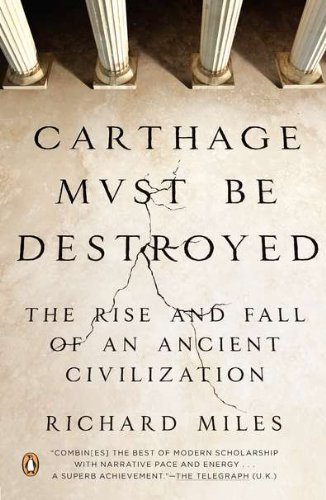
The first full-scale history of Hannibal's Carthage in decades and "a convincing and enthralling narrative." (The Economist )Drawing on a wealth of new... research, archaeologist, historian, and master storyteller Richard Miles resurrects the civilization that ancient Rome struggled so mightily to expunge. This monumental work charts the entirety of Carthage's history, from its origins among the Phoenician settlements of Lebanon to its apotheosis as a Mediterranean empire whose epic land-and-sea clash with Rome made a legend of Hannibal and shaped the course of Western history. Carthage Must Be Destroyed reintroduces readers to the ancient glory of a lost people and their generations-long struggle against an implacable enemy.

Carthusian Spirituality: The Writings of Hugh of Balma and Guigo de...
Authors:
Dennis D. Martin
Publisher:
Paulist Press
Publication Date:
Not available
ISBN:
0809104806
Frederick Lewis Allen was one of the pioneers in social history. Best known as the author of Only Yesterday, Allen originated a model of what is... sometimes called instant history, the reconstruction of past eras through vivid commentary on the news, fashions, customs, and artifacts that altered the pace and forms of American life. The Big Change was Allen’s last and most ambitious book. In it he attempted to chart and explain the progressive evolution of American life over half a century. Written at a time of unprecedented optimism and prosperity, The Big Change defines a transformative moment in American history and provides an implicit and illuminating perspective on what has taken place in the second half of the twentieth century. Allen’s theme is the realization, in large measure, of the promise of democracy. As against the strain of social criticism that saw America as enfeebled by affluence and conformity, Allen wrote in praise of an economic system that had ushered in a new age of well being for the American people. He divides his inquiry into three major sections. The first, “The Old Order,” portrays the turn-of-the-century plutocracy in which the federal government was largely subservient to business interests and the gap between rich and poor portended a real possibility of bloody rebellion. “The Momentum of Change” graphically describes the various forces that gradually transformed the country in the new century: mass production, the automobile, the Great Depression and the coming of big government, World War II and America’s emergence as a world power. Against this background, Allen shows how the economic system was reformed without being ruined, and how social gaps began to steadily close. The concluding section, “The New America,” is a hopeful assessment of postwar American culture. Allen’s analysis takes critical issue with many common perceptions, both foreign and domestic, of American life and places remaining social problems in careful perspective. As William O’Neill remarks in his introduction to this new edition, The Big Change is both a deep and wonderfully readable work of social commentary, a book that gains rather than loses with the years.
Cartographia: Mapping Civilizations
Authors:
Vincent Virga
Publisher:
Little, Brown and Company
Publication Date:
Not available
ISBN:
0316997668
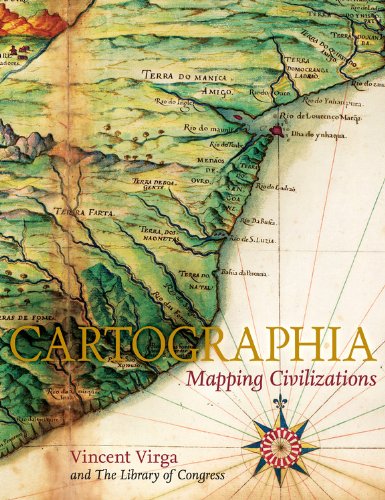
CARTOGRAPHIA offers a stunning array of 200 of the most beautiful, important, and fascinating maps in existence, from the world's largest cartographic... collection, at the Library of Congress. These maps show how our idea of the world has shifted and grown over time, and each map tells its own unique story about nations, politics, and ambitions. The chosen images, with their accompanying stories, introduce the reader to an exciting new way of "reading" maps as travelogues---living history from the earliest of man's imaginings about planet earth to our current attempts at charting cyberspace. Among the rare gems included in the book are the Waldseemuller Map of the World from 1507, the first to include the designation "America"; pages from the Ortelius's Theatrum Orbis Terrarum of 1570, considered the first modern atlas; rare maps from Africa, Asia, and Oceania that challenge traditional Western perspectives; William Faulkner's hand-drawn 1936 map of the fictional Yoknapatawpha County, Mississippi; and even a map of the Human Genome. In an oversized format, with gorgeous four-color reproductions throughout, Catrographia will appeal to collectors, historians, and anyone looking for a perfect gift.
Cartographic Mexico: A History of State Fixations and Fugitive...
Authors:
Raymond B. B. Craib
Publisher:
Duke University Press Books
Publication Date:
Not available
ISBN:
082233416X
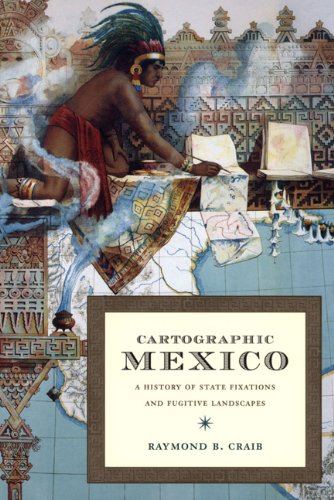
In Cartographic Mexico, Raymond B. Craib analyzes the powerful role cartographic routines such as exploration, surveying, and mapmaking played in the... creation of the modern Mexican state in the nineteenth and early twentieth centuries. Such routines were part of a federal obsession—or “state fixation”—with determining and “fixing” geographic points, lines, and names in order to facilitate economic development and political administration. As well as analyzing the maps that resulted from such routines, Craib examines in close detail the processes that eventually generated them. Taking central Veracruz as a case in point, he shows how in the field, agrarian officials, military surveyors, and metropolitan geographers traversed a “fugitive landscape” of overlapping jurisdictions and use rights, ambiguous borders, shifting place names, and villagers with their own conceptions of history and territory. Drawing on an array of sources—including maps, letters from peasants, official reports, and surveyors’ journals and correspondence—Craib follows the everyday, contested processes through which officials attempted to redefine and codify such fugitive landscapes in struggle with the villagers they encountered in the field. In the process, he vividly demonstrates how surveying and mapmaking were never mere technical procedures: they were, and remain to this day, profoundly social and political practices in which surveyors, landowners, agrarian bureaucrats, and peasants all played powerful and complex roles.

Cartographies of Desire: Male-Male Sexuality in Japanese Discourse,...
Authors:
Gregory M. Pflugfelder
Publisher:
University of California Press
Publication Date:
Not available
ISBN:
0520251652
In this sweeping study of the mapping and remapping of male-male sexuality over four centuries of Japanese history, Gregory Pflugfelder explores the... languages of medicine, law, and popular culture from the seventeenth century through the American Occupation.Pflugfelder opens with fascinating speculations about how an Edo translator might grapple with a twentieth-century text on homosexuality, then turns to law, literature, newspaper articles, medical tracts, and other sources to discover Japanese attitudes toward sexuality over the centuries. During each of three major eras, he argues, one field dominated discourse on male-male sexual relations: popular culture in the Edo period (1600-1868), jurisprudence in the Meiji period (1868-1912), and medicine in the twentieth century.This multidisciplinary and theoretically engaged analysis will interest not only students and scholars of Japan but also readers of gay studies, literary studies, gender studies, and cultural studies.

Cartographies of Knowledge: Exploring Qualitative Epistemologies
Authors:
Celine-Marie Pascale
Publisher:
Sage Publications, Inc
Publication Date:
Not available
ISBN:
1412954967
Mapping geographies of power and knowledge in qualitative research“In this foundational tome, Professor Celine-Marie Pascale critiques methodology in... relationship to specific qualitative methods and argues cogently that despite good intentions, most of this research is still tethered to the Cartesian paradigm thus limiting its emancipatory potential. This is an impressive book that will likely become a classic!”- Eduardo Bonilla-Silva, Duke University, co-author with Tukufu Zuberi, White Logic, White Methods: Racism and Methodology2012 Winner of the International Congress of Qualitative Inquiry English Language Book Award!Using clear language and concrete examples, this text examines theoretical and historical foundations that shape the premise and logic of qualitative social research. It analyzes qualitative methodology and methods in relationship to issues of agency, subjectivity, and experience. Rooted to feminist, critical race, and post-structural literature, it is concerned with social justice as it critiques current research paradigms and advances broad alternatives.This is an ideal text for students in graduate-level courses in Methodology, Epistemology, Qualitative Research Methods, Data Analysis, Ethnomethodology, Symbolic Interaction, Phenomenology, Grounded Theory, and related courses the social, behavioral, and health sciences.
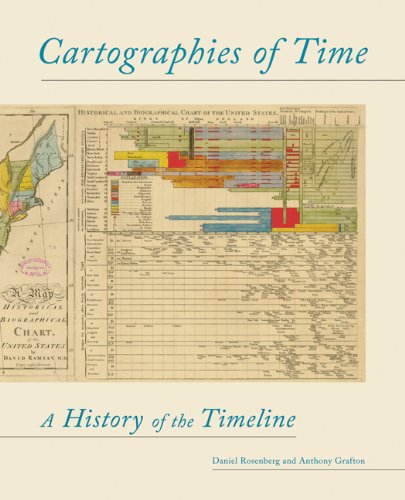
Cartographies of Time: A History of the Timeline
Authors:
Anthony Grafton
Publisher:
Princeton Architectural Press
Publication Date:
Not available
ISBN:
1568987633
What does history look like? How do you draw time?From the most ancient images to the contemporary, the line has served as the central figure in the... representation of time. The linear metaphor is ubiquitous in everyday visual representations of time—in almanacs, calendars, charts, and graphs of all sorts. Even our everyday speech is filled with talk of time having a "before" and an "after" or being "long" and "short." The timeline is such a familiar part of our mental furniture that it is sometimes hard to remember that we invented it in the first place. And yet, in its modern form, the timeline is not even 250 years old. The story of what came before has never been fully told, until now. Cartographies of Time is the first comprehensive history of graphic representations of time in Europe and the United States from 1450 to the present. Authors Daniel Rosenberg and Anthony Grafton have crafted a lively history featuring fanciful characters and unexpected twists and turns. From medieval manuscripts to websites, Cartographies of Time features a wide variety of timelines that in their own unique ways—curving, crossing, branching—defy conventional thinking about the form. A fifty-four-foot-long timeline from 1753 is mounted on a scroll and encased in a protective box. Another timeline uses the different parts of the human body to show the genealogies of Jesus Christ and the rulers of Saxony. Ladders created by missionaries in eighteenth-century Oregon illustrate Bible stories in a vertical format to convert Native Americans. Also included is the April 1912 Marconi North Atlantic Communication chart, which tracked ships, including the Titanic, at points in time rather than by theirgeographic location, alongside little-known works by famous figures, including a historical chronology by the mapmaker Gerardus Mercator and a chronological board game patented by Mark Twain. Presented in a lavishly illustrated edition, Cartographies of Time is a revelation to anyone interested in the role visual forms have played in our evolving conception of history.
 '
'