production
/viewbook/list/all/?page=2132
/
/static/
None

Chaos and All That: An Irreverent Novel (Fiction from Modern China)
Authors:
Liu Sola
Publisher:
University of Hawaii Press
Publication Date:
Not available
ISBN:
082481651X
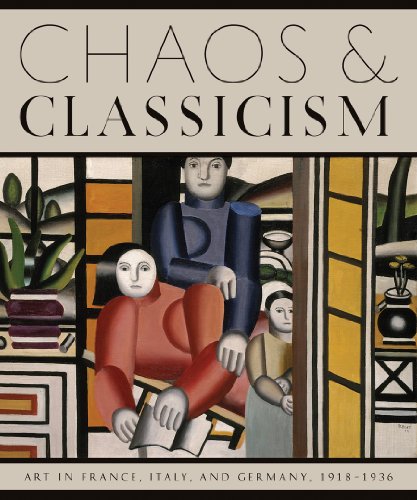
Chaos and Classicism: Art in France, Italy, and Germany, 1918-1936
Authors:
Emily Braun
Publisher:
Guggenheim Museum
Publication Date:
Not available
ISBN:
0892074051
Now available in paperback, Chaos and Classicism explores the classicizing aesthetic that followed the immense destruction of World War I: the poetic... dream of antiquity in the Parisian avant garde of Fernand Léger and Pablo Picasso; the politicized revival of the Roman Empire under Benito Mussolini by artists such as Giorgio de Chirico and Mario Sironi; and the austere functionalist utopianism of the Bauhaus, as well as, more chillingly, the pseudo-biological classicism, or Aryanism, of nascent Nazi society. Among the other artists surveyed here are Ludwig Mies van der Rohe, André Derain, Gino Severini, Jean Cocteau, Le Corbusier, Amédée Ozenfant, Madeleine Vionnet, Émile-Jacques Ruhlmann, Carlo Carrà, Giorgio Morandi, Massimo Campigli, Achille Funi, Ubaldo Oppi, Gio Ponti, Arturo Martini, Georg Kolbe, Oskar Schlemmer, Otto Dix, Georg Scholz, Georg Schrimpf, Wilhelm Schnarrenberger and August Sander.

Chaos and Fractals: New Frontiers of Science
Authors:
Heinz-Otto Peitgen
Publisher:
Springer
Publication Date:
Not available
ISBN:
0387979034
For almost 15 years chaos and fractals have been riding a wave that has enveloped many areas of mathematics and the natural sciences in its power,... creativity and expanse. Traveling far beyond the traditional bounds of mathematics and science to the distant shores of popular culture, this wave captures the attention and enthusiasm of a worldwide audience. The fourteen chapters of this book cover the central ideas and concepts of chaos and fractals as well as many related topics including: the Mandelbrot Set, Julia Sets, Cellulair Automata, L- systems, Percolation and Strange Attractors. Each chapter is closed by a "Program of the Chapter" which provides computer code for a central experiment. Two appendices complement the book. The first, by Yuval Fisher, discusses the details and ideas of fractal images and compression; the second, by Carl J.G. Evertsz and Benoit Mandelbrot, introduces the foundations and implications of multifractals.

Chaos and Organization in Health Care
Authors:
Thomas H. Lee
Publisher:
The MIT Press
Publication Date:
Not available
ISBN:
0262013533
One of the most daunting challenges facing the new U.S. administration is health care reform. The size of the system, the number of stakeholders, and... ever-rising costs make the problem seem almost intractable. But in Chaos and Organization in Health Care, two leading physicians offer an optimistic prognosis. In their frontline work as providers, Thomas Lee and James Mongan see the inefficiency, the missed opportunities, and the occasional harm that can result from the current system. The root cause of these problems, they argue, is chaos in the delivery of care. If the problem is chaos, the solution is organization, and in this timely and outspoken book, they offer a plan.In many ways, this chaos is caused by something good: the dramatic progress in medical science--the explosion of medical knowledge and the exponential increase in treatment options. Imposed on a fragmented system of small practices and individual patients with multiple providers, progress results in chaos. Lee and Mongan argue that attacking this chaos is even more important than whether health care is managed by government or controlled by market forces. Some providers are already tightly organized, adapting management principles from business and offering care that is by many measures safer, better, and less costly. Lee and Mongan propose multiple strategies that can be adopted nationwide, including electronic medical records and information systems for sharing knowledge; team-based care, with doctors and other providers working together; and disease management programs to coordinate care for the sickest patients.

Chaos Des Sens (Le) (Collections Litterature) (French Edition)
Authors:
Ahlam Mosteghanemi
Publisher:
Albin Michel
Publication Date:
Not available
ISBN:
2226168176

Chaos in Dynamical Systems
Authors:
Edward Ott
Publisher:
Cambridge University Press
Publication Date:
Not available
ISBN:
0521010845
In the new edition of this classic textbook Ed Ott has added much new material and has significantly increased the number of homework problems. The most... important change is the addition of a completely new chapter on control and synchronization of chaos. Other changes include new material on riddled basins of attraction, phase locking of globally coupled oscillators, fractal aspects of fluid advection by Lagrangian chaotic flows, magnetic dynamos, and strange nonchaotic attractors.

Chaos is the New Calm (American Poets Continuum)
Authors:
Wyn Cooper
Publisher:
BOA Editions Ltd.
Publication Date:
Not available
ISBN:
1934414344
Chaos is the New Calm expands the parameters of the sonnet form, putting rhymes in unusual places, inventing new stanza structures, and addressing a... variety of subject matter ranging from travelogue to inner monologue, from social commentary to solitary musing. These poems are alive with sound, rhythm, and lyric insights into the world.Wyn Cooper’s poem Fun” was adapted by Sheryl Crow for her hit song All I Wanna Do.” He collaborates on music and spoken word with novelist Madison Smartt Bell. Cooper is co-organizer of the Brattleboro Literary Festival. He consults for the Poetry Foundation’s Harriet Monroe Poetry Institute.From Verse Wisconsin Online:These poems move along at an energetic pace often progressing by plays on words and a kind of free association logic or, to put it another way, a sort of six-degrees-of-separation” type of logic between both people and things.”
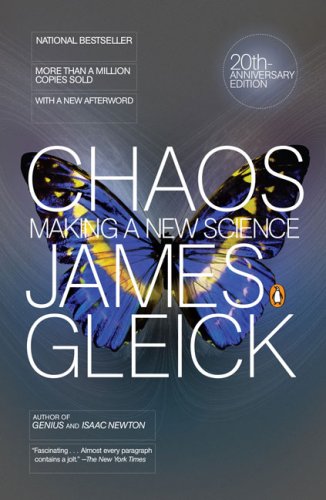
Chaos: Making a New Science
Authors:
James Gleick
Publisher:
Penguin Books
Publication Date:
Not available
ISBN:
0143113453
The million-copy bestseller by National Book Award nominee and Pulitzer Prize finalist James Gleick that reveals the science behind chaos theoryNational... bestsellerMore than a million copies soldA work of popular science in the tradition of Stephen Hawking and Carl Sagan, this 20th-anniversary edition of James Gleick’s groundbreaking bestseller Chaos introduces a whole new readership to chaos theory, one of the most significant waves of scientific knowledge in our time. From Edward Lorenz’s discovery of the Butterfly Effect, to Mitchell Feigenbaum’s calculation of a universal constant, to Benoit Mandelbrot’s concept of fractals, which created a new geometry of nature, Gleick’s engaging narrative focuses on the key figures whose genius converged to chart an innovative direction for science. In Chaos,Gleick makes the story of chaos theory not only fascinating but also accessible to beginners, and opens our eyes to a surprising new view of the universe.

Chaosophy: Texts and Interviews 1972--1977 (Semiotext(e) / Foreign...
Authors:
Félix Guattari
Publisher:
Semiotext(e)
Publication Date:
Not available
ISBN:
1584350601
Chaosophy is an introduction to Félix Guattari's groundbreaking theories of "schizo-analysis": a process meant to replace Freudian interpretation with... a more pragmatic, experimental, and collective approach rooted in reality. Unlike Freud, who utilized neuroses as his working model, Guattari adopted the model of schizophrenia--which he believed to be an extreme mental state induced by the capitalist system itself, and one that enforces neurosis as a way of maintaining normality. Guattari's post-Marxist vision of capitalism provides a new definition not only of mental illness, but also of the micropolitical means for its subversion. Chaosophy includes such provocative pieces as "Everybody Wants to Be a Fascist," a group of texts on Guattari's collaborative work with Gilles Deleuze (including the appendix to Anti-Oedipus, not available in the English edition), and "How Martians Make Love," a roundtable discussion with Guattari, Lotringer, Catherine Clément, and Serge Leclaire from 1972 (still unpublished in French). This new, expanded edition features a new introduction by François Dosse (author of a new biography of Guattari and Gilles Deleuze) and a range of additional essays, including "Franco Basaglia: Guerrilla Psychiatrist," "The Transference," "Semiological Subjection, Semiotic Enslavement," "The Place of the Signifier in the Institution," and "Three Billion Perverts on the Stand."
Chaos, Territory, Art: Deleuze and the Framing of the Earth (The...
Authors:
Elizabeth Grosz
Publisher:
Columbia University Press
Publication Date:
Not available
ISBN:
0231145187
Instead of treating art as a unique creation that requires reason and refined taste to appreciate, Elizabeth Grosz argues that art-especially... architecture, music, and painting-is born from the disruptive forces of sexual selection. She approaches art as a form of erotic expression connecting sensory richness with primal desire, and in doing so, finds that the meaning of art comes from the intensities and sensations it inspires, not just its intention and aesthetic.By regarding our most cultured human accomplishments as the result of the excessive, nonfunctional forces of sexual attraction and seduction, Grosz encourages us to see art as a kind of bodily enhancement or mode of sensation enabling living bodies to experience and transform the universe. Art can be understood as a way for bodies to augment themselves and their capacity for perception and affection-a way to grow and evolve through sensation. Through this framework, which knits together the theories of Charles Darwin, Henri Bergson, Gilles Deleuze, Félix Guattari, and Jakob von Uexküll, we are able to grasp art's deep animal lineage. Grosz argues that art is not tied to the predictable and known but to new futures not contained in the present. Its animal affiliations ensure that art is intensely political and charged with the creation of new worlds and new forms of living. According to Grosz, art is the way in which life experiments with materiality, or nature, in order to bring about change.
Chaos Theory
Authors:
Robert P. Murphy
Publisher:
Ludwig von Mises Institute
Publication Date:
Not available
ISBN:
1933550651
Among the most advanced topics in the literature in the Austro-libertarian milieu is that which deals with the workings of the fully free society, that... is, the society with no state, or anarcho-capitalism. Robert Murphy deals with this head on, and makes the first full contribution to this literature in the new century. Working within a Rothbardian framework, he takes up the challenge of Hans Hoppe regarding the role of market insurance in property security to extend the analysis to the security of person. His applications are part empirical and part speculative, but unfailingly provocative, rigorous, and thoughtful. The title itself refers to the supposed chaos that results from eliminating the state but Murphy shows that out of chaos grows an ordered liberty. Anyone interested in exploring the farthest reaches of anarchist theory must come to terms with Murphy's account. This volume contains:Foreword Introduction (Jeremy Sapienza)

Chaos Under Control: The Art and Science of Complexity
Authors:
David Peak
Publisher:
W H Freeman
Publication Date:
Not available
ISBN:
0716724294
Chaos Under Control introduces the rich concepts driving the new science of complexity. Here you will discover the principles behind some of the most... talked-about research findings of our time and see some astonishing examples and applications. And with the book's supplementary software, you can turn a Macintosh computer into a window of discovery, to watch fractal and chaotic phenomena come to life. "...outstanding book ...Their wide-ranging discussion of complexity is a mixture of fascinating description, unexpected examples, fancy graphics and equations." Times Higher

Chaos, Violence, Dynasty: Politics and Islam in Central Asia...
Authors:
Eric McGlinchey
Publisher:
University of Pittsburgh Press
Publication Date:
Not available
ISBN:
0822961687
In the post-Soviet era, democracy has made little progress in Central Asia. In Chaos, Violence, Dynasty, Eric McGlinchey presents a compelling... comparative study of the divergent political courses taken by Kyrgyzstan, Uzbekistan, and Kazakhstan in the wake of Soviet rule. McGlinchey examines economics, religion, political legacies, foreign investment, and the ethnicity of these countries to evaluate the relative success of political structures in each nation. McGlinchey explains the impact of Soviet policy on the region, from Lenin to Gorbachev. Ruling from a distance, a minimally invasive system of patronage proved the most successful over time, but planted the seeds for current “neo-patrimonial” governments. The level of direct Soviet involvement during perestroika was the major determinant in the stability of ensuing governments. Soviet manipulations of the politics of Uzbekistan and Kazakhstan in the late 1980s solidified the role of elites, while in Kyrgyzstan the Soviets looked away as leadership crumbled during the ethnic riots of 1990. Today, Kyrgyzstan is the poorest and most politically unstable country in the region, thanks to a small, corrupt, and fractured political elite. In Uzbekistan, Islam Karimov maintains power through the brutal suppression of disaffected Muslims, who are nevertheless rising in numbers and influence. In Kazakhstan, a political machine fueled by oil wealth and patronage underlies the greatest economic equity in the region, and far less political violence. McGlinchey’s timely study calls for a more realistic and flexible view of the successful aspects of authoritarian systems in the region that will be needed if there is to be any potential benefit from foreign engagement with the nations of Central Asia, and similar political systems globally.
Chaotic Dynamics: An Introduction
Authors:
Gregory L. Baker
Publisher:
Cambridge University Press
Publication Date:
Not available
ISBN:
0521476852
The previous edition of this text was the first to provide a quantitative introduction to chaos and nonlinear dynamics at the undergraduate level. It... was widely praised for the clarity of writing and for the unique and effective way in which the authors presented the basic ideas. These same qualities characterize this revised and expanded second edition. Interest in chaotic dynamics has grown explosively in recent years. Applications to practically every scientific field have had a far-reaching impact. As in the first edition, the authors present all the main features of chaotic dynamics using the damped, driven pendulum as the primary model. This second edition includes additional material on the analysis and characterization of chaotic data, and applications of chaos. This new edition of Chaotic Dynamics can be used as a text for courses on chaos for physics and engineering students at the second- and third-year level.

Chaotic Elections! A Mathematician Looks at Voting
Authors:
Donald G. Saari
Publisher:
American Mathematical Society
Publication Date:
Not available
ISBN:
0821828479
What does the 2000 U.S. presidential election have in common with selecting a textbook for a calculus course in your department? Was Ralph Nader's... influence on the election of George W. Bush greater than the now-famous chads? In Chaotic Elections!, Don Saari analyzes these questions, placing them in the larger context of voting systems in general. His analysis shows that the fundamental problems with the 2000 presidential election are not with the courts, recounts, or defective ballots, but are caused by the very way Americans vote for president. This expository book shows how mathematics can help to identify and characterize a disturbingly large number of paradoxical situations that result from the choice of a voting procedure. Moreover, rather than being able to dismiss them as anomalies, the likelihood of a dubious election result is surprisingly large. These consequences indicate that election outcomes--whether for president, the site of the next Olympics, the chair of a university department, or a prize winner--can differ from what the voters really wanted. They show that by using an inadequate voting procedure, we can, inadvertently, choose badly. To add to the difficulties, it turns out that the mathematical structures of voting admit several strategic opportunities, which are described. Finally, mathematics also helps identify positive results: By using mathematical symmetries, we can identify what the phrase "what the voters really want" might mean and obtain a unique voting method that satisfies these conditions. Saari's book should be required reading for anyone who wants to understand not only what happened in the presidential election of 2000, but also how we can avoid similar problems from appearing anytime any group is making a choice using a voting procedure. Reading this book requires little more than high school mathematics and an interest in how the apparently simple situation of voting can lead to surprising paradoxes.
 '
'