production
/viewbook/list/all/?page=2137
/
/static/
None
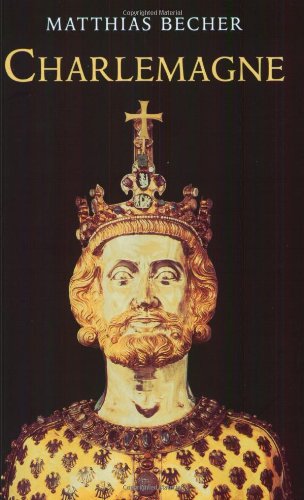
Charlemagne
Authors:
Matthias Becher
Publisher:
Yale University Press
Publication Date:
Not available
ISBN:
0300107587
Charlemagneruler of the vast Frankish kingdom from 768 to his death in 814 and Holy Roman emperor from the year 800is considered the father of... Europe. He founded the first empire in western Europe after the fall of Rome, and his court at Aix-la-Chapelle was a center of classical learning and a focus of the Carolingian Renaissance. This book is a splendid introduction to Charlemagne’s life and legend.Matthias Becher describes Charlemagne’s rise to emperor and traces his political and military maneuvering against the Saxons, the Lombards, and others, as Charlemagne incorporated these lands into his own realm. Becher points out that under Charlemagne, jury courts were introduced, the laws of the Franks revised and written down, new coinage introduced, weights and measures reformed, and a Frankish grammar begun. Charlemagne tried to give his kingdom a spiritual basis by referring to antique traditions, says Becher, and he explores the tensions that existed in Charlemagne’s court between modern ideas and traditional thinking. He concludes by discussing Charlemagne’s kinship network, the evolving arrangements for his succession, the effects of his reign, and his posthumous fame.Concise, insightful, and eminently readable, this biography of Charlemagne provides a wealth of information about a remarkable man and his times.
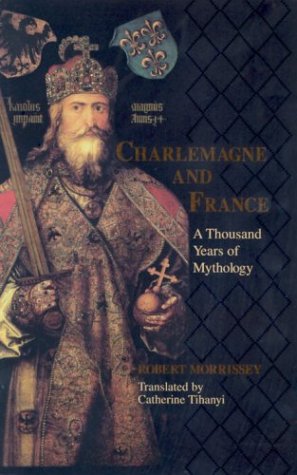
Charlemagne and France: A Thousand Years of Mythology (The Laura...
Authors:
Robert Morrissey
Publisher:
Univ of Notre Dame Pr
Publication Date:
Not available
ISBN:
0268022771
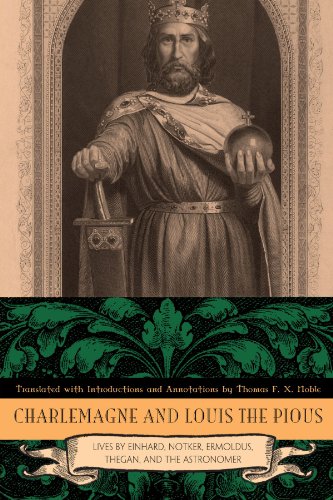
Charlemagne and Louis the Pious: Lives by Einhard, Notker,...
Authors:
Not Available
Publisher:
The Pennsylvania State University Press
Publication Date:
Not available
ISBN:
0271037156
Carolingian historical texts have long stood at the base of our modern knowledge about the eighth and ninth centuries. The ninth century gave birth to a... new revival of secular biography, which has come to be recognized as one of the brightest bands in the spectrum of Carolingian historical writing. This collection brings together, for the first time in one volume, the five royal/imperial biographies written during the Carolingian period. Thomas F. X. Noble's new English translations of these five important texts-Einhard's Life of Emperor Charles, Notker's Deeds of Charles the Great, Ermoldus Nigellus's Poem in Honor of Louis, Thegan's Deeds of Emperor Louis, and the Life of Louis by "the Astronomer" -are each accompanied by a short introduction and a note on "Essential Reading" Offering details on matters of style, sources used by the author, and the influence, if any, exerted by the text, Noble provides a context for each translation, without compromising the author's intended voice. By "reuniting" these five essential medieval texts in an English translation, this volume makes these voices accessible to scholars and non-experts alike throughout the Anglophone world.
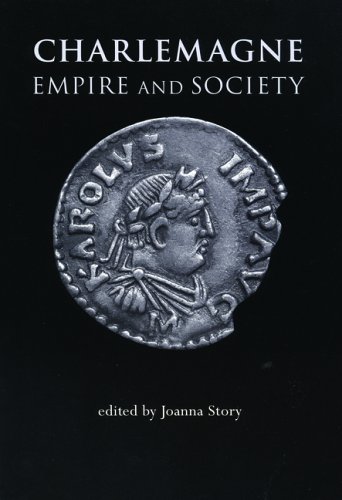
Charlemagne: Empire and Society
Authors:
Not Available
Publisher:
Manchester University Press
Publication Date:
Not available
ISBN:
0719070899
This book focuses directly on the reign of Charlemagne, bringing together a wide range of perspectives and sources with contributions from fifteen of... the top scholars of early medieval Europe. The contributors have taken a number of original approaches to the subject, from the fields of archaeology and numismatics to thoroughly-researched essays on key historical texts. The essays are embedded in the scholarship of recent decades but also offer insights into new areas and new approaches for research. A full bibliography of works in English as well as key reading in European languages is provided, making the volume essential reading for experienced scholars as well as students new to the history of the early middle ages.
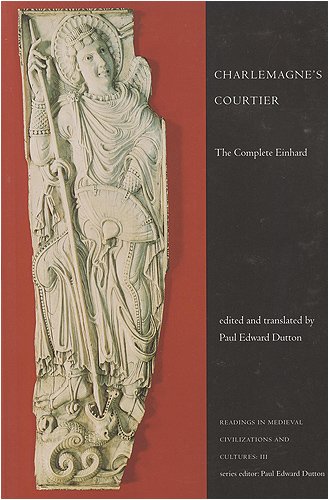
Charlemagne's Courtier: The Complete Einhard
Authors:
Not Available
Publisher:
University of Toronto Press, Higher Education Division
Publication Date:
Not available
ISBN:
1442601124
Among the readings included are several existing letters by Emma (Einhard's wife), The Life of Charlemagne, and The History of His Relics. The latter... work transports us into an almost unknown world as Einhard, the cool rationalist, arranges for a relic salesman, a veritable bone seller, to acquire saints? relics from Italy for installation into his new church. The reader is taken on an intrigue-filled trip to Rome, where Einhard's men creep into churches at night to steal bones and then spirit them away to Einhard in the north. The relics are received in town after town as if they were the living saints come to cure the infirm. Einhard's descriptions of the sick, the lame, and the blind of northern Europe vividly expose us to a side of medieval life too rarely encountered in other medieval sources.
Charlemagne's Courtier: The Complete Einhard (Readings in Medieval...
Authors:
Not Available
Publisher:
University of Toronto Press, Higher Education Division
Publication Date:
Not available
ISBN:
1551111349
Among the readings included are several existing letters by Emma (Einhard's wife), The Life of Charlemagne, and The History of His Relics. The latter... work transports us into an almost unknown world as Einhard, the cool rationalist, arranges for a relic salesman, a veritable bone seller, to acquire saints? relics from Italy for installation into his new church. The reader is taken on an intrigue-filled trip to Rome, where Einhard's men creep into churches at night to steal bones and then spirit them away to Einhard in the north. The relics are received in town after town as if they were the living saints come to cure the infirm. Einhard's descriptions of the sick, the lame, and the blind of northern Europe vividly expose us to a side of medieval life too rarely encountered in other medieval sources.
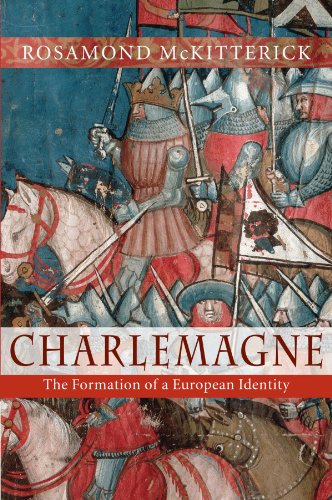
Charlemagne: The Formation of a European Identity
Authors:
Rosamond McKitterick
Publisher:
Cambridge University Press
Publication Date:
Not available
ISBN:
0521716454
Charlemagne is often claimed as the greatest ruler in Europe before Napoleon. This magisterial 2008 study re-examines Charlemagne the ruler and his... reputation. It analyses the narrative representations of Charlemagne produced after his death, and thereafter focuses on the evidence from Charlemagne's lifetime concerning the creation of the Carolingian dynasty and the growth of the kingdom, the court and the royal household, communications and identities in the Frankish realm in the context of government, and Charlemagne's religious and cultural strategies. The book offers a critical examination of the contemporary sources and in so doing transforms our understanding of the development of the Carolingian empire, the formation of Carolingian political identity, and the astonishing changes effected throughout Charlemagne's forty-six year period of rule. This is a major contribution to Carolingian history which will be essential reading for anyone interested in the medieval past. Rosamond McKitterick has also received the 2010 Dr A. H. Heineken Prize for History for her research into the Carolingians.
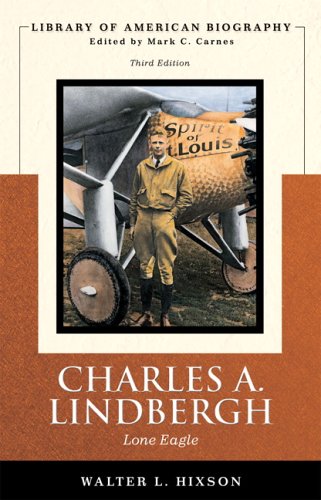
Charles A. Lindbergh: Lone Eagle (Library of American Biography...
Authors:
Walter L. Hixson
Publisher:
Pearson
Publication Date:
Not available
ISBN:
0321093232
In the 1920s America yearned for a hero. They had great baseball players and actors, but they longed for a seminal achievement — authentically heroic... in its defiance of the odds. The Lone Eagle delivered, and the public treated him like a hero from a fairy tale, with rewards of wealth, fame, and a princess in marriage. But domestic tragedy followed. And so, in this wonderful concise biography, Walter Hixson has shown how "Lucky Lindy" exemplifies the triumphs and tragedies of America's coming of age. The titles in the Library of American Biography Series make ideal supplements for American History Survey courses or other courses in American history where figures in history are explored. Paperback, brief, and inexpensive, each interpretative biography in this series focuses on a figure whose actions and ideas significantly influenced the course of American history and national life. At the same time, each biography relates the life of its subject to the broader themes and developments of the times.
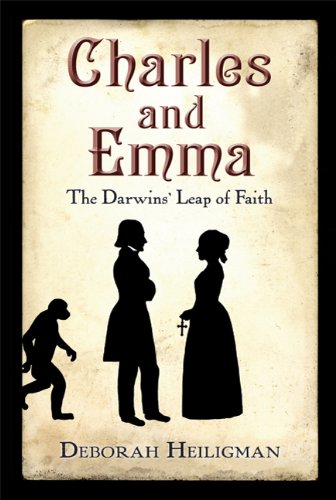
Charles and Emma: The Darwins' Leap of Faith
Authors:
Deborah Heiligman
Publisher:
Square Fish
Publication Date:
Not available
ISBN:
0312661045
Charles Darwin published The Origin of Species, his revolutionary tract on evolution and the fundamental ideas involved, in 1859. Nearly 150 years... later, the theory of evolution continues to create tension between the scientific and religious communities. Challenges about teaching the theory of evolution in schools occur annually all over the country. This same debate raged within Darwin himself, and played an important part in his marriage: his wife, Emma, was quite religious, and her faith gave Charles a lot to think about as he worked on a theory that continues to spark intense debates. Deborah Heiligman's new biography of Charles Darwin is a thought-provoking account of the man behind evolutionary theory: how his personal life affected his work and vice versa. The end result is an engaging exploration of history, science, and religion for young readers. Charles and Emma is a 2009 National Book Award Finalist for Young People's Literature.
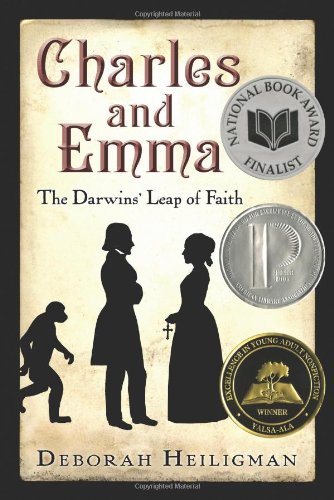
Charles and Emma: The Darwins' Leap of Faith
Authors:
Deborah Heiligman
Publisher:
Henry Holt and Co. (BYR)
Publication Date:
Not available
ISBN:
0805087214
Charles Darwin published The Origin of Species, his revolutionary tract on evolution and the fundamental ideas involved, in 1859. Nearly 150 years... later, the theory of evolution continues to create tension between the scientific and religious communities. Challenges about teaching the theory of evolution in schools occur annually all over the country. This same debate raged within Darwin himself, and played an important part in his marriage: his wife, Emma, was quite religious, and her faith gave Charles a lot to think about as he worked on a theory that continues to spark intense debates. Deborah Heiligman's new biography of Charles Darwin is a thought-provoking account of the man behind evolutionary theory: how his personal life affected his work and vice versa. The end result is an engaging exploration of history, science, and religion for young readers. Charles and Emma is a 2009 National Book Award Finalist for Young People's Literature.

Charles Babbage and The Countess
Authors:
Patricia Warrick
Publisher:
AuthorHouse
Publication Date:
Not available
ISBN:
1425983111
Charles Babbage was thirty years old in 1821, as was his close friend, John Herschel, and in English intellectual circles they were both regarded as... brilliant mathematicians. One day as Babbage worked in preparing logarithmic tables, a tedious and boring task, he commented to Herschel that he thought he could invent a machine to do these calculations with far more speed and accuracy than a human calculator could. And so was born an idea that would fascinate, tantalize, and absorb him for the remainder of his life. Over the years he drew plans, expanded them, modified them, and finally invented two machines, the Difference Engine and the Analytical Engine. The first was capable only of generating tables, but the Analytical Engine could do much more. It could convert into numbers and print the results of any formula that might be required. It could also develop any analytical formula the laws of whose formation were given. Using punched cards it could store early results in a calculation and then use them to make further calculations when they were required. He had invented the first mechanical computer.
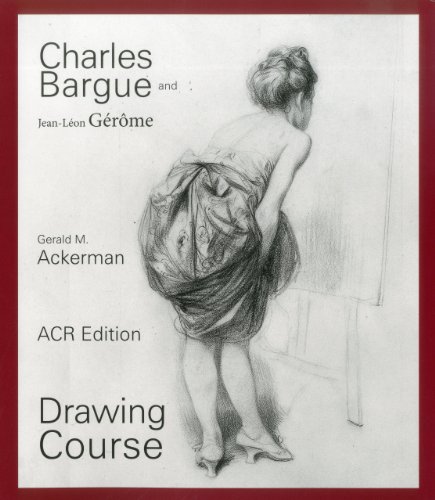
Charles Bargue and Jean-Léon GérÃ'me
Authors:
Gerald Ackerman
Publisher:
Art Creation Realisation
Publication Date:
Not available
ISBN:
2867702038
The Bargue-Gerome Drawing Course is a complete reprint of a famous, late nineteenth century drawing course. It contains a set of almost two hundred... masterful lithographs of subjects for copying by drawing students before they attempt drawing from life or nature. Consequently it is a book that will interest artists, art students, art historians, and lovers and collectors of drawings. It also introduces us to the work and life of a hitherto neglected master: Charles Bargue. The Drawing Course consists of three sections. The first consists of plates drawn after casts, usually of antique examples. Different parts of the body are studied in order of difficulty, until full figures are presented. The second section pays homage to the western school of painting with lithographs after exemplary drawings by Renaissance and modern masters. The third part contains almost sixty academies or drawings after nude male models, all original inventions by Bargue, the lithographer. With great care, the student is introduced to continually more difficult problems in the close observing and recording of nature. Practiced professional artists will see at once the problems of representation that are approached by Bargue, and they will delight in his solutions. Figure painters will copy the plates to keep in tune; so to speak, much as pianists practice the exercises of Czerny before performing Beethoven. Art students will find it a practical and progressive introduction to realistic figure drawing. Art historians can learn by studying these drawings just what was prized in late 19th century figure painting. They will recognize the reliance upon tradition by the use of antique sculptures as models in the first part: Antiquity is here used, not to impose a classical style, but as an aid in seeing the structure of the human body with clarity and intelligence. The result is a convergence of Classicism and Realism. There are no numerical proportional charts, perspective boxes or geometrical schemata to memorize. All the techniques and schemata are developed out of and for the object or person in view. The drawings are splendid; beautiful; not simply products of assiduity, but of careful observation and the wish to transcribe and communicate the beauty of nature and light, as well as the manifold appearances of the human body. These are objectives that will touch and move any careful reader of drawings, and the figurative arts. Charles Bargue started his career as a lithographer of drawings by hack artists for a popular market in comic, sentimental and soft-porn subjects. By working with Gerome, and in preparing the plates for the course, Bargue was transformed into a spectacular painter of single figures and intimate scenes; a master of precious details that always remain observation and never became self-conscious virtuosity, of color schemes that unified his composition in exquisite tonal harmonies. The last part of the book is a biography of Bargue, along with a preliminary catalogue of his paintings, accompanied by reproductions of all that have been found and of many of those lost.
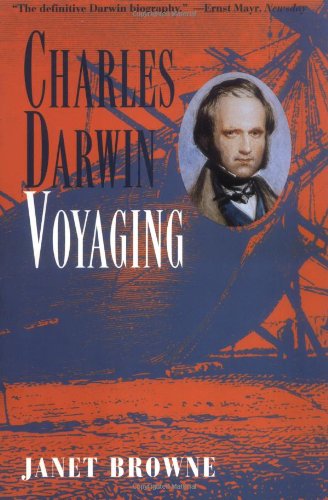
Charles Darwin: A Biography, Vol. 1 - Voyaging
Authors:
Janet Browne
Publisher:
Princeton University Press
Publication Date:
Not available
ISBN:
0691026068
Few lives of great men offer so much interest--and so many mysteries--as the life of Charles Darwin, the greatest figure of nineteenth-century science,... whose ideas are still inspiring discoveries and controversies more than a hundred years after his death. Yet only now, with the publication of Voyaging, the first of two volumes that will constitute the definitive biography, do we have a truly vivid and comprehensive picture of Darwin as man and as scientist. Drawing upon much new material, supported by an unmatched acquaintance with both the intellectual setting and the voluminous sources, Janet Browne has at last been able to unravel the central enigma of Darwin's career: how did this amiable young gentleman, born into a prosperous provincial English family, grow into a thinker capable of challenging the most basic principles of religion and science? The dramatic story of Voyaging takes us from agonizing personal challenges to the exhilaration of discovery; we see a young, inquisitive Darwin gradually mature, shaping, refining, and finally setting forth the ideas that would at last fall upon the world like a thunderclap in The Origin of Species.
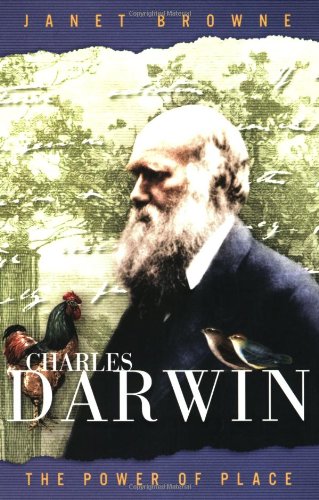
Charles Darwin: A Biography, Vol. 2 - The Power of Place
Authors:
Janet Browne
Publisher:
Princeton University Press
Publication Date:
Not available
ISBN:
0691114390
In 1858, Charles Darwin was forty-nine years old, a gentleman scientist living quietly at Down House in the Kent countryside. He was not yet a focus of... debate; his "big book on species" still lay on his desk as a manuscript. For more than twenty years he had been accumulating material for it, puzzling over the questions that it raised, trying to bring it to a satisfactory conclusion, and wanting to be certain that his startling theory of evolution was correct. It is at this point that the concluding volume of Janet Browne's magisterial biography opens. Beginning with the extraordinary events that finally forced the Origin of Species into print, we come to the years of fame and controversy. Here, Browne does dramatic justice to all aspects of the Darwinian revolution, from a fascinating examination of the Victorian publishing scene to a survey of the debates between scientists and churchmen over evolutionary theory. At the same time, she presents a wonderfully sympathetic and authoritative picture of Darwin himself.
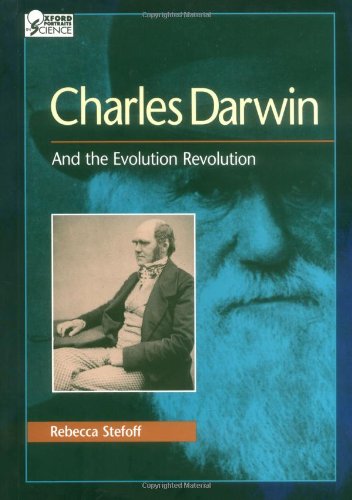
Charles Darwin: And the Evolution Revolution (Oxford Portraits in...
Authors:
Rebecca Stefoff
Publisher:
Oxford University Press, USA
Publication Date:
Not available
ISBN:
0195089960
On the Origin of Species, published in 1858, transformed our view of the world and made Charles Darwin one of the most controversial figures in science.... This biography begins much earlier with his long search for a profession, his five-year voyage around the world on the Beagle, and the decades-long intellectual journey he made in his study and garden. But it is for his theory about the origin of man and natural selection that he is remembered. His book threw the scientific community into a heated debate that continues today, and has made evolutionary biology one of the liveliest areas of science. This new biography looks at the person behind the controversy whose earth- shaking discoveries and ideas remain as exciting and interesting as today's headlines.Oxford Profiles in Science is an on-going series of scientific biographies for young adults. Written by top scholars and writers, each biography examines the personality of its subject as well as the thought process leading to his or her discoveries. These illustrated biographies combine accessible technical information with compelling personal stories to portray the scientists whose work has shaped our understanding of the natural world.
 '
'