production
/viewbook/list/all/?page=2203
/
/static/
None

CHEMISTRY+ST.SOL.MAN+WEBASSIGN +ALG PKG
Authors:
Not Available
Publisher:
Not available
Publication Date:
Not available
ISBN:
Not available
CHEMISTRY-STUDENT LAB NOTEBK.TOP PERF.
Authors:
Not Available
Publisher:
Not available
Publication Date:
Not available
ISBN:
Not available
Chemistry Student Solutions Guide for Zumdahl & Zumdahl"s...
Authors:
Thomas J. Hummel
Publisher:
Brooks/Cole Cengage Learning
Publication Date:
Not available
ISBN:
054716856X
Chemistry, Student Solutions Manual
Authors:
John A. Olmsted
Publisher:
Wiley
Publication Date:
Not available
ISBN:
0470680989
Chemistry 1ce by Olmsted, Williams, Burk is a newly adapted general chemistry text designed for the specific needs and requirements of Canadian... professors and students for use in one or two semester introductory chemistry courses. This adaptation was based on recommendations from an advisory board of instructors from leading institutions across Canada who worked with our Canadian author throughout the development of this text to reach a consensus on topics that best suit Canadian curriculum. This text also incorporates key Canadian content in the form of SI units, IUPAC standards and significant Canadian research which more accurately reflects the discipline of Canadian chemistry than other textbooks currently on the market. Chemistry instructors will find this text sufficiently rigorous while it engages and retains student interest with accessible language, Canadian research and examples and a clear problem solving program. In order to more directly reflect the varied curriculum of Canadian chemistry courses we have uniquely created flexible options which allow instructors to decide whether they want to include or exclude early chemistry chapters for the purposes of review. This Canadian edition retains Olmsted & Williams' innovative approach to teaching chemistry by reinforcing key concepts through molecular-level discussion and graphics. This approach encourages students to move beyond memorization of formulas and equations, to thinking critically about what is really occurring and solving problems based on what they know about the behaviour of molecules and chemical processes. John Olmsted III is Professor Emeritus of Chemistry at California State University, Fullerton, from which he retired in 2003 after nearly 40 years of teaching and research in general and experimental physical chemistry. John was honored as the CSUF Outstanding Professor in 1997-98 and served as department chair from 1998 to 2001. In addition to 25 years at CSUF, he taught for 12 years at the American University of Beirut. He had visiting teaching/research appointments at UCLA and the University of North Carolina at Chapel Hill and did research at the Max-Planck-Institut f?r Biophysikalische Chemie (G?ttingen, Germany), and the University of California at San Diego, and Sandia National Laboratory in Albuquerque, NM. John received his BS degree in chemistry from Carnegie Institute of Technology (now Carnegie-Mellon University) and his PhD in physical chemistry from UC Berkeley, where he also did postdoctoral work at the Lawrence Berkeley Laboratory. He has more than 30 refereed research publications and has also published regularly on chemical education topics in the Journal of Chemical Education. In his retirement, besides continuing to write chemistry textbooks, John keeps busy with his interests in gardening, photography, and the philosophy of chemistry. He and his wife Eileen enjoy traveling, dancing, and visiting with their three married children and two grandchildren. Greg Williams is an Adjunct Professor of Chemistry at the University of Oregon. He earned an undergraduate degree in chemistry at UCLA and a PhD in organic in inorganic chemistry at Princeton University. He had taught and conducted research at the University of Oregon, California State University, Fullerton, UCLA, and the University of California, Irvine. Outside the classroom, Greg?s professional work is concentrated on developing graphics, digital animation, and interactive multimedia for teaching chemistry. When he is not teaching or writing about chemistry, Greg can be found somewhere in the western United States backpacking, climbing, skiing, fly fishing, or kayaking. He also sings low bass with the Eugene Vocal Arts Ensemble. Greg lives in Eugene, Oregon, with his wife Trudy Cameron, a Professor of Economics at the University of Oregon, and their daughters, Casey and Perry. He absolutely insists on enjoying life. Robert C. (Bob) Burk, our Canadian author, is an Associate Professor of Chemistry at Carleton University in Ottawa. He received his B.Sc. and M.Sc. degrees from Carleton. Both involved work in the area of radioanalytical chemistry. Bob worked for six years in the nuclear industry, doing research on the production of nuclear fuels, then returned to Carleton University to do a Ph.D. in the area of supercritical fluid extraction. He has been a member of the Carleton Chemistry faculty since 1993. His research involves the use of supercritical fluids for separation purposes, as well as development of analytical methods for organics in water using novel solid phase materials such as carbon nanotubes. Bob is especially interested in the use of technology for teaching chemistry. His lectures are recorded and available for viewing on i-Tunes, and parts of them appear on Youtube. After-hours, Bob uses instant messaging systems, and more recently social networking tools, to communicate with students while they are studying. He was a winner of the 2004 OCUFA teaching award, and a 3M teaching fellowship in 2006. When not at work, Bob loves to sail in the summer, cross-country ski in the winter with his wife Ewa and two children, Ashley and Adam, and renovate houses and build period furniture all year round.
Chemistry, Student Solutions Manual: Structure and Dynamics
Authors:
James N. Spencer
Publisher:
Wiley
Publication Date:
Not available
ISBN:
0470587121
The Spencer text is the only text that is built on independently researched pedagogy on the best way to teach General Chemistry. Chemistry: Structure... and Dynamics, 5th Edition emphasises deep understanding rather than comprehensive coverage along with a focus on the development of inquiry and reasoning skills. While most mainstream General Chemistry texts offer a breadth of content coverage, the Spencer author team, in contrast, focuses on depth and student preparation for future studies.The fifth edition is revised in keeping with our commitment to the chemical education community and specifically the POGIL (Process Oriented Guided Inquiry Learning) Project. This text reflects two core principles, first that the concepts that are covered are fundamental building blocks for understanding chemistry and second, that the concepts should be perceived by the students as being directly applicable to their interests and careers. The authors further provide this "core" coverage using 1 of 3 models; data-driven, chemical theories and students understanding, which allows for a more concrete foundation on which students build conceptual understanding.
Chemistry, Student Solutions Manual: The Molecular Nature of Matter
Authors:
Neil D. Jespersen
Publisher:
Wiley
Publication Date:
Not available
ISBN:
0470577738
Chemistry: The Study of Matter and Its Changes, Sixth Edition will provide the necessary practice, support and individualised instruction that ensures... success in the General Chemistry course. This text provides the forum for problem solving and concept mastery of chemical phenomena that leads to proficiency and success in the General Chemistry course. This edition will continue a "molecular basis of chemistry" tradition, but in a manner that overtly and repeatedly reinforces the way properties at the molecular level are related to properties we observe at the macroscopic level. The unique "chemical tools" approach employed in this book provides a way of thinking that helps those students develop the ability to analyse and solve both mathematical and conceptual problems. This text follows the successful three-step approach described as "ANALYSIS," "SOLUTION" and "IS THE ANSWER REASONABLE?" This encourages the student to think about the problem before attempting to solve it, then working through the solution, and finally asking the important question "Does the answer make sense?" There are problem sets called "Bringing It Together" that contain problems which require students to bring together concepts from two or more of the preceding chapters. This reinforces learned concepts and builds concept mastery.
Chemistry, Student Solutions Manual: The Study of Matter and Its...
Authors:
James E. Brady
Publisher:
Wiley
Publication Date:
Not available
ISBN:
0470184655
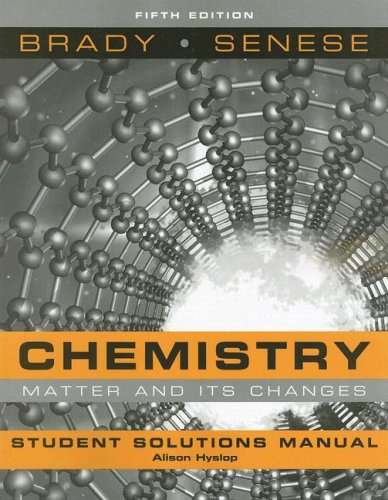
The image on the front cover depicts a carbon nanotube emerging from a glowing plasma of hydrogen and carbon, as it forms around particles of a metal... catalyst. Carbon nanotubes are a recently discovered allotrope of carbon. Three other allotropes of carbon-buckyballs, graphite, and diamond-are illustrated at the left, as is the molecule methane, CH4, from which nanotubes and buckyballs can be made. The element carbon forms an amazing number of compounds with structures that follow from simple methane, found in natural gas, to the complex macromolecules that serve as the basis of life on our planet. The study of chemistry also follows from the simple to the more complex, and the strength of this text is that it enables students with varied backgrounds to proceed together to significant levels of achievement.
Chemistry, Student Study Guide
Authors:
John A. Olmsted
Publisher:
Wiley
Publication Date:
Not available
ISBN:
0471698377
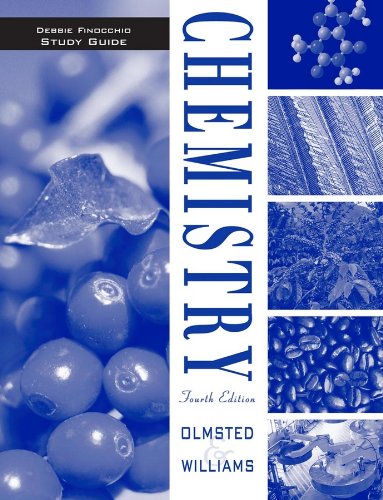
100% Pure Chemical UnderstandingEvery morning many of us are energized by a cup of coffee. Imagine if you were as energized by understanding the... chemistry in your morning cup--from the coffee trees, which fill red coffee berries with caffeine and a variety of other chemical substances, to the feathery crystals formed by the caffeine molecules, to the decaffeinating machines, which use liquid solvents to remove this stimulant from some of the beans. Now, that's real chemical understanding!Olmsted and Williams' Fourth Edition of Chemistry focuses on helping you see and think about the world (and even your coffee) as a chemist. This text helps you understand how chemical phenomena are governed by what happens at the molecular level, apply critical thinking skills to chemical concepts and problems, and master the basic mathematical techniques needed for quantitative reasoning. You'll see the world as chemists do, and learn to appreciate the chemical processes all around us.A Fourth Edition with a lot of new perks!* Revisions include a new, early energy chapter; revised coverage of bonding; expanded coverage of intermolecular forces; and increased coverage of multiple equilibria, including polyprotic acids.* New pedagogy strengthens students' critical thinking and problem-solving skills.* Visual Summaries at the end of each chapter use molecular and diagrammatic visual elements to summarize essential skills, concepts, equations, and terms.* eGrade Plus provides an integrated suite of teaching and learning resources, including a complete online version of the text, links between problems and relevant sections in the online text, practice quizzes, the Visual Tutor, Interactive LearningWare problems, and lab demos, as well as homework management and presentation features for instructors.
Chemistry, Student Study Guide: The Study of Matter and Its Changes
Authors:
James E. Brady
Publisher:
Wiley
Publication Date:
Not available
ISBN:
0470184647
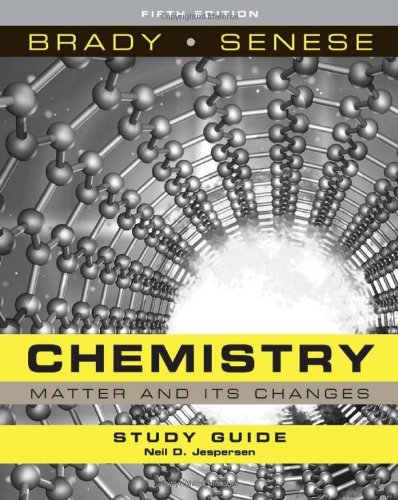
The image on the front cover depicts a carbon nanotube emerging from a glowing plasma of hydrogen and carbon, as it forms around particles of a metal... catalyst. Carbon nanotubes are a recently discovered allotrope of carbon. Three other allotropes of carbon-buckyballs, graphite, and diamond-are illustrated at the left, as is the molecule methane, CH4, from which nanotubes and buckyballs can be made. The element carbon forms an amazing number of compounds with structures that follow from simple methane, found in natural gas, to the complex macromolecules that serve as the basis of life on our planet. The study of chemistry also follows from the simple to the more complex, and the strength of this text is that it enables students with varied backgrounds to proceed together to significant levels of achievement.
CHEMISTRY STUDY AIDE SPARKCHART
Authors:
Not Available
Publisher:
Not available
Publication Date:
Not available
ISBN:
Not available
Chemistry + Study Guide
Authors:
Not Available
Publisher:
Not available
Publication Date:
Not available
ISBN:
0321783212
Chemistry, Study Guide: The Molecular Nature of Matter
Authors:
Neil D. Jespersen
Publisher:
Wiley
Publication Date:
Not available
ISBN:
047057772X
Chemistry: The Study of Matter and Its Changes, Sixth Edition will provide the necessary practice, support and individualised instruction that ensures... success in the General Chemistry course. This text provides the forum for problem solving and concept mastery of chemical phenomena that leads to proficiency and success in the General Chemistry course. This edition will continue a "molecular basis of chemistry" tradition, but in a manner that overtly and repeatedly reinforces the way properties at the molecular level are related to properties we observe at the macroscopic level. The unique "chemical tools" approach employed in this book provides a way of thinking that helps those students develop the ability to analyse and solve both mathematical and conceptual problems. This text follows the successful three-step approach described as "ANALYSIS," "SOLUTION" and "IS THE ANSWER REASONABLE?" This encourages the student to think about the problem before attempting to solve it, then working through the solution, and finally asking the important question "Does the answer make sense?" There are problem sets called "Bringing It Together" that contain problems which require students to bring together concepts from two or more of the preceding chapters. This reinforces learned concepts and builds concept mastery.
Chemistry Survival Manual
Authors:
COKER W LIN
Publisher:
Kendall Hunt Publishing
Publication Date:
Not available
ISBN:
0757577105
A supplement for courses in Child and Adolescent Development, Early Childhood Development, and Observation courses. This 3 volume CD set was created to... help students "see" the development of children with whom they work while guiding them through activities that help them develop a discerning "eye" for the developmental nuances of children's behavior. Topically organized, these CDs can be used to supplement any development text or course, or any educational psychology course where observation and development are a significant focus.
CHEMISTRY SWP WSU ]CUSTOM[
Authors:
Not Available
Publisher:
Not available
Publication Date:
Not available
ISBN:
Not available
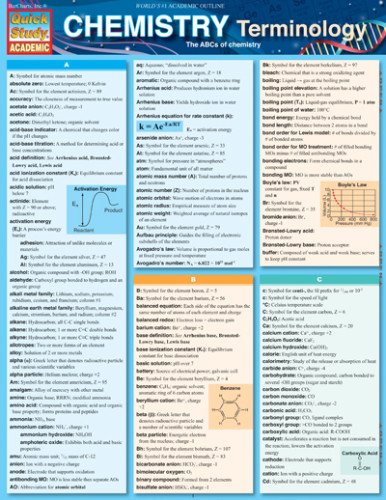
Chemistry Terminology (Quick Study: Academic)
Authors:
Inc. BarCharts
Publisher:
QuickStudy
Publication Date:
Not available
ISBN:
1423216377
Find out the definition of a chain reaction, what the symbol for helium is, the speed of light equation, and more chemistry-based terms with this... invaluable 3-panel (6-page) guide. All terms are up-to-date and listed in alphabetical order for easy reference; full-color images are also included that highlight specific information. No laboratory should be without one! Terms covered include: •Absolute Zero •Balanced Equation •Catalyst •Dalton’s Law •Enzyme •Fusion •…and more!
 '
'