production
/viewbook/list/all/?page=2341
/
/static/
None

Civility in the City: Blacks, Jews, and Koreans in Urban America
Authors:
Jennifer Lee
Publisher:
Harvard University Press
Publication Date:
Not available
ISBN:
0674018443
Hollywood and the news media have repeatedly depicted the inner-city retail store as a scene of racial conflict and acrimony. Civility in the City... uncovers a quite different story. Jennifer Lee examines the relationships between African American, Jewish, and Korean merchants and their black customers in New York and Philadelphia, and shows that, in fact, social order, routine, and civility are the norm. Lee illustrates how everyday civility is negotiated and maintained in countless daily interactions between merchants and customers. While merchant-customer relations are in no way uniform, most are civil because merchants actively work to manage tensions and smooth out incidents before they escalate into racially charged anger. Civility prevails because merchants make investments to maintain the day-to-day routine, recognizing that the failure to do so can have dramatic consequences. How then do minor clashes between merchants and customers occasionally erupt into the large-scale conflicts we see on television? Lee shows how inner-city poverty and extreme inequality, coupled with the visible presence of socially mobile newcomers, can provide fertile ground for such conflicts. The wonder is that they occur so rarely, a fact that the media ignore.

Civilizacion y cultura
Authors:
Lynn A. Sandstedt
Publisher:
Heinle
Publication Date:
Not available
ISBN:
1439084491
The readings in each unit of CIVILIZACIÓN Y CULTURA match the thematic content of the units of the main book, CONVERSACIÓN Y REPASO. There is thematic... and activity correlation of these supplementary books in marginal annotations on each unit-opening and unit-closing page. The exercises are designed to reinforce the development of reading, writing, and speaking skills, to build vocabulary, and to stimulate class discussion.

Civilizacion y cultura de España (5th Edition)
Authors:
Vicente M. Cantarino
Publisher:
Prentice Hall
Publication Date:
Not available
ISBN:
0131946382
A classic for over twenty-five years, Civilización y cultura de España provides a chronological approach to the civilization and continuously changing... culture of Spain by presenting its political, social, economic, and religious history. This new edition incorporates current information about the regional divisions of Spain and its modern-day political organization.

Civilizational Politics in World Affairs Trilogy: Civilizations in...
Authors:
Not Available
Publisher:
Routledge
Publication Date:
Not available
ISBN:
0415777119
A highly original and readily accessible examination of the cultural dimension of international politics, this book provides a sophisticated and nuanced... account of the relevance of cultural categories for the analysis of world politics. The book’s analytical focus is on plural and pluralist civilizations. Civilizations exist in the plural within one civilization of modernity; and they are internally pluralist rather than unitary. The existence of plural and pluralist civilizations is reflected in transcivilizational engagements, intercivilizational encounters and, only occasionally, in civilizational clashes. Drawing on the work of Eisenstadt, Collins and Elias, Katzenstein’s introduction provides a cogent and detailed alternative to Huntington’s. This perspective is then developed and explored through six outstanding case studies written by leading experts in their fields. Combining contemporary and historical perspectives while addressing the civilizational politics of America, Europe, China, Japan, India and Islam, the book draws these discussions together in Patrick Jackson’s theoretically informed, thematic conclusion. Featuring an exceptional line-up and representing a diversity of theoretical views within one integrative perspective, this work will be of interest to all scholars and students of international relations, sociology and political science.

Civilization and Capitalism, 15th-18th Century, Vol. I: The...
Authors:
Fernand Braudel
Publisher:
University of California Press
Publication Date:
Not available
ISBN:
0520081145
By examining in detail the material life of pre-industrial peoples around the world, Fernand Braudel significantly changed the way historians view their... subject. Volume I describes food and drink, dress and housing, demography and family structure, energy and technology, money and credit, and the growth of towns.

Civilization and Its Discontents
Authors:
Sigmund Freud
Publisher:
Hogarth Press and the Institute of Psycho-analysis
Publication Date:
Not available
ISBN:
0393096238
Civilization and Its Discontents, is one of the last of Freud's books, written in the decade before his death. In it he makes known his views on the... broad question of man's place in the world, which he sees in terms of the never-ending conflict of he claim of the individual for freedom and the demands of society. Writing of the book, The Spectator says: "The theme is a very simple one which has often been foreshadowed in Fredu's earlier work. Civilization is only made possible by individual renouncement. The instinctive life of man is one of aggression and egoistic self-satisfaction. The whole structure of culture has been designed to put prohibitions and curbs on him.... The sense of guilt has become the maker of civilized humanity.... The theme is developed with the greatest richness of content and one might use many columns without exhausting the invaluable dicta of men and their institutions which strew the book." Throughout the period when Freud wrote his major works, various translations and edition, differing widely in the accuracy of their texts and the quality of their content, made their appearance. Increasingly, as the body of Freud's work achieved commanding stature, the need arose for a definitive and uniformly authentic English language edition of all his writings. The Standard Edition of the Complete Psychological Works of Sigmund Freud was undertaken to achieve this goal. The work is under the general editorship of James Strachey and he himself has made new translations of many of his writings, supervising the emendation of others and contributing valuable notes, both bibliographical and explanatory.

Civilization and Its Discontents
Authors:
Sigmund Freud
Publisher:
Martino Fine Books
Publication Date:
Not available
ISBN:
1891396250
Reprint of the 1930 American edition. In this seminal book, Sigmund Freud enumerates the fundamental tensions between civilization and the individual.... The primary friction stems from the individual's quest for instinctual freedom and civilization's contrary demand for conformity and instinctual repression. Many of humankind's primitive instincts (for example, the desire to kill and the insatiable craving for sexual gratification) are clearly harmful to the well-being of a human community. As a result, civilization creates laws that prohibit killing, rape, and adultery, and it implements severe punishments if such commandments are broken. This process, argues Freud, is an inherent quality of civilization that instills perpetual feelings of discontent in its citizens.

Civilization and Its Discontents
Authors:
Sigmund Freud
Publisher:
W. W. Norton & Company
Publication Date:
Not available
ISBN:
0393059952
For the 75th anniversary, a new edition of the seminal work with an introduction by Pulitzer Prize-winning author Louis Menand.Civilization and Its... Discontents may be Sigmund Freud's best-known work. Originally published in 1930, it seeks to answer ultimate questions: What influences led to the creation of civilization? How did it come to be? What determines its course? In this seminal volume of twentieth-century thought, Freud elucidates the contest between aggression, indeed the death drive, and its adversary eros. He speaks to issues of human creativity and fulfillment, the place of beauty in culture, and the effects of repression. Louis Menand, author of the Pulitzer Prize-winning The Metaphysical Club, contributor to The New Yorker, and professor of English at Harvard University, reflects on the importance of this work in intellectual thought and why it has become such a landmark book for the history of ideas. Not available in hardcover for decades, this beautifully rendered anniversary edition will be a welcome addition to readers' shelves.
Civilization and Its Discontents
Authors:
Sigmund Freud
Publisher:
W. W. Norton & Company
Publication Date:
Not available
ISBN:
0393304515
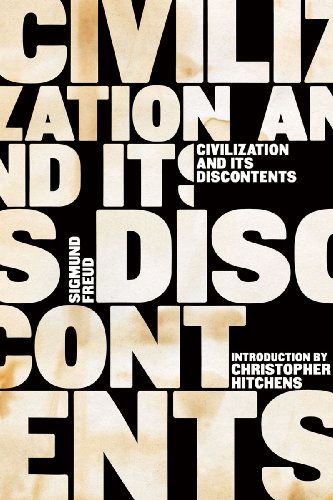
Freud’s seminal volume of twentieth-century cultural thought grounded in psychoanalytic theory, now with a new introduction by Christopher... Hitchens.Written in the decade before Freud’s death, Civilization and Its Discontents may be his most famous and most brilliant work. It has been praised, dissected, lambasted, interpreted, and reinterpreted. Originally published in 1930, it seeks to answer several questions fundamental to human society and its organization: What influences led to the creation of civilization? Why and how did it come to be? What determines civilization’s trajectory? Freud’s theories on the effect of the knowledge of death on human existence and the birth of art are central to his work. Of the various English translations of Freud’s major works to appear in his lifetime, only Norton’s Standard Edition, under the general editorship of James Strachey, was authorized by Freud himself. This new edition includes both an introduction by the renowned cultural critic and writer Christopher Hitchens as well as Peter Gay’s classic biographical note on Freud.

Civilization and Its Discontents
Authors:
sigmund freud
Publisher:
norton
Publication Date:
Not available
ISBN:
0393301583
During the summer of 1929, Freud worked on what became this seminal volume of twentieth-century thought.It stands as a brilliant summary of the views on... culture from a psychoanalytic perspective that he had been developing since the turn of the century. It is both witness and tribute to the late theory of mind—the so-called structural theory, with its stress on aggression, indeed the death drive, as the pitiless adversary of eros. Civilization and Its Discontents is one of the last of Freud's books, written in the decade before his death and first published in German in 1929. In it he states his views on the broad question of man's place in the world, a place Freud defines in terms of ceaseless conflict between the individual's quest for freedom and society's demand for conformity. Freud's theme is that what works for civilization doesn't necessarily work for man. Man, by nature aggressive and egotistical, seeks self-satisfaction. But culture inhibits his instinctual drives. The result is a pervasive and familiar guilt. Of the various English translations of Freud's major works to appear in his lifetime, only one was authorized by Freud himself: The Standard Edition of the Complete Psychological Works of Sigmund Freud under the general editorship of James Strachey. Freud approved the overall editorial plan, specific renderings of key words and phrases, and the addition of valuable notes, from bibliographical and explanatory. Many of the translations were done by Strachey himself; the rest were prepared under his supervision. The result was to place the Standard Edition in a position of unquestioned supremacy over all other existing versions.

Civilization and Its Discontents
Authors:
Sigmund Freud
Publisher:
CreateSpace Independent Publishing Platform
Publication Date:
Not available
ISBN:
1453833897
Reprint of the 1930 American edition. In this seminal book, Sigmund Freud enumerates the fundamental tensions between civilization and the individual.... The primary friction stems from the individual's quest for instinctual freedom and civilization's contrary demand for conformity and instinctual repression. Many of humankind's primitive instincts (for example, the desire to kill and the insatiable craving for sexual gratification) are clearly harmful to the well-being of a human community. As a result, civilization creates laws that prohibit killing, rape, and adultery, and it implements severe punishments if such commandments are broken. This process, argues Freud, is an inherent quality of civilization that instills perpetual feelings of discontent in its citizens. Contributors

Civilization and Its Discontents (Dover Thrift Editions)
Authors:
Sigmund Freud
Publisher:
Dover Pubns
Publication Date:
Not available
ISBN:
0486282538
Reprint of the 1930 American edition. In this seminal book, Sigmund Freud enumerates the fundamental tensions between civilization and the individual.... The primary friction stems from the individual's quest for instinctual freedom and civilization's contrary demand for conformity and instinctual repression. Many of humankind's primitive instincts (for example, the desire to kill and the insatiable craving for sexual gratification) are clearly harmful to the well-being of a human community. As a result, civilization creates laws that prohibit killing, rape, and adultery, and it implements severe punishments if such commandments are broken. This process, argues Freud, is an inherent quality of civilization that instills perpetual feelings of discontent in its citizens.

Civilization and Its Discontents (Penguin Modern Classics)
Authors:
Sigmund Freud
Publisher:
Penguin Books
Publication Date:
Not available
ISBN:
0141182369
In what remains one of his most seminal papers, Freud considers the incompatibility of civilisation and individual happiness, and the tensions between... the claims of society and the individual. We all know that living in civilised groups means sacrificing a degree of personal interest, but couldn't you argue that it in fact creates the conditions for our happiness? Freud explores the arguments and counter-arguments surrounding this proposition, focusing on what he perceives to be one of society's greatest dangers; 'civilised' sexual morality. After all, doesn't repression of sexuality deeply affect people and compromise their chances of happiness?

Civilization and Monsters: Spirits of Modernity in Meiji Japan...
Authors:
Gerald Figal
Publisher:
Duke University Press Books
Publication Date:
Not available
ISBN:
0822324180
Monsters, ghosts, the supernatural, the fantastic, the mysterious. These are not usually considered the “stuff” of modernism. More often they are... regarded as inconsequential to the study of the modern, or, at best, seen as representative of traditional beliefs that are overcome and left behind in the transformation toward modernity. In Civilization and Monsters Gerald Figal asserts that discourse on the fantastic was at the heart of the historical configuration of Japanese modernity—that the representation of the magical and mysterious played an integral part in the production of modernity beginning in Meiji Japan (1868–1912). After discussing the role of the fantastic in everyday Japan at the eve of the Meiji period, Figal draws new connections between folklorists, writers, educators, state ideologues, and policymakers, all of whom crossed paths in a contest over supernatural terrain. He shows the ways in which a determined Meiji state was engaged in a battle to suppress, denigrate, manipulate, or reincorporate folk belief as part of an effort toward the consolidation of a modern national culture. Modern medicine and education, functioning as a means for the state to exercise its power, redefined folk practices as a source of evil. Diverse local spirits were supplanted by a new Japanese Spirit, embodied by the newly constituted emperor, the supernatural source of the nation’s strength. The monsters of folklore were identified, catalogued, and characterized according to a new regime of modern reason. But whether engaged to support state power and forge a national citizenry or to critique the arbitrary nature of that power, the fantastic, as Figal maintains, is the constant condition of Japanese modernity in all its contradictions. Furthermore, he argues, modernity in general is born of fantasy in ways that have scarcely been recognized. Bringing unexplored and provocative new ideas to the Japan specialist, Civilization and Monsters will also appeal to readers concerned with issues of modernity in general.

Civilization And The Limpet
Authors:
Martin Wells
Publisher:
Basic Books
Publication Date:
Not available
ISBN:
073820174X
Written during a long sea voyage from England through the Mediterranean, Civilization and the Limpet unveils many fascinating phenomena of undersea... life. Wells captures with exquisite detail how limpets, like bees, navigate by the stars; how the brainless sea urchin makes a myriad of critical survival decisions every day; how deserted islands” teem with an incredible abundance of animal life; and why deep-diving whales never get the bends. Elegant and finely crafted, Civilization and the Limpet will enlighten, amuse, and awe anyone interested in the natural world.
 '
'