production
/viewbook/list/all/?page=2380
/
/static/
None
Classroom Instruction That Works: Research-Based Strategies for...
Authors:
Ceri B. Dean
Publisher:
Association for Supervision & Curriculum Development
Publication Date:
Not available
ISBN:
1416613625
In 2001, Classroom Instruction That Works inspired more than a million teachers to refine their approach to teaching by asking and answering these... questions: What works in education? How do we know? How can educational research find its way into the classroom? How can we apply it to help individual students?This all-new, completely revised second edition of that classic text pulls from years of research, practice, and results to reanalyze and reevaluate the nine instructional strategies that have the most positive effects on teaching and learning:* Setting objectives and providing feedback* Reinforcing effort and providing recognition* Cooperative learning* Cues, questions, and advance organizers* Nonlinguistic representations* Summarizing and note taking* Assigning homework and providing practice* Identifying similarities and differences* Generating and testing hypothesesA new framework organizes these strategies in preparation for instructional planning, and it highlights the point that all of the strategies are effective and should be used to complement one another. Each teaching strategy is supported with recommended classroom practices, examples of the strategy in use, tips for teaching, and information about using the strategy with today s learners.Whether you are coming to this book for the first time or are a veritable expert in the nine strategies, this second edition will help you develop your instructional approach, broaden your influence as a teacher, and enhance the learning potential of all your students. We haven t reinvented the wheel. We ve taken classroom instruction that works and made it thrive.
Classroom Instruction That Works: Research-Based Strategies for...
Authors:
Robert J. Marzano
Publisher:
Association for Supervision & Curriculum Deve
Publication Date:
Not available
ISBN:
0871205041
What works in education? How do we know? How can teachers find out? How can educational research find its way into the classroom? How can we apply it... to help our individual students? Questions like these arise in most schools, and busy educators often don't have time to find the answers. Robert J. Marzano, Debra J. Pickering, and Jane E. Pollock have examined decades of research findings to distill the results into nine broad teaching strategies that have positive effects on student learning: * Identifying similarities and differences. * Summarizing and note taking. * Reinforcing effort and providing recognition. * Homework and practice. * Nonlinguistic representations. * Cooperative learning. * Setting objectives and providing feedback. * Generating and testing hypotheses. * Questions, cues, and advance organizers. This list is not new. But what is surprising is finding out what a big difference it makes, for example, when students learn how to take good notes, work in groups, and use graphic organizers. The authors provide statistical effect sizes and show how these translate into percentile gains for students, for each strategy. And each chapter presents extended classroom examples of teachers and students in action; models of successful instruction; and many "frames," rubrics, organizers, and charts to help teachers plan and implement the strategies.
Classroom Instruction That Works with English Language Learners
Authors:
Jane Hill
Publisher:
Association for Supervision & Curriculum Deve
Publication Date:
Not available
ISBN:
1416603905
As more and more English language learners (ELLs) are included in mainstream classrooms, what can we do to ensure that they understand academic content... and develop their English language skills? To answer this question, authors Jane Hill and Kathleen Flynn have examined decades of research, interviewed mainstream teachers with ELLs in their classrooms, and reviewed the classroom recommendations from Marzano, Pickering, and Pollock’s seminal Classroom Instruction That Works (2001) through an ELL lens. The result is Classroom Instruction That Works with English Language Learners—a comprehensive guide to helping elementary school students at all levels of English language acquisition succeed.The strategies discussed in the book include homework and practice, summarization and note taking, and use of nonlinguistic representations, among many others. For each strategy, the authors provide a summary of the research, detailed examples of how to modify the strategy for use with ELLs in mainstream classrooms, and teacher accounts of implementation. Because ELLs face cultural hurdles as well as linguistic ones, this book also shows teachers how to glean insight into students’ backgrounds and address the cultural biases inherent in many classroom practices.Accommodating English language learners is one of the greatest challenges educators face today. Just as different levels of fluency require different approaches, so too do different backgrounds and languages. This practical, research-based book gives elementary school teachers the guidance they need to help ELLs of all nationalities thrive alongside their English-dominant peers.
Classroom Interviews: A World of Learning (Teacher to Teacher)
Authors:
Paula Rogovin
Publisher:
Heinemann
Publication Date:
Not available
ISBN:
0325000476
What students can learn from the interview is far beyond the reach of any textbook. Students who might previously have seen teachers and books as the... only valid sources of information will enlarge their perspectives, seeking the experiences of family members, neighbors, peers, and people from all walks of life. When children know their own history and culture, they develop self-esteem; when they understand the history and culture of others, prejudice can be reduced. As Paula Rogovin characterizes it, the interview is a way of saying "I want to learn from you. Let's stop our busy lives for a moment and rejoice in that learning." In this unique book, Rogovin shares proven techniques for tapping into this rich resource. She shows teachers how they can plan a curriculum based on the interview and develop their own schedules. Examples are offered showcasing how student interviews drive inquiry in social studies, writing, reading, science, math, and much more. And in case these ever expanding boundaries become too overwhelming, Rogovin suggests proven strategies to help students focus questions on topics of thematic study. Just as the themes for investigation grow, so does the students' confidence. Note taking becomes more detailed and specific, and students become more inventive, writing books that can be the focus of guided reading, creating poems, painting murals, acting in plays, or singing songs. The interview has far-reaching implications. It can provide a fertile medium for inquiry-based learning . . . the perfect research tool . . . a meaningful way to introduce multiculturalism . . . a springboard for family and community involvement. Although Rogovin describes strategies used in her elementary classroom, the methods can easily be adapted by middle school teachers.
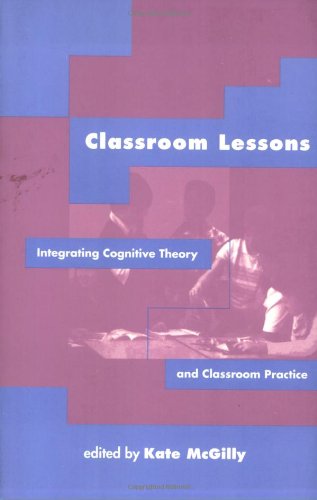
Classroom Lessons: Integrating Cognitive Theory and Classroom Practice
Authors:
Not Available
Publisher:
A Bradford Book
Publication Date:
Not available
ISBN:
0262631687
A timely complement to John Bruer's Schools for Thought, Classroom Lessons documents eight projects that apply cognitive research to improve classroom... practice. The chapter authors are all principal investigators in an influential research initiative on cognitive science and education. Classroom Lessons describes their collaborations with classroom teachers aimed at improving teaching and learning for students in grades K-12. The eight projects cover writing, mathematics, history, social science, and physics. Together they illustrate that principles emerging from cognitive science form the basis of a science of instruction that can be applied across the curriculum.The book is divided into three sections:- applications of cognitive research to teaching specific content areas;- applications for learning across the curriculum; and- applications that challenge traditional concepts of classroom-based learning environments.Chapters consider explicit models of knowledge with corresponding instruction designed to enable learners to build on that knowledge, acquisition of specified knowledge, and what knowledge is useful in contemporary curricula.Contributors : Kate McGilly. Sharon A. Griffin, Robbie Case, and Robert S. Siegler. Earl Hunt and Jim Minstrell. Kathryn T. Spoehr. Howard Gardner, Mara Krechevsky, Robert J. Sternberg, and Lynn Okagaki. Irene W. Gaskins. The Cognition and Technology Group at Vanderbilt. Marlene Scardamalia, Carl Bereiter, and Mary Lamon. Ann L. Brown and Joseph C. Campione. John T. Bruer.A Bradford Book
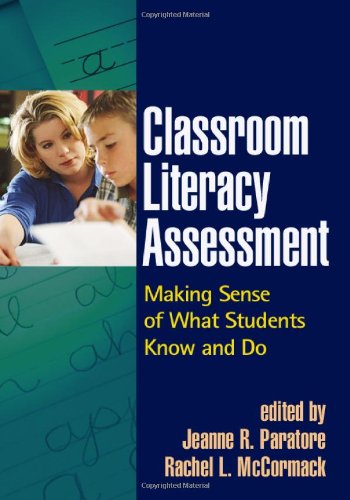
Classroom Literacy Assessment: Making Sense of What Students Know...
Authors:
Not Available
Publisher:
The Guilford Press
Publication Date:
Not available
ISBN:
1593854382
Showcasing assessment practices that can help teachers plan effective instruction, this book addresses the real-world complexities of teaching literacy... in grades K-8. Leading contributors present trustworthy approaches that examine learning processes as well as learning products, that yield information on how the learning environment can be improved, and that are conducted in the context of authentic reading and writing activities. The volume provides workable, nuts-and-bolts ideas for incorporating assessment into instruction in all major literacy domains and with diverse learners, including students in high-poverty schools and those with special learning needs. It is illustrated throughout with helpful concrete examples.

CLASSROOM MANAGEMENT
Authors:
Not Available
Publisher:
Not available
Publication Date:
Not available
ISBN:
Not available
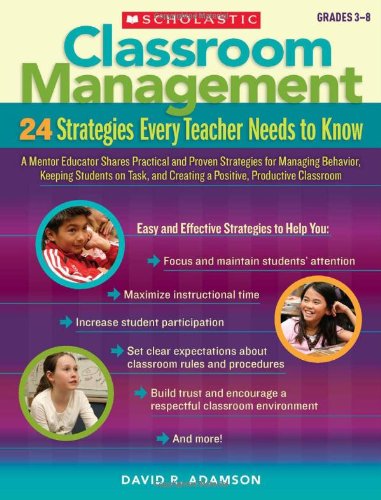
Classroom Management: 24 Strategies Every Teacher Needs to Know: A...
Authors:
Dave Adamson
Publisher:
Scholastic Teaching Resources (Teaching
Publication Date:
Not available
ISBN:
0545195691
A former classroom teacher, principal, and superintendent, David Adamson offers his most effective and easy-to-use strategies for organizing and... managing classrooms that support students’ learning and achievement. Written with both new and experienced teachers in mind, this classroom-tested approach helps teachers prevent behavior problems and effectively intervene when they do occur. Adamson shows teachers how to focus and maintain their students’ attention, maximize instructional time, increase student participation, set clear expectations for classroom rules and procedures, encourage a respectful learning environment, and more. For use with Grades 3–8.
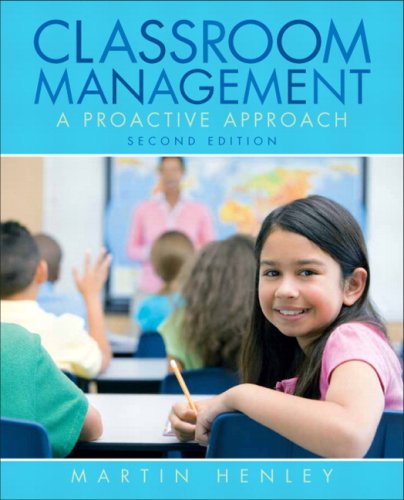
Classroom Management: A Proactive Approach (2nd Edition)
Authors:
Martin Henley
Publisher:
Pearson
Publication Date:
Not available
ISBN:
0135010632
Classroom Management: A Proactive Approach, Second Edition is written on the basis of three principles: community, prevention of discipline problems,... and positive support for students with behavior difficulties. Filled with practical strategies in managing classroom behavior based on theories of human behavior, the author merges the best practices of both general and special education in order to provide a practical and research-based guide to managing all students in the classroom–including those who are culturally diverse and those with special needs. Designed to meet the needs of both pre-service and veteran educators, both in general and special education, and pre-service and graduate students studying early childhood, elementary and special education, this practical and research-based guide to managing all students in the classroom is infused with the belief that successful classroom management is based on a love for children and a will to succeed, and guides its readers to a deeper understanding that good teaching trumps problems with learning every time.
Classroom Management: Creating
Authors:
Not Available
Publisher:
Not available
Publication Date:
Not available
ISBN:
0470566531

Classroom Management: Creating a Successful K-12 Learning Community
Authors:
Paul Burden
Publisher:
Wiley
Publication Date:
Not available
ISBN:
0470522798
This resource will not only help educators learn how to build positive classroom communities, but they’ll also find out how to involve students in the... creation of their learning environment. It helps them gain a practical understanding of what can be accomplished utilizing the technical aspects of classroom management. New practical examples are included to cover situations that are currently found in today’s classrooms. The pages have also been updated with the latest research in the field. In addition, information is presented on discipline. New tables also show educators how this book addresses professional standards from INTASC, Praxis II Principles of Teaching and Learning, Praxis III, and NBPTS.
Classroom Management: Creating Positive Outcomes for All Students
Authors:
Lisa A. Bloom
Publisher:
Pearson
Publication Date:
Not available
ISBN:
0130888389
A brand new, comprehensive text for the field that takes a proactive, child-centered approach, Classroom Management: Creating Positive Classrooms for... all Students walks teachers and pre-service teachers through a detailed, step-by-step plan that will enable them to develop their own personal and unique design for classroom management practices that they will enact in the classroom. Readers will be asked to examine their personal views and ambitions for classroom management, motivation and engagement; think about and develop their hopes and aspirations for the students that they will teach and the relationships and structures that they will build in order to attain their goals. Considering multiple perspectives, implementing and evaluating practices, the author provides the necessary needed to examine the full spectrum of classroom management practices including the student, family and cultural viewpoints, and understanding not only student needs but the teacher’s own perceptions in the context of the school and the community. Furthermore readers will appreciate the special attention that is given to these topics related to classroom management: professional collaboration with regard to school and classroom climate, inclusion, education of diverse learners, preparing learners for living in a democratic society, evidence-based practices, motivation and engagement, classroom management practices that enhance academic achievement, current research and practices, the role of social interaction in learning and behavior, examples of Action Research in the classroom, culturally-responsive classroom management, peer mediation and conflict resolution, real-life examples, excerpts from interviews of children and adolescents, and quotes from classroom teachers. An excellent textbook choice for all undergraduate- and graduate-level courses in Classroom Management, also suitable for courses in Educational Psychology.
Classroom Management for All Teachers: Plans for Evidence-Based...
Authors:
Ennio C. Cipani
Publisher:
Pearson
Publication Date:
Not available
ISBN:
0131991647
This book is based on the idea that a behavior management plan can be as effective in preventing problematic classroom behavior as it is in managing it... and utilizes an evidence-based approach to solving problems. It offers easy-to-implement, research-based plans for addressing problematic classroom behavior in two key areas: on-task time/assignment completion and disruption/rule violation. The author introduces a dozen behavior management plans in non-technical language. This eliminates the need for extensive training in behavior therapy or learning theory. FEATURES: An introductory chapter addressing “evidence-based” practice in education–Explaining the scientific nature of the book's plans and introducing the rationale behind the use of such practice. A chapter on the “beeper” system for enhancing student engagement. Introduces a recently developed device, the “MotivAider”–explains how it works, when it is best used, and what can be expected when it is used. A common format in each plan chapter (Chapters 2 -12)–Description, terms, apparatus, baseline measurement, procedures, “how it works,” additional considerations, hypothetical cases, “what if,” and forms. Facilitates comparison among plans–helps future teachers develop their intuitive sense for what works with which learners, and why. Discussion of a “dual plan” strategy for addressing disruptive behavior–Teaming a plan for stopping the disruptive behavior with one for encouraging desired behavior. Illustrates the advantage in tackling certain problem behaviors “on two fronts”–offers specific plans that work concurrently to change “bad” behavior into “good” behavior. A wide range of plans–For individual students, small groups, and entire classrooms. Expands the repertoire of both beginning and veteran teachers–provides a full complement of strategies to fit a wide range of situations and behaviors. Perforated pages--Enables teachers to tear out specific plans for implementation.
Classroom Management For Elementary Teachers
Authors:
Not Available
Publisher:
Not available
Publication Date:
Not available
ISBN:
013283667X

Classroom Management for Elementary Teachers (8th Edition)
Authors:
Carolyn M. Evertson
Publisher:
Pearson
Publication Date:
Not available
ISBN:
0205578624
This best-selling text helps teachers plan, implement, and develop the most basic classroom management tasks to build a smoothly running classroom that... encourages learning. Written for the prospective or new elementary-level teacher, the text's content is ready to be applied in a classroom setting. The text addresses the planning decisions teachers must make, including arranging the physical space; creating a positive climate; establishing expectations, rules, and procedures; planning and conducting instruction; encouraging appropriate behavior; addressing problem behavior; and using good communication skills, with particular attention paid to the growth of diverse and inclusive classrooms. All examples, checklists, case studies, and group activities are designed for the elementary level.
 '
'