production
/viewbook/list/all/?page=2498
/
/static/
None

COLLEGE COMPOSITION I
Authors:
Not Available
Publisher:
Not available
Publication Date:
Not available
ISBN:
Not available
COLLEGE CONNECTIONS
Authors:
Not Available
Publisher:
Not available
Publication Date:
Not available
ISBN:
Not available
College Counseling: Issues and Strategies for a New Millennium
Authors:
Deborah C. Davis
Publisher:
Amer Counseling Assn
Publication Date:
Not available
ISBN:
1556202202
9" by 6". 320 pages.
Edited by Deborah C. Davis and Keren M. Humphrey
Deborah C. Davis, EdD, is Professor Emeritus of Counseling at the University of... Alaska in Anchorage and is currently a Visiting Professor at Cumberland University in Lebanon, Tennessee. Keren M. Humphrey, is Professor of Counselor Education and Adjunct Professor at the University Counseling Center at Western Illinois University in Macomb, Illinois.

College Culture, Student Success (A Longman Topics Reader)
Authors:
Debra J. Anderson
Publisher:
Longman
Publication Date:
Not available
ISBN:
032143305X
College Culture, Student Success helps develop reading, writing and thinking skills as well as become familiar with the common customs, underlying... assumptions, and strategies for success associated with being a college student.
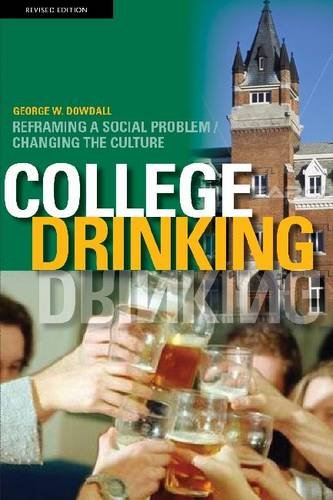
College Drinking: Reframing a Social Problem / Changing the Culture
Authors:
George W. Dowdall
Publisher:
Stylus Publishing
Publication Date:
Not available
ISBN:
1579228135
Drinking is recognized as one of the most important problems confronting students on campus today, with major impacts on health and safety.This book... answers crucial questions about why students drink, examines its complex links to campus crime and sexual assault, and offers new insights on how to address the issue.It differs from other studies of college drinking by dispelling the myth that the problem is universal. Dowdall’s research reveals that the incidence of alcohol abuse varies enormously between colleges, and in doing so identifies interventions and policies that have been effective, and those that have failed. His study is also unique in looking “upstream” at the broader cultural, organizational and social forces that shape this behavior, where most studies focus only on “downstream” behaviors, well after students have selected their college and have started drinking. Students and parents can take action to lower the risk of binge drinking by following the book’s recommendations, and consulting the data it provides about alcohol violations and crime at thousands of colleges. For administrators and student affairs personnel, it both defines and illuminates the issue, and outlines effective interventions.
College English and Communication with OLC Premium Content Card
Authors:
Sue Camp
Publisher:
McGraw-Hill Humanities/Social Sciences/Languages
Publication Date:
Not available
ISBN:
0073317934
College English and Communication, ninth edition continues to provide up-to-date coverage of key topics such as cultural diversity, ethics, global... communications, electronic communications, and using the Internet for communication and online resources. The text covers the basics of grammar, spelling, and punctuation while incorporating customer service, business correspondence, the job search process, oral communication, and technology.
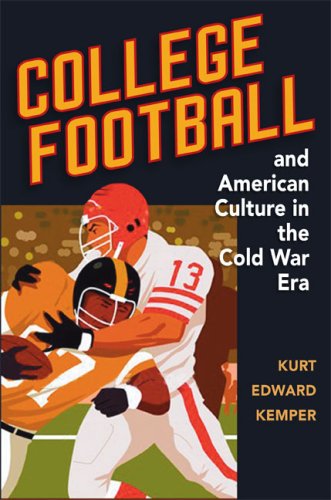
College Football and American Culture in the Cold War Era (Sport...
Authors:
Kurt Edward Kemper
Publisher:
University of Illinois Press
Publication Date:
Not available
ISBN:
025203466X
The Cold War era spawned a host of anxieties in American society, and in response, Americans sought cultural institutions that reinforced their... sense of national identity and held at bay their nagging insecurities. They saw football as a broad, though varied, embodiment of national values. College teams in particular were thought to exemplify the essence of America: strong men committed to hard work, teamwork, and overcoming pain. Toughness and defiance were primary virtues, and many found in the game an idealized American identity. In this book, Kurt Kemper charts the steadily increasing investment of American national ideals in the presentation and interpretation of college football, beginning with a survey of the college game during World War II. From the Army-Navy game immediately before Pearl Harbor, through the gradual expansion of bowl games and television coverage, to the public debates over racially integrated teams, college football became ever more a playing field for competing national ideals. Americans utilized football as a cultural mechanism to magnify American distinctiveness in the face of Soviet gains, and they positioned the game as a cultural force that embodied toughness, discipline, self-deprivation, and other values deemed crucial to confront the Soviet challenge. Americans applied the game in broad strokes to define an American way of life. They debated and interpreted issues such as segregation, free speech, and the role of the academy in the Cold War. College Football and American Culture in the Cold War Era offers a bold new contribution to our understanding of Americans' assumptions and uncertainties regarding the Cold War.
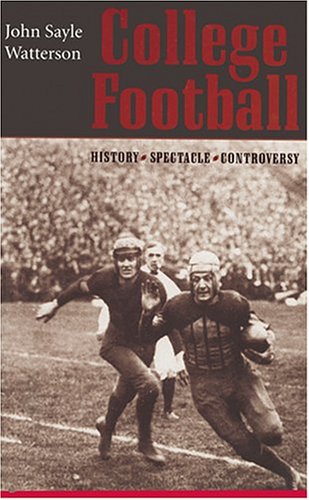
College Football: History, Spectacle, Controversy
Authors:
John Sayle Watterson
Publisher:
The Johns Hopkins University Press
Publication Date:
Not available
ISBN:
080187114X
"In March [1892] Stanford and California had played the first college football game on the Pacific Coast in San Francisco... The pregame activities... included a noisy parade down streets bedecked with school colors. Tickets sold so fast that the Stanford student manager, future president Herbert Hoover, and his California counterpart, could not keep count of the gold and silver coins. When they finally totaled up the proceeds, they found that the revenues amounted to $30,000—a fair haul for a game that had to be temporarily postponed because no one had thought to bring a ball!"—from College Football: History, Spectacle, Controversy, Chapter ThreeIn this comprehensive history of America's popular pastime, John Sayle Watterson shows how college football in more than one hundred years has evolved from a simple game played by college students into a lucrative, semiprofessional enterprise. With a historian's grasp of the context and a novelist's eye for the telling detail, Watterson presents a compelling portrait rich in anecdotes, colorful personalities, and troubling patterns.He tells how the infamous Yale-Princeton "fiasco" of 1881, in which Yale forced a 0-0 tie in a championship game by retaining possession of the ball for the entire game, eventually led to the first-down rule that would begin to transform Americanized rugby into American football. He describes the kicks and punches, gouged eyes, broken collarbones, and flagrant rule violations that nearly led to the sport's demise (including such excesses as a Yale player who wore a uniform soaked in blood from a slaughterhouse). And he explains the reforms of 1910, which gave official approval to a radical new tactic traditionalists were sure would doom the game as they knew it—the forward pass.As college football grew in the booming economy of the 1920s, Watterson explains, the flow of cash added fuel to an already explosive mix. Coaches like Knute Rockne became celebrities in their own right, with highly paid speaking engagements and product endorsements. At the same time, the emergence of the first professional teams led to inevitable scandals involving recruitment and subsidies for student-athletes. Revelations of illicit aid to athletes in the 1930s led to failed attempts at reform by the fledgling NCAA in the postwar "Sanity Code," intended to control abuses by permitting limited subsidies to college players but which actually paved the way for the "free ride" many players receive today.Watterson also explains how the growth of TV revenue led to college football programs' unprecedented prosperity, just as the rise of professional football seemed to relegate college teams to "minor league" status. He explores issues of gender and race, from the shocked reactions of spectators to the first female cheerleaders in the 1930s to their successful exploitation by Roone Arledge three decades later. He describes the role of African-American players, from the days when Southern schools demanded all-white teams (and Northern schools meekly complied); through the black armbands and protests of the 60s; to one of the game's few successful, if limited, reforms, as black athletes dominate the playing field while often being shortchanged in the classroom.Today, Watterson observes, colleges' insatiable hunger for revenues has led to an abuse-filled game nearly indistinguishable from the professional model of the NFL. After examining the standard solutions for reform, he offers proposals of his own, including greater involvement by faculty, trustees, and college presidents. Ultimately, however, Watterson concludes that the history of college football is one in which the rules of the game have changed, but those of human nature have not.
College Geometry: A Discovery Approach (2nd Edition)
Authors:
David Kay
Publisher:
Pearson
Publication Date:
Not available
ISBN:
0321046242
College Geometry is an approachable text, covering both Euclidean and Non-Euclidean geometry. This text is directed at the one semester course at... the college level, for both pure mathematics majors and prospective teachers. A primary focus is on student participation, which is promoted in two ways: (1) Each section of the book contains one or two units, called Moments for Discovery, that use drawing, computational, or reasoning experiments to guide students to an often surprising conclusion related to section concepts; and (2) More than 650 problems were carefully designed to maintain student interest.

College Geometry & Geometr Sketchpad4.01 Pk
Authors:
Not Available
Publisher:
Addison Wesley Publishing Company
Publication Date:
Not available
ISBN:
0321167937
This text emphasizes logic and the theory of sets. Students who take no further courses in the field will find it an excellent resource for developing... an appreciation for the nature of mathematics. Others will discover the foundations for future studies — set theory, logic, counting, numbers, functions, and more. 1968 edition. 43 figures. 25 tables.
College Geometry: A New Paradigm
Authors:
Subhash C. Saxena
Publisher:
Sheriar Press
Publication Date:
Not available
ISBN:
0615323804

College Geometry: A Problem Solving Approach with Applications...
Authors:
Gary L. Musser
Publisher:
Pearson
Publication Date:
Not available
ISBN:
0132362074
0132362074 / 9780132362078 College Geometry: A Problem Solving Approach with Applications Value Package (includes Student Activity Manual) Package... consists of 0131879693 / 9780131879690 College Geometry: A Problem Solving Approach with Applications 013615798X / 9780136157984 Student Activity Manual for College Geometry: A Problem Solving Approach with Applications
COLLEGE GEOMETRY: A PROBLEM SOLVING APPROACH WITH APPLICATIONS...
Authors:
Not Available
Publisher:
Not available
Publication Date:
Not available
ISBN:
Not available

College Geometry: A Problem Solving Approach with Applications (2nd...
Authors:
Gary L. Musser
Publisher:
Pearson
Publication Date:
Not available
ISBN:
0131879693
For courses in Geometry or Geometry for Future Teachers. This popular book has four main goals: 1. to help students become better problem... solvers, especially in solving common application problems involving geometry; 2. to help students learn many properties of geometric figures, to verify them using proofs, and to use them to solve applied problems; 3. to expose students to the axiomatic method of synthetic Euclidean geometry at an appropriate level of sophistication; and 4. to provide students with other methods for solving problems in geometry, namely using coordinate geometry and transformation geometry. Beginning with informal experiences, the book gradually moves toward more formal proofs, and includes special topics sections.
College Geometry: A Unified Development (Textbooks in Mathematics)
Authors:
David C. Kay
Publisher:
CRC Press
Publication Date:
Not available
ISBN:
1439819114
Designed for mathematics majors and other students who intend to teach mathematics at the secondary school level, College Geometry: A Unified... Development unifies the three classical geometries within an axiomatic framework. The author develops the axioms to include Euclidean, elliptic, and hyperbolic geometry, showing how geometry has real and far-reaching implications. He approaches every topic as a fresh, new concept and carefully defines and explains geometric principles. The book begins with elementary ideas about points, lines, and distance, gradually introducing more advanced concepts such as congruent triangles and geometric inequalities. At the core of the text, the author simultaneously develops the classical formulas for spherical and hyperbolic geometry within the axiomatic framework. He explains how the trigonometry of the right triangle, including the Pythagorean theorem, is developed for classical non-Euclidean geometries. Previously accessible only to advanced or graduate students, this material is presented at an elementary level. The book also explores other important concepts of modern geometry, including affine transformations and circular inversion. Through clear explanations and numerous examples and problems, this text shows step-by-step how fundamental geometric ideas are connected to advanced geometry. It represents the first step toward future study of Riemannian geometry, Einstein’s relativity, and theories of cosmology.
 '
'