production
/viewbook/list/all/?page=2560
/
/static/
None

COMM ABOUT HEAL+READINGS]BNDL[
Authors:
Not Available
Publisher:
Not available
Publication Date:
Not available
ISBN:
Not available
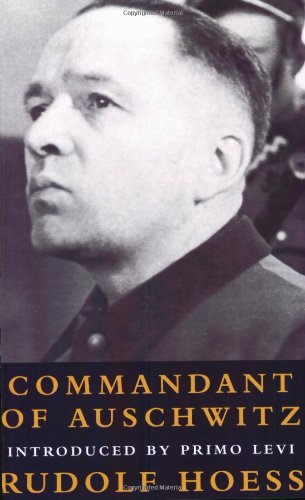
Commandant of Auschwitz : The Autobiography of Rudolf Hoess
Authors:
Constantine Fitzgibbon
Publisher:
Phoenix
Publication Date:
Not available
ISBN:
1842120247
A self-portrait, composed by one of the greatest monsters of all time: Rudolf Hoess, the Commandant at Auschwitz, and the man who knew more than almost... anyone about how Nazi Germany implemented the Final Solution. Captured by the British after the war, tried, and sentenced to death, he was ordered to write his autobiography in the weeks between his trial and his execution (which fittingly took place in Auschwitz itself). Hoess apparently enjoyed the task, and the most careful checking by researchers showed he took great pains to tell the truth. The result: a vivid and unforgettable picture of the 20th century's defining and most horrific event. Royalties from this book go to the fund to help the few survivors of Auschwitz.

Command at Sea: Naval Command and Control since the Sixteenth Century
Authors:
Michael A. Palmer
Publisher:
Harvard University Press
Publication Date:
Not available
ISBN:
0674024117
Commanders at sea struggle not only with the unpredictability of natural elements, but also with a shroud of uncertainty often referred to as the "fog... of war." Over the centuries most admirals yielded to the natural temptation to find in new technologies a means to assert centralized control over their forces. But other commanders have recognized the fog for what it is: a constant level of uncertainty resistant to mere technological solution. In this grand history of naval warfare, Michael Palmer observes five centuries of dramatic encounters under sail and steam. From reliance on signal flags in the seventeenth century to satellite communications in the twenty-first, admirals looked to the next advance in technology as the one that would allow them to control their forces. But while abilities to communicate improved, Palmer shows how other technologies simultaneously shrank admirals' windows of decision. The result was simple, if not obvious: naval commanders have never had sufficient means or time to direct subordinates in battle. Successful commanders as distant as Horatio Nelson (1758-1805) and Arleigh Burke (1901-1996) accepted this reality. They sought solutions to the dilemmas of command in the personal indoctrination of subordinates through discussion, comradeship, and displays of trust and confidence. Such leaders created a commonality of vision and fostered a high degree of individual initiative. Their decentralized approach to command resulted in a resiliency that so often provided the key to success in battle. Palmer's exciting and enlightening history reveals the myriad efforts of naval commanders to navigate the fog of war.
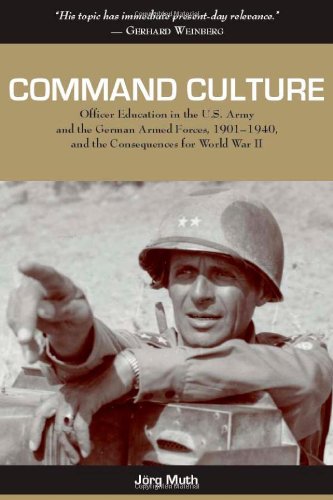
Command Culture: Officer Education in the U.S. Army and the German...
Authors:
Jörg Muth
Publisher:
University of North Texas Press
Publication Date:
Not available
ISBN:
1574413031
- Selected by the US Army Chief of Staff, General Raymond T. Odierno, for his professional reading list, March 2012.- Recieved the 'Distinguished... Writing Award' of the Army Historical Foundation in the category 'Institutional/Functional History', June 2012.In Command Culture, Jörg Muth examines the different paths the United States Army and the German Armed Forces traveled to select, educate, and promote their officers in the crucial time before World War II. Muth demonstrates that the military education system in Germany represented an organized effort where each school and examination provided the stepping stone for the next. But in the United States, there existed no communication about teaching contents or didactical matters among the various schools and academies, and they existed in a self chosen insular environment. American officers who finally made their way through an erratic selection process and past West Point to the important Command and General Staff School at Fort Leavenworth, Kansas, found themselves usually deeply disappointed, because they were faced again with a rather below average faculty who forced them after every exercise to accept the approved "school solution."Command Culture explores the paradox that in Germany officers came from a closed authoritarian society but received an extremely open minded military education, whereas their counterparts in the United States came from one of the most democratic societies but received an outdated military education that harnessed their minds and limited their initiative. On the other hand, German officer candidates learned that in war everything is possible and a war of extermination acceptable. For American officers, raised in a democracy, certain boundaries could never be crossed.This work for the first time clearly explains the lack of audacity of many high ranking American officers during World War II, as well as the reason why so many German officers became perpetrators or accomplices of war crimes and atrocities or remained bystanders without speaking up. Those American officers who became outstanding leaders in World War II did so not so much because of their military education, but despite it.The book connects successfully the pre-World War II officer education of the U. S. Army and its traditions and culture with the conduct of the War against Terror today.
Command Decision
Authors:
Elizabeth Moon
Publisher:
Ballantine
Publication Date:
Not available
ISBN:
0679738010
In Shah of Shahs Kapuscinski brings a mythographer's perspective and a novelist's virtuosity to bear on the overthrow of the last Shah of Iran, one of... the most infamous of the United States' client-dictators, who resolved to transform his country into "a second America in a generation," only to be toppled virtually overnight. From his vantage point at the break-up of the old regime, Kapuscinski gives us a compelling history of conspiracy, repression, fanatacism, and revolution.Translated from the Polish by William R. Brand and Katarzyna Mroczkowska-Brand.
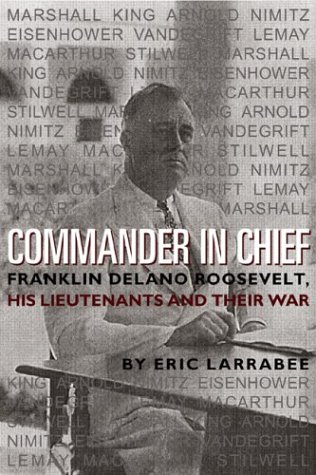
Commander in Chief: Franklin Delano Roosevelt, His Lieutenants, and...
Authors:
Eric Larrabee
Publisher:
Naval Institute Press
Publication Date:
Not available
ISBN:
1591144558
Few American presidents have exercised their constitutional authority as commander in chief with more determination than Franklin D. Roosevelt. He... intervened in military operations more often and to better effect than his contemporaries Churchill and Stalin, and maneuvered events so that the Grand Alliance was directed from Washington. In this expansive history, Eric Larrabee examines the extent and importance of FDR's wartime leadership through his key military leaders-Marshall, King, Arnold, MacArthur, Vandergrift, Nimitz, Eisenhower, Stilwell, and LeMay. Devoting a chapter to each man, the author studies Roosevelt's impact on their personalities, their battles (sometimes with each other), and the consequences of their decisions. He also addresses such critical subjects as Roosevelt's responsibility for the war and how well it achieved his goals. First published in 1987, this comprehensive portrait of the titans of the American military effort in World War II is available in a new paperback edition for the first time in sixteen years. 735 pages. 6 line drawings. Paperback. 6 x 9 inches.

Commander of the Faithful: The Life and Times of Emir Abd el-Kader
Authors:
John W. Kiser
Publisher:
Monkfish Book Publishing
Publication Date:
Not available
ISBN:
0982324669
"A dramatic story . . . any number of episodes could inspire novels . . . impossible to read without thinking of more current events."—The New York... Times"A valuable and timely reminder . . . of that rare figure: a bridge between East and West."—Times Literary SupplementThis well-researched and compelling biography of the Muslim warrior-saint who led the Algerian resistance to French colonization in the mid-nineteenth century sheds light on current US involvement with a global Islam. The most famous "jihadist" of his time, Abd el-Kader was known equally for his military brilliance and his moral authority. His New York Times obituary called him "one of the few great men of the century."
COMMANDING HEIGHTS: BATTLE F/WORLD(DVD)
Authors:
Not Available
Publisher:
Not available
Publication Date:
Not available
ISBN:
Not available
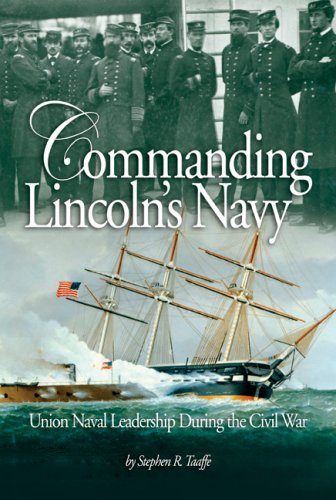
Commanding Lincoln's Navy: Union Naval Leadership During the Civil War
Authors:
Stephen R. Taaffe
Publisher:
Naval Institute Press
Publication Date:
Not available
ISBN:
1591148553
The Union Navy played a vital role in winning the Civil War by blockading Confederate ports, cooperating with the Union Army in amphibious assaults, and... controlling the Mississippi River and its tributaries. President Lincoln understood, however, that the Navy was not as important, militarily and politically, to the war effort as the Army, so he delegated authority to his Secretary of the Navy, Gideon Welles, who divided the Navy into six squadrons and hand-picked their commanders. This book examines Welles selections and why he appointed them. While noting that the officers records, character, and abilities were of primary importance, Taaffe acknowledges that political connections, seniority, and availability were also factored into the selections. He demonstrates that Welles appointments improved markedly as the war continued and as he gained a better understanding of the Navy and its officer corps. Taaffe contends that Welles eventual success in picking effective squadron commanders contributed greatly to Union victory.
Command in War
Authors:
Martin Van Creveld
Publisher:
Harvard University Press
Publication Date:
Not available
ISBN:
0674144414
Many books have been written about strategy, tactics, and great commanders. This is the first book to deal exclusively with the nature of command... itself, and to trace its development over two thousand years from ancient Greece to Vietnam. It treats historically the whole variety of problems involved in commanding armies, including staff organization and administration, communications methods and technologies, weaponry, and logistics. And it analyzes the relationship between these problems and military strategy. In vivid descriptions of key battles and campaigns--among others, Napoleon at Jena, Moltke's Königgrätz campaign, the Arab-Israeli war of 1973, and the Americans in Vietnam--van Creveld focuses on the means of command and shows how those means worked in practice. He finds that technological advances such as the railroad, breech-loading rifles, the telegraph and later the radio, tanks, and helicopters all brought commanders not only new tactical possibilities but also new limitations. Although vast changes have occurred in military thinking and technology, the one constant has been an endless search for certainty--certainty about the state and intentions of the enemy's forces; certainty about the manifold factors that together constitute the environment in which war is fought, from the weather and terrain to radioactivity and the presence of chemical warfare agents; and certainty about the state, intentions, and activities of one's own forces. The book concludes that progress in command has usually been achieved less by employing more advanced technologies than by finding ways to transcend the limitations of existing ones.

Commando: A Boer Journal Of The Boer War
Authors:
Deneys Reitz
Publisher:
CruGuru
Publication Date:
Not available
ISBN:
1920265155
(Revised in May 2009) Deneys Reitz was 17 when the Boer War broke out in 1899. Reitz describes that he had no hatred of the British people, but "as a... South African, one had to fight for one's country." Reitz had learned to ride, shoot and swim almost as soon as he could walk, and the skills and endurance he had acquired during those years were to be made full use of during the war. He fought with different Boer Commandos, where each Commando consisted mainly of farmers on horseback, using their own horses and guns. Commando describes the tumult through the eyes of a warrior in the saddle. Reitz was fortunate to be present at nearly every one of the major battles of the war. Commando is a straightforward narrative that describes an extraordinary adventure and brings us a vivid, unforgettable picture of mobile guerrilla warfare, especially later in the war as General Smuts and men like Reitz fought on, braving heat, cold, rain, tiring horses, and lack of food, clothing, and boots.

Command of Office: How War, Secrecy, and Deception Transformed the...
Authors:
Stephen Graubard
Publisher:
Basic Books
Publication Date:
Not available
ISBN:
046502758X
Command of Office reveals the remarkable-and dangerous-concentration of power in the American presidency over the course of the twentieth century, told... through incisive analyses of the eighteen men who have held the office and the events that shaped their presidencies. Stephen Graubard tracks the steady expansion of secrecy as a tool of presidential authority, one that inevitably diminished the power of the other two branches of government. Widely esteemed by his fellow historians and with unique access to former members of both Republican and Democratic administrations, Graubard has written a masterful history of presidential power-essential reading for anyone concerned with American politics.
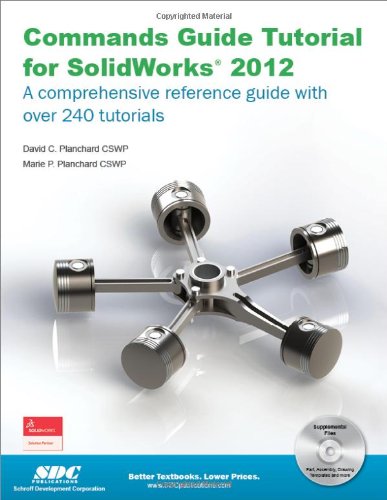
Commands Guide Tutorial for SolidWorks 2012
Authors:
David Planchard
Publisher:
SDC Publications
Publication Date:
Not available
ISBN:
1585036951
The Commands Guide Tutorial for SolidWorks 2012 is a comprehensive reference book written to assist the beginner to intermediate user of SolidWorks... 2012. SolidWorks is an immense software package, and no one book can cover all topics for all users. The book provides a centralized reference location to address many of the tools, features and techniques of SolidWorks 2012. This book covers the following: System and Document properties FeatureManagers PropertyManagers ConfigurationManagers RenderManagers 2D and 3D Sketch tools Sketch entities 3D Feature tools Motion Study Sheet Metal Motion Study Sustainability Sustainability Xpress FlowXpress PhotoView 360 Pack and Go Intelligent Modeling techniques and more. Chapter 1 provides a basic overview of the concepts and terminology used throughout this book using SolidWorks 2012 software. If you are completely new to SolidWorks, you should read Chapter 1 in detail and complete Lesson 1, Lesson 2 and Lesson 3 in the SolidWorks Tutorials. If you are familiar with an earlier release of SolidWorks, you still might want to skim Chapter 1 to be acquainted with some of the commands, menus and features that you have not used; or you can simply jump to any section in any chapter. Each chapter (18 total) provides detail PropertyManager information on key topics with individual stand alone short tutorials to reinforce and demonstrate the functionality and ease of the SolidWorks tool or feature. All models for the 240 plus tutorials are located on the enclosed book CD with their solution (initial and final). Learn by doing, not just by reading! Formulate the skills to create, modify and edit sketches and solid features. Learn the techniques to reuse features, parts and assemblies through symmetry, patterns, copied components, design tables, configurations and more. The book is design to compliment the Online Tutorials and Online Help contained in SolidWorks 2012. The goal is to illustrate how multiple design situations and systematic steps combine to produce successful designs. The authors developed the tutorials by combining their own industry experience with the knowledge of engineers, department managers, professors, vendors and manufacturers.These professionals are directly involved with SolidWorks everyday. Their responsibilities go far beyond the creation of just a 3D model. Table of Contents Introduction 1. Quick Start 2. SolidWorks System Options 3. SolidWorks Document Properties 4. Design Intent, Sketching and Sketch Entities 5. Sketch Tools, Geometric Relations and Dimensions/Relations Tools 6. Extruded Boss/Base, Extruded Cut, Fillet and Cosmetic Features 7. Revolved, Hole, Dome and Curve Features 8. Shell, Draft, and Rib Features 9. Pattern Features, Mirror Features and Coordinate System PropertyManager 10. Sweep, Loft, Wrap and Flex Features 11. Bottom-Up Assembly Modeling and more 12. Top-Down Assembly Modeling and more 13. Drawings and Drawing Tools 14. Sheet Metal Features and Tools 15. SolidWorks PhotoView 360 and Measure Tools 16. Pack and Go, PDFs, SolidWorks Toolbox, Design Library and Explorer 17. SimulationXpress, Sustainability/SustainabilityXpress, and FloXpress 18. Intelligent Modeling Techniques Appendix Index
COMM ARTS:TYPOGRAPHY ANNUAL TWO
Authors:
Not Available
Publisher:
Not available
Publication Date:
Not available
ISBN:
Not available
COMM AS CRITICAL INQUIRY PKG
Authors:
Not Available
Publisher:
Not available
Publication Date:
Not available
ISBN:
Not available
 '
'