production
/viewbook/list/all/?page=2644
/
/static/
None

COMPOSITION BOOK
Authors:
Not Available
Publisher:
Not available
Publication Date:
Not available
ISBN:
Not available
COMPOSITION BOOK/80 PAGES/5X5 RULED
Authors:
Not Available
Publisher:
Not available
Publication Date:
Not available
ISBN:
Not available
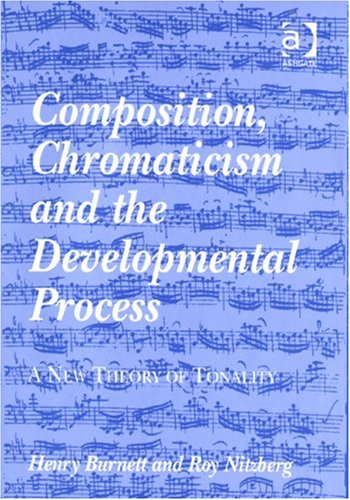
Composition, Chromaticism and the Developmental Process: A New...
Authors:
Henry Burnett and Roy Nitzberg
Publisher:
Ashgate
Publication Date:
Not available
ISBN:
0754651622
Musicology, having been transmitted as a compilation of disparate events and disciplines, has long necessitated a 'magic bullet', a 'unified field... theory' so to speak, that can interpret the steady metamorphosis of Western art music from late medieval modality to twentieth century atonality within a single theoretical construct. Without that magic bullet, discussions of this kind are increasingly complicated and, to make matters worse, the validity of any transformational models and ideas of the natural evolution of styles is questioned and even frowned upon today as epitomizing a grotesque teleological bigotry. Going against current thinking, Henry Burnett and Roy Nitzberg claim that the teleological approach to observing stylistic change is still valid when considered from the purely compositional perspective. The authors challenge the traditional understanding of development, and advance a new theory of eleven-pitch tonality as it relates to the corpus of Western composition. The book plots the evolution of tonality and its bearing on style and the compositional process itself. The theory is not based on the diatonic aspect of the various tonal systems exploited by composers; rather, the theory is chromatically based - the chromatically inflected octave being the source not only of a highly ingenious developmental dialectic, but also encompassing the moment-to-moment progression of the musical narrative itself. Even the most profound teachings of Schenker, and the often startlingly original and worthwhile speculations of Riemann, Tovey, Dahlhaus and others, still provide no theory of development and so are ultimately unable to unite the various tendrils of the compositional organism into a unified whole. Burnett and Nitzberg move beyond existing theory and analysis to base their theory from the standpoint of chromatic 'pitch fields'. These fields are the specific chromatic pitch choices that a composer uses to inform and design a complete composition, utilizing specific chromatic inflections to control a large-scale working out process that is the very essence of 'development'. In short, the authors claim that a chromatic background that coexists with a diatonic contrapuntal background may define the process of compositional development. These chromatic and diatonic events are the two genus expressions of slowly unfolding tonic octaves.
Composition & Critical Thinking/Primis Reader
Authors:
Not Available
Publisher:
Not available
Publication Date:
Not available
ISBN:
0390303895
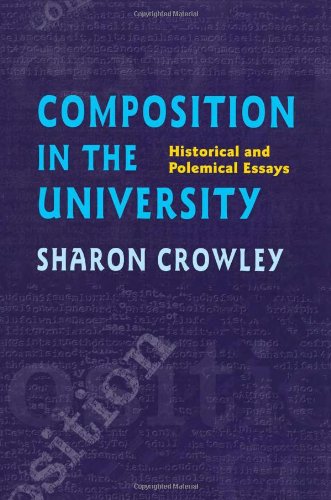
Composition In The University: Historical and Polemical Essays...
Authors:
Sharon Crowley
Publisher:
University of Pittsburgh Press
Publication Date:
Not available
ISBN:
0822956608
Composition in the University examines the required introductory course in composition within American colleges and universities. Crowley argues that... due to its association with literary studies in English departments, composition instruction has been inappropriately influenced by humanist pedagogy and that modern humanism is not a satisfactory rationale for the study of writing. Crowley envisions possible nonhumanist rationales that could be developed for vertical curricula in writing instruction, were the universal requirement not in place.Composition in the University examines the required introductory course in composition within American colleges and universities. According to Sharon Crowley, the required composition course has never been conceived in the way that other introductory courses have been—as an introduction to the principles and practices of a field of study. Rather it has been constructed throughout much of its history as a site from which larger educational and ideological agendas could be advanced, and such agendas have not always served the interests of students or teachers, even though they are usually touted as programs of study that students “need.” If there is a master narrative of the history of composition, it is told in the institutional attitude that has governed administration, design, and staffing of the course from its beginnings—the attitude that the universal requirement is in place in order to construct docile academic subjects.Crowley argues that due to its association with literary studies in English departments, composition instruction has been inappropriately influenced by humanist pedagogy and that modern humanism is not a satisfactory rationale for the study of writing. She examines historical attempts to reconfigure the required course in nonhumanist terms, such as the advent of communications studies during the 1940s. Crowley devotes two essays to this phenomenon, concentrating on the furor caused by the adoption of a communications program at the University of Iowa. Composition in the University concludes with a pair of essays that argue against maintenance of the universal requirement. In the last of these, Crowley envisions possible nonhumanist rationales that could be developed for vertical curricula in writing instruction, were the universal requirement not in place. Crowley presents her findings in a series of essays because she feels the history of the required composition course cannot easily be understood as a coherent narrative since understandings of the purpose of the required course have altered rapidly from decade to decade, sometimes in shockingly sudden and erratic fashion. The essays in this book are informed by Crowley’s long career of teaching composition, administering a composition program, and training teachers of the required introductory course. The book also draw on experience she gained while working with committees formed by the Conference on College Composition and Communication toward implementation of the Wyoming Resolution, an attempt to better the working conditions of post-secondary teachers of writing.
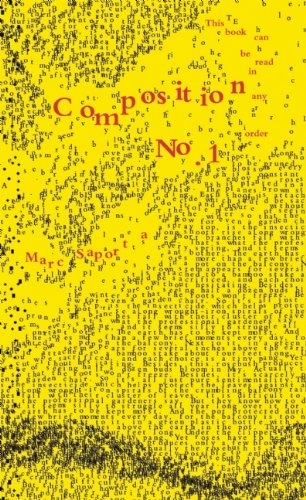
Composition No. 1
Authors:
Marc Saporta
Publisher:
Visual Editions
Publication Date:
Not available
ISBN:
0956569226
VE3 is a re-imagining of a book originally published in the 1960s. The book is the first ever book in a box”, called Composition No.1 by Marc... Saporta. When we say book in a box we mean: quite literally a book that comes in a box with loose pages. The narrative is contained on each page, leaving it up to the reader to decide the order they read the book, and how much or how little of the book they want to read before they begin again. In so many ways, Composition No.1 was published ahead of its time: the book raises all the questions we ask ourselves today about user-centric, non-linear screen driven ways of reading.With this in mind, Visual Editions approached Tom Uglow of Creative Labs Google and Youtube to write an introduction for the book. This re-imagined edition also includes several of Salvador Plascencia’s (author of The People of Paper) drawings, looking at all the different components that make up a typical” book. The book is designed by Universal Everything, a London based design studio known for their interactive screen-based work (clients include MTV and AOL).The book, as Visual Editions have shown with their other two titles, will have a high attention to design and production values and in many ways is the best example of a book as an object, or better yet, the book as an experience. Along with their usual consideration to high quality craft and finish, the designers have also generated unique digitally-generated artwork for the backs of each page, making for a gorgeous, tactile design relevant to literary, art and design and digital audiences.Ultimately, Visual Editions’ re-imagined Composition No.1 asks readers to question: what is it that makes a book a book?
COMPOSITION NOTEBOOK
Authors:
Not Available
Publisher:
Not available
Publication Date:
Not available
ISBN:
Not available
COMPOSITION NOTEBOOK
Authors:
Not Available
Publisher:
Not available
Publication Date:
Not available
ISBN:
Not available
COMPOSITION NOTEBOOK
Authors:
Not Available
Publisher:
Not available
Publication Date:
Not available
ISBN:
Not available
COMPOSITION NOTEBOOK
Authors:
Not Available
Publisher:
Not available
Publication Date:
Not available
ISBN:
Not available
COMPOSITION NOTEBOOK
Authors:
Not Available
Publisher:
Not available
Publication Date:
Not available
ISBN:
Not available
COMPOSITION NOTEBOOK QUAD RULED
Authors:
Not Available
Publisher:
Not available
Publication Date:
Not available
ISBN:
Not available
COMPOSITION OF EVERYDAY LIFE EBOOK ACC.
Authors:
Not Available
Publisher:
Not available
Publication Date:
Not available
ISBN:
Not available
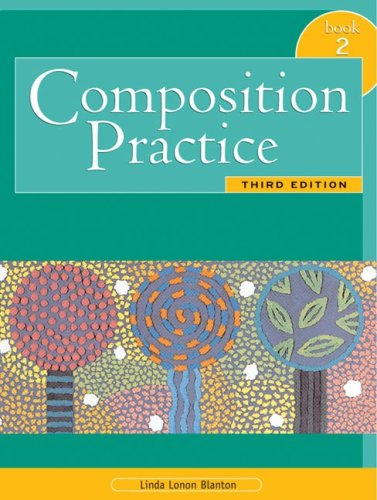
Composition Practice 2
Authors:
Linda Lonon Blanton
Publisher:
Heinle ELT
Publication Date:
Not available
ISBN:
0838419984
This classic, step-by-step approach emphasizes the fundamentals of great composition writing. Students develop writing skills to prepare them to make... the transition from use of simple prose to more linguistically sophisticated and complex discourse.
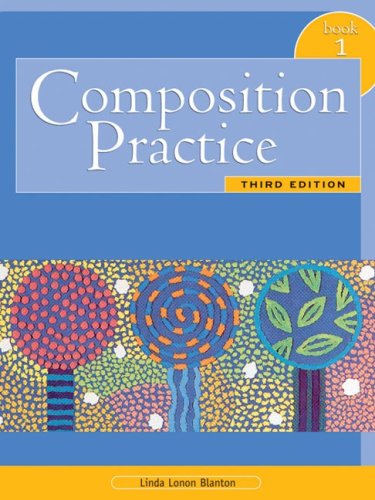
Composition Practice, Book 1: A Text for English Language Learners,...
Authors:
Linda Lonon Blanton
Publisher:
Heinle ELT
Publication Date:
Not available
ISBN:
0838419933
This classic, step-by-step approach emphasizes the fundamentals of great composition writing. Students develop writing skills to prepare them to make... the transition from use of simple prose to more linguistically sophisticated and complex discourse.
 '
'