production
/viewbook/list/all/?page=2674
/
/static/
None
Computers Understanding Technology
Authors:
Floyd Fuller
Publisher:
Emc Pub
Publication Date:
Not available
ISBN:
0763837288
Computers, Visualization, and History: How New Technology Will...
Authors:
David J. Staley
Publisher:
M E Sharpe Inc
Publication Date:
Not available
ISBN:
0765610957
For more than two hundred years, Americans have imagined and described Cuba and its relationship to the United States by conjuring up a variety of... striking images--Cuba as a woman, a neighbor, a ripe fruit, a child learning to ride a bicycle. Louis A. Perez Jr. offers a revealing history of these metaphorical and depictive motifs and discovers the powerful motives behind such characterizations of the island as they have persisted and changed since the early nineteenth century. Drawing on texts and visual images produced by Americans ranging from government officials, policy makers, and journalists to travelers, tourists, poets, and lyricists, Perez argues that these charged and coded images of persuasion and mediation were in service to America's imperial impulses over Cuba.
Computer System Architecture (3rd Edition)
Authors:
M. Morris Mano
Publisher:
Prentice Hall
Publication Date:
Not available
ISBN:
0131755633
Dealing with computer architecture as well as computer organization and design, this fully updated book provides the basic knowledge necessary to ... understand the hardware operation of digital computers. Written to aid electrical engineers, computer engineers, and computer scientists, the volume includes: KEY FEATURES: the computer architecture, organization, and design associated with computer hardware • the various digital components used in the organization and design of digital computers • detailed steps that a designer must go through in order to design an elementary basic computer • the organization and architecture of the central processing unit • the organization and architecture of input-output and memory • the concept of multiprocessing • two new chapters on pipeline and vector processing • two sections devoted completely to the reduced instruction set computer (RISC) • and sample worked-out problems to clarify topics.
Computer Systems
Authors:
J. Stanley Warford
Publisher:
Jones & Bartlett Publishers
Publication Date:
Not available
ISBN:
0763771449
Completely revised and updated, Computer Systems, Fourth Edition offers a clear, detailed, step-by-step introduction to the central concepts in computer... organization, assembly language, and computer architecture. It invites students to explore the many dimensions of computer systems through a top-down approach to levels of abstraction. By examining how the different levels of abstraction relate to one another, the text helps students look at computer systems and their components as a unified concept. The new Fourth Edition is based on the Pep/8 assembler and simulator, which was designed to teach the basics of the classic von Neumann machine. Pep/8 now includes a new symbolic trace feature that displays global variables and the run-time stack in real time as the student single steps through the program. Throughout the text Warford emphasizes the importance of mastering fundamental computer concepts, which provides a basis for understanding both current and future technology, while also stressing the importance of keen problem solving skills. Computer Systems, Fourth Edition covers all of the core topics in the Architecture and Organization category of the ACM-IEEE Curriculum 2001 Guidelines for Computer Science.

COMPUTER SYSTEMS
Authors:
Not Available
Publisher:
Not available
Publication Date:
Not available
ISBN:
Not available
Computer Systems: An Integrated Approach to Architecture and...
Authors:
Umakishore Ramachandran
Publisher:
Addison-Wesley
Publication Date:
Not available
ISBN:
0321486137
In the early days of computing, hardware and software systems were designed separately. Today, as multicore systems predominate, this separation is... becoming impractical. Computer Systems examines the key elements of all computer systems using an integrated approach that treats hardware and software as part of the same, larger system. Students gain important insights into the interplay between hardware and software and leave the course with a better understanding of a modern computer system
Computer Systems: A Programmer's Perspective
Authors:
Randal E. Bryant
Publisher:
Addison-Wesley
Publication Date:
Not available
ISBN:
0136108040
For Computer Systems, Computer Organization and Architecture courses in CS, EE, and ECE departments. Few students studying computer science or... computer engineering will ever have the opportunity to build a computer system. On the other hand, most students will be required to use and program computers on a near daily basis. Computer Systems: A Programmer’s Perspective introduces the important and enduring concepts that underlie computer systems by showing how these ideas affect the correctness, performance, and utility of application programs. The text's hands-on approach (including a comprehensive set of labs) helps students understand the “under-the-hood” operation of a modern computer system and prepares them for future courses in systems topics such as compilers, computer architecture, operating systems, and networking. Visit the CSS:AP web page http://csapp.cs.cmu.edu for more information and resources.
COMPUTER SYSTEMS: A PROGRAMMER'S PERSPECTIVE
Authors:
Not Available
Publisher:
Not available
Publication Date:
Not available
ISBN:
Not available
COMPUTER SYSTEMS(BRYANT)
Authors:
Not Available
Publisher:
Not available
Publication Date:
Not available
ISBN:
Not available
Computer Systems Design and Architecture (2nd Edition)
Authors:
Vincent P. Heuring
Publisher:
Prentice Hall
Publication Date:
Not available
ISBN:
0130484407
The authors take a “No Mysteries” approach to computer systems. They interrelate three different viewpoints to provide a unique understanding of... the subject: the perspective of the logic designer, the assembly language programmer, and the computer architect. The book has up-to-the-minute coverage of the latest developments in microprocessors, including ALU, pipelining, memory hierarchy, networks and the Internet. And, rather than focusing on a single type of architecture, Heuring and Jordan examine both CISC and RISC models at the ISA level using the unambiguous language of RTN (Register Transfer Notation), allowing for a more in-depth appreciation of different machine structures and functions. The authors examine general purpose machine, machine languages, and digital logic, some real machines, processor design, processor design—advanced topics, computer arithmetic and the arithmetic unit, memory system design, input and output, peripheral devices, communications, networking and the Internet. For computer science and engineering professionals.
Computer Systems Organization and Architecture
Authors:
John D. Carpinelli
Publisher:
Addison-Wesley
Publication Date:
Not available
ISBN:
0201612534
This book provides up-to-date coverage of fundamental concepts for the design of computers and their subsystems. It presents material with a serious... but easy-to-understand writing style that makes it accessible to readers without sacrificing important topics. The book emphasizes a finite state machine approach to CPU design, which provides a strong background for reader understanding. It forms a solid basis for readers to draw upon as they study this material and in later engineering and computer science practice. The book also examines the design of computer systems, including such topics as memory hierarchies, input/output processing, interrupts, and direct memory access, as well as advanced architectural aspects of parallel processing. To make the material accessible to beginners, the author has included two running examples of increasing complexity: the Very Simple CPU, which contains four instruction sets and shows very simple CPU design; and the Relatively Simple CPU which contains 16 instruction sets and adds enough complexity to illustrate more advanced concepts. Each chapter features a real-world machine on which the discussed organization and architecture concepts are implemented. This book is designed to teach computer organization/architecture to engineers and computer scientists.
COMPUTER TECH SUPPLEMENT
Authors:
Not Available
Publisher:
Not available
Publication Date:
Not available
ISBN:
Not available
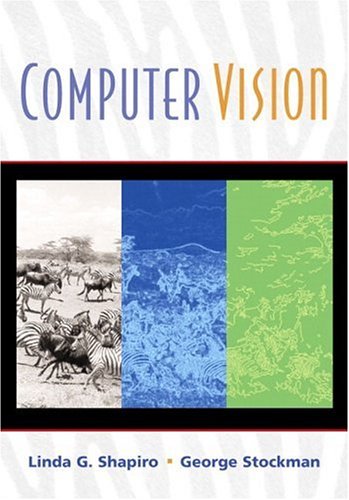
Computer Vision
Authors:
Linda G. Shapiro
Publisher:
Prentice Hall
Publication Date:
Not available
ISBN:
0130307963
Using a progressive intuitive/mathematical approach, this introduction to computer vision provides necessary theory and examples for practitioners... who work in fields where significant information must be extracted automatically from images-- including those interested in multimedia, art and design, geographic information systems, and image databases, in addition to the traditional areas of automation, image science, medical imaging, remote sensing and computer cartography. The book provides a basic set of fundamental concepts, (representations of image information, extraction of 3D scene information from 2D images, etc.) algorithms for analyzing images, and discusses some of the exciting evolving application areas of computer vision. The approach is language and software independent, and includes two significant commercial case studies. Imaging and Image Representation. Binary Image Analysis. Pattern Recognition Concepts. Filtering and Enhancing Images. Color and Shading. Texture. Content-Based Image Retrieval. Motion from 2D Image Sequences. Image Segmentation. Matching in 2D. Perceiving 3D from 2D Images. 3D Sensing and Object Pose Computation. 3D Models and Matching. Virtual Reality. Case Studies. For practitioners in any field where information must be extracted automatically from images.

COMPUTER VISION
Authors:
Not Available
Publisher:
Not available
Publication Date:
Not available
ISBN:
Not available
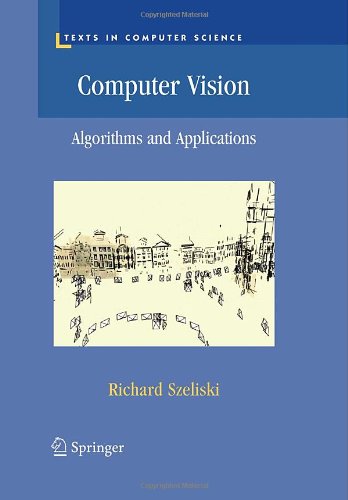
Computer Vision: Algorithms and Applications (Texts in Computer...
Authors:
Richard Szeliski
Publisher:
Springer
Publication Date:
Not available
ISBN:
1848829345
Humans perceive the three-dimensional structure of the world with apparent ease. However, despite all of the recent advances in computer vision... research, the dream of having a computer interpret an image at the same level as a two-year old remains elusive. Why is computer vision such a challenging problem and what is the current state of the art? Computer Vision: Algorithms and Applications explores the variety of techniques commonly used to analyze and interpret images. It also describes challenging real-world applications where vision is being successfully used, both for specialized applications such as medical imaging, and for fun, consumer-level tasks such as image editing and stitching, which students can apply to their own personal photos and videos. More than just a source of “recipes,” this exceptionally authoritative and comprehensive textbook/reference also takes a scientific approach to basic vision problems, formulating physical models of the imaging process before inverting them to produce descriptions of a scene. These problems are also analyzed using statistical models and solved using rigorous engineering techniques Topics and features: structured to support active curricula and project-oriented courses, with tips in the Introduction for using the book in a variety of customized courses; presents exercises at the end of each chapter with a heavy emphasis on testing algorithms and containing numerous suggestions for small mid-term projects; provides additional material and more detailed mathematical topics in the Appendices, which cover linear algebra, numerical techniques, and Bayesian estimation theory; suggests additional reading at the end of each chapter, including the latest research in each sub-field, in addition to a full Bibliography at the end of the book; supplies supplementary course material for students at the associated website, http://szeliski.org/Book/. Suitable for an upper-level undergraduate or graduate-level course in computer science or engineering, this textbook focuses on basic techniques that work under real-world conditions and encourages students to push their creative boundaries. Its design and exposition also make it eminently suitable as a unique reference to the fundamental techniques and current research literature in computer vision.
 '
'