production
/viewbook/list/all/?page=2712
/
/static/
None
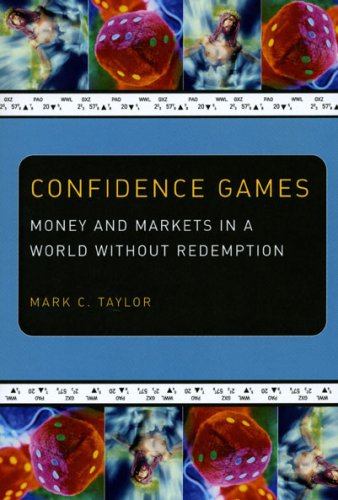
Confidence Games: Money and Markets in a World without Redemption...
Authors:
Mark C. Taylor
Publisher:
University Of Chicago Press
Publication Date:
Not available
ISBN:
0226791688
Awash in a sea of data that seems to have no meaning and bombarded by images and sounds transmitted from around the globe 24/7, people are no longer... sure what is real and what is fake. Artists recycle ads in their paintings and businesses use images of artists in their ads; politicians mount campaigns based on hit films; and bankers make billions trading incomprehensible financial products backed by nothing more than abstract figures and signs.In Confidence Games, Mark C. Taylor considers the implications of these developments for our digital and increasingly virtual economy. According to Taylor, money and markets do not exist in a vacuum but grow in a profoundly cultural medium, reflecting and in turn shaping their world. To understand the recent changes in our economy, it is not enough to analyze the impact of politics and technology—one must consider the influence of art, philosophy, and religion as well.Bringing John Calvin, G. W. F. Hegel, and Adam Smith to Wall Street by way of Las Vegas, Taylor first explores the historical and psychological origins of money, the importance of religious beliefs and practices for the emergence of markets, and the unexpected role of religion and art in the classical understanding of economics. He then moves to an account of economic developments during the past four decades, exploring the dawn of our new information age, the growing virtuality of money and markets, and the complexity of the networks by which monetary value is now negotiated.Returning full circle to a version of the market first proposed by Adam Smith when he used theology and aesthetics to rethink economics, Confidence Games closes with a plea for a conception of life that embraces uncertainty and insecurity as signs of the openness of the future. Like religion and economics, life is a confidence game in which the challenge is not to find redemption but to learn to live without it."Before the global credit system began its collapse in 2007, Mark Taylor had connected the dots between increasingly complex financial instruments and larger cultural forces. Anyone who wants to understand the disappearing foundation of our financial markets needs to read this book immediately."—Michael Lewitt, editor, The HCM Market Letter“Beyond simply dealing with ‘money and markets,’ Confidence Games is a fascinating and wide-ranging tour of modern and postmodern ideas and conditions from Aristotle to Nietzsche, from Wall Street to Las Vegas.”—Craig Bay, Journal of Markets & Morality
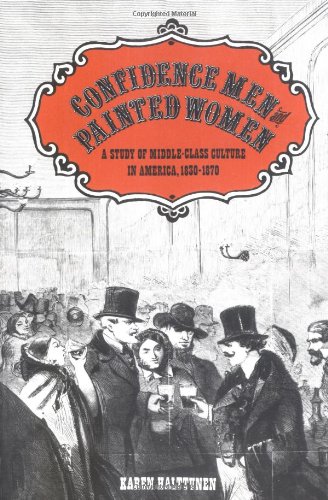
Confidence Men and Painted Women: A Study of Middle-class Culture...
Authors:
Professor Karen Halttunen
Publisher:
Yale University Press
Publication Date:
Not available
ISBN:
0300037880
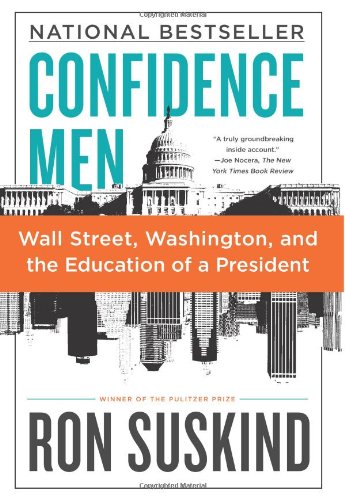
Confidence Men: Wall Street, Washington, and the Education of a...
Authors:
Ron Suskind
Publisher:
Harper Perennial
Publication Date:
Not available
ISBN:
0061430463
The hidden history of Wall Street and the White House comes down to a single, powerful, quintessentially American concept: confidence. Both centers of... power, tapping brazen innovations over the past three decades, learned how to manufacture it. But in August 2007, that confidence finally began to crumble. In this gripping and brilliantly reported book, Ron Suskind tells the story of what happened next, as Wall Street struggled to save itself while a man with little experience and soaring rhetoric emerged from obscurity to usher in "a new era of responsibility." It is a story that follows the journey of Barack Obama, who rose as the country fell, offering the first full portrait of his tumultuous presidency.
Confidence Men: Wall Street, Washington, and the Education of a...
Authors:
Ron Suskind
Publisher:
Harper
Publication Date:
Not available
ISBN:
0061429252
The hidden history of Wall Street and the White House comes down to a single, powerful, quintessentially American concept: confidence. Both centers of... power, tapping brazen innovations over the past three decades, learned how to manufacture it. Until August 2007, when that confidence finally began to crumble. In this gripping and brilliantly reported book, Ron Suskind tells the story of what happened next, as Wall Street struggled to save itself while a man with little experience and soaring rhetoric emerged from obscurity to usher in “a new era of responsibility.” It is a story that follows the journey of Barack Obama, who rose as the country fell, and offers the first full portrait of his tumultuous presidency. Wall Street found that straying from long-standing principles of transparency, accountability, and fair dealing opened a path to stunning profits. Obama’s determination to reverse that trend was essential to his ascendance, especially when Wall Street collapsed during the fall of an election year and the two candidates could audition for the presidency by responding to a national crisis. But as he stood on the stage in Grant Park, a shudder went through Barack Obama. He would now have to command Washington, tame New York, and rescue the economy in the first real management job of his life. The new president surrounded himself with a team of seasoned players—like Rahm Emanuel, Larry Summers, and Tim Geithner—who had served a different president in a different time. As the nation’s crises deepened, Obama’s deputies often ignored the president’s decisions—“to protect him from himself”—while they fought to seize control of a rudderless White House. Bitter disputes—between men and women, policy and politics—ruled the day. The result was an administration that found itself overtaken by events as, year to year, Obama struggled to grow into the world’s toughest job and, in desperation, take control of his own administration. Pulitzer Prize–winning journalist Ron Suskind introduces readers to an ensemble cast, from the titans of high finance to a new generation of reformers, from petulant congressmen and acerbic lobbyists to a tight circle of White House advisers—and, ultimately, to the president himself, as you’ve never before seen him. Based on hundreds of interviews and filled with piercing insights and startling disclosures, Confidence Men brings into focus the collusion and conflict between the nation’s two capitals—New York and Washington, one of private gain, the other of public purpose—in defining confidence and, thereby, charting America’s future.
Confident Public Speaking (with CD-ROM and InfoTrac)
Authors:
Deanna D. Sellnow
Publisher:
Wadsworth Publishing
Publication Date:
Not available
ISBN:
0534551920
Previously titled PUBLIC SPEAKING: A PROCESS APPROACH, Deanna Sellnow's CONFIDENT PUBLIC SPEAKING, SECOND EDITION distinguishes itself as the... introductory text that most effectively presents the process of public speaking and the strategies students can use to become confident public speakers. Student-oriented and reader-friendly, the book offers unique coverage of learning styles as an aspect of audience diversity, as well as its extensive, integrated coverage of overcoming communication apprehension and the significant role ethics plays in public speaking. Changes to the Second Edition include three new types of boxes, even greater attention to ethics, a completely new interior design, and expanded technology offerings that include our Web-based Speech Builder Express. An ancillary CD-ROM and Web site offer adopters an interactive and multimedia enhanced presentation of public speaking principles and skills.
Configurations from a Graphical Viewpoint (Birkhäuser Advanced...
Authors:
Toma Pisanski
Publisher:
Birkhäuser
Publication Date:
Not available
ISBN:
0817683631
Configurations can be studied from a graph-theoretical viewpoint via the so-called Levi graphs and lie at the heart of graphs, groups, surfaces, and... geometries, all of which are very active areas of mathematical exploration. In this self-contained textbook, algebraic graph theory is used to introduce groups; topological graph theory is used to explore surfaces; and geometric graph theory is implemented to analyze incidence geometries. After a preview of configurations in Chapter 1, a concise introduction to graph theory is presented in Chapter 2, followed by a geometric introduction to groups in Chapter 3. Maps and surfaces are combinatorially treated in Chapter 4. Chapter 5 introduces the concept of incidence structure through vertex colored graphs, and the combinatorial aspects of classical configurations are studied. Geometric aspects, some historical remarks, references, and applications of classical configurations appear in the last chapter. With over two hundred illustrations, challenging exercises at the end of each chapter, a comprehensive bibliography, and a set of open problems, Configurations from a Graphical Viewpoint is well suited for a graduate graph theory course, an advanced undergraduate seminar, or a self-contained reference for mathematicians and researchers.
Configurations of Points and Lines (Graduate Studies in Mathematics)
Authors:
Branko Grunbaum
Publisher:
American Mathematical Society
Publication Date:
Not available
ISBN:
0821843087
This is the only book on the topic of geometric configurations of points and lines. It presents in detail the history of the topic, with its surges and... declines since its beginning in 1876. It covers all the advances in the field since the revival of interest in geometric configurations some 20 years ago. The author's contributions are central to this revival. In particular, he initiated the study of 4-configurations (that is, those that contain four points on each line, and four lines through each point); the results are fully described in the text. The main novelty in the approach to all geometric configurations is the concentration on their symmetries, which make it possible to deal with configurations of rather large sizes. The book brings the readers to the limits of present knowledge in a leisurely way, enabling them to enjoy the material as well as entice them to try their hand at expanding it.

CONFIGURING WINDOWS 7 TESTOUT ]CUSTOM[
Authors:
Not Available
Publisher:
Not available
Publication Date:
Not available
ISBN:
Not available
CONFIGURING WINDOWS SERVER 2008 ACTIVE DIRECTORY (70-640)
Authors:
Not Available
Publisher:
Not available
Publication Date:
Not available
ISBN:
Not available
Confirmation: The Baby in Solomon's Court Revised & Updated
Authors:
Turner Paul
Publisher:
Liturgy Training Publications
Publication Date:
Not available
ISBN:
159525014X
This book presents seven models of Confirmation: Christian initiation of adults, chrismation, Protestant-Anglican Churches, Catholic initiation,... Confirmation of children, adolescent Confirmation, and persons in danger of death. The chapter presentations cover how each model developed and how each model interprets the meaning of Confirmation. This new edition is an updated and revised version of the widely read 1993 publication. Revisions include: recent developments in other Christian Churches, especially in regard to the catechumenate recent thinking on the Rite of Reception into the Full Communion of the Catholic Church in light of 'Dominus Jesus' and recent research discussions in light of the Catechism of the Catholic Church Published by Liturgy Training Publications.
Confirmative Evaluation: Practical Strategies for Valuing...
Authors:
Joan C. Dessinger
Publisher:
Pfeiffer
Publication Date:
Not available
ISBN:
1118219147
This much-needed book offers trainers, consultants, evaluation professionals, and human resource executives and practitioners a hands-on resource for... understanding and applying the proven principles of confirmative evaluation. Confirmative evaluation is a marriage of evaluation and continuous improvement. Unlike other types of evaluation—which are used during the design of a learning program or applied immediately after conducting a program—confirmative evaluation follows several months after the program is implemented. It tests the endurance of outcomes, the return on investment, and establishes the effectivenss, efficiency, impact, and value of the training over time.
Confirmative Evaluation: Practical Strategies for Valuing...
Authors:
Joan C. Dessinger
Publisher:
Pfeiffer
Publication Date:
Not available
ISBN:
0787965006
This much-needed book offers trainers, consultants, evaluation professionals, and human resource executives and practitioners a hands-on resource for... understanding and applying the proven principles of confirmative evaluation. Confirmative evaluation is a marriage of evaluation and continuous improvement. Unlike other types of evaluation—which are used during the design of a learning program or applied immediately after conducting a program—confirmative evaluation follows several months after the program is implemented. It tests the endurance of outcomes, the return on investment, and establishes the effectivenss, efficiency, impact, and value of the training over time.

Confirmatory Factor Analysis for Applied Research (Methodology in...
Authors:
Timothy A. Brown PsyD
Publisher:
The Guilford Press
Publication Date:
Not available
ISBN:
1593852746
Emphasizing practical and theoretical aspects of confirmatory factor analysis (CFA) rather than mathematics or formulas, Timothy A. Brown uses rich... examples derived from the psychology, management, and sociology literatures to provide in-depth treatment of the concepts, procedures, pitfalls, and extensions of CFA methodology. Chock full of useful advice and tables that outline the procedures, the text shows readers how to conduct exploratory factor analysis (EFA) and understand similarities to and differences from CFA; formulate, program, and interpret CFA models using popular latent variable software packages such as LISREL, Mplus, Amos, EQS, and SAS/CALIS; and report results from a CFA study. Also covered are extensions of CFA to traditional IRT analysis, methods for determining necessary sample sizes, and new CFA modeling possibilities, including multilevel factor models and factor mixture models. Special features include a Web page offering data and program syntax files for many of the research examples so that readers can practice the procedures described in the book with real data. The Web page also includes links to additional CFA-related resources.
Confirming Elections: Creating Confidence and Integrity through...
Authors:
Not Available
Publisher:
Palgrave Macmillan
Publication Date:
Not available
ISBN:
0230341217
Since the 2000 election, American politics has been obsessed with the question of fraud in, and accuracy, of election results. The 36 days of... controversy in Florida in the 2000 election – with changing results, ballot problems, ballot counting discrepancies, and the issues with the chain of custody of ballots – illustrated to the public the challenges that can occur in elections. This book shows how, by applying simple concepts used in auditing, elections in the U.S. and internationally can be made more transparent, more accurate, and better managed. The techniques are presented in easy to understand chapters that can be applied in elections today.
Conflict 101: A Manager's Guide to Resolving Problems So Everyone...
Authors:
Susan H. Shearouse
Publisher:
AMACOM
Publication Date:
Not available
ISBN:
0814417116
We all know conflict is unavoidable, especially in the workplace. Whether it's a fight over resources, a disagreement about how to get things done, or... an argument stemming from perceived differences in identities or values, it's a manager's role to navigate relationships, and build compromises and collaborations. "Conflict 101" gives readers the tools they need to ensure not only that employees get back on track, but that disagreements breed positive results. Readers will learn how to: build trust; harness negative emotions; encourage apologies and forgiveness; use a solution-seeking approach; and, say what needs to be said. Incorporating anecdotes taken from the author's twenty years of experience as a conflict resolution professional, the book helps readers more deeply understand how conflict is created, how to respond to it, and how to manage it more effectively.
 '
'