production
/viewbook/list/all/?page=2751
/
/static/
None

Conservation in the Progressive Era: Classic Texts (Weyerhaeuser...
Authors:
William Cronon
Publisher:
University of Washington Press
Publication Date:
Not available
ISBN:
0295983752
Conservation became the first nationwide political movement in American history to grapple with environmental problems like waste, pollution, resource... exhaustion, and sustainability. At its height, the conservation movement was a critical aspect of the broader reforms undertaken in the Progressive Era (1890-1910), as the rapidly industrializing nation struggled to protect human health, natural beauty, and "national efficiency." This highly effective Progressive Era movement was distinct from earlier conservation efforts and later environmentalist reforms."Conservation in the Progressive Era" places conservation in historical context, using the words of participants in and opponents to the movement. Together, the documents collected here reveal the various and sometimes conflicting uses of the term conservation" and the contested nature of the reforms it described. This collection includes classic texts by such well-known figures as Theodore Roosevelt, Gifford Pinchot, and John Muir, as well as texts from lesser-known but equally important voices that are often overlooked in environmental studies: those of rural communities, women, and the working class. These lively selections provoke unexpected questions and ideas about many of the significant environmental issues facing us today.
Conservation Is Our Government Now: The Politics of Ecology in...
Authors:
Paige West
Publisher:
Duke University Press Books
Publication Date:
Not available
ISBN:
0822337495
A significant contribution to political ecology, Conservation Is Our Government Now is an ethnographic examination of the history and social effects of... conservation and development efforts in Papua New Guinea. Drawing on extensive fieldwork conducted over a period of seven years, Paige West focuses on the Crater Mountain Wildlife Management Area, the site of a biodiversity conservation project implemented between 1994 and 1999. She describes the interactions between those who ran the program—mostly ngo workers—and the Gimi people who live in the forests surrounding Crater Mountain. West shows that throughout the project there was a profound disconnect between the goals of the two groups. The ngo workers thought that they would encourage conservation and cultivate development by teaching Gimi to value biodiversity as an economic resource. The villagers expected that in exchange for the land, labor, food, and friendship they offered the conservation workers, they would receive benefits, such as medicine and technology. In the end, the divergent nature of each group’s expectations led to disappointment for both.West reveals how every aspect of the Crater Mountain Wildlife Management Area—including ideas of space, place, environment, and society—was socially produced, created by changing configurations of ideas, actions, and material relations not only in Papua New Guinea but also in other locations around the world. Complicating many of the assumptions about nature, culture, and development underlying contemporary conservation efforts, Conservation Is Our Government Now demonstrates the unique capacity of ethnography to illuminate the relationship between the global and the local, between transnational processes and individual lives.
Conservation: Linking Ecology, Economics, and Culture
Authors:
Monique Borgerhoff Mulder
Publisher:
Princeton University Press
Publication Date:
Not available
ISBN:
0691049807
Nearly 90 percent of the earth's land surface is directly affected by human infrastructure and activities, yet less than 5 percent is legally... "protected" for biodiversity conservation--and even most large protected areas have people living inside their boundaries. In all but a small fraction of the earth's land area, then, conservation and people must coexist. Conservation is a resource for all those who aim to reconcile biodiversity with human livelihoods. It traces the historical roots of modern conservation thought and practice, and explores current perspectives from evolutionary and community ecology, conservation biology, anthropology, political ecology, economics, and policy. The authors examine a suite of conservation strategies and perspectives from around the world, highlighting the most innovative and promising avenues for future efforts. Exploring, highlighting, and bridging gaps between the social and natural sciences as applied in the practice of conservation, this book provides a broad, practically oriented view. It is essential reading for anyone involved in the conservation process--from academic conservation biology to the management of protected areas, rural livelihood development to poverty alleviation, and from community-based natural resource management to national and global policymaking.
Conservation of Wildlife Populations: Demography, Genetics and...
Authors:
L. Scott Mills
Publisher:
Wiley-Blackwell
Publication Date:
Not available
ISBN:
1405121467
Professor L. Scott Mills has been named a 2009 Guggenheim Fellow by the board of trustees of the John Simon Guggenheim Memorial Foundation.Conservation... of Wildlife Populations provides an accessible introduction to the most relevant concepts and principles for solving real-world management problems in wildlife and conservation biology. Bringing together insights from traditionally disparate disciplines, the book shows how population biology addresses important questions involving the harvest, monitoring, and conservation of wildlife populations.Covers the most up-to-date approaches for assessing factors that affect both population growth and interactions with other species, including predation, genetic changes, harvest, introduced species, viability analysis and habitat loss and fragmentation.Is an essential guide for undergraduates and postgraduate students of wildlife biology, conservation biology, ecology, and environmental studies and an invaluable resource for practising managers on how population biology can be applied to wildlife conservation and management.Artwork from the book is available to instructors online at www.blackwellpublishing.com/mills. An Instructor manual CD-ROM for this title is available. Please contact our Higher Education team at HigherEducation@wiley.com for more information.
Conservation Psychology: Understanding and promoting human care for...
Authors:
Susan Clayton
Publisher:
Wiley-Blackwell
Publication Date:
Not available
ISBN:
1405176784
This textbook introduces the reader to the new and emerging field of Conservation Psychology, which explores connections between the study of human... behavior and the achievement of conservation goals.People are often cast as villains in the story of environmental degradation, seen primarily as a threat to healthy ecosystems and an obstacle to conservation. But humans are inseparable from natural ecosystems. Understanding how people think about, experience, and interact with nature is crucial for promoting environmental sustainability as well as human well-being.The book first summarizes theory and research on human cognitive, emotional, and behavioral responses to nature and goes on to review research on people's experience of nature in wild, managed, and urban settings. Finally, it examines ways to encourage conservation-oriented behavior at both individual and societal levels. Throughout, the authors integrate a wide body of published literature to demonstrate how and why psychology is relevant to promoting a more sustainable relationship between humans and nature.
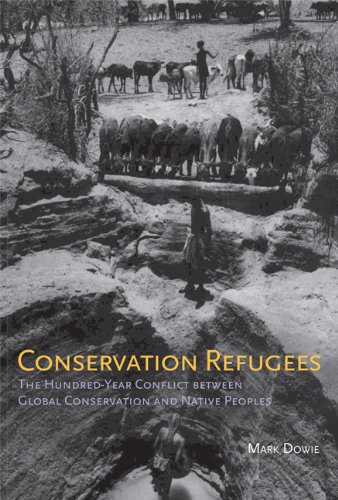
Conservation Refugees: The Hundred-Year Conflict between Global...
Authors:
Mark Dowie
Publisher:
The MIT Press
Publication Date:
Not available
ISBN:
0262516004
Since 1900, more than 108,000 officially protected conservation areas have been established worldwide, largely at the urging of five international... conservation organizations. About half of these areas were occupied or regularly used by indigenous peoples. Millions who had been living sustainably on their land for generations were displaced in the interests of conservation. In Conservation Refugees, Mark Dowie tells this story. This is a "good guy vs. good guy" story, Dowie writes; the indigenous peoples' movement and conservation organizations have a vital common goal--to protect biological diversity--and could work effectively and powerfully together to protect the planet and preserve biological diversity. Yet for more than a hundred years, these two forces have been at odds. The result: thousands of unmanageable protected areas and native peoples reduced to poaching and trespassing on their ancestral lands or "assimilated" but permanently indentured on the lowest rungs of the money economy. Dowie begins with the story of Yosemite National Park, which by the turn of the twentieth century established a template for bitter encounters between native peoples and conservation. He then describes the experiences of other groups, ranging from the Ogiek and Maasai of eastern Africa and the Pygmies of Central Africa to the Karen of Thailand and the Adevasis of India. He also discusses such issues as differing definitions of "nature" and "wilderness," the influence of the "BINGOs" (Big International NGOs, including the Worldwide Fund for Nature, Conservation International, and The Nature Conservancy), the need for Western scientists to respect and honor traditional lifeways, and the need for native peoples to blend their traditional knowledge with the knowledge of modern ecology. When conservationists and native peoples acknowledge the interdependence of biodiversity conservation and cultural survival, Dowie writes, they can together create a new and much more effective paradigm for conservation.
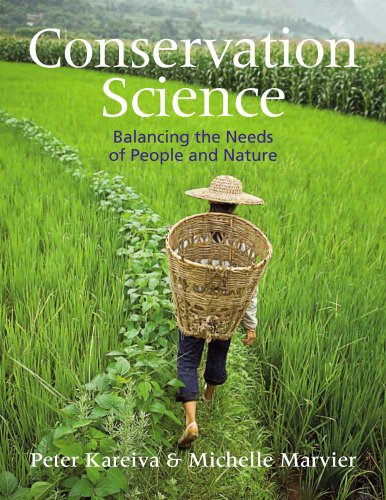
Conservation Science: Balancing the Needs of People and Nature
Authors:
Peter Kareiva
Publisher:
Roberts and Company Publishers
Publication Date:
Not available
ISBN:
1936221063
Conservation Science is the first textbook to teach the scientific foundations of conservation biology while highlighting strategies to better connect... its practice with the needs and priorities of a growing human population.
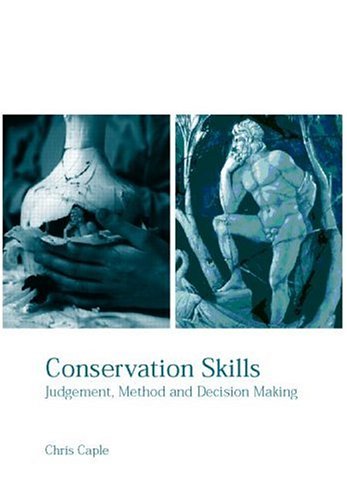
Conservation Skills: Judgement, Method and Decision Making
Authors:
Chris Caple
Publisher:
Routledge
Publication Date:
Not available
ISBN:
0415188814
Conservation Skills provides an overview of the issues facing conservators of historic and artistic works. It not only describes the nature of... conservation but also provides an ethical framework to which the conservation of objects can be related. Drawing on case studies of well-known objects such as the body of Lindow Man and the Statue of Liberty it addresses the following issues: * perception, judgement and learning * reasons for preserving the past * the nature and history of conservation * conservation ethics * recording, investigating, cleaning objects * stabilisation and restoration * preventive conservation * decision making and responsibilities.
Conservatism
Authors:
Jerry Z. Muller
Publisher:
Princeton University Press
Publication Date:
Not available
ISBN:
0691037116
At a time when the label "conservative" is indiscriminately applied to fundamentalists, populists, libertarians, fascists, and the advocates of one or... another orthodoxy, this volume offers a nuanced and historically informed presentation of what is distinctive about conservative social and political thought. It is an anthology with an argument, locating the origins of modern conservatism within the Enlightenment and distinguishing between conservatism and orthodoxy. Bringing together important specimens of European and American conservative social and political analysis from the mid-eighteenth century through our own day, Conservatism demonstrates that while the particular institutions that conservatives have sought to conserve have varied, there are characteristic features of conservative argument that recur over time and across national borders.The book proceeds chronologically through the following sections: Enlightenment Conservatism (David Hume, Edmund Burke, and Justus Möser), The Critique of Revolution (Burke, Louis de Bonald, Joseph de Maistre, James Madison, and Rufus Choate), Authority (Matthew Arnold, James Fitzjames Stephen), Inequality (W. H. Mallock, Joseph A. Schumpeter), The Critique of Good Intentions (William Graham Sumner), War (T. E. Hulme), Democracy (Carl Schmitt, Schumpeter), The Limits of Rationalism (Winston Churchill, Michael Oakeshott, Friedrich Hayek, Edward Banfield), The Critique of Social and Cultural Emancipation (Irving Kristol, Peter Berger and Richard John Neuhaus, Hermann Lübbe), and Between Social Science and Cultural Criticism (Arnold Gehlen, Philip Rieff). The book contains an afterword on recurrent tensions and dilemmas of conservative thought.

Conservatism Among the Iroquois at the Six Nations Reserve (The...
Authors:
Annemarie Anrod Shimony
Publisher:
Syracuse Univ Pr (Sd)
Publication Date:
Not available
ISBN:
0815626304
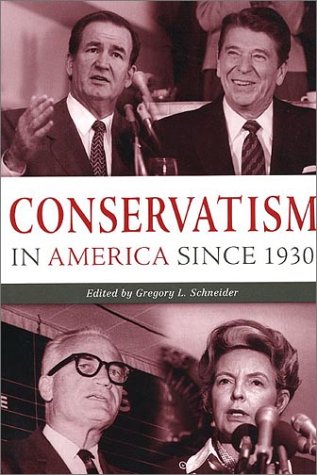
Conservatism in America since 1930: A Reader
Authors:
Not Available
Publisher:
NYU Press
Publication Date:
Not available
ISBN:
0814797997
While there have long been libertarians, agrarians, individualists, collectivists, nationalists, and others who fit the contemporary label of... “conservative,” no cohesive conservative movement existed prior to World War II. How, then, did conservatism develop into such a powerful American political force?Tracing the history of conservatism from the concerns and ideas of the Old Right, through the Cold War, the “Gingrich revolution,” and into the present, Conservatism in America Since 1930 gathers a wide range of conservative writings and documents showcasing the development and protean character of the modern conservative intellectual and political movement.The book includes essays from Russell Kirk, Milton Friedman, F.A. Hayek, William F. Buckley, Jr., Ronald Reagan, and Pat Buchanan, among others, and highlights key debates between the movement’s factions. Along with essays by these canonical conservative figures, the volume also contains excerpts from sources less frequently cited, such as the Twelve Southerners and Seward Collins, as well as documents from conservative organizations and journals. The primary documents are supplemented by introductions which set the historical context and offer illuminating commentary on how conservatism shifted identity over the course of modern American history.
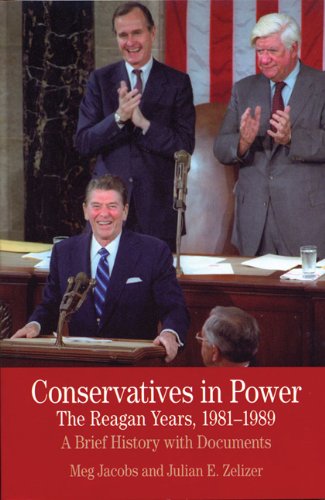
Conservatives in Power: The Reagan Years, 1981-1989: A Brief...
Authors:
Meg Jacobs
Publisher:
Bedford/St. Martin's
Publication Date:
Not available
ISBN:
0312488319
Ronald Reagan's election to the presidency in 1980 marked a victory for conservatism. But, as Meg Jacobs and Julian Zelizer point out in their... introduction, once in power, conservatives discovered that implementing their agenda and reversing the liberalism entrenched in American government would not be as easy as they had hoped. In this collection, Jacobs and Zelizer explore the successes and limitations of the so-called Reagan Revolution and chronicle its legacy through subsequent presidencies up to Barack Obama's election in 2008. More than 60 thematically organized documents -- some recently released -- illuminate conservatives' efforts to shift American politics to the right. These materials -- including speeches, memos, and articles from the popular press -- explore Reagan's personal evolution as a conservative leader, as well as Reaganomics, tax cuts, anticommunism, the arms race, the culture wars, and scandals such as Iran Contra. Photographs, document headnotes, a chronology, selected bibliography, and questions for consideration provide pedagogical support.
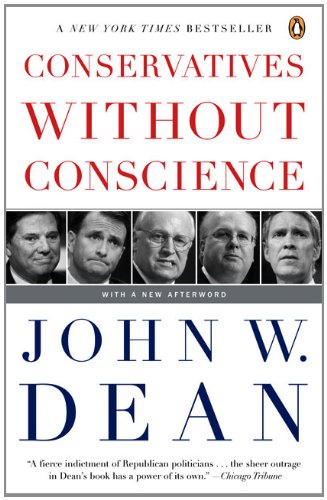
Conservatives Without Conscience
Authors:
John W. Dean
Publisher:
Penguin Books
Publication Date:
Not available
ISBN:
0143038869
On the heels of his national bestseller Worse Than Watergate, John Dean takes a critical look at the current conservative movement In Conservatives... Without Conscience, John Dean places the conservative movement's inner circle of leaders in the Republican Party under scrutiny. Dean finds their policies and mind- set to be fundamentally authoritarian, and as such, a danger to democracy. By examining the legacies of such old-line conservatives as J. Edgar Hoover, Spiro Agnew, and Phyllis Schlafly and of such current figures as Dick Cheney, Newt Gingrich, and leaders of the Religious Right, Dean presents an alarming record of abuses of power. His trenchant analysis of how conservatism has lost its bearings serves as a chilling warning and a stirring inspiration to safeguard constitutional principles.
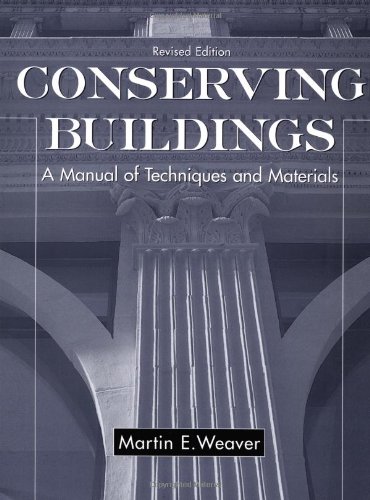
Conserving Buildings: Guide to Techniques and Materials, Revised...
Authors:
Martin E. Weaver
Publisher:
Wiley
Publication Date:
Not available
ISBN:
0471509442
The updated paperback edition of Weaver's landmark work--the essential manual on materials and procedures for restoring buildingsConserving Buildings,... Revised Edition, is the ideal resource for anyone involved in the maintenance, restoration, or rehabilitation of historic buildings. The book combines practical information on the characteristics, composition, and deterioration of building materials with detailed coverage of state-of-the-art conservation methods, fully updated in this edition with current developments in research and practice.The book contains: * Systematic treatment of all major building materials--stone, ceramics, masonry, cement-based materials, metal, glass, synthetic resins, and polymers * Valuable instruction on the restoration and renewal of foundations and footings, slate roofing systems, materials, and other structural details * Easy-to-follow procedures for conducting structural building surveys * Over 150 photographs and line drawings, plus case studies from Columbia University's acclaimed Center for Preservation Research * Newly expanded references, with accessible sources of further informationWhether used as a hands-on sourcebook or a technical desktop reference, Conserving Buildings, Revised Edition, is the manual of choice for architects, engineers, preservation professionals, historic building owners, and students.
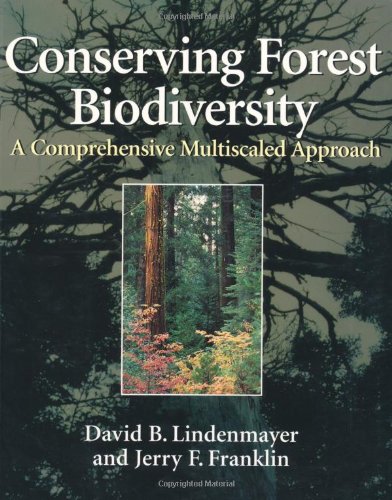
Conserving Forest Biodiversity: A Comprehensive Multiscaled Approach
Authors:
David Lindenmayer
Publisher:
Island Press
Publication Date:
Not available
ISBN:
1559639350
While most efforts at biodiversity conservation have focused primarily on protected areas and reserves, the unprotected lands surrounding those areas -... the "matrix" - are equally important to preserving global biodiversity and maintaining forest health. In this volume, leading forest scientists David B. Lindenmayer and Jerry F. Franklin argue that the conservation of forest biodiversity requires a comprehensive and multiscaled approach that includes both reserve and non-reserve areas. They lay the foundations for such a strategy, bringing together the latest scientific information on landscape ecology, forestry, conservation biology, and related disciplines as they examine: the importance of the matrix in key areas of ecology such as metapopulation dynamics, habitat fragmentation, and landscape connectivity; general principles for matrix management; using natural disturbance regimes to guide human disturbance; landscape-level and stand-level elements of matrix management; the role of adaptive management and monitoring; and social dimensions and tensions in implementing matrix-based forest management.
 '
'