production
/viewbook/list/all/?page=276
/
/static/
None
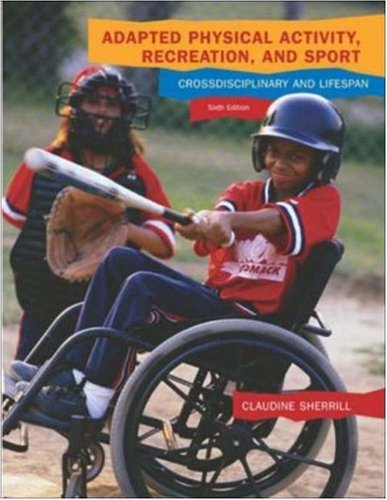
Adapted Physical Activity, Recreation and Sport with Powerweb...
Authors:
Claudine Sherrill
Publisher:
McGraw-Hill Humanities/Social Sciences/Languages
Publication Date:
Not available
ISBN:
0072878614
Offering the most comprehensive coverage available and broadening the audience scope to include students majoring in exercise science or coaching who... are preparing for nonteaching positions, this new edition features a lifespan, cross-disciplinary approach valuable for both teaching and non-teaching professionals. Adapted Physical Activity, Recreation, and Sport emphasizes attitude change, inclusion, and psychosocial perspectives for understanding individual differences.

ADAPTED PHYSICAL EDUCATION
Authors:
Not Available
Publisher:
Not available
Publication Date:
Not available
ISBN:
Not available
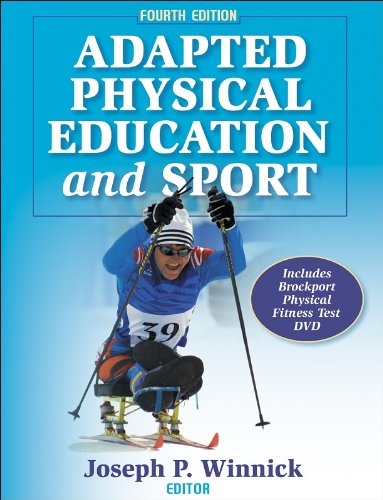
Adapted Physical Education and Sport - 4th Edition (Book & DVD)
Authors:
Joseph Winnick
Publisher:
Human Kinetics
Publication Date:
Not available
ISBN:
073605216X
The world of adapted physical education and sport continues to undergo both legislative and practical changes. Those who want to stay abreast of... those changes and provide people with disabilities the best physical education and sport experiences possible will benefit from Adapted Physical Education and Sport, Fourth Edition.Specifically, the book helps teachers fulfill these requirements:- Provide education compatible with the definition of special education- Identify the unique needs of each person within the program - Offer personalized education specific to each participant's needs - Provide the most included, integrated setting possible for each individual with disabilities Adapted Physical Education and Sport, Fourth Edition prepares readers to provide services in the most included setting for each individual. The following are among the new features in this edition:- Chapter updates to incorporate current legislation- Expanded coverage of inclusion - Greater focus on adapted sport, exploring the opportunities in various sports - Major revisions to the measurement and assessment chapter to reflect advances, particularly in alternative assessment- DVD version of the Brockport Physical Fitness Test Video bound into the textbook- Greater attention on behavioral disabilities, with practical applications consistent with IDEA provided for youngsters with behavioral disabilities - New chapter on pervasive developmental disabilities- More emphasis on working with individuals with visual impairments, hearing impairments, or both- Expanded and updated instructor guide and test package, plus a new presentation packagePart I introduces foundational topics in adapted physical education and sport, including program organization and management, adapted sport, individualized programs, and instructional strategies. It helps teachers and leaders to plan, assess, prescribe, teach, and evaluate adapted physical education. Part II explores the unique physical education needs of students with various disabilities.Part III examines developmental considerations, including motor development, perceptual motor development, and considerations for infants and toddlers as well as for early childhood. In part IV the focus is on physical activities and sports for people with disabilities. It includes chapters on rhythmic movement and dance, aquatics, team sports, individual and adventure sports, and enhancing wheelchair sport performance. Each chapter identifies skills, lead-up activities, modifications, and variations to make the experience meaningful, motivating, and fun for the participants. Chapter-opening vignettes and numerous real-life problems that must be solved help readers learn and apply the material. Adapted Physical Education and Sport, Fourth Edition, will help practitioners bring out the capabilities of each individual.
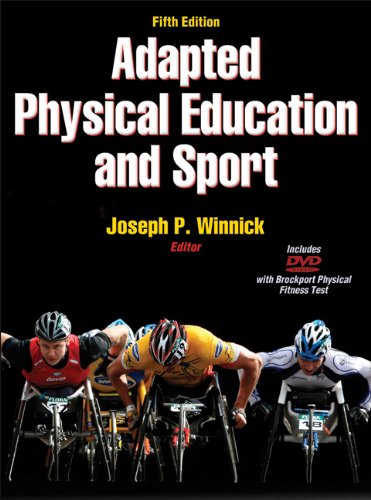
Adapted Physical Education and Sport - 5th Edition
Authors:
Not Available
Publisher:
Human Kinetics
Publication Date:
Not available
ISBN:
0736089187
Through this latest edition of Adapted Physical Education and Sport, you can provide top-quality physical education for youth with disabilities and... help them get the most out of their sport participation. This new edition is updated to keep you current with today’s trends in adapted physical education and sport: • Major revisions to chapters on measurement and assessment from new contributors, including information about the Brockport Physical Fitness Test and individualized education programs • An updated chapter on autism and its implications for teaching • Separate chapters—and new information—on visual disabilities, deafness, and deafblindness • An increased emphasis on best practices and applications for successful inclusion In addition, a chapter on adapted sport is updated to reflect current information regarding classifications, sport organizations, national governing bodies, and the Paralympic Games. This chapter also focuses on adapted sport for in-school programs, including interscholastic competition. Adapted Physical Education and Sport is greatly influenced by the Individuals with Disabilities Education Act (IDEA), and as such it will help teachers, schools, and agencies develop and implement adapted physical education programs consistent with federal legislation. Following are some of the student-friendly features of this edition: • Four-color design throughout to draw readers’ attention to important elements • A DVD that shows the Brockport Physical Fitness Test in action • Appendixes • Author and subject indexes • Resources at the end of each chapter for further exploration • Examples that apply concepts in the text to real-life situations Instructors also benefit from the companion Web site, which features an instructor guide that provides objectives, suggestions for learning and enrichment activities, and resources. The Web site also supplies a test bank and PowerPoint presentations for each of the 29 chapters. The authors—leading authorities in their fields—introduce chapter concepts through real-life scenarios and show how you can apply those concepts to solve issues. In addition to helping you understand the relationship between disabilities and their implications for people through age 21, the authors ground you in the foundational topics for adapted physical education and sport, explore the developmental considerations involved, and outline activities for people with unique physical education needs, suggesting activity modifications along the way. Adapted Physical Education and Sport, Fifth Edition, provides future educators the information they need to develop high-quality programs for people with unique physical education needs.
ADAPTED PHYSICAL EDUCATION DESK REFERENCE BOOK (# APEDESK)
Authors:
Not Available
Publisher:
Not available
Publication Date:
Not available
ISBN:
Not available
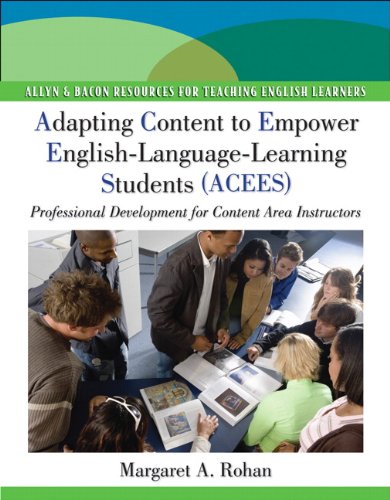
Adapting Content to Empower English Language Learning Students...
Authors:
Margaret A. Rohan
Publisher:
Pearson
Publication Date:
Not available
ISBN:
0135095867
Aimed at 6-12 grade content area instructors that work with ELLs, this book emphasizes the importance of developing and enhancing teachers’ abilities... to work with linguistically and culturally diverse students using their districts’ adopted text materials. Adapting Content to Empower English-Language-Learning Students (ACEES) is designed to provide a resource for professional development to assist secondary teachers in meeting achievement standards for teaching English Language Learner (ELL) students. There remains a stark mismatch between adequate professional development to help teachers work with ELLs and what is actually delivered. With added pressures on teachers to ensure that standardized test strategies are covered, emanating from the No Child Left Behind Act of 2001, teachers need to reach out to ELL students who have achieved varying degrees of English language proficiency. This book emphasizes the importance of developing and enhancing all subject area teachers’ abilities to work with linguistically and culturally diverse students, using their districts’ adopted text materials. To facilitate instructional approaches that intend to foster success for ELL students, the ACEES text was specifically designed for secondary content-area instructors. ACEES focuses on principles of effective practice and resource material analysis, equitable assessment of ELLs, second language acquisition, reading, writing and literacy, specific accommodations in math, science and social studies, instructional technology and cross-cultural dimensions. The book was written to provide a resource for both instructors and teacher-trainers in developing best practice instructional approaches to teach ELL students at the secondary level.
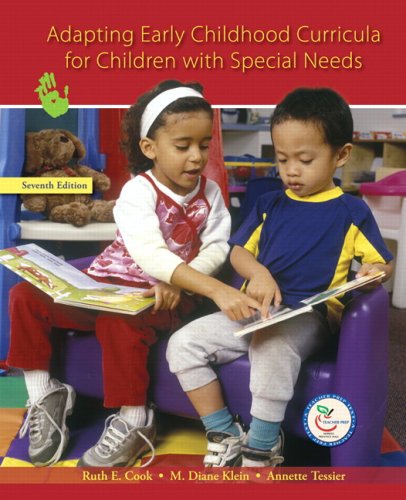
Adapting Early Childhood Curricula for Children with Special Needs...
Authors:
Ruth E. Cook
Publisher:
Prentice Hall
Publication Date:
Not available
ISBN:
0131723812
This comprehensive, practical book is built on solid theory and evidence-based practices from both the fields of Special Education and Early Childhood... Education. When the first edition was conceived in 1980, the authors encountered students who either had a strong special education background or a strong early childhood (child development) background. Each group had a lot to learn from the other and a lot to contribute to the other. The original purpose was to bring together the best from both fields into Early Childhood Special Education. The book continues to take a practical, “activity based” approach that is theoretically sound and current. It also provides ample detail related to specific intervention strategies that enhance the effective use of embedded learning opportunities within daily curriculum activities and routines. Its relatively jargon free, “readable” approach, that is built on evidence-based practices, make it appropriate for a wide range of readers. The illustrations of techniques and strategies throughout make it sustainable as a resource.. It has always encouraged a family-centered, inclusive approach to working with young children with special needs and their families.
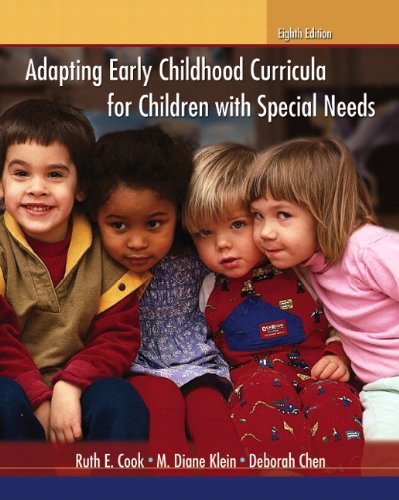
Adapting Early Childhood Curricula for Children with Special Needs...
Authors:
Ruth E. Cook
Publisher:
Pearson
Publication Date:
Not available
ISBN:
0132596784
A practical, activity-based approach to early childhood special education built on a foundation of theory and research. This comprehensive... text on early childhood special education emphasizes a developmental focus over a disability focus. The authors believe that children are more alike than different in their developmental processes and avoid the negative impact of labeling children with disability categorical names. The authors have produced a book that offers educators a practical and effective guide to finding learning opportunities within daily curriculum activities and routine. The current edition maintains the focus on inclusive, family-centered, real-world approaches that are also theoretically based. The text also provides ample detail related to specific intervention strategies that enhance teachers’ ability to work with young children with special needs and their families. Readable and practical, the illustrations of techniques and strategies throughout make this text a valuable resource long after students leave their formal education.
Adapting Instruction to Accommodate Students in Inclusive Settings...
Authors:
Judy W. Wood
Publisher:
Prentice Hall
Publication Date:
Not available
ISBN:
0130910686
This book presents practical, content-based strategies that form a comprehensive process to teaching all students. It promotes the philosophy that... inclusion and transition do not take place as a single event, but are part of a process that occurs throughout instruction. It retains the use of the Systematic Approach for Adapting the Learning Environment (SAALE) model and includes important updates regarding legal mandates, bilingual children, technology, and transition in different school environments. Legal Implications; The Road to Responsibility: Referral to Placement; Bilingual or Limited English Proficient Students; Characteristics of Students with Special Needs; Transition; The Process of Collaboration; The Content: Using the SAALE Model; Adapting the Socioemotional Environment; Adapting the Behavioral Environment; Adapting the Physical Environment; Adapting Lesson Plans; Adapting Teaching Techniques; Adapting the Format of Content; Adapting Multi-Media Approaches; Adapting Student Evaluation; Adapting Grading.
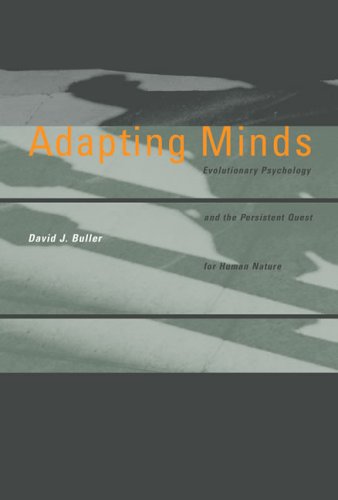
Adapting Minds: Evolutionary Psychology and the Persistent Quest...
Authors:
David J. Buller
Publisher:
A Bradford Book
Publication Date:
Not available
ISBN:
0262025795
Was human nature designed by natural selection in the Pleistocene epoch? The dominant view in evolutionary psychology holds that it was -- that our... psychological adaptations were designed tens of thousands of years ago to solve problems faced by our hunter-gatherer ancestors. In this provocative and lively book, David Buller examines in detail the major claims of evolutionary psychology -- the paradigm popularized by Steven Pinker in The Blank Slate and by David Buss in The Evolution of Desire -- and rejects them all. This does not mean that we cannot apply evolutionary theory to human psychology, says Buller, but that the conventional wisdom in evolutionary psychology is misguided.Evolutionary psychology employs a kind of reverse engineering to explain the evolved design of the mind, figuring out the adaptive problems our ancestors faced and then inferring the psychological adaptations that evolved to solve them. In the carefully argued central chapters of Adapting Minds, Buller scrutinizes several of evolutionary psychology's most highly publicized "discoveries," including "discriminative parental solicitude" (the idea that stepparents abuse their stepchildren at a higher rate than genetic parents abuse their biological children). Drawing on a wide range of empirical research, including his own large-scale study of child abuse, he shows that none is actually supported by the evidence.Buller argues that our minds are not adapted to the Pleistocene, but, like the immune system, are continually adapting, over both evolutionary time and individual lifetimes. We must move beyond the reigning orthodoxy of evolutionary psychology to reach an accurate understanding of how human psychology is influenced by evolution. When we do, Buller claims, we will abandon not only the quest for human nature but the very idea of human nature itself.
Adapting Philosophy: Jean Baudrillard and "The Matrix Trilogy"
Authors:
Catherine Constable
Publisher:
Manchester University Press
Publication Date:
Not available
ISBN:
0719075327
This book looks at the ways in which The Matrix Trilogy adapts Jean Baudrillard’s Simulacra and Simulation, and in doing so creates its own... distinctive philosophical position. Where previous work in the field has presented the trilogy as a simple ‘beginner’s guide’ to philosophy, this study offers a new methodology for inter-relating philosophy and film texts, focusing on the conceptual role played by imagery in both types of text. This focus on the figurative enables a new-found appreciation of the liveliness of philosophical writing and the multiple philosophical dimensions of Hollywood films. The book opens with a critical overview of existing philosophical writing on The Matrix Trilogy and goes on to draw on adaptation theory and feminist philosophy in order to create a new methodology for interlinking philosophical and filmic texts. Three chapters are devoted to detailed textual analysis of the films, tracing the ways in which the imagery that dominates Baudrillard’s writing is adapted and transformed by the trilogy’s complex visuals and soundtrack. The conclusion situates the methodology developed throughout the book in relation to other approaches currently emerging in the new field of Film-Philosophy. The book’s multi-disciplinary approach encompasses Philosophy, Film Studies and Adaptation Theory and will be of interest to undergraduates and postgraduates studying these subjects. It also forms part of the developing interdisciplinary field of Film-Philosophy. The detailed textual analysis of The Matrix Trilogy will also be of interest to anyone wishing to deepen their understanding of the multi-faceted nature of this seminal work.
Adapting Reading and Math Materials for the Inclusive Classroom:...
Authors:
Jeanne Shay Schumm
Publisher:
Council Exceptional Children
Publication Date:
Not available
ISBN:
0865863393
Proven Strategies for Getting a Project LEED® CertifiedHere is the ideal guide for architects, engineers, interior designers, project managers,... facility managers, and building owners for understanding the project certification process for the Leadership for Energy and Environmental Design (LEED?) for New Construction and Major Renovations (LEED NC), LEED for Core & Shell (LEED CS), and LEED for Commercial Interiors (LEED CI) rating systems of the U.S. Green Building Council (USGBC?). Written by an expert who is the President of Design Management Services, a LEED consulting firm?Guidebook to the LEED Certification Process engages readers by outlining the steps, roles, and responsibilities of the team members in a straightforward, chronological manner that helps streamline the certification process.With the release of the LEED v3 rating systems and a new version of LEED-Online, the Guidebook to the LEED Certification Process helps project teams to streamline the project team efforts and outlines the role of the LEED consultant and project administrator. Written for LEED AP professionals and building owners that need guidance navigating a project through the process, this book outlines each step in the design and construction phases including programming and post-occupancy. Serving as a valuable resource for anyone seeking information on how to get a project LEED certified, Guidebook to the LEED Certification Process features:An overview of the integrative design process.Understanding the role of a LEED consultant.How to build a successful team for a project pursuing LEED certification.How to register a project with Green Building Certification Institute (GBCI).Common pitfalls to avoid during the LEED certification process. Checklists to use during design and construction to keep the team on track. Ask the Author: Michelle Cottrell Answers the Most Commonly Asked Questions About LEED Certification Author Michell Cottrell What are there so many registered projects as compared to certified projects? Most projects begin with an emphasis on pursuing LEED certification but fail to keep that momentum going during construction. The key is to assign the responsibility to one person to manage the effort from design through construction until the project is awarded certification. What is the biggest mistake project teams are making? I constantly am receiving calls after a project is under construction with teams now deciding to pursue certification. Unfortunately, starting the effort this late in the game typically costs more than anticipated as strategies need to be rethought causing the drawings to be revised. I am not a LEED AP, is this book still useful to me? The book was intended for professionals that are somewhat knowledgeable about green building strategies and terminology. So it might be helpful to pursue the LEED Green Associate credential to learn this type of information seen throughout the book. I worked on a project pursuing certification in 2009 under the old NC rating system, how have things changed? The biggest change to be aware of is the addition of a Water Reduction Prerequisite under the WE category as there was never one before. In addition, the rating systems have been re-weighted as some credits are no longer worth just one point. USGBC also added a new category, Regional Priority, although it does not contain new credits but instead provides bonus points for achieving existing credits depending on a project's zip code. Last, there is a new version of LEED-Online to manage the review process a bit differently! What is a commissioning agent and are we required to have one? NIBS defines commissioning as "a quality-oriented process for achieving, verifying, and documenting that the performance of facilities, systems, and assemblies meets defined objectives and criteria." Therefore a commissioning agent should be thought of a second set of eyes on behalf of the owner. The reason being is that most owners do come from a background in engineering to understand why systems might be required, to double check drawings, or to ensure energy related systems are installed and calibrated appropriately. Commissioning is a prerequisite but the commissioning agent (CxA) requirement can be addressed in one of two ways depending on the size of your project. Although someone needs to be assigned the role as a commissioning agent regardless. Should the project be less than 50,000 gross square feet, the CxA is not required to be an independent, third party but can be a member of the design or construction team (just not the engineer of record).
ADAPTION ]CUSTOM[
Authors:
Not Available
Publisher:
Not available
Publication Date:
Not available
ISBN:
Not available
Adaptive Approximation Based Control: Unifying Neural, Fuzzy and...
Authors:
Jay A. Farrell
Publisher:
Wiley-Interscience
Publication Date:
Not available
ISBN:
0471727881
A highly accessible and unified approach to the design and analysis of intelligent control systemsAdaptive Approximation Based Control is a tool every... control designer should have in his or her control toolbox.Mixing approximation theory, parameter estimation, and feedback control, this book presents a unified approach designed to enable readers to apply adaptive approximation based control to existing systems, and, more importantly, to gain enough intuition and understanding to manipulate and combine it with other control tools for applications that have not been encountered before.The authors provide readers with a thought-provoking framework for rigorously considering such questions as:* What properties should the function approximator have?* Are certain families of approximators superior to others?* Can the stability and the convergence of the approximator parameters be guaranteed?* Can control systems be designed to be robust in the face of noise, disturbances, and unmodeled effects?* Can this approach handle significant changes in the dynamics due to such disruptions as system failure?* What types of nonlinear dynamic systems are amenable to this approach?* What are the limitations of adaptive approximation based control?Combining theoretical formulation and design techniques with extensive use of simulation examples, this book is a stimulating text for researchers and graduate students and a valuable resource for practicing engineers.
Adaptive Control: Second Edition (Dover Books on Electrical...
Authors:
Karl J. Astrom
Publisher:
Dover Publications
Publication Date:
Not available
ISBN:
0486462781
Suitable for advanced undergraduates and graduate students, this overview introduces theoretical and practical aspects of adaptive control. It presents... an excellent perspective on techniques and an active knowledge of key approaches, offering a well-developed sense of when to use adaptive techniques and when other methods are more appropriate. 1995 edition.
 '
'