production
/viewbook/list/all/?page=2905
/
/static/
None
Counselors Finding Their Way
Authors:
Not Available
Publisher:
Amer Counseling Assn
Publication Date:
Not available
ISBN:
1556201923
Adam Smith, asserting the common humanity of the street porter and the philosopher, articulated the classical economists' model of social interactions... as exchanges among equals. This model had largely fallen out of favor until, recently, a number of scholars in the avant-garde of economic thought rediscovered it and rechristened it "analytical egalitarianism." In this volume, Sandra J. Peart and David M. Levy bring together an impressive array of authors to explore the ramifications of this analytical ideal and to discuss the ways in which an egalitarian theory of individuality can enable economists to reconcile ideas from opposite ends of the political spectrum."The analytical egalitarianism project that Peart and Levy have advanced has come to occupy a prominent place in the current agenda of historians of economic thought."---Ross Emmett, Associate Professor of Economics and Co-Director of the Michigan Center for Innovation and Economic Prosperity, Michigan State University"These essays and dialogs from the Summer Institute would make Adam Smith, economist and moral philosopher, proud."---J. Daniel Hammond, Hultquist Family Professor of Economics, Wake Forest UniversityWith essays by:James M. Buchanan, Alfred Nobel Memorial Prize in Economic Sciences recipient (1985) and Professor Emeritus, George Mason University and Virginia Polytechnic and State University Juan Pablo Couyoumdijian, Universidad del Desearrollo, Chile Tyler Cowen, George Mason University Eric Crampton, University of Canterbury, New Zealand Andrew Farrant, Dickinson College Samuel Hollander, Professor Emeritus, University of Toronto M. Ali Khan, Johns Hopkins University Thomas Leonard, Princeton University Deirdre McCloskey, University of Illinois, Chicago Leonidas Montes, Dean of School of Government, Universidad Adolfo Ibañez, Chile Maria Pia Paganelli, Yeshiva University and New York University Warren J. Samuels, Professor Emeritus, Michigan State University Eric Schliesser, VENI post-doctoral research fellow, Leiden University, and University of Amsterdam Gordon Tullock, George Mason UniversitySandra J. Peart is Dean of the Jepson School of Leadership Studies, University of Richmond, Virginia.David M. Levy is Professor of Economics at George Mason University (GMU) and Research Associate at the Center for Study of Public Choice at GMU.They are Co-Directors of George Mason University's Summer Institute for the Preservation of the History of Economics.
Counselor's Guide to Clinical, Personality, And Behavioral Assessment
Authors:
Bradley T. Erford
Publisher:
Wadsworth Cengage Learning
Publication Date:
Not available
ISBN:
0618474145
This combined textbook and reference guide identifies the three major types of psychological assessment, clinical, personality, and behavioral, and... provides a survey of current theory and an expert review of the most commonly used assessment instruments (tests) in each area. The book concludes with three representative case studies that demonstrate the uses of various assessment instruments in practice.
Counselor Supervision
Authors:
Not Available
Publisher:
Routledge
Publication Date:
Not available
ISBN:
0415801494
This new edition of Counseling Supervision is intended for counselor educators, counselor supervisor practitioners, and supervisors-in-training in a... variety of educational and mental health settings. The editors have brought together experts in the field of counselor education to review and examine primary supervision theories and their application to the issues that counselor supervisors will encounter. Special topic areas included are multicultural issues in counselor supervision; the supervisory relationship, an essential and sometimes forgotten component of supervision, and its influence on supervision process and outcome; supervision of career counselor trainees; supervision of school counselors; supervision of family and group counselors; group supervision; understanding and conducting research in counselor supervision and training; ethical and advocacy issues in supervision, and supervisor training. The authors include numerous case examples throughout the text in order to illustrate the application of theory to practical issues that the counselor supervisors encounter. All chapters in this edition have been revised and updated, and new chapters have been added that expand on areas of supervision that are highly relevant to students, researchers, and practitioners.

Countdown
Authors:
Deborah Wiles
Publisher:
Scholastic Press
Publication Date:
Not available
ISBN:
0545106052
The story of a formative year in 12-year-old Franny Chapman's life, and the life of a nation facing the threat of nuclear war.It's 1962, and it seems... everyone is living in fear. Twelve-year-old Franny Chapman lives with her family in Washington, DC, during the days surrounding the Cuban Missile Crisis. Amidst the pervasive threat of nuclear war, Franny must face the tension between herself and her younger brother, figure out where she fits in with her family, and look beyond outward appearances. For Franny, as for all Americans, it's going to be a formative year.
Countdown to Summer: A Poem for Every Day of the School Year
Authors:
J. Patrick Lewis
Publisher:
Little, Brown Books for Young Readers
Publication Date:
Not available
ISBN:
0316020893
Whether readers love poetry, riddles, and rhymes or just like to laugh, this richly varied collection of original poems is sure to keep them coming back... for more! J. Patrick Lewis's fun and accessible poetry features delightful wordplay and a variety of subjects and forms featured in a compendium that counts down from the first day of school to the last. Paired with Ethan Long's lively art, these poems will have readers wishing there were more days in the school year!
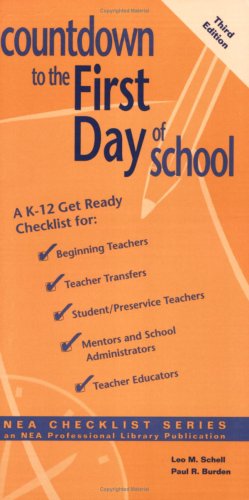
Countdown to the First Day of School: A K-12 Get-Ready Checklist...
Authors:
Leo M. Schell
Publisher:
Natl Education Assn
Publication Date:
Not available
ISBN:
0810621622
Does the thought of the first day of school give you that sinking feeling because you're afraid you're not as prepared as you could be? You're not... alone, and help is at hand in this perennial best-seller - now expanded with 16 brand-new pages and content for educators in all grades, K through 12. The time-saving checklist format features extensively updated tips that can help the beginning, transfer, or student teacher, as well as the paraeducator, prepare for the first day of school, and the entire year. It's a handy addition to the principal's or administrator's bookshelf, too. You'll find practical advice for getting acquainted, making management preparations, determining procedures and rules, making instructional preparations, planning for the first day, and organizing your classroom and materials.Also available: The First-Year Teacher: Teaching With Confidence (K-8) - ISBN 0810620146 Peer Support: Teachers Mentoring Teachers - ISBN 0810629135The NEA Professional Library is the book publishing arm of the National Education Association. Our books are enjoyed by teachers, education students, education support professionals, higher education faculty and retired educators. Our mission is to provide timely and topical titles that enhance the professional lives of our members.Some of the areas we publish in include:-Classroom Teaching Skills - The NEA Checklist series-Student Achievement-Professional Development-Peer Support-Classroom Management-Assessment & Standards-Based Education-School and Classroom Resources

Countdown to the Principalship: How Successful Principals Begin...
Authors:
Anne O'Rourke
Publisher:
Not available
Publication Date:
Not available
ISBN:
1596670312

Count Dracula
Authors:
Ted Tiller
Publisher:
Samuel French Ltd
Publication Date:
Not available
ISBN:
057360729X
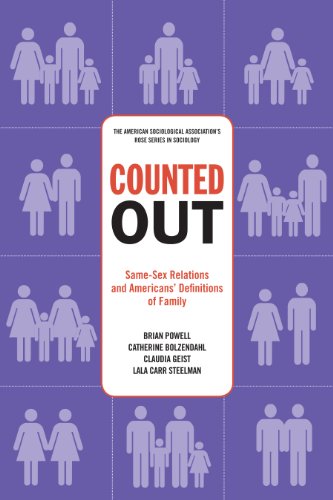
Counted Out: Same-sex Relations and Americans' Definitions of...
Authors:
Brian Powell
Publisher:
Russell Sage Foundation
Publication Date:
Not available
ISBN:
0871546876
When state voters passed the California Marriage Protection Act (Proposition 8) in 2008, it restricted the definition of marriage to a legal union... between a man and a woman. The act s passage further agitated an already roiling debate about whether American notions of family could or should expand to include, for example, same-sex marriage, unmarried cohabitation, and gay adoption. But how do Americans really define family? The first study to explore this largely overlooked question, Counted Out asks men and women of different ages, races, religions, and socioeconomic backgrounds to share their opinions on what counts as family and what doesn t. The book examines these currents in public opinion to assess their policy implications and to predict how Americans definitions of family may change in the future.Counted Out broadens the scope of previous studies by moving beyond efforts to understand how Americans view their own families to examine the way Americans characterize the concept of family in general. The book reports on and analyzes the results of the authors Constructing the Family Surveys (2003 and 2006), which asked more than 1500 people to explain their views on a broad range of issues, including gay marriage and adoption, single parenthood, the influence of biological and social factors in child development, religious ideology, and the legal rights of unmarried partners. Not surprisingly, the authors find that the standard bearer for public conceptions of family continues to be a married, heterosexual couple with children. More than half of Americans also consider same-sex couples with children as family, and from 2003 to 2006 the percentages of those who believe so increased significantly up six percent for lesbian couples and five percent for gay couples. The presence of children in any living arrangement meets with a notable degree of public approval. Less than 30 percent of Americans view heterosexual cohabitating couples without children as family, while similar couples with children count as family for nearly 80 percent. Many Americans, however, are still torn over whether certain living arrangements count as family, particularly same-sex couples without children. And nearly all reject the idea that housemates, for example, are family. Counted Out shows that for most Americans, however, the boundaries around what they define as family are becoming more malleable with time.Although such issues as same-sex marriage and gay adoption remain at the center of a cultural divide, Counted Out demonstrates that American definitions of family are becoming more expansive not less. Who counts as family has far-reaching implications for policy, including health insurance coverage, end-of-life decisions, estate rights, and child custody. Public opinion matters. As lawmakers consider the future of family policy, they will want to consider the evolution in American opinion represented in this groundbreaking book.
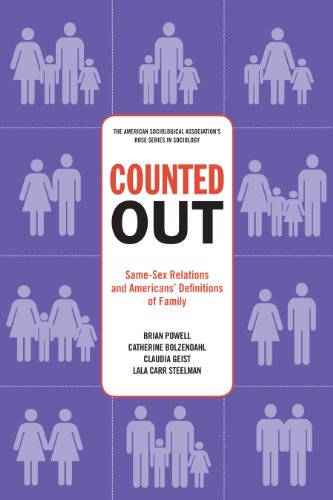
Counted Out: Same-Sex Relations and Americans' Definitions of Family
Authors:
Brian Powell
Publisher:
CUP Services
Publication Date:
Not available
ISBN:
0871546884
When state voters passed the California Marriage Protection Act (Proposition 8) in 2008, it restricted the definition of marriage to a legal union... between a man and a woman. The act s passage further agitated an already roiling debate about whether American notions of family could or should expand to include, for example, same-sex marriage, unmarried cohabitation, and gay adoption. But how do Americans really define family? The first study to explore this largely overlooked question, Counted Out asks men and women of different ages, races, religions, and socioeconomic backgrounds to share their opinions on what counts as family and what doesn t. The book examines these currents in public opinion to assess their policy implications and to predict how Americans definitions of family may change in the future.Counted Out broadens the scope of previous studies by moving beyond efforts to understand how Americans view their own families to examine the way Americans characterize the concept of family in general. The book reports on and analyzes the results of the authors Constructing the Family Surveys (2003 and 2006), which asked more than 1500 people to explain their views on a broad range of issues, including gay marriage and adoption, single parenthood, the influence of biological and social factors in child development, religious ideology, and the legal rights of unmarried partners. Not surprisingly, the authors find that the standard bearer for public conceptions of family continues to be a married, heterosexual couple with children. More than half of Americans also consider same-sex couples with children as family, and from 2003 to 2006 the percentages of those who believe so increased significantly up six percent for lesbian couples and five percent for gay couples. The presence of children in any living arrangement meets with a notable degree of public approval. Less than 30 percent of Americans view heterosexual cohabitating couples without children as family, while similar couples with children count as family for nearly 80 percent. Many Americans, however, are still torn over whether certain living arrangements count as family, particularly same-sex couples without children. And nearly all reject the idea that housemates, for example, are family. Counted Out shows that for most Americans, however, the boundaries around what they define as family are becoming more malleable with time.Although such issues as same-sex marriage and gay adoption remain at the center of a cultural divide, Counted Out demonstrates that American definitions of family are becoming more expansive not less. Who counts as family has far-reaching implications for policy, including health insurance coverage, end-of-life decisions, estate rights, and child custody. Public opinion matters. As lawmakers consider the future of family policy, they will want to consider the evolution in American opinion represented in this groundbreaking book.

Counted Righteous in Christ: Should We Abandon the Imputation of...
Authors:
John Piper
Publisher:
Crossway
Publication Date:
Not available
ISBN:
1581344473
Are Christians merely forgiven, or do they possess the righteousness of Christ? Recently the time-honored understanding of the doctrine of justification... has come under attack. Many question how-or if-we receive the full righteousness of Christ. Martin Luther said that if we understand justification "we are in the clearest light; if we do not know it, we dwell in the densest darkness." And now, in this new and important book, John Piper accepts Luther's challenge. He points out that we need to see ourselves as having been recipients of the imputation of Christ's righteousness and therefore enjoy full acceptance with God and the everlasting inheritance of life and joy. Piper writes as both a pastor and a scholar. His pastor's heart is shown in his zeal for the welfare of the church. His careful scholarship is evident in each explanation and undergirds each conclusion.
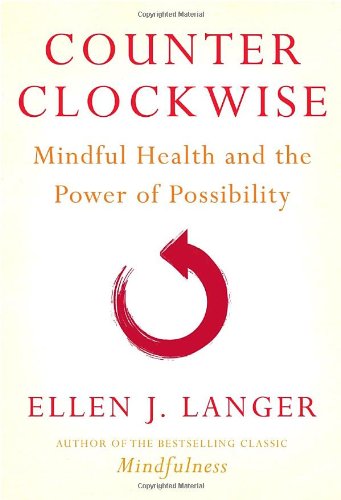
Counterclockwise: Mindful Health and the Power of Possibility
Authors:
Ellen J. Langer
Publisher:
Ballantine Books
Publication Date:
Not available
ISBN:
0345502043
If we could turn back the clock psychologically, could we also turn it back physically? For more than thirty years, award-winning social psychologist... Ellen Langer has studied this provocative question, and now, in Counterclockwise, she presents the answer: Opening our minds to what’s possible, instead of presuming impossibility, can lead to better health–at any age. Drawing on landmark work in the field and her own body of colorful and highly original experiments–including the first detailed discussion of her “counterclockwise” study, in which elderly men lived for a week as though it was 1959 and showed dramatic improvements in their hearing, memory, dexterity, appetite, and general well-being–Langer shows that the magic of rejuvenation and ongoing good health lies in being aware of the ways we mindlessly react to social and cultural cues. Examining the hidden decisions and vocabulary that shape the medical world (“chronic” versus “acute,” “cure” versus “remission”), the powerful physical effects of placebos, and the intricate but often defeatist ways we define our physical health, Langer challenges the idea that the limits we assume and impose on ourselves are real. With only subtle shifts in our thinking, in our language, and in our expectations, she tells us, we can begin to change the ingrained behaviors that sap health, optimism, and vitality from our lives. Improved vision, younger appearance, weight loss, and increased longevity are just four of the results that Langer has demonstrated.Immensely readable and riveting, Counterclockwise offers a transformative and bold new paradigm: the psychology of possibility. A hopeful and groundbreaking book by an author who has changed how people all over the world think and feel, Counterclockwise is sure to join Mindfulness as a standard source on new-century science and healing.

Counterculture Green: The Whole Earth Catalog and American...
Authors:
Andrew G. Kirk
Publisher:
Not available
Publication Date:
Not available
ISBN:
070061821X
For those who eagerly awaited its periodic appearance, it was more than a publication: it was a way of life. The Whole Earth Catalog billed itself as... "Access to Tools," and it grew from a Bay Area blip to a national phenomenon catering to hippies, do-it-yourselfers, and anyone interested in self-sufficiency independent of mainstream America. In recovering the history of the Catalog's unique brand of environmentalism, Andrew Kirk recounts how San Francisco's Stewart Brand and his counterculture cohorts in the Point Foundation promoted a philosophy of pragmatic environmentalism that celebrated technological achievement, human ingenuity, and sustainable living. By piecing together the social, cultural, material, environmental, and technological history of that philosophy's incarnation in the Catalog, Kirk reveals the driving forces behind it, tells the story of the appropriate technology movement it espoused, and assesses its fate. This book takes a fresh look at the many individuals and organizations who worked in the 1950s, 1960s, and 1970s to construct this philosophy of pragmatic environmentalism. At a time when many of these ideas were seen as heretical to a predominantly wilderness-based movement, Whole Earth became a critical forum for environmental alternatives and a model for how complicated ecological ideas could be presented in a hopeful and even humorous way. It also enabled later environmental advocates like Al Gore to explain our current "inconvenient truth," and the actions of Brand's Point Foundation demonstrated that the epistemology of Whole Earth could be put into action in meaningful ways that might foster an environmental optimism distinctly different from the jeremiads that became the stock in trade of American environmentalism. Kirk shows us that Whole Earth was more than a mere counterculture fad. In an era of political protest, it suggested that staying home and modifying your toilet or installing a solar collector could make a more significant contribution than taking to the streets to shout down establishment misdeeds. Given its visible legacy in the current views of Al Gore and others, the subtle environmental heresies of Whole Earth continue to resonate today, which makes Kirk's lucid and lively tale an extremely timely one as well. This book is part of the CultureAmerica series.

Counterculture Kaleidoscope: Musical and Cultural Perspectives on...
Authors:
Nadya Zimmerman
Publisher:
University of Michigan Press
Publication Date:
Not available
ISBN:
0472115588
Forty years after the fact, 1960s counterculture---personified by hippies, protest, and the Summer of Love---basks in a nostalgic glow in the popular... imagination as a turning point in modern American history and the end of the age of innocence. Yet, while the era has come to be synonymous with rebellion and opposition, its truth is much more complex.In a bold reconsideration of the late sixties San Francisco counterculture movement, Counterculture Kaleidoscope takes a close look at the cultural and musical practices of that era. Addressing the conventional wisdom that the movement was grounded in rebellion and opposition, the book exposes two myths: first, that the counterculture was an organized social and political movement of progressives with a shared agenda who opposed the mainstream (dubbed "hippies"); and second, that the counterculture was an innocent entity hijacked by commercialism and transformed over time into a vehicle of so-called "hip consumerism."Seeking an alternative to the now common narrative, Nadya Zimmerman examines primary source material including music, artwork, popular literature, personal narratives, and firsthand historical accounts. She reveals that the San Francisco counterculture wasn't interested in commitments to causes and made no association with divisive issues---that it embraced everything in general and nothing in particular."Astute and accessible, Counterculture Kaleidoscope provides thought-provoking insights into the historical, cultural and social context of the San Francisco counter-culture and its music scene, including discussions of Vietnam and student protest, the Haight-Ashbury Diggers, the Grateful Dead, Led Zeppelin, Altamont, and Charlie Manson. A must for students and scholars of socio-musical activity and for all of us to whom music matters."---Sheila Whiteley, author of The Space Between the Notes: Rock and the Counter-Culture and Too Much Too Young: Popular Music, Age and Gender"The hippie counterculture has never garnered the scholarly attention accorded the new left and the black freedom struggle. Overviews of the period ritualistically mention it as part and parcel of that apparently incandescent era---the Sixties---but rarely capture its distinctiveness. Counterculture Kaleidoscope is a timely and provocative intervention in Sixties scholarship that significantly deepens our understanding of this important but understudied phenomenon."—Alice Echols, Associate Professor, University of Southern California, and author of Scars of Sweet Paradise: The Life and Times of Janis Joplin

Counterculture Reader, The (A Longman Topics Reader)
Authors:
E. A. Swingrover
Publisher:
Longman
Publication Date:
Not available
ISBN:
0321145623
Part of the &#147Longman Topics” reader series, The Counterculture Reader provides a fascinating look at American culture in the 60's . This... brief collection of readings presents an engaging and informed overview of the counterculture movement, challenging students to understand &#147what happened and why.” Brief apparatus helps students read and write more thoughtfully about the idea of counterculture and think critically about its effects on contemporary culture. &#147Longman Topics” are brief, attractive readers on a single complex, but compelling, topic. Featuring about 30 full-length selections, these volumes are generally half the size and half the cost of standard composition readers.
 '
'