production
/viewbook/list/all/?page=3014
/
/static/
None

CRIME MAPING+SPATIAL ASPECTS+CRIME E-BK
Authors:
Not Available
Publisher:
Not available
Publication Date:
Not available
ISBN:
Not available
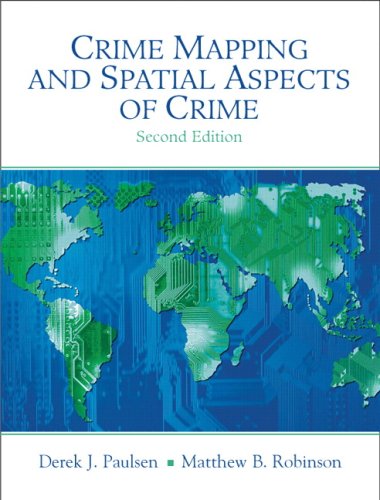
Crime Mapping and Spatial Aspects of Crime (2nd Edition)
Authors:
Derek J. Paulsen
Publisher:
Prentice Hall
Publication Date:
Not available
ISBN:
0205609457
Spatial Aspects of Crime: Theory and Practice is the first book specifically designed to teach the theoretical and practical aspects of mapping for... criminal justice purposes. First, the book provides a solid understanding of the theoretical and empirical realities of the spatial aspects of crime. Second, the book provides readers with the practical tools necessary to conduct effective crime mapping and spatial analyses of crime. This book covers the most current, state-of-the-art uses for GIS in the criminal justice system, theoretical aspects of the geography of crime and practical instruction, and exercises on how to use GIS to conduct crime mapping and spatial analysis of crime.
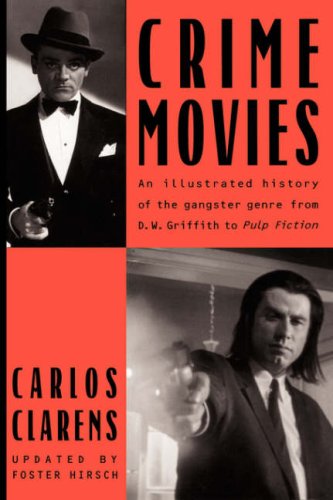
Crime Movies
Authors:
Carlos Clarens
Publisher:
Da Capo Press
Publication Date:
Not available
ISBN:
0306807688
Crime movies are as old as filmmaking itself. They embody the American nightmare, functioning both as a mirror of society and a tool for educating the... public about its enemies. In this history of the genre Carlos Clarens gives us a mini-history of crime American-style. From D. W. Griffith and New York's Biograph Studios, where raw violence was introduced to celluloid immortality, to today's multimillion-dollar celebrations of blood and power, Crime Movies shows us the whole picture: the unchanging cast of characters (the gangster hero, swaggering, charming, suspicious; the stoolpigeon or strikebreaker; the moll); the stars (James Cagney, Spencer Tracy, George Raft, Edward G. Robinson, Humphrey Bogart, Richard Widmark); the censorship battles, political pressure, and public outcry. This book illuminates movies such as Intolerance, Underworld, Little Caesar, Public Enemy, Kiss of Death, On the Waterfront, Bonnie and Clyde, The Godfather, Goodfellas, Reservoir Dogs, and hundreds of others, while detailing the film-making strategies Hollywood has adopted to deal with the controversial yet profitable and enduring subject of American criminality.
Crimenes Imperceptibles (Spanish Edition)
Authors:
Guillermo Martinez
Publisher:
Not available
Publication Date:
Not available
ISBN:
9875801577
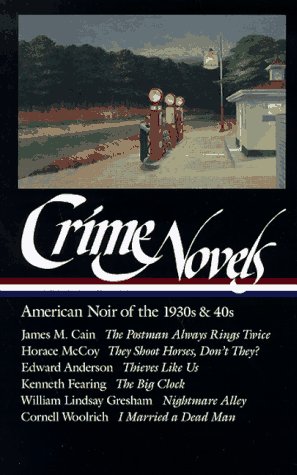
Crime Novels: American Noir of the 1930s & 40s
Authors:
Robert Polito
Publisher:
Library of America
Publication Date:
Not available
ISBN:
1883011469
The first collection in a two-volume set celebrating American crime fiction contains classic novels of the 1930s and 1940s, including The Postman... Always Rings Twice, Thieves Like Us, Nightmare Alley, The Big Clock, They Shoot Horses, Don't They?, and I Married a Dead Man. "

Crimen Y Castigo
Authors:
Not Available
Publisher:
Selector S.A. De C.V.
Publication Date:
Not available
ISBN:
9990032726
The comprehensive coverage in this hugely important and timely handbook makes it invaluable to clinical child, school, and counseling psychologists;... clinical social workers; and child psychiatrists. As a textbook for advanced clinical and counseling psychology programs, and a solid reference for the researcher in child/adolescent mental health, its emphasis on flexibility and attention to emerging issues will help readers meet ongoing challenges, as well as advance the field. Its relevance cannot be overstated, as growing numbers of young people have mental health problems requiring intervention, and current policy initiatives identify evidence-based therapies as the most effective and relevant forms of treatment.
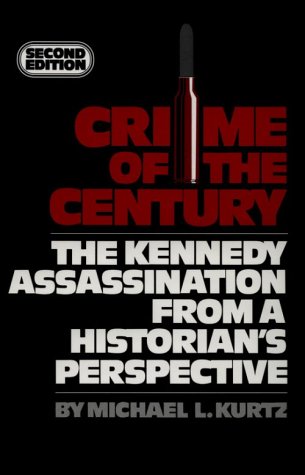
Crime Of Century: Kennedy Assassination From
Authors:
Michael L. Kurtz
Publisher:
Univ Tennessee Press
Publication Date:
Not available
ISBN:
087049824X
The assassination of President John F. Kennedy has generated countless books, virtually all of them heavily biased for or against the “lone... assassination” conclusion of the Warren Commission. Now, in the first scholarly treatment of the assassination, Michael Kurtz brings all the skills and objectivity of the professional historian to bear on the key question: “Who killed President Kennedy?”This book recounts the tragic events of November 22, 1963, and provides a detailed critical analysis of the investigations of the Warren Commission and the House Select Committee on Assassinations. Professor Kurtz outlines the major areas of controversy about the assassination and sifts all the known evidence before concluding that both official inquiries failed to evaluate the considerable evidence of an assassination conspiracy. Operating on the a priori assumption that Lee Harvey Oswald was guilty, the Commission and the Committee both ignored and distorted the overwhelming evidence that more than one assassin fired shots at the president. Professor Kurtz also shows why the most prevalent conspiracy theories fail to fit the facts and concludes by offering a new and more plausible theory of how the assassination occurred.Thoroughly documented and based on the most exhaustive research carried out to date on John Kennedy’s murder, Crime of the Century draws on a variety of primary source materials from the National Archives and the FBI’s and CIA’s declassified assassination files. It utilizes the latest source materials released by the House Select Committee’s investigation. The depth of research, the rigorously objective sifting of evidence, and the incisive critique of official investigative bias make this a book of importance not only to students of the Kennedy assassination in particular, but also to scholars of government response to political violence in general.Michael L. Kurtz is professor of history at Southeastern Louisiana University, Hammond, Louisiana. He is co-author of LOUISIANA: A HISTORY and was associate editor for READINGS IN LOUISIANA HISTORY.
Crime On-line: Correlates, Causes, and Context
Authors:
Thomas J. Holt
Publisher:
Carolina Academic Press
Publication Date:
Not available
ISBN:
1594607818
The ubiquity of computers and the Internet have drastically changed the landscape of crime and deviance. This book provides detailed criminological... explorations of multiple forms of cybercrime--including phishing, hacking, and sex crimes--and the law enforcement response using empirical tests and unique data. This work will prove invaluable to academics, law enforcement, legal counsel, and students at the undergraduate and graduate levels.
Crime on the Border: Immigration and Homicide in Urban Communities...
Authors:
Matthew T. Lee
Publisher:
LFB Scholarly Publishing LLC
Publication Date:
Not available
ISBN:
1931202702
Studying El Paso, Miami, and San Diego over the years 1985-1995, Lee explores the complex relationship between ethnicity, immigration, and homicide.... Popular opinion and sociological theory, particularly the social disorganization perspective, predict that immigration should increase levels of homicide where immigrants settle, but LeeÕs analysis (statistical, spatial, and temporal) generally finds that this is not the case. His results cast doubt on the taken-for-granted idea that immigration disrupts communities, weakens social control, and increases homicide levels. Rather, recent arrivals appear to play a positive role in these three cities, suggesting that conventional theories of crime be re-examined in light of the potentially revitalizing impact of immigration.
Crime Prevention
Authors:
David Mackey
Publisher:
Jones & Bartlett Learning
Publication Date:
Not available
ISBN:
1449615937
Written By A Collection Of Scholarly Experts, Crime Prevention Presents Significant Issues Related To Contemporary Crime Prevention Efforts.... Interdisciplinary In Its Approach, The Text Is Written For Courses Within A Criminal Justice Or Sociology Curriculum. Co-Editor And Author, David Mackey Begins By Emphasizing The Importance Of Crime Prevention As It Relates To Financial And Social Costs And Introduces Students To The Theoretical Models Of Crime Prevention. The Subsequent Order Of The Chapters Parallels The Medical Model Of Crime Prevention Moving From Primary Crime Prevention, Secondary Crime Prevention, And Tertiary Crime Prevention Efforts. Traditional Areas Of Crime Prevention Are Reflected In The Chapters On Family/Schools, Guns, Policing, Sentencing, And Correctional Programs, And Additional Chapters Cover Emerging Areas Now Considered Critical To Crime Prevention, Such As Technology, Surveillance, And Specific Efforts To Protect More Vulnerable Populations. Key Features: - Includes A Comprehensive Look At The Many Facets Of Crime Prevention, Merging Both The Theory And Practice. - Provides A Comprehensive Discussion On A Range Of Crime Prevention Topics While Incorporating A Theoretical Foundation, A Look At Previous Research, And Existing Policy Analysis. - Includes The Most Recent Data In The Field, Acknowledging The Recent Changes In Crime Prevention Due To Increased Awareness Of Terrorism And Advances In Technological Capabilities. Resources: - Instructor Resources Include A Complete Test Bank And Powerpoint Lecture Outlines.
Crime Prevention and the Built Environment
Authors:
Richard H. Schneider and Ted Kitchen
Publisher:
Routledge
Publication Date:
Not available
ISBN:
0415373255
With a comprehensive analysis, this book links theory, evidence and practical application to bridge gaps between planning, design and criminology. The... authors investigate connections between crime prevention and development planning with an international approach, looking at initiatives in the field and incorporating an understanding of current responses to the growth of technology and terrorism.

Crime Prevention: Approaches, Practices and Evaluations
Authors:
Steven P. Lab
Publisher:
Not available
Publication Date:
Not available
ISBN:
Not available
Crime Prevention in America
Authors:
Dean J. Champion
Publisher:
Prentice Hall
Publication Date:
Not available
ISBN:
0132253771
Crime prevention is multidimensional: Police, community residents, the courts, the correctional community and intervention programs all play a role in... it. Crime Prevention in the United States is a collection of readings that explore each area of crime prevention including its history; the impact of law enforcement, the courts, and corrections; juvenile delinquency and its prevention; and crime prevention programs for selected offenses. Drawing on a variety of sources, these forty-nine articles address the most compelling issues in crime prevention such as early intervention techniques, crime mapping, sentencing strategies, program evaluations and more! The media’s coverage of crime and victimization; Cybercrime; Terrorism; COMPSTAT; Crime mapping; State sentencing schemes; Juvenile treatment services and intervention programs; Education and therapy for the incarcerated; Electronic monitoring; Problem-solving probation; Restitution; Parole; Crimes against the elderly; Assault prevention. Includes articles from the Journal of Criminal Justice and Popular Culture, the FBI Law Enforcement Bulletin, the Homeland Security office, Corrections Today, Criminology and Public Policy, Federal Probation and more! Anyone involved or interested in crime prevention and law enforcement.
Crime Prevention, Seventh Edition: Approaches, Practices and...
Authors:
Steven P. Lab
Publisher:
Anderson
Publication Date:
Not available
ISBN:
1422463273
This book examines several types of crime prevention approaches and their goals, including those that are designed to prevent conditions that foster... deviance, those directed toward persons or conditions with a high potential for deviance, and those for persons who have already committed crimes. This edition provides research and information on all aspects of crime prevention, including the physical environment and crime, neighborhood crime prevention, the mass media and crime prevention, crime displacement and diffusion, prediction, community policing, drugs, schools, and electronic monitoring and home confinement.Key terms and learning objectives supplement each chapter. A glossary defines terms from the text.
Crime Profiles: The Anatomy of Dangerous Persons, Places, and...
Authors:
Terance D. Miethe
Publisher:
Oxford University Press, USA
Publication Date:
Not available
ISBN:
0195330552
The third edition of this thought-provoking text addresses the following questions about crime:* Who are the offenders and victims?* What are the major... motivators of crime?* Are most offenders specialists or generalists?* Are most offenders planners or opportunists?* What are their criminal histories?* How often are co-offenders involved?* What are the common features of dangerous places, times, and situational dynamics?* How effective are current crime prevention strategies?Crime Profiles provides a descriptive summary of seven major forms of crime: homicide and aggravated assault, sexual assault, robbery, burglary, motor vehicle theft, occupational and organizational crime, and public order crimes.The new edition provides an extensive update of the material in each chapter. Each chapter now includes national crime reports and national victimization surveys for 2003, the most recently available data. A new chapter has been added on theories of crime. New examples are also used to illustrate both change and stability in the type of situations in which particular crimes occur. Each chapter focuses on crime definitions, trends in their occurrence, the offender and victim profiles, situational elements and circumstances, particular subsets of crime syndromes, prevention, and intervention strategies.
 '





