production
/viewbook/list/all/?page=3018
/
/static/
None
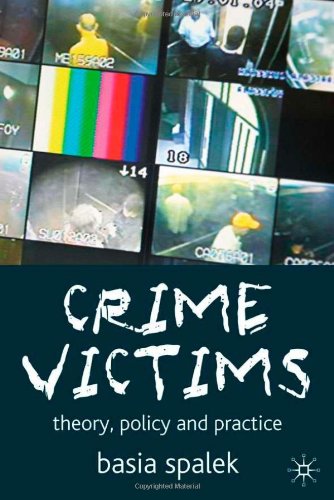
Crime Victims: Theory, Policy and Practice
Authors:
Basia Spalek
Publisher:
Palgrave Macmillan
Publication Date:
Not available
ISBN:
1403935424
This text offers a much-needed overview of theory and practice in the topical area of crime, victimization, and criminal justice policy. Spalek explores... the impact of crime upon victims, looks at the establishment of victim initiatives, and pushes debates in the area forward. Engagingly presented with case studies and questions drawn from high-profile cases such as the Oklahoma City bombing.

CRIME VICTIMS W. PAC SSO CARRERS IN CRJ
Authors:
Not Available
Publisher:
Not available
Publication Date:
Not available
ISBN:
Not available
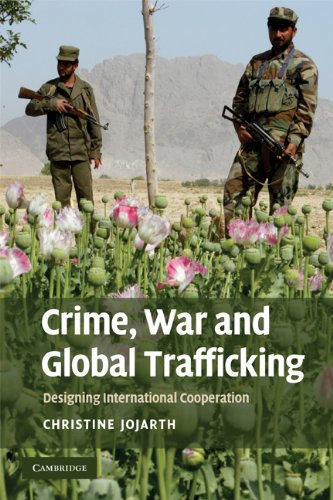
Crime, War, and Global Trafficking: Designing International...
Authors:
Christine Jojarth PhD
Publisher:
Cambridge University Press
Publication Date:
Not available
ISBN:
0521713765
Globalization creates lucrative opportunities for traffickers of drugs, dirty money, blood diamonds, weapons, and other contraband. Effective... countermeasures require international collaboration, but what if some countries suffer while others profit from illicit trade? Only international institutions with strong compliance mechanisms can ensure that profiteers will not dodge their law enforcement responsibilities. However, the effectiveness of these institutions may also depend on their ability to flexibly adjust to fast-changing environments. Combining international legal theory and transaction cost economics, this book develops a novel, comprehensive framework which reveals the factors that determine the optimal balance between institutional credibility and flexibility. The author tests this rational design paradigm on four recent anti-trafficking efforts: narcotics, money laundering, conflict diamonds, and small arms. She sheds light on the reasons why policymakers sometimes adopt suboptimal design solutions and unearths a nascent trend toward innovative forms of international cooperation which transcend the limitations of national sovereignty.
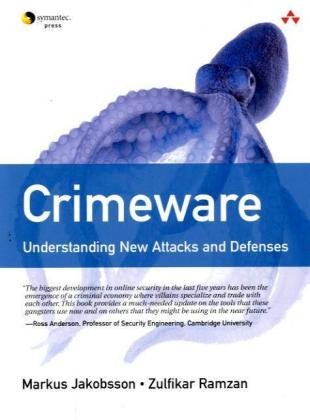
Crimeware: Understanding New Attacks and Defenses
Authors:
Markus Jakobsson
Publisher:
Addison-Wesley Professional
Publication Date:
Not available
ISBN:
0321501950
“This book is the most current and comprehensive analysis of the state of Internet security threats right now. The review of current issues and... predictions about problems years away are critical for truly understanding crimeware. Every concerned person should have a copy and use it for reference.” —Garth Bruen, Project KnujOn Designer There’s a new breed of online predators—serious criminals intent on stealing big bucks and top-secret information—and their weapons of choice are a dangerous array of tools called “crimeware.” With an ever-growing number of companies, organizations, and individuals turning to the Internet to get things done, there’s an urgent need to understand and prevent these online threats. Crimeware: Understanding New Attacks and Defenses will help security professionals, technical managers, students, and researchers understand and prevent specific crimeware threats. This book guides you through the essential security principles, techniques, and countermeasures to keep you one step ahead of the criminals, regardless of evolving technology and tactics. Security experts Markus Jakobsson and Zulfikar Ramzan have brought together chapter contributors who are among the best and the brightest in the security industry. Together, they will help you understand how crimeware works, how to identify it, and how to prevent future attacks before your company’s valuable information falls into the wrong hands. In self-contained chapters that go into varying degrees of depth, the book provides a thorough overview of crimeware, including not only concepts prevalent in the wild, but also ideas that so far have only been seen inside the laboratory. With this book, you will Understand current and emerging security threats including rootkits, bot networks, spyware, adware, and click fraud Recognize the interaction between various crimeware threats Gain awareness of the social, political, and legal implications of these threats Learn valuable countermeasures to stop crimeware in its tracks, now and in the future Acquire insight into future security trends and threats, and create an effective defense plan With contributions by Gary McGraw, Andrew Tanenbaum, Dave Cole, Oliver Friedrichs, Peter Ferrie, and others.
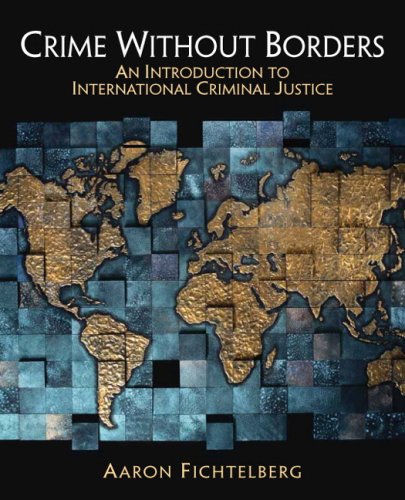
Crime Without Borders: An Introduction to International Criminal...
Authors:
Aaron Fichtelberg
Publisher:
Prentice Hall
Publication Date:
Not available
ISBN:
0132319926
Crime Wthout Borders examines the globalization of crime and justice in today’s contemporary society. It not only discusses the nuts and bolts of... international crime and international law enforcement, but also raises abstract, theoretical issues for debate and asks critical questions about the best ways to think about international criminal justice problems. Throughout the book, it places global crime within the context of contemporary politics and current events. Hot topics such as terrorism, drug trafficking, and cybercrime are addressed throughout and connections between globalization, politics and criminal justice reflect the modern realities of international and transnational crime.
Criminal Appellate Procedure, Cases and Materials (American Casebook)
Authors:
James A. Strazzella
Publisher:
West
Publication Date:
Not available
ISBN:
0314267573
This casebook fills a niche for in-depth teaching materials on appellate procedure in federal and state criminal cases. It uses edited opinions together... with constitutional provisions and statutes to provide a substantial platform for enhancing case-reading skills and analytical ability while exploring basic appellate procedure doctrine. Notes and questions tie appeals to trial processes and offer broadened historical, comparative, and terminology insights. It covers purposes of appeal, limitations and conditions on appeal rights (e.g., plea limitations, final decision, harmless error, forfeiture principles, standards of review, and abatement), and the ancillary rights afforded defendants (e.g., the right to counsel, transcripts, bail). There is an in-depth chapter on prosecution appeals and double jeopardy which provides particular insights into the relation of appellate procedure to trial court procedure. This book may be used in an advanced capstone elective course focusing on doctrine; or, it can be used for a basic course for beginning law students to build more basic skills.
Criminal Behavior
Authors:
Elaine Cassel
Publisher:
Psychology Press
Publication Date:
Not available
ISBN:
0805848924
Criminal Behavior explores crime as a developmental process from birth through early adulthood. It further examines the role that legal, political, and... criminal justice systems play in the development of criminal behavior. Criminal Behavior: takes into account biological, genetic, developmental, familial, social, educational, cultural, political, and economic factors correlated with crime; references actual cases and events to serve as examples of the principles introduced; critically examines the roles of the criminal and juvenile justice systems and methods of punishment in the development of and response to criminal behavior; explores the effects of crime on victims and looks at correlations between crimes and victim characteristics and behaviors; examines the role of childhood and adolescent behavioral and mental health disorders in the development of criminal behavior; and investigates the differences between criminals and the rest of society, and the differences and similarities between and among criminals. Chock-full of personal anecdotes, this engaging text is unique in that it combines the experience of Doug Bernstein, a clinical psychologist and a successful textbook author, and Elaine Cassel, a practicing attorney who regularly teaches psychology and law. Organized around five dimensions related to the causes, characteristics, and consequences of crime, the book summarizes the programs that research suggest offer the best hope for doing a better job of dealing with crime in the 21st century. The authors argue that prevention is the key to dealing with crime, and present comprehensive suggestions for crime prevention. The new edition features the latest criminal statistics available, as well as the most current research on the causes and correlations of crime and violence. Other highlights include: discussion of the latest brain-imaging research in psychopathy - how psychopaths' brains are different from "normal" brains; the latest on gang activities and how their venues have migrated to suburban and rural areas; terrorism and its roots; Internet crimes, especially sexual predator crimes; the latest research on how media violence, especially violent interactive video games, contributes to criminal behavior; the examination of drug and mental health courts as alternatives to punishment; and recent Supreme Court rulings eliminating the death penalty for juveniles and the mentally retarded. Intended as a textbook for upper-level courses on criminal behavior, psychology and law, and developmental psychopathology taught in departments of psychology, criminology, criminal justice, law, and sociology and/or criminal justice training academies.
Criminal Behavior: A Process Psychology Analysis
Authors:
Nathaniel J. Pallone
Publisher:
Transaction Publishers
Publication Date:
Not available
ISBN:
156000729X
Crime Statistics suggest that Americans are not a notably law-abiding people. With some 13 million felonies reported every year, it is not surprising... that few topics engage public attention and imagination more compellingly than the dynamics of criminal behavior. Volume and ubiquity alone might suggest the psychology of criminal behavior is well understood and there exists an integrated body of explanatory theory and empirical evidence. But in fact only fragmentary and incomplete accounts have thus far appeared. Criminal Behavior is virtually unique in providing a comprehensive psychological paradigm that fits across variant species of crime, while meeting the requirements of science and the needs of law enforcement and administration of justice in controlling criminal behavior. The authors begin this remarkable text by outlining a model for criminal behavior based not on abnormal psychology but on the tenets of social learning theory. They illuminate the processes by which criminal activity is initiated and repeated, including personal constructs, stimulus determinants, and behavioral repertoires. They define four process elements that interact in precipitating criminal behavior-inclination, opportunity, expectation of reward, expectation of impunity. They show how these process elements are regulated and confined by a series of complex and variable boundary conditions in specific criminal offenses. Conceptual, methodological, and operational constraints on the study of criminal behavior are defined, and statistically and behavioral science data bearing upon larceny and homicide, two crimes at diametric extremes, are examined in detail. Pallone and Hennessy locate and define those psychological variables that render comprehensible the process whereby formally criminal acts are construed as possible and desirable by individual actors and show how those actors self-select psychosocial environments that facilitate or at least do not impede the commission of crime. They identify and explain the phenomenon of “tinderbox violence.” Its comprehensive perspective and balanced consideration of competing viewpoints make Criminal Behavior an ideal text for students and teachers of criminology and of the psychology of criminal behavior. It is also a pioneering work for psychologists, sociologists, criminologists, and law-enforcement official.
Criminal Behavior: A Psychological Approach (9th Edition)
Authors:
Curt R. Bartol
Publisher:
Prentice Hall
Publication Date:
Not available
ISBN:
0135050502
CRIMINAL BEHAVIOR: A PSYCHOLOGICAL APPROACH, 9/e approaches the understanding of delinquent and criminal behavior from a psychological... perspective—with particular focus on the developmental, cognitive-behavioral aspects of offending. Viewing the juvenile and adult offender as being embedded and continually influenced by multiple systems, it highlights how psychological, social, economic, political and ecological factors all play a role in influencing individual behavior. Streamlined in this edition, it offers a separate chapter on delinquency, updated examples and more on the link between psychology and specific crimes.
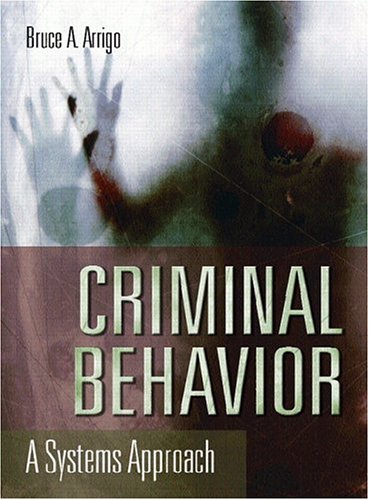
Criminal Behavior: A Systems Approach
Authors:
Bruce A. Arrigo
Publisher:
Prentice Hall
Publication Date:
Not available
ISBN:
0131915215
Criminal Behavior: A Systems Approach strikes a sensible, reader-friendly, and insightful balance between explaining crime and delinquency and... interpreting human behavior. In this way, the emerging insights of criminal justice and the unique values of psychology are strategically brought to bear on what conduct society defines as criminal. Utilizing a “systems” approach, the book skillfully and methodically addresses relevant theories of criminal behavior, various types of violent and non-violent crimes and criminals and institutional and organizational responses to crime and criminal behavior. For careers in Criminology.
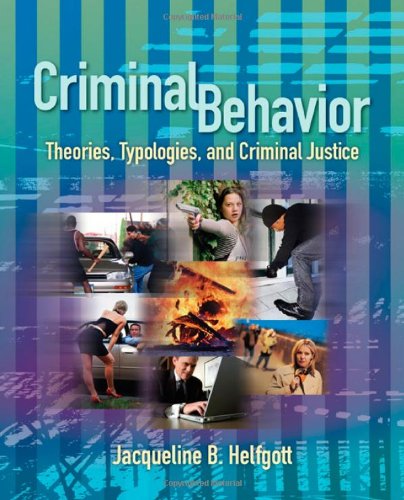
Criminal Behavior: Theories, Typologies and Criminal Justice
Authors:
Jacqueline B. Helfgott
Publisher:
Sage Publications, Inc
Publication Date:
Not available
ISBN:
1412904870
Rich in historical and contemporary theory and research, Criminal Behavior: Theories, Typologies, and Criminal Justice is a comprehensive core text... that provides an interdisciplinary overview of criminal behavior by examining relevant crime theories, explanations of how and why crime typologies are developed, literature reviews for major crime categories, and discussions of how crime theories and crime typologies are used throughout the criminal justice process. Focusing on relevant themes and current issues, this text also looks closely at categorizations of criminal behavior, the relationship between crime and pop culture, mass media, and computer technology, and gender issues and crime. This engaging book applies theory and research to real-world criminal justice practice. Key Features and Benefits:Applies theory and research to concrete examples of criminal justice practice in law enforcement, public safety, courts/law, and correctionsExplores real-world examples and contemporary issues–using chapter-opening vignettes, illustrative photos and graphs, boxed real-life case studies, and an interdisciplinary framework-making the text lively and engagingViews crime as a dynamic, changing phenomenon and examines how mass media and computer technology shape criminal behavior in a unique chapter on crime, media, and technology that addresses cybercrime and copy cat crimes-topics that fascinate studentsExamines feminist issues and cultural criminology, reviewing the role of gender and culture in shaping criminal behaviorBoasts full chapters on political crime and economic crime-subjects often ignored in other texts Includes comparative information throughout, giving students an international perspective, as well as topical coverage relating to race, ethnicity, and gender issuesAncillariesA Student study site at www.sagepub.com/helfgottstudy includes self-quizzes, e-flashcards, NPR and Frontline audio and video clips, SAGE Journal articles, and more. Instructor Resources on CD include test questions, PowerPoint slides, and in-class exercises. Contact Customer Care at 1.800.818.7243 to request a copy. Intended Audience This core text offers contemporary insight on criminal behavior for undergraduate and graduate students in criminology and criminal justice, psychology, and related fields.
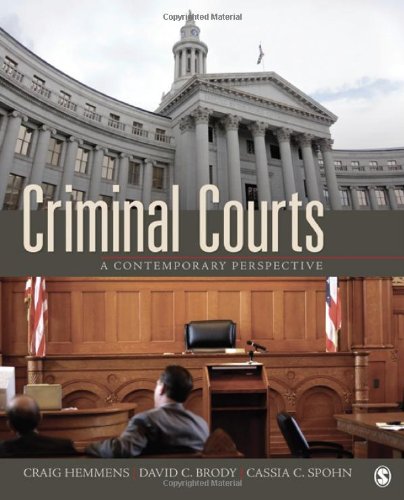
Criminal Courts: A Contemporary Perspective
Authors:
Craig T. Hemmens
Publisher:
Sage Publications, Inc
Publication Date:
Not available
ISBN:
1412979560
Written by three leaders in the field, this comprehensive and accessible text for undergraduate courses explores all conventional topics (court... structure, courtroom actors, and the trial and appeal process) as well as others seldom covered. The text first reviews the judicial function, the role and purpose of law, sources of law, the various types of law, and the American court system structure and operations, both state and federal. The participants in the system are discussed next, followed by the pretrial, trial, and posttrial processes. A wealth of pedagogical tools adds valuable related content, ranging from the points of view of court process participants to comparative information to hotly debated topics. Key FeaturesThorough coverage of topics typically omitted or treated briefly elsewhere, including judicial decision making, specialized courts, and comparative court systems“View From the Field” features topics from the perspective of a participant in the process, from a criminal defense attorney to a U.S. District Court judge“Controversial Issues” boxes provide balanced views of current issues, encouraging classroom discussion and sparking student interest“Comparative Courts” inserts provide students with a glimpse of how courts around the world approach a topic discussed in the chapter“Current Research” boxes present current social science research and show how research can help policymakers and those in the court system evaluate and implement processes and programs
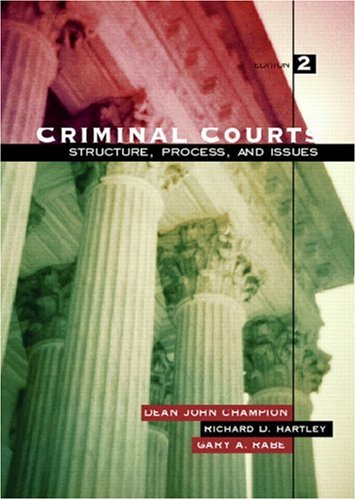
Criminal Courts: Structure, Process, and Issues (2nd Edition)
Authors:
Dean J. Champion
Publisher:
Prentice Hall
Publication Date:
Not available
ISBN:
0131189794
Provides a comprehensive examination of the criminal court system, from the basic pretrial procedures, to the trial process, to the sentencing and... appeals. Examining all angles, it begins with a discussion of the law and its origins, compares the federal and state court systems, and examines the key courtroom personnel. Separate chapters on the juvenile justice system and the courts and the media round out the book’s coverage. References to key cases, articles from local newspapers and examples of real courts in action add practicality and a deeper understanding of the structure, process and issues surrounding criminal courts today. Comparison of state and federal court systems. Explains the diverse court systems that exist on the state and local level and the more consistent organization of the federal level. Comprehensive examination of the trial process. Discusses the difference between “bench” and “jury” trials, where either the judge or the jury will decide on their case. Includes opening and closing arguments, examination and cross-examination, and other aspects of presentation of testimony and evidence. Discussion of the major sentencing systems. Explains the differences between indeterminate, determinate, mandatory, and guidelines-based or presumptive sentencing. Separate discussion of the juvenile court system. Examines the language that applies to juvenile processing and highlights similarities and differences between the juvenile and criminal justice systems. A chapter on the courts and the media. Shows how the Internet and television are used in the courtroom and examines the role it has played in the increase in litigation today. Key state and federal cases concerning court actions and defendant rights. Highlights important case law that has impacted the way courts process offenders. Law Enforcement professionals and those involved or interested in the criminal court system.
Criminal Courts: Structure, Process, and Issues (3rd Edition)
Authors:
Dean J. Champion
Publisher:
Prentice Hall
Publication Date:
Not available
ISBN:
0132457792
Criminal Courts: Structure, Process, and Issues, 3e provides a comprehensive examination of the criminal court system, from basic pretrial... procedures, to the trial process, to sentencing and appeals. It begins with a discussion of the law and its origins, compares the federal and state court systems, and examines the key courtroom personnel. This edition includes separate chapters on the juvenile justice system and juvenile courts, and a new chapter on diversion, alternative dispute resolution and specialty courts. Key cases, newspaper articles, and real court examples add practicality and provide a deeper understanding of the issues surrounding criminal courts today.
Criminal Dilemmas: Understanding and Preventing Crime (Studies in...
Authors:
Katri K. Sieberg
Publisher:
Springer
Publication Date:
Not available
ISBN:
3540240098
An analysis of criminal behavior from the perspectives of rational choice theory leading to suggestions for a criminal policy. Previous edition sold... 900 copies world wide since its release in June 2001.
 '





