production
/viewbook/list/all/?page=3051
/
/static/
None
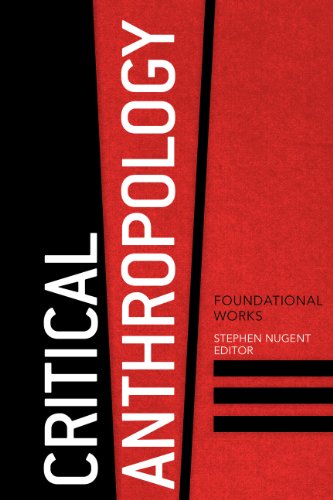
Critical Anthropology: Foundational Works
Authors:
Not Available
Publisher:
Left Coast Press
Publication Date:
Not available
ISBN:
1611321786
Critical anthropology has had a major influence on the discipline, shifting it away from concepts of bounded societies with evolutionary trajectories to... complex analyses of interconnected economic, political, and social processes. This book brings together some of critical anthropology’s most influential writings, collecting classic articles and spirited rebuttals by major scholars such as Eric Wolf, Marshall Sahlins, Sidney Mintz, Andre Gunder Frank, and Michael Taussig. Editor Stephen Nugent positions these key debates, originally published in the journal Critique of Anthropology, with new introductions that detail the lasting influence of these articles on anthropology over four decades, showing how critical anthropology is relevant today more than ever. An ideal supplementary text, this book is a rich exploration of intellectual history that will continue to shape anthropology for decades to come.

Critical Anthropology Now: Unexpected Contexts, Shifting...
Authors:
George E. Marcus
Publisher:
SAR Press
Publication Date:
Not available
ISBN:
0933452519
Ten innovative ethnographic projects demonstrate how new and more complicated locations of research from the boardrooms of multinational corporations to... the chat rooms of the Internet are giving rise to shifts in the character of both fieldwork and fieldworker. They also affirm that social scientists participate in a regime of power and knowledge similar to those found in corporations, the military, finance, politics, and science and technology.

Critical Appraisal of Epidemiological Studies and Clinical Trials...
Authors:
Mark Elwood
Publisher:
Oxford University Press, USA
Publication Date:
Not available
ISBN:
0198529554
This book presents a logical system of critical appraisal, to allow readers to evaluate studies and to carry out their own studies more effectively. ... This system emphasizes the central importance of cause and effect relationships. Its great strength is that it is applicable to a wide range of issues, and both to intervention trials and observational studies. This system unifies the often different approaches used in epidemiology, health services research, clinical trials, and evidence-based medicine, starting from a logical consideration of cause and effect. The author's approach to the issues of study design, selection of subjects, bias, confounding, and the place of statistical methods has been praised for its clarity and interest. Systematic reviews, meta-analysis, and the applications of this logic to evidence-based medicine, knowledge-based health care, and health practice and policy are discussed. Current and often controversial examples are used, including screening for prostate cancer, publication bias in psychiatry, public health issues in developing countries, and conflicts between observational studies and randomized trials. Statistical issues are explained clearly without complex mathematics, and the most useful methods are summarized in the appendix. The final chapters give six applications of the critical appraisal of major studies; randomized trials of medical treatment and prevention, a prospective and a retrospective cohort study, a small matched case-control study, and a large case-control study. In these chapters, sections of the original papers are reproduced and the original studies places in context by a summary of current developments.

Critical Approaches to International Security
Authors:
Karin M. Fierke
Publisher:
Polity
Publication Date:
Not available
ISBN:
0745632939
During the Cold War the concept of international security was traditionally understood in military terms as the threat or use of force by states. The... end of East-West hostilities, however, brought new 'critical' perspectives to the fore as scholars sought to explain the emergence of new challenges to international stability, such as environmental degradation, immigration and terrorism. 'Critical Approaches to International Security' is the first book to offer a wide-ranging and comprehensive analysis of the field of critical security studies. It maps the evolution of debates about security from the end of the Cold War to the present day, arguing that the conceptual and methodological innovations of critical security studies are crucial for understanding many contemporary international developments. Organized around a range of core concepts that have defined various critical approaches, the book guides the reader through a wide range of literature and debates. Topics covered include: the relationship between security and change, identity, the production of danger, trauma, human insecurity and emancipation. The book explores the meaning and use of these concepts and their relevance to real-life situations ranging from NATO expansion, conflict in the Balkans, migration, suffering in war, failed states and state-building, the war on terror and Hurricane Katrina. This book makes a significant and original contribution to the study of international relations and security studies and will be of great value to students and scholars of international relations and security studies.
Critical Approaches to Television
Authors:
Leah R. Vande Berg
Publisher:
Houghton Mifflin College Div
Publication Date:
Not available
ISBN:
0618206744
This comprehensive text provides a broad overview of television criticism through the explanation of theoretical foundations, analyses of critical... approaches, and sample critical essays, eliminating the need for multiple texts. Students increase their understanding of material through introductory essays in every chapter, headnotes for articles, marginal annotations, and analysis writing exercises. In addition, each chapter offers suggestions for relevant web sites and readings.The text is organized by critical method, but includes an alternative table of contents for instructors who prefer to teach by genre.New! The instructor web site includes a wealth of teaching resources and the student site hosts ACE self-tests and other activities that will increase understanding of the material.New! More emphasis has been placed on theoretical and critical foundations.New! The methods of criticism now include Theoretical and Critical Foundations, Text Centered, Producer Centered, and Reception Centered.New! The final chapter reflects new thoughts about the current and future affects of television and how television has effected society, as well as ethical considerations regarding this media.
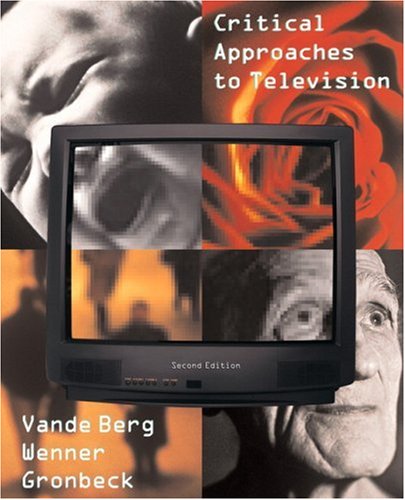
Critical Approaches to Television (2nd Edition)
Authors:
Leah R Vande Berg
Publisher:
Pearson
Publication Date:
Not available
ISBN:
0205564666
I. Theoretical and Critical Foundations 1. The Context for Criticism: Television and Society 2. Foundations of Television Criticism 3.... Critical Approaches to Television Discourse: An Overview 4. Writing Television Criticism II. Text-Centered Critical Approaches 5. Semiotic/Structural Criticism A Sample Study: John Fiske's "Popularity and Ideology: A Structuralist Reading of Dr. Who" 6. Genre Criticism A Sample Study: Matthew P. McAllister's "Recombinant Television Genres and Doogie Howser, M.D." 7. Rhetorical Criticism Two Sample Studies: Bonnie Dow's "Murphy Brown: Postfeminism Personified"; Sarah R. Stein's, "The 1984 Macintosh Ad: Cinematic Icons and Constitutive Rhetoric in the Launch of a New Machine" 8. Narrative Criticism A Sample Study: Bruce E. Gronbeck's "The Visual and Narrative Rhetoric of Redemption: American Culture Responds to 9/11" III. Producer-Centered Approaches 9. Auteur Criticism A Sample Study: Richard Campbell and Jimme L. Reeves's "Television Authors: The Case of Hugh Wilson" 10. Production Context Criticism A Sample Study: Elana Levine's "Toward a Paradigm for Media Production Research: Behind the Scenes at General Hospital" 11. Ideological Criticism A Sample Study: Mark P. Orbe's "Constructions of Reality on MTV's The Real World: An Analysis of the Restrictive Coding of Black Masculinity" IV. Reception-Centered Approaches 12. Reader-Oriented Criticism A Sample Study: Lawrence A. Wenner's "The Dream Team, Communicative Dirt, and the Marketing of Synergy: USA Basketball and Cross-Merchandising in Television Commercials" 13. Audience Ethnographic Criticism A Sample Study: Rona Tamiko Halualani and Leah R. Vande Berg's "'Asian or American': Meanings In, Through, and Around All-American Girl" 14. Cultural Criticism: General Approaches Two Sample Studies: Heather L. Hundley's "The Naturalization of Beer in Cheers; Cathy Sandeen's "Success Defined by Television: The Value System Promoted by PM Magazine" 15. Cultural Criticism: Mythic, Feminist, and Psychoanalytic Approaches Three Sample Studies: Susan Owen's "Vampires, Postmodernity and Postfeminism: Buffy the Vampire Slayer"; Robert Westerfelhaus and Teresa A. Combs's "Criminal Investigations and Spiritual Quests: The X-Files as an Example of Hegemonic Concordance in Mass-Mediated Society"; Sonia Livingstone and Tamar Liebes's "Where Have All the Mothers Gone? Soap Opera's Replaying of the Oedipal Story" V. Ethics and the Critical Approach 16. Television, Ethics, and Criticism
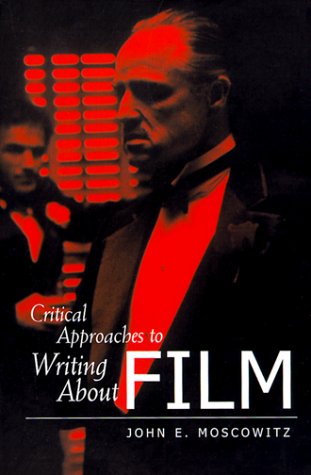
Critical Approaches to Writing About Film
Authors:
John E. Moscowitz
Publisher:
Longman
Publication Date:
Not available
ISBN:
0130837075
This book explains how to prepare for and write various types of critical pieces on film. It distinguishes the four main critical formats of writing... about film—the review, the critique, the comparative analysis and the documented research paper—from each other (why, when, and how to use each and the different aspects within each). The book provides theory, discussion, component examples and full samples of all formats discussed. The book also provides exercises and strategies to prepare the critic to watch the film and write a first draft. B> preparation for and the process of film criticism, style and structure in film criticism, the review, the analytical critique, the comparative analysis, the documented research paper, primary and secondary sources of works guidelines and an index of names and titles. For anyone interested in critiquing films for personal interest or professional writing.
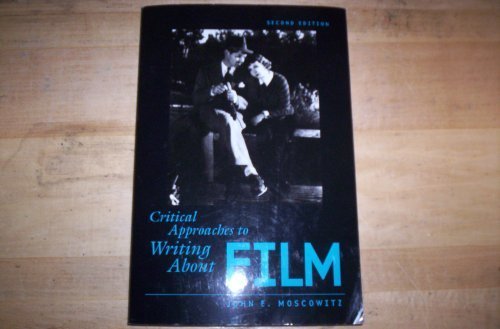
Critical Approaches to Writing About Film (2nd Edition) Broward...
Authors:
John E. Moscowitz
Publisher:
Pearson Custom Publishing
Publication Date:
Not available
ISBN:
0536124132
You Are There, a classic of television's Golden Age, was produced from 1953 to 1955. Each episode, 'reported' by such journalists as Mike Wallace,... Walter Cronkite, and Bill Leonard, investigated a historical event as if it were current breaking news. The series starred such luminaries as James Dean, Paul Newman, Rod Steiger, John Cassevetes, and Lorne Greene. Not able to officially work on the programme, they submitted their scripts through 'fronts'. (This volume re-establishes screen credit for ten of Polonsky's episodes.) Polonsky was blacklisted until 1968. In this volume: Cortez Conquers Mexico; The Crisis of Galileo; The Fate of Nathan Hale; The Secret of Sigmund Freud; The Recognition of Michelangelo; The Vindication of Savonarola; Mallory's Tragedy on Mt Everest; The Emergence of Jazz; The Torment of Beethoven; The Tragedy of John Milton.
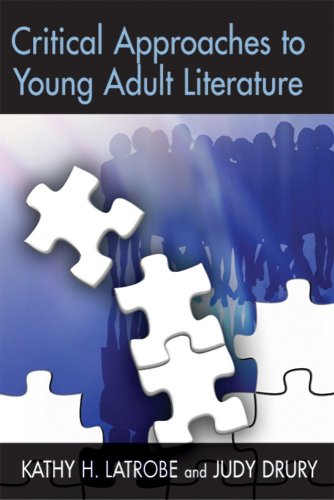
Critical Approaches to Young Adult Literature
Authors:
Kathy H. Latrobe
Publisher:
Neal-Schuman Publishers, Inc.
Publication Date:
Not available
ISBN:
1555705642
With today's digital natives, educators face new challenges in guiding young adults to discovery of the critical thinking and enjoyment that comes from... lifelong literacy not to mention simply reading simply for pleasure. For anyone seeking to hone their skills as a guide to YA reading, Latrobe and Drury give you a theoretical basis for your programming with cogent explanations of eight critical theories of literature: New Criticism/Formal Criticism; Psychological Criticism; Sociological Criticism: Relationships in Context; Historical Criticism; Gender Criticism: Opposite Sexes or Neighboring Sexes; Archetypal/Mythological Criticism; Popular Culture and Criticism; and, Reader-Response: A Unique Literary Event. "Critical Approaches to Young Adult Literature" is for librarians in school and public libraries (plus their colleagues across the curriculum) who strive for collections and programming that elicit thoughtful responses and build higher-level literacy skills across grades 6-12. In this book and CD ROM set, the authors explore all facets of creating a vibrant YA reading community such as inquiry-based learning, promoting and motivating reading, collection management, understanding multiple intelligences, accepting diverse beliefs, and acting as a change agent to name a few. Latrobe and Drury also provide basic questions designed to involve young people, activities to encourage critical responses and bibliographies of YA books with annotations. Time-saving author, title, and subject indexes round-out the work, along with appendices so you'll have reviewing media, YA awards and YA magazines at your fingertips.

CRITICAL APPROACH TO SIGHT SINGING & MUSICAL STYLE: VOLUME 1
Authors:
Not Available
Publisher:
Not available
Publication Date:
Not available
ISBN:
Not available
CRITICAL APPROACH TO SIGHT SINGING VOL 2 (V2)
Authors:
Not Available
Publisher:
Not available
Publication Date:
Not available
ISBN:
Not available
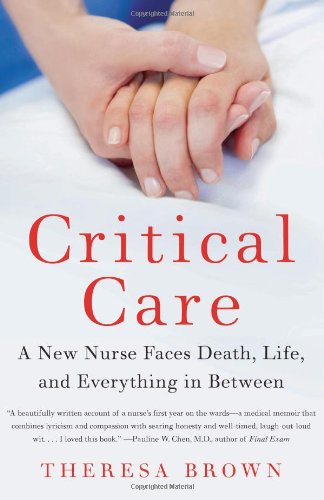
Critical Care: A New Nurse Faces Death, Life, and Everything in...
Authors:
Theresa Brown
Publisher:
HarperOne
Publication Date:
Not available
ISBN:
0061791555
"Doctors heal, or try to, but as nurses we step into the breach, figure out what needs to be done for any given patient today, on this shift, and... then, with love and exasperation, do it as best as we can."—from Critical Care "At my job, people die," writes Theresa Brown, capturing both the burden and the singular importance of her profession. Brown, a former English professor at Tufts University, chronicles here her first year as an R.N. in medical oncology. As she does so, Brown illuminates the unique role of nurses in health care, giving us a deeply moving portrait of the day-to-day work nurses do: caring for the person who is ill, not just the illness itself. Critical Care takes us with Brown as she struggles to tend to her patients' needs, both physical (the rigors of chemotherapy) and emotional (their late-night fears). Along the way, we see the work nurses do to fight for their patients' dignity, in spite of punishing treatments and an often uncaring hospital bureaucracy. We also see how a twelve-hour day of caring for the seriously ill gives Brown herself a deeper appreciation of what it means to be alive. Ultimately, this is a book about embracing life, whether in times of sickness or health. As she takes us into the place where patients and nurses meet, Brown shows us the power of human connection in the face of mortality. She does so with a keen sense of humor and remarkable powers of observation, making Critical Care a powerful contribution to the literature of medicine.
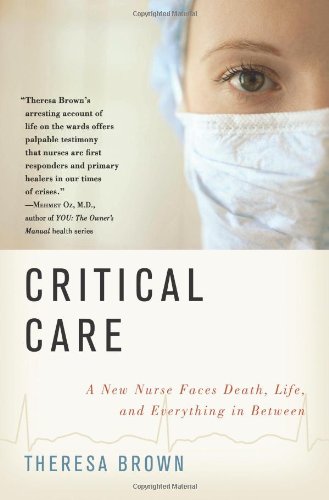
Critical Care: A New Nurse Faces Death, Life, and Everything in...
Authors:
Theresa Brown
Publisher:
HarperOne
Publication Date:
Not available
ISBN:
0061791547
"Doctors heal, or try to, but as nurses we step into the breach, figure out what needs to be done for any given patient today, on this shift, and... then, with love and exasperation, do it as best as we can."—from Critical Care "At my job, people die," writes Theresa Brown, capturing both the burden and the singular importance of her profession. Brown, a former English professor at Tufts University, chronicles here her first year as an R.N. in medical oncology. As she does so, Brown illuminates the unique role of nurses in health care, giving us a deeply moving portrait of the day-to-day work nurses do: caring for the person who is ill, not just the illness itself. Critical Care takes us with Brown as she struggles to tend to her patients' needs, both physical (the rigors of chemotherapy) and emotional (their late-night fears). Along the way, we see the work nurses do to fight for their patients' dignity, in spite of punishing treatments and an often uncaring hospital bureaucracy. We also see how a twelve-hour day of caring for the seriously ill gives Brown herself a deeper appreciation of what it means to be alive. Ultimately, this is a book about embracing life, whether in times of sickness or health. As she takes us into the place where patients and nurses meet, Brown shows us the power of human connection in the face of mortality. She does so with a keen sense of humor and remarkable powers of observation, making Critical Care a powerful contribution to the literature of medicine.
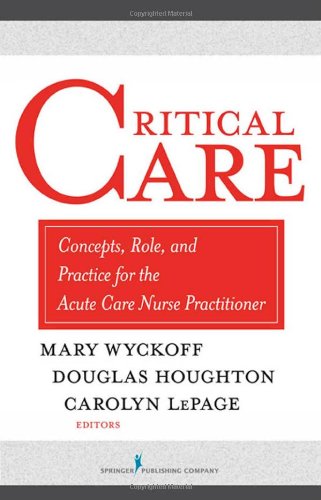
Critical Care: Concepts, Role, and Practice for the Acute Care...
Authors:
Not Available
Publisher:
Springer Publishing Company
Publication Date:
Not available
ISBN:
0826138268
Winner of an AJN Book of the Year Award for 2009! There is little doubt that every ACNP in practice or in training will want a copy of this reference... in their lab coat pocket. --Ric Cuming, RN, MSN, EdD (c), CNOR, NEA-BCChief Nursing Officer Jackson Memorial Hospital Long overdue-This comprehensive critical care text will fill the void, especially for nurses advancing from BSN to Advanced Practice. The authors have covered all the basics and produced a text that provides a well-rounded knowledge base for critical care.-Jeanne H. Siegel, PhD, ARNPUniversity of Miami School of Nursing and Health Studies This book defines what it means to be a nurse in critical care. With this text, Acute Care Nurse Practitioners (ACNPs) will learn what to expect in the critical care unit, and how to manage various complications with patients in acute and intensive care settings. Significant emphasis is given to the complex pathophysiology and appropriate management of common problems encountered in the critical care environment, including trauma, infections, and disease. One chapter is also dedicated to the medical, legal, and ethical aspects of critical care. Critical Care is thus the must-have reference for graduate students as well as for practicing ACPNs. Key topics include: The role of the ACPN in acute and critical care Pulmonary management Cardiac concepts in acute care settings Managing liver, kidney, and kidney pancreas transplant in the ICU Burn management Multisystem organ failure End-of-life and palliative care Family-centered care
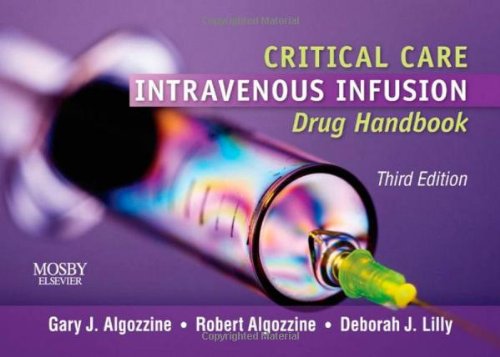
Critical Care Intravenous Infusion Drug Handbook, 3e
Authors:
Gary J. Algozzine PharmD BCNSP
Publisher:
Mosby
Publication Date:
Not available
ISBN:
0323066577
Compact and easy to use, this handy reference focuses on the information you need to administer intravenous medications in critical care and emergency... environments. Essential coverage of 48 of the most common and complex IV drugs, including drip rate calculation charts, drug calculation formulae, and much more help you safely and efficiently administer IV drugs.Fully updated coverage includes the newest IV treatments with magnesium, conivaptan, potassium, and nicardipine, helping you provide the most effective care possible.Current drug dosing charts for 48 of the most common, and most difficult to administer, intravenous infusion critical care drugs ensure that the information you need is readily available. Quick reference drug compatibility charts provide instant access to this crucial information. Drip Rates and Dosing information are arranged in tabular manner for each drug referenced in the text, allowing you to quickly prepare drugs in critical situations. A Drug Calculation Formulae section includes a list of the formulae most useful in determining IV drug concentration, doses, and infusion rates, helping you to eliminate memorization errors when calculating these important parameters. Calculation factors based on patient weight enable you to quickly change a patient's infusion dose and titrate the drug to reduce the chance of medication errors. Nursing Considerations in each drug monograph offer practical information on administration and monitoring. Trade and generic drug name indexes help you find information quickly no matter what name is used. A handy reference to ACLS guidelines allows you to quickly see how infusion therapy fits into the ACLS protocol.
 '





