production
/viewbook/list/all/?page=3139
/
/static/
None

Culture Smart! Finland: A Quick Guide to Customs & Etiquette
Authors:
Terttu Leney
Publisher:
Graphic Arts Center Publishing Company
Publication Date:
Not available
ISBN:
1558688420
CULTURE SMART! is the series of travel guides written for the smart traveler on the go. Each volume is a quick, accurate guide to customs and etiquette.... What you'll find in CULTURE SMART!: --All the essential cultural and etiquette points covered, making you confident in a variety of situations. --You'll know what to expect in each particular culture. --You'll know how to behave in specific social and business situations. --Essential attitudes and values are clearly explained. --You'll find the concise writing style makes each topic a quick, easy read. --Each has the same look, page count, and organization for reference use. --Small and light, it tucks into your pocket or purse for on-the-go use. --Culture Smart! books are written by a staff of experts who consult on world travel as a profession.
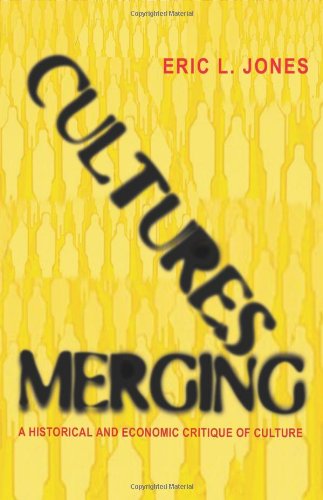
Cultures Merging: A Historical and Economic Critique of Culture...
Authors:
Eric L. Jones
Publisher:
Princeton University Press
Publication Date:
Not available
ISBN:
0691117373
"Economists agree about many things--contrary to popular opinion--but the majority agree about culture only in the sense that they no longer give it... much thought." So begins the first chapter of Cultures Merging, in which Eric Jones--one of the world's leading economic historians--takes an eloquent, pointed, and personal look at the question of whether culture determines economics or is instead determined by it. Bringing immense learning and originality to the issue of cultural change over the long-term course of global economic history, Jones questions cultural explanations of much social behavior in Europe, East Asia, the United States, Australia, and the Middle East. He also examines contemporary globalization, arguing that while centuries of economic competition have resulted in the merging of cultures into fewer and larger units, these changes have led to exciting new syntheses. Culture matters to economic outcomes, Jones argues, but cultures in turn never stop responding to market forces, even if some elements of culture stubbornly persist beyond the time when they can be explained by current economic pressures. In the longer run, however, cultures show a fluidity that will astonish some cultural determinists. Jones concludes that culture's "ghostly transit through history" is much less powerful than noneconomists often claim, yet it has a greater influence than economists usually admit. The product of a lifetime of reading and thinking on culture and economics, a work of history and an analysis of the contemporary world, Cultures Merging will be essential reading for anyone concerned about the interaction of cultures and markets around the world.

Cultures of Abortion in Weimar Germany (Monographs in German History)
Authors:
Cornelie Usborne
Publisher:
Berghahn Books
Publication Date:
Not available
ISBN:
0857451669
"...a richly textured analysis of medical and lay abortion discourses and practices, artistic representations of the procedure, and of women's,... particularly lower-class women's, own perceptions and experiences of abortion. Skilfully using an impressive variety of sources, Usborne provides a meticulous, insightful, and lively study that questions some of the continuing assumptions about the Weimar Republic.and provides an exciting example of how to approach the history of the body." · Medical History "Based on a careful reading of court files, this investigation reveals a rich and often ambiguous repertoire of perceptions and descriptions...Cultures of Abortion is not only the seminal study on one of the most contested and high-profile issues in Weimar politics, it is also a superb demonstration of how 'gender' can be used to complicate well established historical narratives." · German History "With inspiration from Alltagsgeschichte(history of the everyday) and body history, Usborne presents a fascinating collection of stories about how abortion was practiced in both rural and urban, medicalized and folk-healing contexts...[It] performs several valuable services. It brings us far closer to the actual experiences of Weimar women who underwent abortions than we have ever been before, it usefully questions our tendency to respect complex medical procedures over simpler but often just as effective techniques, and it provides considerable evidence that the practice and social acceptance of abortion were far more widespread in this period than previously appreciated." · Bulletin of the History of Medicine "This revealing study teases out the various ways that official discourses often clashed with women‚s everyday experiences and attitudes towards abortion...Overall, this monograph is an important addition for any scholar interested in abortion, the body, medical discourses, gender and modern Germany." · H-Soz-u-Kult "Usborne provides a vivid picture not only of...individuals, but of the communities that they lived in and the social networks that facilitated their relationships and contacts. Many of her conclusions are fascinating...[a] compelling book." · German Studies Review "The book includes introductory and concluding chapters that effectively place the story in the historiography of modern Germany and of modern abortion and, more broadly, the female body. Usborne's monograph contains much of worth and interest for scholars and students of modern Germany, gender relations, sexuality, medicine, and, certainly, abortion." · American Historical Review Abortion in the Weimar Republic is a compelling subject since it provoked public debates and campaigns of an intensity rarely matched elsewhere. It proved so explosive because populationist, ecclesiastical and political concerns were heightened by cultural anxieties of a modernity in crisis. Based on an exceptionally rich source material (e.g., criminal court cases, doctors' case books, personal diaries, feature films, plays and literary works), this study explores different attitudes and experiences of those women who sought to terminate an unwanted pregnancy and those who helped or hindered them. It analyzes the dichotomy between medical theory and practice, and questions common assumptions, i.e. that abortion was "a necessary evil," which needed strict regulation and medical control; or that all back-street abortions were dangerous and bad. Above all, the book reveals women's own voices, frequently contradictory and ambiguous: having internalized medical ideas they often also adhered to older notions of reproduction which opposed scientific approaches.

Cultures of Arab Schooling: Critical Ethnographies from Egypt
Authors:
Not Available
Publisher:
State University of New York Press
Publication Date:
Not available
ISBN:
0791469026

Cultures of Collecting (Reaktion Books - Critical Views)
Authors:
Roger Cardinal
Publisher:
Reaktion Books
Publication Date:
Not available
ISBN:
0948462515
This book traces the psychology, history and theory of the compulsion to collect, focusing not just on the normative collections of the Western canon,... but also on collections that reflect a fascination with the "Other" and the marginal – the ephemeral, exotic, or just plain curious.There are essays on the Neoclassical architect Sir John Soane, Sigmund Freud and Kurt Schwitters, one of the masters of collage. Others examine imperialist encounters with remote cultures – the consquitadors in America in the sixteenth century, and the British in the Pacific in the eighteenth – and the more recent collectors of popular culture, be they of Swatch watches, Elvis Presley memorabilia or of packaging and advertising.With essays by Jean Baudrillard, Thomas DaCosta Kaufmann, Nicholas Thomas, Mieke Bal, John Forrester, John Windsor, Naomi Schor, Susan Stewart, Anthony Alan Shelton, John Elsner, Roger Cardinal and an interview with Robert Opie.
Cultures of Curriculum
Authors:
Not Available
Publisher:
Routledge
Publication Date:
Not available
ISBN:
0415991870
Using "cultures of curriculum" as a lens, this clear, compelling text reveals and critically examines the belief systems and classroom practices of... curricular orientations in contemporary American society. It is designed to foster awareness, examination, and deliberation about the curricula planned for and carried out in classrooms and schools; to inspire conversations about theory and practice as well as political, social, and moral issues; and to expand critical consciousness about approaches to curriculum and practice. Readers are encouraged to give serious attention to the issues this book raises for them, and to join with their colleagues, students, and communities in considering how to create curricula with purpose and congruent practices and to reculture classrooms and schools. A framework of inquiry is presented to facilitate such reflection and to accomplish these goals. Cultures of Curriculum, Second Edition: Introduces the field of curriculum studies by describing theories and questions pertinent to curriculum inquiry Describes the process of curriculum leadership drawing from historical and contemporary research on curriculum change and transformation Presents the concept of cultures of curriculum as a way of thinking of curriculum as cultural text encompassing histories, norms, beliefs, values, roles, and environments. Connects theory to practice by describing curricular orientations as depicted in practice, providing educators with approaches to instruction, planning, and assessment for creating intentional practices in classrooms and schools Uses a heuristic that helps educators to understand curricular orientations, examine curriculum in classrooms and schools, and reflect upon their own beliefs and practices Integrates moral and political discourse into discussions of curriculum orientations so that educators can recognize, question, and challenge aims and actions by examining dominant paradigms and both their direct and unforeseeable influences upon schooling Changes in the second edition: Four new chapters – "Narrowing the Curriculum" (current trends of standardization and high-stakes testing) "Educating Through Occupations (Deweyan progressive and career/technical education) "Sustaining Indigenous Traditions" (Native American/indigenous education) "Envisioning Peace" (peace, global, human rights, environmental education) Updates and pertinent scholarship in all chapters reflecting recent events and discourses Curricular cultures all are examples of progressive alternatives to traditional education New two-part structure: Curriculum Studies and Curricular Cultures

Cultures of Darkness: Night Travels in the Histories of Transgression
Authors:
Bryan D. Palmer
Publisher:
Monthly Review Press
Publication Date:
Not available
ISBN:
1583670270
Peasants, religious heretics, witches, pirates, runaway slaves, prostitutes and pornographers, frequenters of taverns and fraternal society lodge rooms,... revolutionaries, blues and jazz musicians, beats, and contemporary youth gangs--those who defied authority, choosing to live outside the defining cultural dominions of early insurgent and, later, dominant capitalism are what Bryan D. Palmer calls people of the night. These lives of opposition, or otherness, were seen by the powerful as deviant, rejecting authority, and consequently threatening to the established order. Constructing a rich historical tapestry of example and experience spanning eight centuries, Palmer details lives of exclusion and challenge, as the "night travels" of the transgressors clash repeatedly with the powerful conventions of their times. Nights of liberation and exhilarating desire--sexual and social--are at the heart of this study. But so too are the dangers of darkness, as marginality is coerced into corners of pressured confinement, or the night is used as a cover for brutalizing terror, as was the case in Nazi Germany or the lynching of African Americans. Making extensive use of the interdisciplinary literature of marginality found in scholarly work in history, sociology, cultural studies, literature, anthropology, and politics, Palmer takes an unflinching look at the rise and transformation of capitalism as it was lived by the dispossessed and those stamped with the mark of otherness.

Cultures of Devotion: Folk Saints of Spanish America
Authors:
Frank Graziano
Publisher:
Oxford University Press, USA
Publication Date:
Not available
ISBN:
0195171306
Spanish America has produced numerous "folk saints" -- venerated figures regarded as miraculous but not officially recognized by the Catholic Church.... Some of these have huge national cults with hundreds -- perhaps millions -- of devotees. In this book Frank Graziano provides the first overview in any language of these saints, offering in-depth studies of the beliefs, rituals, and devotions surrounding seven representative figures. These case studies are illuminated by comparisons to some hundred additional saints from contemporary Spanish America. Among the six primary cases are Difunta Correa, at whose shrines devotees offer bottles of water and used auto parts in commemoration of her tragic death in the Argentinean desert. Gaucho Gil is only one of many gaucho saints, whose characteristic narrative involves political injustice and Robin-Hood crimes on behalf of the exploited people. The widespread cult of the Mexican saint Nino Fidencio is based on faith healing performed by devotees who channel his powers. Nino Compadrito is an elegantly dressed skeleton of a child, whose miraculous powers are derived in part from an Andean belief in the power of the skull of one who has suffered a tragic death. Graziano draws upon site visits and extensive interviews with devotees, archival material, media reports, and documentaries to produce vivid portraits of these fascinating popular movements. In the process he sheds new light on the often fraught relationship between orthodox Catholicism and folk beliefs and on an important and little-studied facet of the dynamic culture of contemporary Spanish America.

Cultures Of Insecurity: States, Communities, and the Production of...
Authors:
Jutta Weldes
Publisher:
Univ Of Minnesota Press
Publication Date:
Not available
ISBN:
0816633088

Cultures of Migration: The Global Nature of Contemporary Mobility
Authors:
Jeffrey H. Cohen
Publisher:
University of Texas Press
Publication Date:
Not available
ISBN:
0292726856
Around the globe, people leave their homes to better themselves, to satisfy needs, and to care for their families. They also migrate to escape... undesirable conditions, ranging from a lack of economic opportunities to violent conflicts at home or in the community. Most studies of migration have analyzed the topic at either the macro level of national and global economic and political forces, or the micro level of the psychology of individual migrants. Few studies have examined the "culture of migration"—that is, the cultural beliefs and social patterns that influence people to move.Cultures of Migration combines anthropological and geographical sensibilities, as well as sociological and economic models, to explore the household-level decision-making process that prompts migration. The authors draw their examples not only from their previous studies of Mexican Oaxacans and Turkish Kurds but also from migrants from Europe, sub-Saharan Africa, the Pacific, and many parts of Asia. They examine social, economic, and political factors that can induce a household to decide to send members abroad, along with the cultural beliefs and traditions that can limit migration. The authors look at both transnational and internal migrations, and at shorter- and longer-term stays in the receiving location. They also consider the effect that migration has on those who remain behind. The authors' "culture of migration" model adds an important new dimension to our understanding of the cultural beliefs and social patterns associated with migration and will help specialists better respond to increasing human mobility.

Cultures of Peace: The Hidden Side of History (Peace and Conflict...
Authors:
Elise Boulding
Publisher:
Syracuse University Press
Publication Date:
Not available
ISBN:
0815628323

Cultures of Piety: Medieval English Devotional Literature in...
Authors:
Not Available
Publisher:
Cornell University Press
Publication Date:
Not available
ISBN:
0801484553
Devotional texts in late medieval England were notable for their flamboyant piety and their preoccupation with the tortured body of Christ and the grief... of the Virgin Mary. Generations of readers internalized and shaped the "cultures of piety" represented by these works. Anne Clark Bartlett and Thomas H. Bestul here gather seven examples of this literature, all written in the period 1350-1450, one in Anglo-Norman, the remainder in Middle English. (The volume includes an appendix containing the original texts of the latter six pieces.) The collection illustrates the polyglottal, conflicting, and often polemical nature of devotional culture in the Middle Ages. It provides a valuable context for and interesting counterpoint to the Canterbury Tales and other classic works of late medieval England. The introduction and the translators' headnotes discuss crucial aspects of the texts' histories and thematics, including the importance of the body in spiritual practices, the development of female patronage and of a wide audience for this literature, and the indivisibility of the political and the religious in medieval times.

Cultures of Politics, Politics of Cultures: Re-visioning Latin...
Authors:
Sonia E Alvarez
Publisher:
Westview Press
Publication Date:
Not available
ISBN:
0813330726
Investigating the complex interrelations between culture and politics in a wide range of social movements in Latin America, this book focuses on the... cultural politics enacted by social movements as they struggle for new visions and practices of citizenship, democracy, social relations, and development. The volume explores the potential of these cultural politics for fostering alternative political cultures and social transformations. Theoretical and empirical chapters assess and build upon novel conceptions of culture and politics in a variety of disciplines and fieldsparticularly anthropology, political science, sociology, feminist theory, and cultural studies.The notion of the cultural politics of social movements provides a lens for analyzing emergent discourses and practices grounded in society and culture, the state and political institutions, and the extent to which they may unsettle, or be reinscribed into, the dominant neoliberal strategies of the 1990s. Contributors explore how social movementsurban popular, women’s, indigenous, and black movements as well as movements for citizenship and democracyengage in the cultural resignification of notions such as rights, equality, and difference, thus altering what counts as political. By highlighting simultaneously the cultural dimensions of the political and the political dimensions of the cultural, the book transcends the distinction between new” and old” social movements and thus significantly renews our understanding of them.
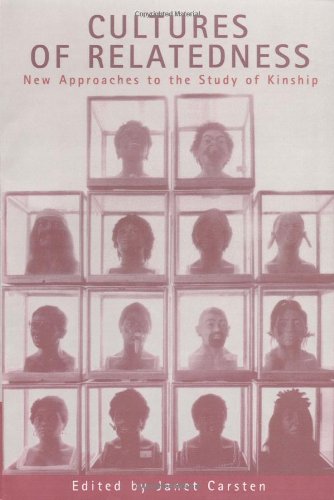
Cultures of Relatedness: New Approaches to the Study of Kinship
Authors:
Not Available
Publisher:
Cambridge University Press
Publication Date:
Not available
ISBN:
0521656273
Our understanding of what makes a person a relative has been transformed by radical changes in marriage arrangements and gender relations, and by new... reproductive technologies. We can no longer take it for granted that our most fundamental social relationships are grounded in "biology" or "nature." Examining the idioms of relatedness in other societies, and ways in which relationship is symbolized and interpreted in our own society, this book challenges established analytic categories of anthropology, and brings into question the received wisdom at the heart of the study of kinship.
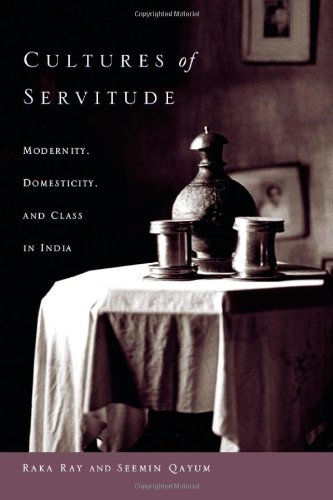
Cultures of Servitude: Modernity, Domesticity, and Class in India
Authors:
Raka Ray
Publisher:
Stanford University Press
Publication Date:
Not available
ISBN:
0804760721
Domestic servitude blurs the divide between family and work, affection and duty, the home and the world. In Cultures of Servitude, Raka Ray and Seemin... Qayum offer an ethnographic account of domestic life and servitude in contemporary Kolkata, India, with a concluding comparison with New York City. Focused on employers as well as servants, men as well as women, across multiple generations, they examine the practices and meaning of servitude around the home and in the public sphere.This book shifts the conversations surrounding domestic service away from an emphasis on the crisis of transnational care work to one about the constitution of class. It reveals how employers position themselves as middle and upper classes through evolving methods of servant and home management, even as servants grapple with the challenges of class and cultural distinction embedded in relations of domination and inequality.
 '





