production
/viewbook/list/all/?page=3278
/
/static/
None
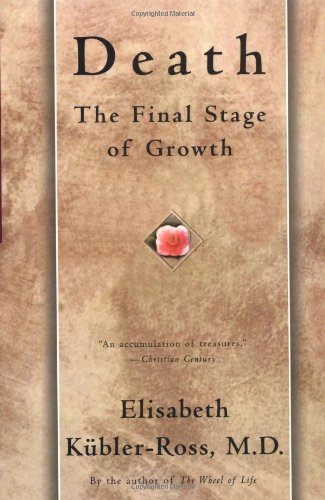
Death: The Final Stage of Growth
Authors:
Elisabeth Kubler-Ross
Publisher:
Scribner
Publication Date:
Not available
ISBN:
0684839415
Ours is a death-denying society. But death is inevitable, and we must face the question of how to deal with it. Coming to terms with our own finiteness... helps us discover life's true meaning. Why do we treat death as a taboo? What are the sources of our fears? How do we express our grief, and how do we accept the death of a person close to us? How can we prepare for our own death? Drawing on our own and other cultures' views of death and dying, Elisabeth Kübler-Ross provides some illuminating answers to these and other questions. She offers a spectrum of viewpoints, including those of ministers, rabbis, doctors, nurses, and sociologists, and the personal accounts of those near death and of their survivors. Once we come to terms with death as a part of human development, the author shows, death can provide us with a key to the meaning of human existence.
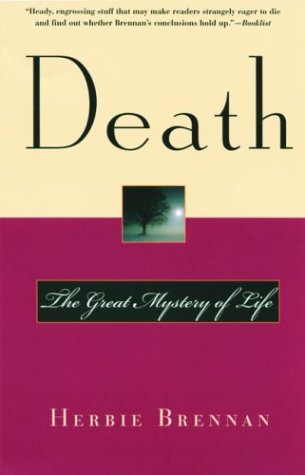
Death: The Great Mystery of Life
Authors:
Herbie Brennan
Publisher:
Da Capo Press
Publication Date:
Not available
ISBN:
0786712171
From the burial rites of the earliest humans to the current price of freezing one's dead body, this engaging study confronts the mystery of death,... leaving no question unanswered. In Death, Herbie Brennan dissects the biological processes by which people die, delving into the history of plagues, wars, and natural disasters. This fearless exploration also goes beyond the moment of physical death to unravel the mysteries of the afterlife, with chapters on ghosts and near-death experiences. Clear and informative, this book presents a wide array of research, inviting readers to learn the likely causes of death and telling them what to expect in the process. Brennan turns the most frightening concepts into comforting revelations and devotes a good portion of the book to "the good news"-the history of the afterlife, the tranquility of near-death experiences, and how scientific advances are increasing our chances of cheating death. Traveling the world, Brennan reveals the surprising similarities and differences in cultural manifestations of this universal concept. Brennan also explores out-of-body experiences, documented radio communication with the deceased, and telepathy. The result is a comprehensive account from multiple perspectives that is captivating, mysterious, and wonderfully reassuring about this most feared of human experiences.

Death (The Open Yale Courses Series)
Authors:
Shelly Kagan
Publisher:
Yale University Press
Publication Date:
Not available
ISBN:
0300180845
There is one thing we can be sure of: we are all going to die. But once we accept that fact, the questions begin. In this thought-provoking book,... philosophy professor Shelly Kagan examines the myriad questions that arise when we confront the meaning of mortality. Do we have reason to believe in the existence of immortal souls? Or should we accept an account according to which people are just material objects, nothing more? Can we make sense of the idea of surviving the death of one’s body? If I won’t exist after I die, can death truly be bad for me? Would immortality be desirable? Is fear of death appropriate? Is suicide ever justified? How should I live in the face of death?Written in an informal and conversational style, this stimulating and provocative book challenges many widely held views about death, as it invites the reader to take a fresh look at one of the central features of the human condition—the fact that we will die.

Death to the Dictator!: A Young Man Casts a Vote in Iran's 2009...
Authors:
Afsaneh Moqadam
Publisher:
Sarah Crichton Books
Publication Date:
Not available
ISBN:
0374139636
Tehran, June 12, 2009. Mohsen Abbaspour, an ordinary young man in his twenties—not particularly political, or ambitious, or worldly—casts the first... vote of his life in Iran’s tenth presidential election. Fed up with rising unemployment and inflation, he backs the reformist party and its candidate, Mir-Hossein Mousavi. Mohsen believes his vote will count.It will not. Almost the instant the polls close, Mahmoud Ahmadinejad will declare himself president by an overwhelming majority. And as the Western world scrambles to make sense of the brazenly fraudulent election, Mohsen, along with his friends and family and neighbors, will experience a sense of utter desolation, and then something else: an increasingly sharper feeling—the beginning of anger. In a matter of weeks, millions of Iranians will flow into the streets, chanting in protest, “Death to the dictator!” Mohsen Abbaspour will be swept up in an uncontrollable and ultimately devastating chain of events.Like Philip Gourevitch’s We Wish to Inform You That Tomorrow We Will Be Killed with Our Families and Ryszard Kapuscinski’s incisive reportage, Death to the Dictator! stuns readers with its heartbreaking immediacy. Our pseudonymous author was a keen eyewitness in Tehran during the summer of 2009 and beyond. In this brave and true book, we see what we are not supposed to see, and learn what we are not supposed to know.
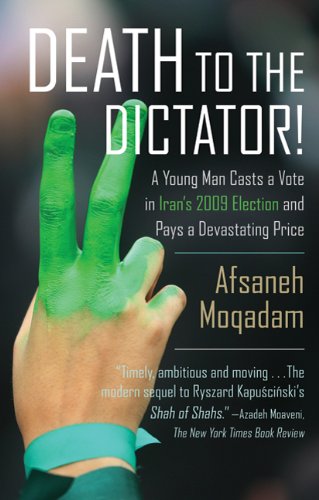
Death to the Dictator!: A Young Man Casts a Vote in Iran's 2009...
Authors:
Afsaneh Moqadam
Publisher:
Farrar, Straus and Giroux
Publication Date:
Not available
ISBN:
0374532958
Tehran, June 12, 2009. Mohsen Abbaspour, an ordinary young man in his twenties—not particularly political, or ambitious, or worldly—casts the first... vote of his life in Iran’s tenth presidential election. Fed up with rising unemployment and inflation, he backs the reformist party and its candidate, Mir-Hossein Mousavi. Mohsen believes his vote will count. It will not. Almost the instant the polls close, Mahmoud Ahmadinejad will declare himself president by an overwhelming majority. And as the Western world scrambles to make sense of the brazenly fraudulent election, Mohsen, along with his friends and family and neighbors, will experience a sense of utter desolation, and then something else: an increasingly sharper feeling—the beginning of anger. In a matter of weeks, millions of Iranians will flow into the streets, chanting in protest, “Death to the dictator!” Mohsen Abbaspour will be swept up in an uncontrollable and ultimately devastating chain of events. Death to the Dictator! stuns readers with its heartbreaking immediacy. Our pseudonymous author was a keen eyewitness in Tehran during the summer of 2009 and beyond. In this brave and true book, we see what we are not supposed to see, and learn what we are not supposed to know.

Death Tractates (Wesleyan Poetry Series)
Authors:
Brenda Hillman
Publisher:
Wesleyan
Publication Date:
Not available
ISBN:
0819512028
From the depths of sorrow following the sudden death of her closest female mentor, Brenda Hillman asks anguished questions in this book of poems about... separation, spiritual transcendence, and the difference between life and death. Both personal and philosophical, her work can be read as a spirit-guide for those mourning the loss of a loved one and as a series of fundamental ponderings on the inevitability of death and separation. At first refusing to let go, desperate to feel the presence of her friend, the poet seeks solace in a belief in the spirit world. But life, not death, becomes the issue when she begins to see physical existence as "an interruption" that preoccupies us with shapes and borders. "Shape makes life too small," she realizes. Comfort at last comes in the idea of "reverse seeing": that even if she cannot see forward into the spirit world, her friend can see "backward into this world" and be with her. Death Tractates is the companion volume to a philosophical poetic work entitles Bright Existence, which Hillman was in the midst of writing when her friend died. Published by Wesleyan University Press in 1993, it shares many of the same Gnostic themes and sources.

Death Traps: The Survival of an American Armored Division in World...
Authors:
Belton Y. Cooper
Publisher:
Presidio Press
Publication Date:
Not available
ISBN:
0891418148
“Cooper saw more of the war than most junior officers, and he writes about it better than almost anyone. . . . His stories are vivid, enlightening,... full of life—and of pain, sorrow, horror, and triumph.”—STEPHEN E. AMBROSE From his Foreword“In a down-to-earth style, Death Traps tells the compelling story of one man’s assignment to the famous 3rd Armored Division that spearheaded the American advance from Normandy into Germany. Cooper served as an ordnance officer with the forward elements and was responsible for coordinating the recovery and repair of damaged American tanks. This was a dangerous job that often required him to travel alone through enemy territory, and the author recalls his service with pride, downplaying his role in the vast effort that kept the American forces well equipped and supplied. . . . [Readers] will be left with an indelible impression of the importance of the support troops and how dependent combat forces were on them.”—Library Journal“[DEATH TRAPS] FILLS A CRITICAL GAP IN WW2 LITERATURE. . . . IT’S A TRULY UNIQUE AND VALUABLE WORK.”—G.I. Journal

Deathtripping: Underground Trash Cinema (ScreenPrint)
Authors:
Jack Sargeant
Publisher:
Soft Skull Press
Publication Date:
Not available
ISBN:
1933368950
This exhaustive study focuses on the New York filmmakers that coalesced around the radical manifesto espoused by downtown filmmaker Nick Zedd: none... shall emerge unscathed.” Placing their work within the wider alternative film and downtown post-punk scenes, Deathtripping offers detailed analyses of the movement’s films alongside interviews with the filmmakers and their collaborators, including Richard Kern, Nick Zedd, Tommy Turner, Beth B, Joe Coleman, and Lydia Lunch. Also discussed are seminal influences such as the Kuchar brothers, Jack Smith, and Andy Warhol as well as the history of underground and trash cinema.
Death Underground: The Centralia and West Frankfort Mine Disasters
Authors:
Robert E Hartley
Publisher:
Southern Illinois University Press
Publication Date:
Not available
ISBN:
0809327066
Death Underground: The Centralia and West Frankfort Mine Disasters examines two of the most devastating coal mine disasters in United States... history since 1928. In two southern Illinois towns only forty miles apart, explosions killed 111 men at the Centralia No. 5 mine in 1947 and 119 men at the New Orient No. 2 mine in West Frankfort in 1951. Robert E. Hartley and David Kenney explain the causes of the accidents, identify who was to blame, and detail the emotional impact the disasters had on the survivors, their families, and their communities.Politics at the highest level of Illinois government played a critical role in the conditions that led to the accidents. Hartley and Kenney address how safety was compromised when inspection reports were widely ignored by state mining officials and mine company supervisors. Highlighted is the role of Driscoll Scanlan, a state inspector at Centralia, who warned of an impending disaster but whose political enemies shifted the blame to him, ruining his career. Hartley and Kenney also detail the New Orient No. 2 mine explosion, the attempts at rescue, and the resulting political spin circulated by labor, management, and the state bureaucracy. They outline the investigation, the subsequent hearings, and the efforts in Congress to legislate greater mine safety.Hartley and Kenney include interviews with the survivors, a summary of the investigative records, and an analysis of the causes of both mine accidents. They place responsibility for the disasters on individual mine owners, labor unions, and state officials, providing new interpretations not previously presented in the literature. Augmented by twenty-nine illustrations, the volume also covers the history, culture, and ethnic pluralism of coal mining in Illinois and the United States.
Death with Interruptions: A Novel
Authors:
Jose Saramago
Publisher:
Mariner Books
Publication Date:
Not available
ISBN:
0547247885
Nobel Prize-winner Jose Saramago's brilliant new novel poses the question -- what happens when the grim reaper decides there will be no more death? On... the first day of the new year, no one dies. This of course causes consternation among politicians, religious leaders, morticians, and doctors. Among the general public, on the other hand, there is initially celebration—flags are hung out on balconies, people dance in the streets. They have achieved the great goal of humanity: eternal life. Then reality hits home—families are left to care for the permanently dying, life-insurance policies become meaningless, and funeral parlors are reduced to arranging burials for pet dogs, cats, hamsters, and parrots.Death sits in her chilly apartment, where she lives alone with scythe and filing cabinets, and contemplates her experiment: What if no one ever died again? What if she, death with a small d, became human and were to fall in love?

Death Without Weeping: The Violence of Everyday Life in Brazil
Authors:
Nancy Scheper-Hughes
Publisher:
University of California Press
Publication Date:
Not available
ISBN:
0520075374
When lives are dominated by hunger, what becomes of love? When assaulted by daily acts of violence and untimely death, what happens to trust? Set in the... lands of Northeast Brazil, this is an account of the everyday experience of scarcity, sickness and death that centres on the lives of the women and children of a hillside "favela". Bringing her readers to the impoverished slopes above the modern plantation town of Bom Jesus de Mata, where she has worked on and off for 25 years, the author follows three generations of shantytown women as they struggle to survive through hard work, cunning and triage. It is a story of class relations told at the most basic level of bodies, emotions, desires and needs. Most disturbing - and controversial - is her finding that mother love, as conventionally understood, is something of a bourgeois myth, a luxury for those who can reasonably expect, as these women cannot, that their infants will live. The author also wrote "Saints, Scholars and Schizophrenics: Mental Illness in Rural Ireland".

Death Work: A Study of the Modern Execution Process (Contemporary...
Authors:
Robert Johnson
Publisher:
Wadsworth Pub Co
Publication Date:
Not available
ISBN:
0534615597
A very frank insiders look at the use of the death penalty in modern America. Johnson has done a great deal of reasearch on the process and use of the... death penalty, including the witnessing of an electrocution. Exploring both the emotional and empirical controversy surrounding the use of the death penalty, he promotes the idea that death row and the death penalty process are tools leading to the dehumanization of the criminal - a dehumanization which has no place in the United States justice system. His masterful argument against the death penalty is developed on both moral and effectiveness grounds. This book should be of interest to undergraduate and postgraduate courses in criminology, sociology, law and American politics.
Death Work: A Study of the Modern Execution Process (Wadsworth...
Authors:
Robert Johnson
Publisher:
Wadsworth Publishing
Publication Date:
Not available
ISBN:
053452155X
This text is a frank look at the consequences of the death penalty in the United States. It takes the reader through the world of American executions, ... from the prisoners who spend years on death row to the prison staff who guard the condemned and the people who are executioners. Utilizing both ethnographic and quantitative research, this book creates a dramatic presentation of all sides of this controversial topic.

Debates, Differences and Divisions: The 25 Issues that Shape...
Authors:
Michael Kryzanek
Publisher:
Longman
Publication Date:
Not available
ISBN:
0205617646
Debuting it its first edition, this book is organized around the approach that American politics can best be understood by examining the issues that... reflect the ideas, principles, concerns, fears, morals and hopes of the American people. Debates, Differences and Divisions looks at twenty-five “hot button” issues affecting American politics and policy today. The author argues that these issues are the heart and soul of the American political system, serving as the basis for the disagreements that drive our political system into action.

Debates in Contemporary Political Philosophy: An Anthology
Authors:
Not Available
Publisher:
Routledge
Publication Date:
Not available
ISBN:
0415302110
This textbook reflects the buoyant state of contemporary political philosophy, and the development of the subject in the past two decades. It includes... seminal papers on fundamental philosophical issues such as:the nature of social explanationdistributive justice liberalism and communitarianismcitizenship and multiculturalismnationalismdemocracy criminal justice.A range of views is represented, demonstrating the richness of the philosophical contribution to some of the most contested areas of public policy and political decision making. Each section has an introduction by the editors that situates the papers in the ongoing debate. Further Reading sections feature at the end of each chapter.Readings from the following thinkers are included:Steven Lukes, Robert Nozick, John Rawls, Bhikhu Parekh, Antony Duff, G.A. Cohen, Derek Parfit, Roger Scruton, Michael Sandel, Alasdair MacIntrye.Debates in Contemporary Political Philosophy will be a valuable resource for upper-level students interested in current thinking in this area.
 '





