production
/viewbook/list/all/?page=3289
/
/static/
None

Decolonising the Mind: The Politics of Language in African...
Authors:
Ngugi Wa Thiongo
Publisher:
Heinemann
Publication Date:
Not available
ISBN:
0435080164
Ngugi describes this book as "a summary of some of the issues in which I have been passionately involved for the last twenty years of my practice in... fiction, theatre, criticism and in the teaching of literature. In the eighteenth and nineteenth centuries Europe stole art treasures from Africa to decorate their houses and museums; in the twentieth century Europe is stealing the treasures of the mind to enrich their languages and cultures...."
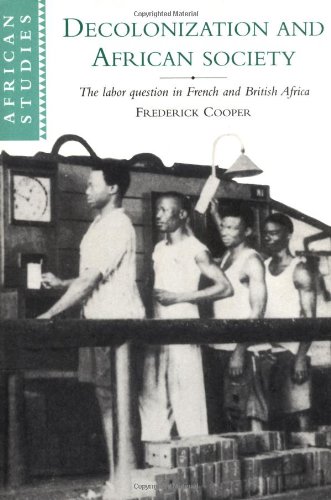
Decolonization and African Society: The Labor Question in French...
Authors:
Frederick Cooper
Publisher:
Cambridge University Press
Publication Date:
Not available
ISBN:
0521566002
This authoritative volume changes our conceptions of "imperial" and "African" history. Frederick Cooper gathers a vast range of archival sources to... achieve a truly comparative study of colonial policy toward African labor forces. He shows how African trade union and political leaders used the new language of social change to claim equality and a share of power. In the end, Britain and France could not reshape African society. As they left the continent, the question was how they had affected the ways in which Africans could reorganize society themselves.

Decolonization and the Evolution of International Human Rights...
Authors:
Roland Burke
Publisher:
University of Pennsylvania Press
Publication Date:
Not available
ISBN:
081224219X
In the decades following the triumphant proclamation of the Universal Declaration of Human Rights in 1948, the UN General Assembly was transformed by... the arrival of newly independent states from Asia, Africa, and the Middle East. This diverse constellation of states introduced new ideas, methods, and priorities to the human rights program. Their influence was magnified by the highly effective nature of Asian, Arab, and African diplomacy in the UN human rights bodies and the sheer numerical superiority of the so-called Afro-Asian bloc. Owing to the nature of General Assembly procedure, the Third World states dominated the human rights agenda, and enthusiastic support for universal human rights was replaced by decades of authoritarianism and an increasingly strident rejection of the ideas laid out in the Universal Declaration.In Decolonization and the Evolution of International Human Rights, Roland Burke explores the changing impact of decolonization on the UN human rights program. By recovering the contributions of those Asian, African, and Arab voices that joined the global rights debate, Burke demonstrates the central importance of Third World influence across the most pivotal battles in the UN, from those that secured the principle of universality, to the passage of the first binding human rights treaties, to the flawed but radical step of studying individual pleas for help. The very presence of so many independent voices from outside the West, and the often defensive nature of Western interventions, complicates the common presumption that the postwar human rights project was driven by Europe and the United States. Drawing on UN transcripts, archives, and the personal papers of key historical actors, this book challenges the notion that the international rights order was imposed on an unwilling and marginalized Third World. Far from being excluded, Asian, African, and Middle Eastern diplomats were powerful agents in both advancing and later obstructing the promotion of human rights.
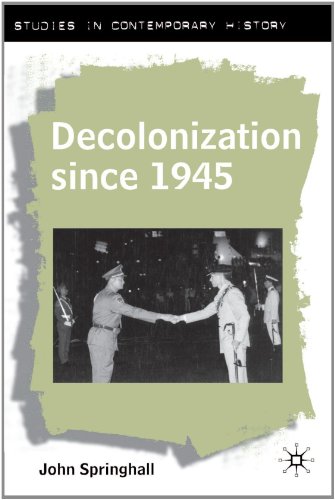
Decolonization Since 1945: The Collapse of European Overseas...
Authors:
John Springhall
Publisher:
Palgrave Macmillan
Publication Date:
Not available
ISBN:
0333746007
One of the most significant changes of the post-1945 world has been the decline and final dismemberment of European colonial empires in Africa, Asia,... the Middle East, the Pacific, and the Caribbean. In 1939, roughly a third of the world's entire population lived under colonial rule. At the end of the 20th-century, less than one per cent did so. In this study, each major European overseas colony, rather than being subject to chronological or thematic subdivision, receives separate, extensive, and consecutive treatment.
Decolonization (The Making of the Contemporary World)
Authors:
Raymond Betts
Publisher:
Routledge
Publication Date:
Not available
ISBN:
0415318211
Raymond F. Betts considers the 'process' of decolonization and the outcomes which have left a legacy of problems, drawing on numerous examples including... Ghana, India, Rwanda and Hong Kong. He examines: the effects of the two World Wars on the colonial empire the expectations and problems created by independence the major demographic shifts accompanying the end of the empire the cultural experiences, literary movements, and the search for ideology of the dying empire and the newly independent nations. With an annotated bibliography and a chronology of political decolonization, Decolonization gives a concise, original and multi-disciplinary introduction to this controversial theme and analyzes what the future holds beyond the empire.
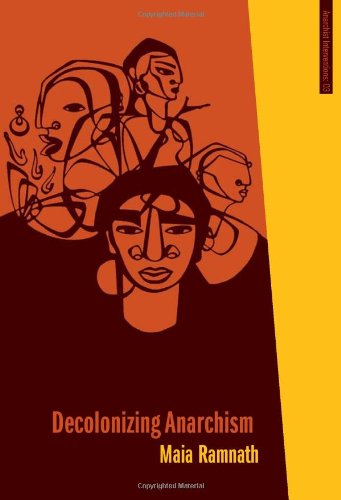
Decolonizing Anarchism: An Antiauthoritarian History of India's...
Authors:
Maia Ramnath
Publisher:
AK Press
Publication Date:
Not available
ISBN:
1849350825
Decolonizing Anarchism looks at the history of South Asian struggles against colonialism and neocolonialism, highlighting lesser-known dissidents as... well as iconic figures. This approach reveals an alternate narrative of decolonization, in which achieving a nation-state is not the objective. Maia Ramnath also studies the anarchist vision of alternate society, which closely echoes the concept of total decolonization on the political, economic, social, cultural, and psychological planes. This facilitates not only a reinterpretation of the history of anticolonialism, but insight into the meaning of anarchism itself. Maia Ramnath teaches at New York University and is a board member of the Institute for Anarchist Studies.
Decolonizing Anthropology: Moving Further Toward an Anthropology...
Authors:
Not Available
Publisher:
American Anthropological Association
Publication Date:
Not available
ISBN:
0913167835
“provides a most-needed analysis of the benefits and limitations of the new cultural anthropology.” Bolles ~American Ethnologist, 1994 ... “groundbreaking” Levinson ~The Teachers College Record, 2008 DECOLONIZING ANTHROPOLOGY is part of a broader effort that aims to advance the critical reconstruction of the discipline devoted to understanding humankind in all its diversity and commonality. The utility and power of a decolonized anthropology must continue to be tested and developed. May the results of ethnographic probes--the data, the social and cultural analysis, the theorizing, and the strategies for knowledge application--help scholars envision clearer paths toincreased understanding, a heightened sense of intercultural and international solidarity, and last, but certainly not least, world transformation. TABLE OF CONTENTS Foreword by Yolanda T Moses Preface by Kimberly Eison Simmons Anthropology as an Agent of Transformation: Introductory Comments and Queries by Faye V Harrison Man and Nature, White and Other by Michael L Blakey Colonized Anthropology: Cargo-Cult Discourse by Pem Davidson Buck On Ethnography in an Intertextual Situation: Reading Narratives or Desconstructing Discourse? by Glenn H Jordan Undoing Fieldwork: Personal, Political, Theoretical and Methodological Implications by Deborah D'Amico-Samuels Ethnography as Politics by Faye V Harrison Confronting the Ethics of Ethnography: Lessons from Fieldwork in Central American by Philippe Bourgeois "They Exploited Us But We Didn't Feel It": Hegemony, Ethnic Militancy, and the Miskitu-Sandinista Conflict by Charles R Hale Anthropology and Liberation by Edmund T Gordon Militarism and Accumulation as Cargo Cult by Angelia Gilliam Epilogue by Delmos J Jones
Decolonizing Methodologies: Research and Indigenous Peoples
Authors:
Linda Tuhiwai Smith
Publisher:
Zed Books
Publication Date:
Not available
ISBN:
1848139500
After a long awaited 13 years, the new Second Edition of the best-selling methodology textbook is finally here. The Second Edition of Decolonizing... Methodologies by Linda Tuhiwai Smith has been heavily updated with: * A brand NEW Foreword * Entire NEW Chapter 11 * Substantially revised chapter 5, 7, 8 and ConclusionThe Second Edition of Decolonizing Methodologies will be the essential textbook for anyone involved in researching indigenous people, and a classic text in research methodology.To the colonized, the term "research" is conflated with colonialism; academic research steeped in imperialism remains a painful reality. This essential volume explores intersections of imperialism and research - specifically, the ways in which imperialism is embedded in disciplines of knowledge and tradition as "regimes of truth." Concepts such as "discovery" and "claiming" are discussed and an argument presented that the decolonization of research methods will help to reclaim control over indigenous ways of knowing and being.Now in its eagerly awaited second edition, this bestselling book has been substantially revised, with new case studies and examples and important additions on new indigenous literature and the role of research in indigenous struggles for social justice, which brings this essential volume urgently up-to-date.
Decolonizing Methodologies: Research and Indigenous Peoples
Authors:
Linda Tuhiwai Smith
Publisher:
Zed Books
Publication Date:
Not available
ISBN:
1856496244
'NOW AVAILABLE- FULLY UPDATED SECOND EDITION OF DECOLONIZING METHODOLOGIES. CLICK HERE FOR MORE INFORMATION.' From the vantage point of the colonized,... the term "research" is inextricably linked with European colonialism; the ways in which scientific research has been implicated in the worst excesses of imperialism remains a powerful remembered history for many of the world's colonized peoples. Here, an indigenous researcher issues a clarion call for the decolonization of research methods.The book is divided into two parts. In the first, the author critically examines the historical and philosophical base of Western research. Extending the work of Foucault, she explores the intersections of imperialism, knowledge and research, and the different ways in which imperialism is embedded in disciplines of knowledge and methodologies as "regimes of truth". Providing a history of knowledge from the Enlightenment to Postcoloniality, she also discusses the fate of concepts such as "discovery", "claiming", and "naming" through which the west has incorporated and continues to incorporate the indigenous world within its own web.The second part of the book meets the urgent need for people who are carrying out their own research projects, for literature which validates their frustrations in dealing with various western paradigms, academic traditions and methodologies, which continue to position the indigenous as "Other". In setting an agenda for planning and implementing indigenous research, the author shows how such programmes are part of the wider project of reclaiming control over indigenous ways of knowing and being.Exploring the broad range of issues which have confronted, and continue to confront, indigenous peoples, in their encounters with western knowledge, this book also sets a standard for truly emancipatory research. It brilliantly demonstrates that "when indigenous peoples become the researchers and not merely the researched, the activity of research is transformed."

Decolonizing Museums: Representing Native America in National and...
Authors:
Not Available
Publisher:
The University of North Carolina Press
Publication Date:
Not available
ISBN:
0807837156
Museum exhibitions focusing on Native American history have long been curator controlled. However, a shift is occurring, giving Indigenous people a... larger role in determining exhibition content. In Decolonizing Museums, Amy Lonetree examines the complexities of these new relationships with an eye toward exploring how museums can grapple with centuries of unresolved trauma as they tell the stories of Native peoples. She investigates how museums can honor an Indigenous worldview and way of knowing, challenge stereotypical representations, and speak the hard truths of colonization within exhibition spaces to address the persistent legacies of historical unresolved grief in Native communities.Lonetree focuses on the representation of Native Americans in exhibitions at the Smithsonian's National Museum of the American Indian, the Mille Lacs Indian Museum in Minnesota, and the Ziibiwing Center of Anishinabe Culture and Lifeways in Michigan. Drawing on her experiences as an Indigenous scholar and museum professional, Lonetree analyzes exhibition texts and images, records of exhibition development, and interviews with staff members. She addresses historical and contemporary museum practices and charts possible paths for the future curation and presentation of Native lifeways.
Decolonizing the Academy: African Diaspora Studies
Authors:
Not Available
Publisher:
Africa World Pr
Publication Date:
Not available
ISBN:
159221066X
Decolonizing the Academy asserts that the academy is perhaps the most colonized space. As we enter the twenty-first century, this has become even... clearer now that the academy is one of the primary sites for the production and re-production of ideas that serve the interests of colonizing powers. Operating at the macro level in terms of the state and at the micro level in various applications, these interests include the organization of the disciplines, the marginalization of interdisciplinary studies, the re-assertion of masculinities, and the operations of class, privilege, and hierarchy. This collection of essays argues that African diaspora theory has the possibility of interrupting the current colonizing process and re-engaging the decolonizing process at the level of the mind, as emphasized by Ngugi wa Thiong’o in an earlier contribution. In addition, the collection asserts that this will be an ongoing project worthy of being undertaken in a variety of fields of study as we confront the challenges of the twenty-first century.
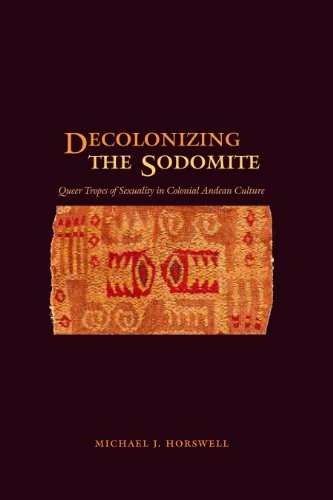
Decolonizing the Sodomite: Queer Tropes of Sexuality in Colonial...
Authors:
Michael J. Horswell
Publisher:
University of Texas Press
Publication Date:
Not available
ISBN:
0292712677
Early Andean historiography reveals a subaltern history of indigenous gender and sexuality that saw masculinity and femininity not as essential... absolutes. Third-gender ritualists, Ipas, mediated between the masculine and feminine spheres of culture in important ceremonies and were recorded in fragments of myths and transcribed oral accounts. Ritual performance by cross-dressed men symbolically created a third space of mediation that invoked the mythic androgyne of the pre-Hispanic Andes. The missionaries and civil authorities colonizing the Andes deemed these performances transgressive and sodomitical.In this book, Michael J. Horswell examines alternative gender and sexuality in the colonial Andean world, and uses the concept of the third gender to reconsider some fundamental paradigms of Andean culture. By deconstructing what literary tropes of sexuality reveal about Andean pre-Hispanic and colonial indigenous culture, he provides an alternative history and interpretation of the much-maligned aboriginal subjects the Spanish often referred to as "sodomites." Horswell traces the origin of the dominant tropes of masculinist sexuality from canonical medieval texts to early modern Spanish secular and moralist literature produced in the context of material persecution of effeminates and sodomites in Spain. These values traveled to the Andes and were used as powerful rhetorical weapons in the struggle to justify the conquest of the Incas.
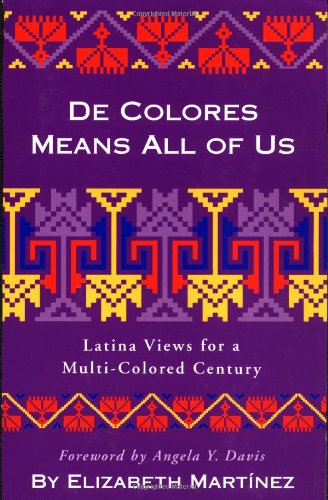
De Colores Means All of Us: Latina Views for a Multi-Colored Century
Authors:
Elizabeth Martînez
Publisher:
South End Press
Publication Date:
Not available
ISBN:
089608583X
"Elizabeth Martnez's work comprises one of the most important living histories of progressive activism in the contemporary era. . . . [Martnez is]... inimitable. . . irrepressible. . . indefatigable."-From the foreword by Angela Y. Davis. "Elizabeth Martnez is a beautiful and courageous person. She is also a writer of great depth, power, and compassion, a longtime activist who speaks eloquently about class, race, identity, and the problems of achieving real `democracy' today. Her essays in this book are perceptive, thoughtful, thought-provoking, and often humorous, too. They are fierce and touching and profoundly educational. . . . Surely she is one of our great teachers. She's certainly been one of mine."-John Nichols, author, Milagro Beanfield Wars. "Elizabeth Martinez has played a unique and extraordinary role as chronicler of Chicana-Chicano history, and De Colores beautifully captures her passion, her intelligence, her powerful commitment to universal human values. I am very happy this volume exists, and hope it will be widely read."-Howard Zinn

De como las muchachas Garcia perdieron el acento (Spanish Edition)
Authors:
Julia Alvarez
Publisher:
Vintage
Publication Date:
Not available
ISBN:
1400096944
Cuando las hermanas García Carla, Sandra, Yolanda y Sofía y sus padres huyen de la República Dominicana buscando refugio de la persecución... política, encuentran un nuevo hogar en los Estados Unidos. Pero el Nueva York de los años sesenta es marcadamente diferente de la vida privilegiada, aunque conflictiva, que han dejado atrás. Bajo la presión de asimilarse a una nueva cultura, las muchachas García se alisan el pelo, abandonan la lengua española y se encuentran con muchachos sin una chaperona. Pero por más que intentan distanciarse de su isla natal, las hermanas no logran desprender el mundo antiguo del nuevo. Lo que las hermanas han perdido para siempre y lo que logran encontrar se revela en esta novela magistral de una de las novelistas más celebradas de nuestros tiempos.
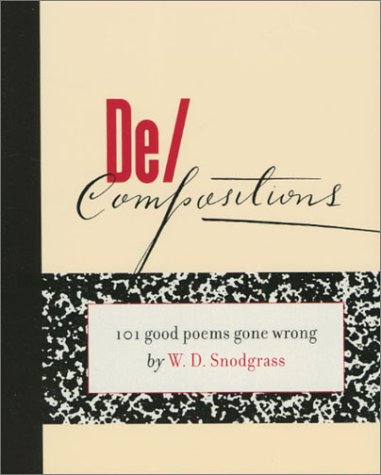
De/Compositions
Authors:
W. D. Snodgrass
Publisher:
Graywolf Press
Publication Date:
Not available
ISBN:
1555973175
This original, illuminating, and sometimes quite funny poetry anthology is primarily concerned with a fundamental and familiar question: How can we tell... good poetry from bad? To illustrate precisely why these 101 poems, many of them well-loved classics, are so accomplished and remarkable, the prize-winning poet, author, critic, and veteran teacher Snodgrass herein rewrites them—wrongly. De/Compositions tellingly presents these rewrites next to the originals—by poets ranging from William Shakespeare to William Stafford—and thus we can more fully appreciate the artistry of these astonishing poems word by word, line by line, stanza by stanza. This book will appeal to anyone studying the craft and/or creativity that good poems demand.
 '





