production
/viewbook/list/all/?page=3296
/
/static/
None

Defending Congress and the Constitution (Studies in Government and...
Authors:
Louis Fisher
Publisher:
Univ Pr of Kansas
Publication Date:
Not available
ISBN:
070061799X
The culmination of four decades of research and service on behalf of Congress, Louis Fisher's latest work is a fitting capstone to a remarkable career... as scholar and writer and presents his most articulate, passionate, and persuasive defense yet of Congress as an institution. Our nation's leading authority on the separation of powers, Fisher offers a lucid primer on our nation's government and its executive, legislative, and judicial branches while vigorously advocating a robust reassertion of Congress's rightful role within that system. Drawing on a wide range of legislation, Supreme Court rulings, and presidential decisions, Fisher illuminates the contentious contest among the three major branches for power and control of government, presents a panorama of American history, and touches on issues as wide-ranging as federalism, religious freedom, and national security policy. Fisher is especially critical of the stereotypical view of the Supreme Court's decisions as possessing a kind of effectiveness and absolute finality that transcends the efforts and powers of Congress. Indeed, he argues that Congress, as much or more than the judiciary, has had a major positive impact on protecting individual rights in this country, while the judiciary has fallen short in such areas as child labor regulation and compulsory flag salute--or has attempted to settle a constitutional issue only to have it fester for years, breeding anger and resentment, until the political process forces the courts rethink their views. He highlights legislative accomplishments in many areas, often in the face of judicial opposition and obstruction, but also chides Congress for not protecting its key prerogatives over the power of the purse and going to war. In yielding to other branches, Fisher warns, lawmakers fail to represent their constituents and cripple the very system of checks and balances the Framers counted on to limit the destructive capacity of government. His book offers a wealth of forceful insights and provides an important reminder of and guide to how our government should really work. This book is part of the Studies in Government and Public Policy series.

Defending Constantine: The Twilight of an Empire and the Dawn of...
Authors:
Peter J. Leithart
Publisher:
IVP Academic
Publication Date:
Not available
ISBN:
0830827226
We know that Constantine And if Constantine the emperor were not problem enough, we all know that Constantinianism has been very bad for the church. ... Or do we know these things? Peter Leithart weighs these claims and finds them wanting. And what's more, in focusing on these historical mirages we have failed to notice the true significance of Constantine and Rome baptized. For beneath the surface of this contested story there emerges a deeper narrative of the end of Roman sacrifice--a tectonic shift in the political theology of an empire--and with far-reaching implications. In this probing and informative book Peter Leithart examines the real Constantine, weighs the charges against Constantinianism, and sets the terms for a new conversation about this pivotal emperor and the Christendom that emerged.

Defending Democracy: Reactions to Extremism in Interwar Europe
Authors:
Giovanni Capoccia
Publisher:
The Johns Hopkins University Press
Publication Date:
Not available
ISBN:
0801887550
How does a democracy deal with threats to its stability and continued existence when those threats come from political parties that play the democratic... game? In Defending Democracy, political scientist Giovanni Capoccia studies key European nations between World Wars I and II which survived such democratic crises.A comprehensive and thoughtful historical analysis of the democracies of interwar Europe, Defending Democracy provides a unique perspective on the many lessons to be learned from their successes and failures. With this exclusively empirical investigative approach, Capoccia develops a methodology for analyzing contemporary democracies—such as Algeria, Turkey, Israel, and others—where similar political conditions are present. Given the rise of terrorism and the persistence of extremism in both established and new democracies today, continued research and dialogue on the defense of democracy are necessary for its preservation.
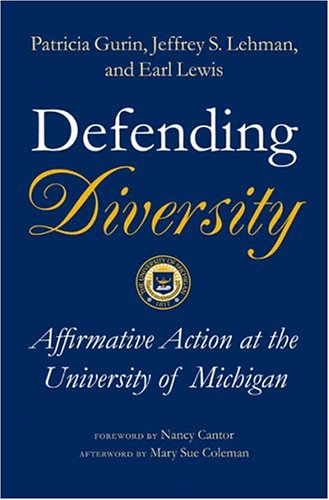
Defending Diversity: Affirmative Action at the University of Michigan
Authors:
Patricia Gurin
Publisher:
University of Michigan Press
Publication Date:
Not available
ISBN:
0472113070
Even as lawsuits challenging its admissions policies made their way through the courts, the University of Michigan carried the torch for affirmative... action in higher education.In June 2003, the Supreme Court vindicated UM's position on affirmative action when it ruled that race may be used as a factor for universities in their admissions programs, thus confirming what the UM had argued all along: diversity in the classroom translates to a beneficial and wide-ranging social value. With the green light given to the law school's admissions policies, Defending Diversity validates the positive benefits gained by students in a diverse educational setting.Written by prominent University of Michigan faculty, Defending Diversity is a timely response to the court's ruling. Providing factual background, historical setting, and the psychosocial implications of affirmative action, the book illuminates the many benefits of a diverse higher educational setting -- including preparing students to be full participants in a pluralistic democracy -- and demonstrates why affirmative action is necessary to achieve that diversity.Defending Diversity is a significant contribution to the ongoing discussion on affirmative action in higher education. Perhaps more important, it is a valuable record of the history, events, arguments, and issues surrounding the original lawsuits and the Supreme Court's subsequent ruling, and helps reclaim the debate from those forces opposed to affirmative action.Patricia Gurin is Professor Emerita, Department of Psychology, University of Michigan. Jeffrey S. Lehman, former Dean of the University of Michigan Law School, is President of Cornell University. Earl Lewis is Dean of Rackham Graduate School, University of Michigan.

Defending Evolution: A Guide to the Evolution/Creation Controversy
Authors:
Brian Alters
Publisher:
Jones and Bartlett Publishers, Inc.
Publication Date:
Not available
ISBN:
0763711187

Defending Gary: Unraveling the Mind of the Green River Killer
Authors:
Mark Prothero
Publisher:
Jossey-Bass
Publication Date:
Not available
ISBN:
0787995487
At first, Mark Prothero, Defense Attorney for Gary Ridgway, thought: "This can't be the Green River Killer! He's too ordinary! He's too small. He's... too calm. He's too polite! He can't possibly have murdered forty-nine women. They can't be serious! They must have screwed up! I didn't realize then, but I was right. Gary Ridgway hadn't killed forty-nine women. He'd killed even more than that."Soon, Mark Prothero faced the question: "How could you possibly defend the most prolific serial killer in United States history, the infamous Green River Killer? If anyone deserved to be executed for his crimes, didn't he?"Mark Prothero, co-lead defense attorney who helped save Gary Ridgway from the death sentence, has heard that question many times. Now he’s written a book that reveals the true, inside story of exactly how an idealistic public defender, high school swim coach, husband, and dad could bring himself to spend many months of close confinement with a man who brutally murdered at least 75 young women, often in the act of sex. Defending Gary shows how Prothero could reconcile these monstrous acts knowing the reality of this unassuming fellow Gary Ridgway, a mild-mannered, church-going, devoted husband, father, and former Navy man, with an IQ of around 82 and a longtime job as a truck painter from Auburn, Washington, near Seattle.

Defending Government: Why Big Government Works
Authors:
Max Neiman
Publisher:
Pearson
Publication Date:
Not available
ISBN:
0133730441
This book explores the decline in public trust in government, and the efforts of the public to use the powers of democratic governing to improve the... lives of people—especially people who require such government intervention. It focuses on the debate over government size and the role of the public sector, with a look at the implications of unqualified disdain for politics, institutions, public servants, elected officials, and the very process of democracy itself. A look at the key and current issues helps expose the anti-democratic sentiments that underlie much conservative criticism of government size. For individuals who want to make their lives more rewarding, productive, and just—through the use of the tools of governing in democratically organized societies.

Defending Jacob: A Novel
Authors:
William Landay
Publisher:
Delacorte Press
Publication Date:
Not available
ISBN:
0385344228
Andy Barber has been an assistant district attorney in his suburban Massachusetts county for more than twenty years. He is respected in his community,... tenacious in the courtroom, and happy at home with his wife, Laurie, and son, Jacob. But when a shocking crime shatters their New England town, Andy is blindsided by what happens next: His fourteen-year-old son is charged with the murder of a fellow student.Every parental instinct Andy has rallies to protect his boy. Jacob insists that he is innocent, and Andy believes him. Andy must. He’s his father. But as damning facts and shocking revelations surface, as a marriage threatens to crumble and the trial intensifies, as the crisis reveals how little a father knows about his son, Andy will face a trial of his own—between loyalty and justice, between truth and allegation, between a past he’s tried to bury and a future he cannot conceive.Award-winning author William Landay has written the consummate novel of an embattled family in crisis—a suspenseful, character-driven mystery that is also a spellbinding tale of guilt, betrayal, and the terrifying speed at which our lives can spin out of control.

Defending Life: A Moral and Legal Case Against Abortion Choice
Authors:
Francis J. Beckwith
Publisher:
Cambridge University Press
Publication Date:
Not available
ISBN:
0521691354
Defending Life is the most comprehensive defense of the prolife position on abortion ever published. It is sophisticated, but still accessible to the... ordinary citizen. Without high-pitched rhetoric or appeals to religion, the author offers a careful and respectful case for why the prolife view of human life is correct. He responds to the strongest prochoice arguments found in law, science, philosophy, politics, and the media. He explains and critiques Roe v. Wade, and he explains why virtually all the popular prochoice arguments fail. There is simply nothing like this book.

Defending Mother Earth: Native American Perspectives on...
Authors:
Jace Weaver
Publisher:
Orbis Books
Publication Date:
Not available
ISBN:
1570750963
Incisive analyses of mass media – including such forms as talk shows, MTV, the Internet, soap operas, television sitcoms, dramatic series,... pornography, and advertising-enable this provocative new edition of Gender, Race and Class in Media to engage students in critical mass media scholarship. Issues of power related to gender, race, and class are integrated into a wide range of articles examining the economic and cultural implications of mass media as institutions, including the political economy of media production, textual analysis, and media consumption.

Defending Our Dreams: Global Feminist Voices for a New Generation
Authors:
Not Available
Publisher:
Zed Books
Publication Date:
Not available
ISBN:
1842777270
This book brings together analyses by feminists of diverse identities on themes including women's rights and economic change, new technologies,... sexuality, feminist organizations and movements. It presents key issues arising out of the experiences of young women living in both North and South, the challenges confronting young feminists, and the agenda for a new era of feminist leadership and activism.

Defending Science - within Reason: Between Scientism And Cynicism
Authors:
Susan Haack
Publisher:
Prometheus Books
Publication Date:
Not available
ISBN:
1591024587
Sweeping in scope, penetrating in analysis, and generously illustrated with examples from the history of science, this new and original approach to... familiar questions about scientific evidence and method tackles vital questions about science and its place in society. Avoiding the twin pitfalls of scientism and cynicism, noted philosopher Susan Haack argues that, fallible and flawed as they are, the natural sciences have been among the most successful of human enterprises - valuable not only for the vast, interlocking body of knowledge they have discovered, and not only for the technological advances that have improved our lives, but as a manifestation of the human talent for inquiry at its imperfect but sometimes remarkable best. This wide-ranging, trenchant, and illuminating book explores the complexities of scientific evidence, and the multifarious ways in which the sciences have refined and amplified the methods of everyday empirical inquiry; articulates the ways in which the social sciences are like the natural sciences, and the ways in which they are different; disentangles the confusions of radical rhetoricians and cynical sociologists of science; exposes the evasions of apologists for religious resistance to scientific advances; weighs the benefits and the dangers of technology; tracks the efforts of the legal system to make the best use of scientific testimony; and tackles predictions of the eventual culmination, or annihilation, of the scientific enterprise. Writing with verve and wry humour, in a witty, direct, and accessible style, Haack takes readers beyond the "Science Wars" to a balanced understanding of the value, and the limitations, of the scientific enterprise.

Defending Slavery: Proslavery Thought in the Old South: A Brief...
Authors:
Paul Finkelman
Publisher:
Bedford/St. Martin's
Publication Date:
Not available
ISBN:
0312133278
Within decades of the American Revolution, the Northern states had either ended slavery or provided for its gradual abolition. Slavery, however, was... entrenched in the South and remained integral to American politics and culture. Nationally, it was protected by the U.S. Constitution, federal laws, and Supreme Court decisions, and slaveowners dominated all three branches of the federal government. From the time of the Revolution until the Civil War (and beyond), Southern thinkers offered a variety of proslavery arguments. This body of thought—based on religion, politics and law, economics, history, philosophy, expediency, and science—offers invaluable insights into how slavery shaped American history and continues to affect American society. In this volume, Paul Finkelman presents a representative selection of proslavery thought and includes an introduction that explores the history of slavery and the debate over it. His headnotes supply a rich context for each reading. The volume also includes a chronology, a selected bibliography, and illustrations.

Defending Slavery: Proslavery Thought in the South & New York...
Authors:
Paul Finkelman
Publisher:
Bedford/St. Martin's
Publication Date:
Not available
ISBN:
1457636972

Defending the Community College Equity Agenda
Authors:
Not Available
Publisher:
The Johns Hopkins University Press
Publication Date:
Not available
ISBN:
0801884470
Community colleges enroll almost half of all undergraduates in the United States. These two-year colleges manifest the American commitment to accessible... and affordable higher education. With about 1,200 institutions nationwide, community colleges have made significant progress over the past decade in opening access and have become the critical entry point to higher education for many Americans who traditionally have been left out of educational and economic opportunity. Yet economic, political, and social developments have increased the challenges community colleges face in pursuing an "equity agenda." Some of these include falling state budgets combined with growing enrollments, a greater emphasis on outcome-based accountability, competition from for-profit institutions, and growing immigrant student populations. These trials come at a time when community colleges confront crucial economic and workforce development pressures that may impact their mission. How can community colleges continue to maintain their open-door policies, support underprepared students, and struggle to help enrolled students complete degrees and certificates that prepare them for success in the workplace? Building on case studies of colleges in six states—New York, Texas, Florida, California, Washington, and Illinois—this volume offers a fresh examination of the issues currently facing American community colleges. Drawing on their fieldwork supplemented by national data, the authors analyze how these challenges impact the community college mission of educational opportunity—especially for low-income students, students of color, and other underserved groups—and how colleges are responding to a drastically different environment. They then propose a set of strategies to strengthen the role of community colleges in providing both access and opportunities for achievement for all students.
 '





