production
/viewbook/list/all/?page=3313
/
/static/
None

Democracy and the Public Space in Latin America
Authors:
Leonardo Avritzer
Publisher:
Princeton University Press
Publication Date:
Not available
ISBN:
0691090882
This is a bold new study of the recent emergence of democracy in Latin America. Leonardo Avritzer shows that traditional theories of democratization... fall short in explaining this phenomenon. Scholars have long held that the postwar stability of Western Europe reveals that restricted democracy, or "democratic elitism," is the only realistic way to guard against forces such as the mass mobilizations that toppled European democracies after World War I. Avritzer challenges this view. Drawing on the ideas of Jürgen Habermas, he argues that democracy can be far more inclusive and can rely on a sphere of autonomous association and argument by citizens. He makes this argument by showing that democratic collective action has opened up a new "public space" for popular participation in Latin American politics.Unlike many theorists, Avritzer builds his case empirically. He looks at human rights movements in Argentina and Brazil, neighborhood associations in Brazil and Mexico, and election-monitoring initiatives in Mexico. Contending that such participation has not gone far enough, he proposes a way to involve citizens even more directly in policy decisions. For example, he points to experiments in "participatory budgeting" in two Brazilian cities. Ultimately, the concept of such a space beyond the reach of state administration fosters a broader view of democratic possibility, of the cultural transformation that spurred it, and of the tensions that persist, in a region where democracy is both new and different from the Old World models.

Democracy and the Rise of Women's Movements in Sub-Saharan Africa
Authors:
Kathleen M. Fallon
Publisher:
The Johns Hopkins University Press
Publication Date:
Not available
ISBN:
080189008X
Despite a late and fitful start, democracy in Africa, Latin America, and Eastern Europe has recently shown promising growth. Kathleen M. Fallon... discusses the role of women and women's advocacy groups in furthering the democratic transformation of formerly autocratic states.Using Ghana as a case study, Fallon examines the specific processes women are using to bring about political change. She assesses information gathered from interviews and surveys conducted in Ghana and assays the existing literature to provide a focused look at how women have become involved in the democratization of sub-Saharan nations. The narrative traces the history of democratic institutions in the region—from the imposition of male-dominated mechanisms by western states to latter-day reforms that reflect the active resurgence of women’s political power within many African cultures—to show how women have made significant recent political gains in Ghana and other emerging democracies. Fallon attributes these advances to a combination of forces, including the decline of the authoritarian state and its attendant state-run women's organizations, newly formed constitutions, and newfound access to good-governance funding. She draws the study into the larger debate over gendered networks and democratic reform by exploring how gender roles affect and are affected by the state in Africa, Latin America, and Eastern Europe. In demonstrating how women’s activism is evolving with and shaping democratization across the region, Democracy and the Rise of Women’s Movements in Sub-Saharan Africa reveals how women’s social movements are challenging the barriers created by colonization and dictatorships in Africa and beyond.

Democracy and the State in the New Southern Europe (Oxford Studies...
Authors:
Not Available
Publisher:
Oxford University Press, USA
Publication Date:
Not available
ISBN:
0199202826
This volume analyzes the evolution of selected public policies and the changing roles and structure of the state in Greece, Italy, Portugal, and Spain... since the 1960s. It makes a major contribution to work on recent democratic regime transition in southern Europe, demonstrating how the state has responded and adapted to the challenges and pressures associated with the overarching processes of democratization, socio-economic development, and Europeanization.

Democracy and Tradition
Authors:
Jeffrey Stout
Publisher:
Princeton University Press
Publication Date:
Not available
ISBN:
0691123829
Do religious arguments have a public role in the post-9/11 world? Can we hold democracy together despite fractures over moral issues? Are there moral... limits on the struggle against terror? Asking how the citizens of modern democracy can reason with one another, this book carves out a controversial position between those who view religious voices as an anathema to democracy and those who believe democratic society is a moral wasteland because such voices are not heard.Drawing inspiration from Whitman, Dewey, and Ellison, Jeffrey Stout sketches the proper role of religious discourse in a democracy. He discusses the fate of virtue, the legacy of racism, the moral issues implicated in the war on terrorism, and the objectivity of ethical norms. Against those who see no place for religious reasoning in the democratic arena, Stout champions a space for religious voices. But against increasingly vocal antiliberal thinkers, he argues that modern democracy can provide a moral vision and has made possible such moral achievements as civil rights precisely because it allows a multitude of claims to be heard.Stout's distinctive pragmatism reconfigures the disputed area where religious thought, political theory, and philosophy meet. Charting a path beyond the current impasse between secular liberalism and the new traditionalism, Democracy and Tradition asks whether we have the moral strength to continue as a democratic people as it invigorates us to retrieve our democratic virtues from very real threats to their practice.

Democracy and Trust
Authors:
Not Available
Publisher:
Cambridge University Press
Publication Date:
Not available
ISBN:
0521646871
Is declining trust in government and in other citizens bad for democracy? Bringing together social science and political theory, this book analyzes the... relationship between democracy and trust. Trust can develop where interests converge, but in politics interests conflict. Democracy includes a healthy distrust of the interests of the powerful, and institutionalizes it by providing opportunities for citizens to oversee them. Yet democratic institutions depend on a trust among citizens sufficient for representation, resistance, and alternative forms of governance. Leading scholars explore this paradoxical relationship.
Democracy: A Reader
Authors:
Not Available
Publisher:
Columbia University Press
Publication Date:
Not available
ISBN:
0231124813
At a time when democracy appears to be universally acclaimed as the only acceptable form of government, it is all the more necessary to be clear about... what democracy means. Democracy: A Reader provides a range of pivotal statements on this important topic from supporters and defenders as well as critics and skeptics.

Democracy: A Reader (A Journal of Democracy Book)
Authors:
Not Available
Publisher:
The Johns Hopkins University Press
Publication Date:
Not available
ISBN:
080189378X
Since its inception, the Journal of Democracy has served as the premier venue for scholarship on democratization. The newest volume in the acclaimed ... Journal of Democracy book series, Democracy: A Reader brings together the seminal works that have appeared in its pages in nearly twenty years of publication.Democracy is in retreat around the world, giving renewed relevance and urgency to fundamental questions about the system that nevertheless remains the ideal standard of governance. Contributors ask: What exactly is democracy, and what sustains it? What institutions are best suited to a democratic system? Can elections produce undemocratic outcomes? Is democracy a universal value? Democracy: A Reader addresses these important concerns with critical discussions on delegative democracy, social capital, constitutional design, federalism, hybrid regimes, competitive authoritarianism, and more. With such influential contributors as Francis Fukuyama, Robert Putnam, His Holiness the Dalai Lama, and Anwar Ibrahim, this is an indispensable resource for students of democracy and instructors at the undergraduate and graduate levels.Contributors: Michael E. Alvarez, Nancy Bermeo, Russell Bova, José Antonio Cheibub, Larry Diamond, Jørgen Elklit, Abdou Filali-Ansary, M. Steven Fish, Francis Fukuyama, His Holiness the Dalai Lama, Donald L. Horowitz, Anwar Ibrahim, Terry Lynn Karl, Steven Levitsky, Arend Lijphart, Fernando Limongi, Vali Nasr, Guillermo O'Donnell, Marc F. Plattner, Adam Przeworski, Robert D. Putnam, Andrew Reynolds, Giovanni Sartori, Andreas Schedler, Philippe C. Schmitter, Amartya Sen, Alfred Stepan, Palle Svensson, Nicolas van de Walle, Lucan A. Way
Democracy as Problem Solving: Civic Capacity in Communities Across...
Authors:
Xavier de Souza Briggs
Publisher:
The MIT Press
Publication Date:
Not available
ISBN:
0262524856
Complexity, division, mistrust, and "process paralysis" can thwart leaders and others when they tackle local challenges. In Democracy as Problem... Solving, Xavier de Souza Briggs shows how civic capacity--the capacity to create and sustain smart collective action--can be developed and used. In an era of sharp debate over the conditions under which democracy can develop while broadening participation and building community, Briggs argues that understanding and building civic capacity is crucial for strengthening governance and changing the state of the world in the process. More than managing a contest among interest groups or spurring deliberation to reframe issues, democracy can be what the public most desires: a recipe for significant progress on important problems. Briggs examines efforts in six cities, in the United States, Brazil, India, and South Africa, that face the millennial challenges of rapid urban growth, economic restructuring, and investing in the next generation. These challenges demand the engagement of government, business, and nongovernmental sectors. And the keys to progress include the ability to combine learning and bargaining continuously, forge multiple forms of accountability, and find ways to leverage the capacity of the grassroots and what Briggs terms the "grasstops," regardless of who initiates change or who participates over time. Civic capacity, Briggs shows, can--and must--be developed even in places that lack traditions of cooperative civic action.

Democracy: A Very Short Introduction
Authors:
Bernard Crick
Publisher:
Oxford University Press
Publication Date:
Not available
ISBN:
019280250X
No political concept is more used, and misused, than that of democracy. Nearly every regime today claims to be democratic, but not all "democracies"... allow free politics, and free politics existed long before democratic franchises. This book is a short account of the history of the doctrine and practice of democracy, from ancient Greece and Rome through the American, French, and Russian revolutions, and of the usages and practices associated with it in the modern world. It argues that democracy is a necessary but not a sufficient condition for good government, and that ideas of the rule of law, and of human rights, should in some situations limit democratic claims.
Democracy Begins Between Two
Authors:
Luce Irigaray
Publisher:
Routledge
Publication Date:
Not available
ISBN:
0415918170
In Democracy Begins Between Two, Luce Irigaray calls for a form of specific civil rights guaranteeing women a separate civil identity of their own... equivalent to-though not simply the same as-that enjoyed by men.
Democracy Betrayed: The Wilmington Race Riot of 1898 and Its Legacy
Authors:
David S. Cecelski and John Hope Franklin
Publisher:
The University of North Carolina Press
Publication Date:
Not available
ISBN:
0807847550
At the close of the nineteenth century, the Democratic Party in North Carolina engineered a white supremacy revolution. Frustrated by decades of African... American self-assertion and threatened by an interracial coalition advocating democratic reforms, white conservatives used violence, demagoguery, and fraud to seize political power and disenfranchise black citizens. The most notorious episode of the campaign was the Wilmington "race riot" of 1898, which claimed the lives of many black residents and rolled back decades of progress for African Americans in the state. Published on the centennial of the Wilmington race riot, Democracy Betrayed draws together the best new scholarship on the events of 1898 and their aftermath. Contributors to this important book hope to draw public attention to the tragedy, to honor its victims, and to bring a clear and timely historical voice to the debate over its legacy.The contributors are David S. Cecelski, William H. Chafe, Laura F. Edwards, Raymond Gavins, Glenda E. Gilmore, John Haley, Michael Honey, Stephen Kantrowitz, H. Leon Prather Sr., Timothy B. Tyson, LeeAnn Whites, and Richard Yarborough.
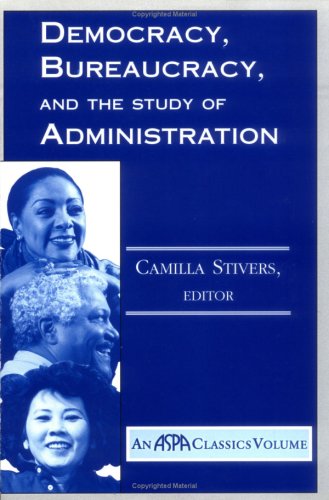
Democracy, Bureaucracy, And The Study Of Administration (ASPA...
Authors:
Camilla Stivers
Publisher:
Westview Press
Publication Date:
Not available
ISBN:
0813398096
This anthology addresses several of the most central ideas in the field of public administration. These ideas are as relevant to public budgeting as... they are to performance measurement or human resource management. Collectively and individually the essays explore what Dwight Waldo referred to as the political theories” of public administration: issues that are ultimately unresolvable yet crucial to understanding the nature of public administrative practice. How can democracy and efficiency be balanced? Can there be a science of administration? How should we think about administrative accountability? What is the nature of the relationship between citizen and state? Is professionalism an adequate mechanism for ensuring accountability? How efficient can or should bureaucracy be? What is proper leadership by administrators hoping to address political democracy and managerial efficiency? This ASPA Classics Volumes serves to connect the practice of public policy and administration with the normative theory base that has accrued and the models for practice that may be deduced from this theory.

Democracy Denied, 1905-1915: Intellectuals and the Fate of Democracy
Authors:
Charles Kurzman
Publisher:
Harvard University Press
Publication Date:
Not available
ISBN:
0674030923
In the decade before World War I, a wave of democratic revolutions swept the globe, consuming more than a quarter of the world’s population.... Revolution transformed Russia, Iran, the Ottoman Empire, Portugal, Mexico, and China. In each case, a pro-democracy movement unseated a long-standing autocracy with startling speed. The nascent democratic regime held elections, convened parliament, and allowed freedom of the press and freedom of association. But the new governments failed in many instances to uphold the rights and freedoms that they proclaimed. Coups d’état soon undermined the democratic experiments. How do we account for these unexpected democracies, and for their rapid extinction? In Democracy Denied, Charles Kurzman proposes that the collective agent most directly responsible for democratization was the emerging class of modern intellectuals, a group that had gained a global identity and a near-messianic sense of mission following the Dreyfus Affair of 1898. Each chapter of Democracy Denied focuses on a single angle of this story, covering all six cases by examining newspaper accounts, memoirs, and government reports. This thoroughly interdisciplinary treatment of the early-twentieth-century upheavals promises to reshape debates about the social origins of democracy, the causes of democratic collapse, the political roles of intellectuals, and the international flow of ideas.

Democracy Derailed in Russia: The Failure of Open Politics...
Authors:
M. Steven Fish
Publisher:
Cambridge University Press
Publication Date:
Not available
ISBN:
0521618967
Although Russia experienced dramatic political breakthroughs in the late 1980s and early 1990s after shedding the shackles of Soviet rule, it... subsequently failed to continue progressing toward democracy. M. Steven Fish offers an explanation for the direction of regime change in post-Soviet Russia, relying on cross-national comparative analysis as well as on in-depth field research in Russia. Fish demonstrates that Russia's failure to democratize has three causes: too much economic reliance on oil, too little economic liberalization, and too weak a national legislature.

Democracy Despite Itself: Why a System That Shouldn't Work at All...
Authors:
Danny Oppenheimer
Publisher:
The MIT Press
Publication Date:
Not available
ISBN:
0262017237
Voters often make irrational decisions based on inaccurate and irrelevant information. Politicians are often inept, corrupt, or out of touch with the... will of the people. Elections can be determined by the design of the ballot and the gerrymandered borders of a district. And yet, despite voters who choose candidates according to the boxer--brief dichotomy and politicians who struggle to put together a coherent sentence, democracy works exceptionally well: citizens of democracies are healthier, happier, and freer than citizens of other countries. In Democracy Despite Itself, Danny Oppenheimer and Mike Edwards explore this seeming paradox: How can democracy lead to such successful outcomes when the defining characteristic of democracy, elections, is so flawed? Oppenheimer, a psychologist, and Edwards, a political scientist, draw on cutting-edge research in their fields to investigate the question and suggest an answer. Oppenheimer and Edwards argue that democracy works because regular elections, no matter how flawed, produce a variety of unintuitive, positive consequences. Mass participation in contested elections creates psychological pressure for voters to be better citizens and for politicians to be better leaders; alternating power regularly between different factions helps avoid instability; citizens are sometimes able to overcome their ignorance and make informed choices; and voters do have the power to punish politicians for excessively bad behavior. The brilliance of democracy, write Oppenheimer and Edwards, does not lie in the people's ability to pick superior leaders. It lies in the many ways that it subtly encourages the flawed people and their flawed leaders to work toward building a better society.
 '





