production
/viewbook/list/all/?page=3317
/
/static/
None
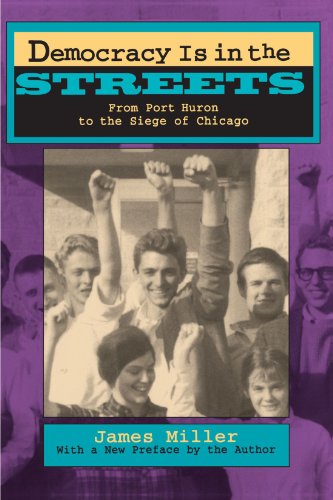
Democracy Is in the Streets: From Port Huron to the Siege of...
Authors:
James Miller
Publisher:
Harvard University Press
Publication Date:
Not available
ISBN:
0674197259
On June 12, 1962, sixty young student activists drafted a manifesto for their generation—The Port Huron Statement—that ignited a decade of dissent.... Democracy Is in the Streets is the definitive history of the major people and ideas that shaped the New Left in America during that turbulent decade. Because the 1960s generation is now moving into positions of power in politics, education, the media, and business, their early history is crucial to our understanding. James Miller, in his new Preface, puts the 1960s and them into a context for our time, claiming that something of value did happen: "Most of the large questions raised by that moment of chaotic openness—political questions about the limits of freedom, and cultural questions, too, about the authority of the past and the anarchy of the new—are with us still."
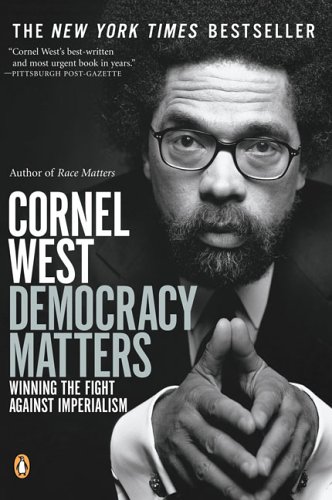
Democracy Matters: Winning the Fight Against Imperialism
Authors:
Cornel West
Publisher:
Penguin Books
Publication Date:
Not available
ISBN:
0143035835
In his major bestseller, Race Matters, philosopher Cornel West burst onto the national scene with his searing analysis of the scars of racism in... American democracy. Race Matters has become a contemporary classic, still in print after ten years, having sold more than four hundred thousand copies. A mesmerizing speaker with a host of fervidly devoted fans, West gives as many as one hundred public lectures a year and appears regularly on radio and television. Praised by The New York Times for his "ferocious moral vision" and hailed by Newsweek as "an elegant prophet with attitude," he bridges the gap between black and white opinion about the country's problems. In Democracy Matters, West returns to the analysis of the arrested development of democracy-both in America and in the crisis-ridden Middle East. In a strikingly original diagnosis, he argues that if America is to become a better steward of democratization around the world, we must first wake up to the long history of imperialist corruption that has plagued our own democracy. Both our failure to foster peace in the Israeli-Palestinian conflict and the crisis of Islamist anti-Americanism stem largely from hypocrisies in our dealings with the world. Racism and imperial expansionism have gone hand in hand in our country's inexorable drive toward hegemony, and our current militarism is only the latest expression of that drive. Even as we are shocked by Islamic fundamentalism, our own brand of fundamentalism, which West dubs Constantinian Christianity, has joined forces with imperialist corporate and political elites in an unholy alliance, and four decades after the murder of Dr. Martin Luther King, Jr., insidious racism still inflicts debilitating psychic pain on so many of our citizens. But there is a deep democratic tradition in America of impassioned commitment to the fight against imperialist corruptions-the last great expression of which was the civil rights movement led by Dr. King-and West brings forth the powerful voices of that great democratizing tradition in a brilliant and deeply moving call for the revival of our better democratic nature. His impassioned and provocative argument for the revitalization of America's democracy will reshape the terms of the raging national debate about America's role in today's troubled world.
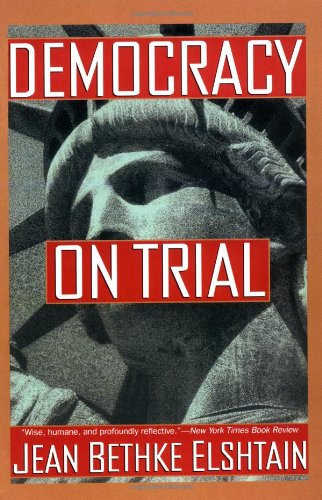
Democracy On Trial
Authors:
Jean Bethke Elshtain
Publisher:
Basic Books
Publication Date:
Not available
ISBN:
0465016170
Even as Russia and the other former Soviet republics struggle to redefine themselves in democratic terms, our own democracy if faltering, not... flourishing. We confront one another as aggrieved groups rather than as free citizens. Cynicism, boredom, apathy, despair, violencethese have become coin of the civic realm. They are dark signs of the times and a warning that democracy may not be up to the task of satisfying the yearnings it unleashesyearnings for freedom, fairness, and equality.In this timely, thought-provoking book, one of America’s leading political philosophers and public intellectuals questions whether democracy will prove sufficiently robust and resilient to survive the century. Beginning with a catalogue of our discontents, Jean Bethke Elshtain asks what has gone wrong and why. She draws on examples from America and other parts of the world as she explores the politics of race, ethnicity, and gender identitycontroversial, and essential, political issues of our day. Insisting that there is much to cherish in our democratic traditions, she concludes that democracy involves a permanent clash between conservatism and progressive change.Elshtain distinguishes her own position from those of both the Left and the Right, demonstrating why she has been called one of our most interesting and independent civic thinkers. Responding to critics of democracy, ancient and modern, Elshtain urges us to have the courage of our most authentic democratic convictions. We need, she insists, both hope and a sense of reality.Writing her book for citizens, not experts, Elshtain aims to open up a dialogue and to move us beyond sterile sectarian disputes. Democracy on Trial will generate wide debate and controversy.
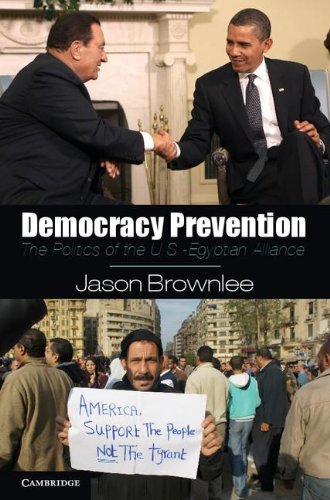
Democracy Prevention: The Politics of the U.S.-Egyptian Alliance
Authors:
Jason Brownlee
Publisher:
Cambridge University Press
Publication Date:
Not available
ISBN:
1107677866
When a popular revolt forced long-ruling Egyptian President Hosni Mubarak to resign on February 11, 2011, U.S. President Barack Obama hailed the victory... of peaceful demonstrators in the heart of the Arab World. But Washington was late to endorse democracy - for decades the United States favored Egypt's rulers over its people. Since 1979, the United States had provided the Egyptian regime more than $60 billion in aid and immeasurable political support to secure its main interests in the region: Israeli security and strong relations with Persian Gulf oil producers. During the Egyptian uprising, the White House did not promote popular sovereignty but instead backed an "orderly transition" to one of Mubarak's cronies. Even after protesters derailed that plan, the anti-democratic U.S.-Egyptian alliance continued. Using untapped primary materials, this book helps explain why authoritarianism has persisted in Egypt with American support, even as policy makers claim to encourage democratic change.
Democracy Realized: The Progressive Alternative
Authors:
Roberto Mangabeira Unger
Publisher:
Verso
Publication Date:
Not available
ISBN:
1859840094
Unger gives detailed content to a progressive and practical alternative to neoliberalism and institutionally conservative social democracy in a strategy... that has drawn increasing attention throughout the world as well as in his native Brazil.Roberto Mangabeira Unger is widely regarded as one of the leading social thinkers of our time. In Democracy Realized Unger gives detailed content to a progressive and practical alternative to both neoliberalism and institutionally conservative social democracy. His efforts to inspire and develop this alternative have drawn increasing attention throughout the world as well as in his native Brazil.
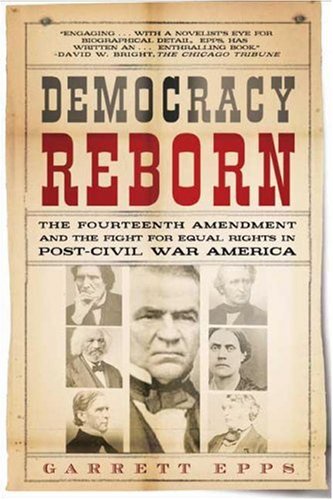
Democracy Reborn: The Fourteenth Amendment and the Fight for Equal...
Authors:
Garrett Epps
Publisher:
Holt Paperbacks
Publication Date:
Not available
ISBN:
0805086633
"Engaging . . . With a novelist's eye for biographical detail, Epps has written an . . . enthralling book."--David W. Blight, Chicago Tribune The last... battle of the Civil War wasn't fought at Appomattox by dashing generals or young soldiers but by middle-aged men in frock coats. Yet it was war all the same--a desperate struggle for the soul and future of the new American Republic that was rising from the ashes of Civil War. It was the battle that planted the seeds of democracy, under the bland heading "Amendment XIV." Scholars call it the "Second Constitution." Over time, the Fourteenth Amendment--which at last provided African Americans with full citizenship and prohibited any state from denying any citizen due process and equal protection under the law--changed almost every detail of our public life.Democracy Reborn tells the story of this desperate struggle, from the halls of Congress to the bloody streets of Memphis and New Orleans. Both a novelist and a constitutional scholar, Garrett Epps unfolds a powerful story against a panoramic portrait of America on the verge of a new era.
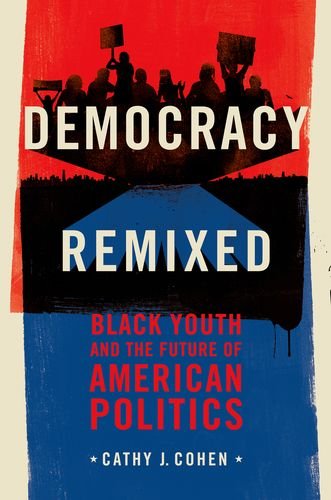
Democracy Remixed: Black Youth and the Future of American Politics...
Authors:
Cathy J. Cohen
Publisher:
Oxford University Press, USA
Publication Date:
Not available
ISBN:
0199896267
In Democracy Remixed, award-winning scholar Cathy J. Cohen offers an authoritative and empirically powerful analysis of the state of black youth in... America today. Utilizing the results from the Black Youth Project, a groundbreaking nationwide survey, Cohen focuses on what young Black Americans actually experience and think--and underscores the political repercussions. Featuring stories from cities across the country, she reveals that black youth want, in large part, what most Americans want--a good job, a fulfilling life, safety, respect, and equality. But while this generation has much in common with the rest of America, they also believe that equality does not yet exist, at least not in their lives. Many believe that they are treated as second-class citizens. Moreover, for many the future seems bleak when they look at their neighborhoods, their schools, and even their own lives and choices. Through their words, these young people provide a complex and balanced picture of the intersection of opportunity and discrimination in their lives. Democracy Remixed provides the insight we need to transform the future of young Black Americans and American democracy.
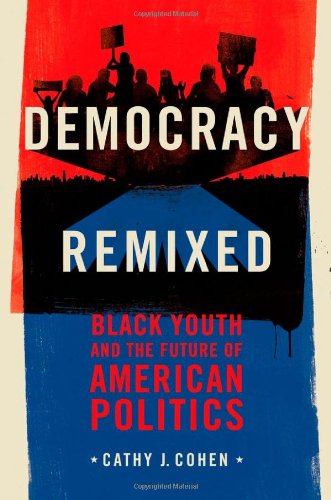
Democracy Remixed: Black Youth and the Future of American Politics...
Authors:
Cathy J. Cohen
Publisher:
Oxford University Press, USA
Publication Date:
Not available
ISBN:
0195378008
In Democracy Remixed, award-winning scholar Cathy J. Cohen offers an authoritative and empirically powerful analysis of the state of black youth in... America today. Utilizing the results from the Black Youth Project, a groundbreaking nationwide survey, Cohen focuses on what young Black Americans actually experience and think--and underscores the political repercussions. Featuring stories from cities across the country, she reveals that black youth want, in large part, what most Americans want--a good job, a fulfilling life, safety, respect, and equality. But while this generation has much in common with the rest of America, they also believe that equality does not yet exist, at least not in their lives. Many believe that they are treated as second-class citizens. Moreover, for many the future seems bleak when they look at their neighborhoods, their schools, and even their own lives and choices. Through their words, these young people provide a complex and balanced picture of the intersection of opportunity and discrimination in their lives. Democracy Remixed provides the insight we need to transform the future of young Black Americans and American democracy.
Democracy, Revolution, and History (The Wilder House Series in...
Authors:
Not Available
Publisher:
Cornell University Press
Publication Date:
Not available
ISBN:
0801486262
The work of Barrington Moore, Jr., is one of the landmarks of modern social science. A distinguished roster of contributors here discusses the influence... of his best-known work, Social Origins of Dictatorship and Democracy. Their individual perspectives combine in delineating Moore's contributions to the transformation of comparative and historical social science over the past several decades.The essays in Democracy, Revolution, and History all address substantive and methodological problems, asking questions about the different historical paths toward democratic or nondemocratic political outcomes. Following Moore's example, they use well-researched comparative cases to make their arguments. In the process, they demonstrate how vital Moore's work remains to contemporary research in the social sciences. This volume points, as well, to new frontiers of scholarship, suggesting lines of work that build upon Moore's achievements.

Democracy's Children: The Young Rebels of the 1960s and the Power...
Authors:
Edward K. Spann
Publisher:
Rowman & Littlefield Publishers
Publication Date:
Not available
ISBN:
0842051414
They burned bras, draft cards, and even the American flag. In acts of civil disobedience, they defied the police, the military, and the government as... they battled to change American society. But what drove a group of young Americans to democratic revolution in the tumultuous years of the 1960s, and what made them think they could win?They were a generation brought up to expect fairness and equality. Born in the 1940s, a time of strong democratic idealism influenced by the political Left and remnants of the New Deal, they grew up in families where parents treated their children as equals in a sort of mini-democracy. They attended progressive schools that stressed individuality and the importance of students. They were part of the Baby Boom, but a separate and discrete subsection who grew up in the idealistic decade from 1940 to 1950. They were Democracy's Children.In this new book, Edward K. Spann looks at the motivations and values of the young rebels of the 1960s. He links their fight for equality for African Americans, women, and other marginalized groups to the democratic values of their World War II-era parents.Unlike other books which explore the revolutionary movements of the era, Democracy's Children looks at the individuals who comprised the movements. Spann provides a cultural portrait of who the rebels were, what they thought, what they did, and what became of them after they crossed that magical divide of age thirty. He gives due consideration to the wide spectrum of youth opinion from radical to conservative to apolitical. Democracy's Children will fascinate readers with its colorful depictions of the individuals, events, and drama of the 1960s.
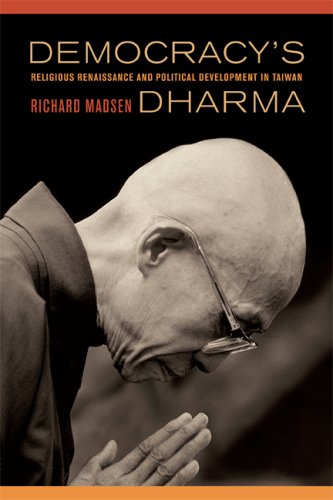
Democracy's Dharma: Religious Renaissance and Political Development...
Authors:
Richard Madsen
Publisher:
University of California Press
Publication Date:
Not available
ISBN:
0520252284
This book explores the remarkable religious renaissance that has reformed, revitalized, and renewed the practices of Buddhism and Daoism in Taiwan.... Democracy's Dharma connects these noteworthy developments to Taiwan's transition to democracy and the burgeoning needs of its new middle classes. Richard Madsen offers fresh thinking on Asian religions and shows that the public religious revival was not only encouraged by the early phases of the democratic transition but has helped to make that transition successful and sustainable. Madsen makes his argument through vivid case studies of four groups--Tzu Chi (the Buddhist Compassion Relief Association), Buddha's Light Mountain, Dharma Drum Mountain, and the Enacting Heaven Temple--and his analysis demonstrates that the Taiwan religious renaissance embraces a democratic modernity.
Democracys Discontent. America in Search of a Public Philosophy.
Authors:
Michael J. Sandel
Publisher:
Harvard University Press Cambridge.
Publication Date:
Not available
ISBN:
0674197453
The defect, Sandel maintains, lies in the impoverished vision of citizenship and community shared by Democrats and Republicans alike. American politics... has lost its civic voice, leaving both liberals and conservatives unable to inspire the sense of community and civic engagement that self-government requires. In search of a public philosophy adequate to our time, Sandel ranges across the American political experience, recalling the arguments of Jefferson and Hamilton, Lincoln and Douglas, Holmes and Brandeis, FDR and Reagan. He relates epic debates over slavery and industrial capitalism to contemporary controversies over the welfare state, religion, abortion, gay rights, and hate speech. Democracy's Discontent provides a new interpretation of the American political and constitutional tradition that offers hope of rejuvenating our civic life.
Democracy's Edge: Choosing to Save Our Country by Bringing...
Authors:
Frances Moore Lappe
Publisher:
Jossey-Bass
Publication Date:
Not available
ISBN:
0787943118
Three out of five Americans, both Republicans and Democrats, feel our country is headed in the wrong direction. America is at the edge, a critical place... at which we can either renew and revitalize or give in and lose that most precious American ideal—democracy—and along with it the freedom, fairness, and opportunities it assures. Democracy’s Edge is a rousing battle cry that we can—and must—act now. From Jefferson to Eisenhower, presidents from both parties have warned us of the danger of letting a closed, narrow group of business and government officials concentrate power over our lives. Yet today, a small and unrepresentative group of people is making vital decisions for all of us.But this crisis is only a symptom, Lappé argues. It’s a symptom of thin democracy, something done to us or for us, not by or with us. Such democracy is always at risk of being stolen by private interests or extremist groups, left and right. But there is a solution. The answer, says Lappé, is Living Democracy, a powerful yet often invisible citizens’ revolution surging in communities across America. It’s not random, disjointed activism but the emergence of a new historical stage of democracy in which Americans realize that democracy isn’t something we have but something we do. Either we live it or lose it, says Lappé.
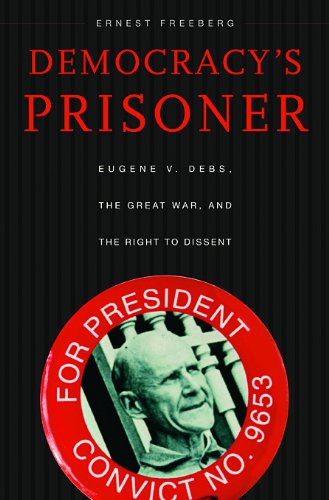
Democracy's Prisoner: Eugene V. Debs, the Great War, and the Right...
Authors:
Dr. Ernest Freeberg
Publisher:
Harvard University Press
Publication Date:
Not available
ISBN:
0674057201
In 1920, socialist leader Eugene V. Debs ran for president while serving a ten-year jail term for speaking against America’s role in World War I.... Though many called Debs a traitor, others praised him as a prisoner of conscience, a martyr to the cause of free speech. Nearly a million Americans agreed, voting for a man whom the government had branded an enemy to his country. In a beautifully crafted narrative, Ernest Freeberg shows that the campaign to send Debs from an Atlanta jailhouse to the White House was part of a wider national debate over the right to free speech in wartime. Debs was one of thousands of Americans arrested for speaking his mind during the war, while government censors were silencing dozens of newspapers and magazines. When peace was restored, however, a nationwide protest was unleashed against the government’s repression, demanding amnesty for Debs and his fellow political prisoners. Led by a coalition of the country’s most important intellectuals, writers, and labor leaders, this protest not only liberated Debs, but also launched the American Civil Liberties Union and changed the course of free speech in wartime. The Debs case illuminates our own struggle to define the boundaries of permissible dissent as we continue to balance the right of free speech with the demands of national security. In this memorable story of democracy on trial, Freeberg excavates an extraordinary episode in the history of one of America’s most prized ideals.
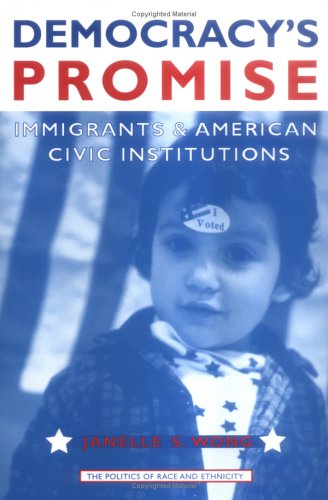
Democracy's Promise: Immigrants and American Civic Institutions...
Authors:
Janelle Wong
Publisher:
University of Michigan Press
Publication Date:
Not available
ISBN:
0472069136
Given the massive demographic changes in the United States during the past few decades, understanding the place of immigrants in the public sphere has... never been more critical. Democracy's Promise examines both the challenges and opportunities posed to American civic institutions by the presence of increasing numbers of immigrants. Author Janelle Wong argues that the low levels of political participation among contemporary immigrants are not due to apathy or preoccupation with their homeland, but to the inability of American political parties and advocacy organizations to mobilize immigrant voters. Wong's rich study of Chinese and Mexican immigrants in New York and Los Angeles complements traditional studies of political behavior and civic institutions while offering a nuanced examination of immigrants' political activity.Democracy's Promise will appeal to a broad spectrum of social scientists and ethnic studies scholars who study or teach immigration, racial and ethnic politics, political participation, civic engagement, and American political institutions. In addition, it will appeal to community organizers and party activists who are interested in issues of race and ethnicity, immigration, political participation, and political mobilization.Janelle Wong is Assistant Professor of Political Science and American Studies and Ethnicity at the University of Southern California."As political parties (perhaps) decline in the United States, as civic organizations (perhaps) move away from direct participatory politics, and as the number of immigrants certainly increases--what will link new Americans to the political realm? Janelle Wong answers this important question clearly, with elegance, nuance, rich description, and galvanizing provocativeness. Her evidence is compelling and her sense of urgency about the need for parties to look beyond short-term interests even more so."--Jennifer L. Hochschild, Harvard University"Wong draws on the Latino and Asian immigrant experience, with specific examples from the Chinese and Mexican communities of New York and Los Angeles, to show how the political parties have largely failed to organize these groups and why labor unions and immigrant advocacy organizations have stepped in to take their place. Far from 'disuniting' America, she clearly shows that bringing these groups into the political fray is central to the project of renewing American democracy."--John Mollenkopf, CUNY Graduate Center"A scathing critique of the role of parties in the mobilization of new immigrants and an invaluable analysis of alternative pathways of mobilization through community organizations."--Michael Jones-Correa, Cornell University"By employing multiple empirical methods, including in-depth interviews and sophisticated survey analyses, Janelle Wong provides a compelling account of the political activities and allegiances of America's Asian and Latino immigrants that challenges much conventional wisdom. Often the political parties are failing to reach out to these groups, and often immigrants remain concerned about their home countries; but they are nonetheless increasingly active in American politics, in ways that may do much to shape the course of American political development in the 21st century. Democracy's Promise is a major contribution to our understanding of this crucial dimension of American politics."--Rogers M. Smith, University of Pennsylvania"Democracy's Promise challenges political parties to reexamine their priorities for mobilizing new voters, and identifies the critical role civic institutions play in invigorating participation among immigrant citizens. Wong's analysis is at once precise and expansive; illuminating the contours of Latino and Asian American political incorporation and provoking thoughtful debate on inclusion in democratic theory."--Jane Junn, Rutgers University
 '





