production
/viewbook/list/all/?page=3328
/
/static/
None

Dependent on D.C.: The Rise of Federal Control over the Lives of...
Authors:
Charlotte A. Twight
Publisher:
Palgrave Macmillan
Publication Date:
Not available
ISBN:
1403961468
Dependent on D.C. raises serious concerns about the future of liberty in America and proves beyond a doubt that the growth of dependence on government... in the past seventy years has not been accidental, that its creation has been bipartisan, and that it is accelerating. Twight shows how growing federal power--driven by legislation, validated by Supreme Court decisions, and accelerated by presidential ambition--has eroded the rule of law in our nation, leaving almost no activity that the central government cannot at its discretion regulate, manipulate, or prohibit. Dependent on D.C. shows why Americans have not resistedthis expansion of federal power. In these uncertain times, Dependent on D.C. is the book Americans need to read when thinking about the future of their individual liberty.

Dependent Rational Animals: Why Human Beings Need the Virtues (The...
Authors:
Alasdair MacIntyre
Publisher:
Open Court
Publication Date:
Not available
ISBN:
081269452X
To flourish, humans need to develop virtues of independent thought and acknowledged social dependence. In this book, a leading moral philosopher... presents a comparison of humans to other animals and explores the impact of these virtues.

Dependent States: The Child's Part in Nineteenth-Century American...
Authors:
Karen Sanchez-Eppler
Publisher:
University Of Chicago Press
Publication Date:
Not available
ISBN:
0226734595
Because childhood is not only culturally but also legally and biologically understood as a period of dependency, it has been easy to dismiss children as... historical actors. By putting children at the center of our thinking about American history, Karen Sánchez-Eppler recognizes the important part childhood played in nineteenth-century American culture and what this involvement entailed for children themselves.Dependent States examines the ties between children's literacy training and the growing cultural prestige of the novel; the way children functioned rhetorically in reform literature to enforce social norms; the way the risks of death to children shored up emotional power in the home; how Sunday schools socialized children into racial, religious, and national identities; and how class identity was produced, not only in terms of work, but also in the way children played. For Sánchez-Eppler, nineteenth-century childhoods were nothing less than vehicles for national reform. Dependent on adults for their care, children did not conform to the ideals of enfranchisement and agency that we usually associate with historical actors. Yet through meticulously researched examples, Sánchez-Eppler reveals that children participated in the making of social meaning. Her focus on childhood as a dependent state thus offers a rewarding corrective to our notions of autonomous individualism and a new perspective on American culture itself.

Depois Daquela Viagem: Diário de Bordo uma Jovem
Authors:
Not Available
Publisher:
Ática
Publication Date:
Not available
ISBN:
850808742X

Deportation Nation: Outsiders in American History
Authors:
Daniel Kanstroom
Publisher:
Harvard University Press
Publication Date:
Not available
ISBN:
0674046226
The danger of deportation hangs over the head of virtually every noncitizen in the United States. In the complexities and inconsistencies of... immigration law, one can find a reason to deport almost any noncitizen at almost any time. In recent years, the system has been used with unprecedented vigor against millions of deportees. We are a nation of immigrants--but which ones do we want, and what do we do with those that we don't? These questions have troubled American law and politics since colonial times. Deportation Nation is a chilling history of communal self-idealization and self-protection. The post-Revolutionary Alien and Sedition Laws, the Fugitive Slave laws, the Indian "removals," the Chinese Exclusion Act, the Palmer Raids, the internment of the Japanese Americans--all sought to remove those whose origins suggested they could never become "true" Americans. And for more than a century, millions of Mexicans have conveniently served as cheap labor, crossing a border that was not official until the early twentieth century and being sent back across it when they became a burden. By illuminating the shadowy corners of American history, Daniel Kanstroom shows that deportation has long been a legal tool to control immigrants' lives and is used with increasing crudeness in a globalized but xenophobic world.

Deposition Rules, 5th Edition
Authors:
David M Malone
Publisher:
Foundation Press
Publication Date:
Not available
ISBN:
1601561725
The 2012 Statutory and Case Supplement brings together major legislative and judicial developments since the publication of the Tenth Edition.... Background Notes provide continuing coverage of current business and legal developments.
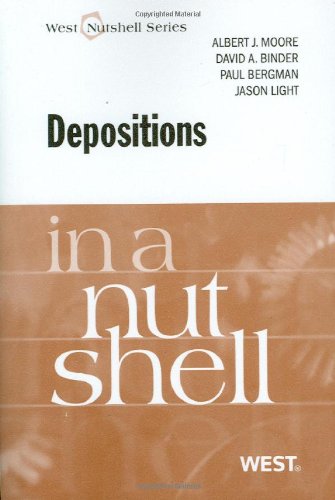
Depositions in a Nutshell (Nutshell Series)
Authors:
Albert J. Moore
Publisher:
West
Publication Date:
Not available
ISBN:
0314194894
This book provides comprehensive descriptions and concrete illustrations of effective strategies and techniques for taking and defending depositions.... The book can serve as a text for a 2-4 unit stand-alone depositions course (either live client or simulated) or as a supplement to a civil pre-trial lawyering course. The book devotes separate chapters to such fundamental skills as obtaining helpful answers to critical questions, undercutting harmful testimony, obtaining a deponent's version of significant events, and obtaining information from evasive deponents. Other chapters include topics such as responding to inconsistent or implausible testimony, overcoming opposing counsel's objections and obstructionist tactics, and preparing a client to be deposed.

Depository and Lending Institutions: Banks and Savings...
Authors:
American Institute of CPAs
Publisher:
AICPA
Publication Date:
Not available
ISBN:
0870518992
This guide summarizes new standards, guidance, and practices, and delivers "how-to" advice for handling audit and
accounting issues common to the... depository and lending institutions industry.
Updated as of June 1, 2010, the guide provides information related to the banking and savings institutions, credit
unions, finance companies, and mortgage companies industries, including general information on the regulatory
environment and prevalent banking and lending activities. The guide includes relevant guidance contained in the
FASB Accounting Standards Codification™ and other technical sources and includes recent authoritative
accounting developments in areas such as other-than-temporary impairments, fair value measurements, and transfers
of financial assets. In addition, the guide provides guidance related to new and existing regulatory reporting matters, including updates to the FDI Act reporting requirements. The guide also offers clear and practical guidance on risk assessment and internal controls. All content is reviewed by industry experts and approved by the
appropriate AICPA senior technical committee(s). A subject index has been added to the Guide for ease of use.
Updates significant to this edition include technical guidance contained in:
· FSP FAS 115-2 and FAS 124-2, Recognition and Presentation of Other-Than-Temporary Impairments (FASB ASC 320)
· FASB ASU No. 2009-16, Transfers and Servicing (Topic 860): Accounting for Transfers of Financial Assets
· FASB ASU No. 2009-17, Consolidations (Topic 810): Improvements to Financial Reporting by Enterprises Involved with Variable Interest Entities
· AICPA TIS section 9110.16 "Example Reports on Federal Deposit Insurance Corporation Loss Sharing Purchase and Assumption Transactions"
· FASB Statement No. 141(R), Business Combinations (FASB ASC 805)

Depression and Bipolar Disorder: Stahl's Essential...
Authors:
Stephen M. Stahl
Publisher:
Cambridge University Press
Publication Date:
Not available
ISBN:
0521714125
Essential. Trusted. Indispensable. Stahl's Essential Psychopharmacology has established itself as the preeminent source of education and information... in its field. This much-expanded third edition relies on advances in neurobiology and recent clinical developments to explain the concepts underlying drug treatment of psychiatric disorders. In addition to redrawn art, an improved and more readable layout, and 30% more illustrations, the Third Edition has four all-new chapters on Psychiatric Genetics, Chronic Pain and Functional Somatic Syndromes, Disorders of Sleep, and Disorders of Cognition. Covered within are new neurotransmitter systems; theories on schizophrenia; clinical advances in antipsychotic and antidepressant therapy; coverage of attention deficit disorder and drug abuse; and new coverage of sleep disorders, chronic pain, and disorders of impulse control. This volume is indispensable for all students and professionals in mental health, enabling them to master the complexities of psychopharmacology.

Depression: Causes and Treatment, 2nd Edition
Authors:
Aaron T. Beck
Publisher:
University of Pennsylvania Press
Publication Date:
Not available
ISBN:
0812219643
More than forty years ago, Dr. Aaron T. Beck's pioneering Depression: Causes and Treatment presented the first comprehensive account of all aspects of... depression and introduced cognitive therapy to health care providers and patients struggling with one of the most common and devastating diseases of the modern age. Since that classic text first appeared, the appreciation of the multifaceted nature of mood disorders has grown, and the phenomenological and biological aspects of psychology are increasingly seen as intertwined. Taking these developments into account, Beck and his colleague Brad A. Alford have written a second edition of Depression that will help patients and caregivers understand depression as a cognitive disorder.The new edition of Depression builds on the original research and approach of the seminal first edition, including the tests of Freud's theory that led to a new system of psychological theory and therapy, one that addresses the negative schema and automatic thoughts that can trap people in painful emotional states. Beck and Alford examine selected scientific tests and randomized controlled trials that have enhanced the cognitive approach since the time it was first introduced.Incorporating accepted changes in the definitions and categories of the various mood disorders into its discussion, Depression addresses the treatment role of revolutionary drugs, such as the selective serotonin reuptake inhibitors (SSRIs), electroconvulsive therapy (ECT), and transcranial magnetic stimulation (TMS) in relation to cognitive approaches. Beck and Alford explore research on neurotrophic and neurogenesis theories of depression. They also report on advances in psychosocial treatment of depression, including the value of cognitive therapy in the prevention of relapse.

Depression in Japan: Psychiatric Cures for a Society in Distress
Authors:
Junko Kitanaka
Publisher:
Princeton University Press
Publication Date:
Not available
ISBN:
069114205X
Since the 1990s, suicide in recession-plagued Japan has soared, and rates of depression have both increased and received greater public attention. In a... nation that has traditionally been uncomfortable addressing mental illness, what factors have allowed for the rising medicalization of depression and suicide? Investigating these profound changes from historical, clinical, and sociolegal perspectives, Depression in Japan explores how depression has become a national disease and entered the Japanese lexicon, how psychiatry has responded to the nation's ailing social order, and how, in a remarkable transformation, psychiatry has overcome the longstanding resistance to its intrusion in Japanese life. Questioning claims made by Japanese psychiatrists that depression hardly existed in premodern Japan, Junko Kitanaka shows that Japanese medicine did indeed have a language for talking about depression which was conceived of as an illness where psychological suffering was intimately connected to physiological and social distress. The author looks at how Japanese psychiatrists now use the discourse of depression to persuade patients that they are victims of biological and social forces beyond their control; analyzes how this language has been adopted in legal discourse surrounding "overwork suicide"; and considers how, in contrast to the West, this language curiously emphasizes the suffering of men rather than women. Examining patients' narratives, Kitanaka demonstrates how psychiatry constructs a gendering of depression, one that is closely tied to local politics and questions of legitimate social suffering. Drawing upon extensive research in psychiatric institutions in Tokyo and the surrounding region, Depression in Japan uncovers the emergence of psychiatry as a force for social transformation in Japan.

Depression, War, and Cold War: Challenging the Myths of Conflict...
Authors:
Robert Higgs
Publisher:
Independent Institute
Publication Date:
Not available
ISBN:
1598130293
Offering a powerful interpretation of U.S. political economy from the early-1930s to the end of the Cold War, this resource refutes many popular myths... about the Great Depression and New Deal, the World War II economy, and the postwar national-security state that is still so pervasive today. What accounts for the extraordinary duration of the Great Depression? How did the war alter relations between government and leaders of big business? What is Congress’s role in the military-industrial-congressional complex? This book answers these and other crucial questions by presenting new insights and analyses along with statistical evidence that defies mainstream interpretation of economic history.
De Profectione Ludovici VII in Orientem: The Journey of Louis the ...
Authors:
Odo of Deuil
Publisher:
W W Norton & Co Inc (Np)
Publication Date:
Not available
ISBN:
0393096629

De Profundis and Other Writings (Penguin Classics)
Authors:
Oscar Wilde
Publisher:
Penguin Classics
Publication Date:
Not available
ISBN:
014043089X
'I have nothing to declare,' Wilde once told an American customs official, 'except my genius.' A good part of that genius is evident in the essays and... poems included in this volume. There is the intellectual genius of "The Soul of Man under Socialism", in which he clearly foresaw the dangers of economic bureaucracy and state-worship: for Wilde, socialism meant liberation and individuality, not enslavement. Then there is the emotional genius of "De Profundis", the long, introspective and often hostile letter he addressed to Lord Alfred Douglas from prison. And there is the poetical genius of "The Ballad of Reading Gaol", in which Wilde's generous nature could movingly express for another's misery the sorrow he found it hard to express for his own. This collection contains, too, many examples of that humorous and epigrammic genius which captured the London theatre and which, by suddenly casting light from an unexpected angle, widened the bounds of truth.

De Profundis (Dover Thrift Editions)
Authors:
Oscar Wilde
Publisher:
Dover Publications
Publication Date:
Not available
ISBN:
0486293084
While jailed for homosexual offenses, Wilde wrote this long, bitter letter of recrimination to his lover, Lord Alfred Douglas. It offers fascinating... insights into Wilde's life in prison and the background and psychology of a notorious affair, but its eloquence, passion and literary excellence make it a universal statement about love, injustice and suffering.
 '





