production
/viewbook/list/all/?page=3335
/
/static/
None

Der Vorleser
Authors:
Bernhard Schlink
Publisher:
Distribooks Inc
Publication Date:
Not available
ISBN:
3257229534

Der Weg Zum Lesen
Authors:
Van Horn Vail
Publisher:
Wiley
Publication Date:
Not available
ISBN:
0470426411
DER WEG ZUM LESEN is designed to help instructors and students over one of the most difficult hurdles in language instruction-the transition from... working lessons in a grammar book to reading unedited literary texts.

Der Weg zum Lesen (German Edition)
Authors:
Van Horn Vail
Publisher:
Heinle
Publication Date:
Not available
ISBN:
0155173510
DER WEG ZUM LESEN is designed to help instructors and students over one of the most difficult hurdles in language instruction-the transition from... working lessons in a grammar book to reading unedited literary texts.
Der Zerbrochene Krug (German Edition)
Authors:
Kleist
Publisher:
Klett (Ernst) Verlag,Stuttgart
Publication Date:
Not available
ISBN:
3123513904
Paperback: 113 pages
Publisher: Klett (Ernst) Verlag,Stuttgart (December 1, 1993)
Language: German
ISBN-10: 3123513904
ISBN-13: 978-3123513909
Product... Dimensions: 6.9 x 4.1 x 0.4 inches
Shipping Weight: 2.7 ounces

Der Zerbrochene Krug - Leseheft MIT Audio-CD (German Edition)
Authors:
Not Available
Publisher:
Max Hueber Verlag
Publication Date:
Not available
ISBN:
3194016733

Der zerbrochne Krug: Ein Lustspiel
Authors:
Not Available
Publisher:
Philipp Reclam Jun Verlag GmbH
Publication Date:
Not available
ISBN:
3150000912

Der Zimmerspringbrunnen. Text und Kommentar
Authors:
Jens Sparschuh
Publisher:
Buchners C.C. Verlag
Publication Date:
Not available
ISBN:
3766139770
Ce livre de maturité fait apparaître avec plus d''éclat que jamais les qualités d''émotion, d''évocation et d''écriture qui singularisent si... fortement l''œuvre de la grande romancière. En s''inspirant du temps où elle enseignait au Manitoba, Gabrielle Roy trace ici le portrait d''élèves qui pour elle portent à la fois le visage de l''enfance et celui de l''humanité tout entière. Par Nil et Demetrioff, elle découvre le pouvoir de l''art et la beauté ; par André, le courage et le don de soi ; par Médéric, enfin, elle éprouve les frémissements de la sensualité et la puissance irrésistible de l''amour.Depuis sa première publication en 1977, Ces enfants de ma vie a été traduit en anglais et en japonais et a valu à Gabrielle Roy son troisième prix du Gouverneur général du Canada.Cette nouvelle édition est accompagnée d''une chronologie et d''une courte bibliographie de la critique.

DESARROLLO DEL ESPANOL PARA MAESTROS EN PROGRAMAS DE EDUCACI
Authors:
Not Available
Publisher:
Not available
Publication Date:
Not available
ISBN:
Not available
Descartes: A Biography
Authors:
Desmond M. Clarke
Publisher:
Cambridge University Press
Publication Date:
Not available
ISBN:
0521823013
Although René Descartes' (1596-1650) is best remembered today for writing "I think, therefore, I am," his unique contribution to the history of ideas... was his effort to construct a philosophy that would be sympathetic to the new sciences that emerged in the seventeenth century. In four major publications, he fashioned a philosophical system that accommodated the needs of these new sciences, thereby earning the unrelenting hostility of both Catholic and Calvinist theologians, who relied on the scholastic philosophy that Descartes hoped to replace. His contemporaries claimed that his proofs of God's existence, in the Meditations, were so unsuccessful that he must have been a cryptic atheist, and that his discussion of skepticism served merely to fan the flames of libertinism. Although Descartes died in Stockholm in obscurity, he soon became one of the most famous philosophers of the seventeenth century, a status that he continues to enjoy today. This English-language biography addresses the complete range of Descartes' interests in theology, philosophy, and the sciences, and traces his intellectual development throughout his entire career. Desmond M. Clarke is Professor of Philosophy at University College Cork, Ireland, where he previously served as Dean of Arts and Vice-President. He is author of a number of books on Descartes and the seventeenth century, including Descartes' Philosophy of Science (1982), Occult Powers & Hypotheses (1989) and Descartes' Theory of Mind (1993). He has translated two selections of Descartes' writings and has also translated La Forge's Treatise on the Human Mind (1997) and Poulain de la Barre's The Equality of the Sexes.
Descartes: An Analytical and Historical Introduction
Authors:
Georges Dicker
Publisher:
Oxford University Press, USA
Publication Date:
Not available
ISBN:
0195075900
A solid grasp of the main themes and arguments of the seventeenth century philosopher Rene Descartes is an essential tool towards understanding modern... thought, and a necessary entree to the work of the empiricists and Immanuel Kant, and to the study of contemporary epistemology and philosophy of mind. Clear and accessible, this new book serves as an introduction to Descartes's ideas for undergraduates and as a sophisticated companion to his Meditations for more advanced readers. After a thorough discussion of the main themes and arguments of the Meditations, the historical background of the work, and its critical reception, the author offers his own reflections on Cartesian doubt, the cogito, the causal and ontological proofs of God's existence, the Cartesian circle, Cartesian dualism, and Descartes' views of the material world. The commentary includes and cross-references the full text of Meditations I, II, and V, and most of Meditations III and VI, employing John Cottingham's highly-praised translation.
Descartes' Baby: How the Science of Child Development Explains What...
Authors:
Paul Bloom
Publisher:
Basic Books
Publication Date:
Not available
ISBN:
0465007864
All humans see the world in two fundamentally different ways: even babies have a rich understanding of both the physical and social worlds. They expect... objects to obey principles of physics, and they’re startled when things disappear or defy gravity. Yet they can also read emotions and respond with anger, sympathy, and joy.In Descartes’ Baby, Bloom draws on a wealth of scientific discoveries to show how these two ways of knowing give rise to such uniquely human traits as humor, disgust, religion, art, and morality. How our dualist perspective, developed throughout our lives, profoundly influences our thoughts, feelings, and actions is the subject of this richly rewarding book.
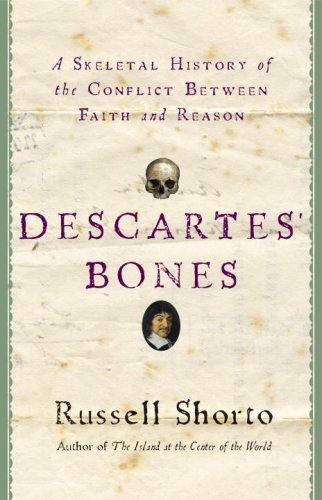
Descartes' Bones: A Skeletal History of the Conflict between Faith...
Authors:
Russell Shorto
Publisher:
Doubleday
Publication Date:
Not available
ISBN:
038551753X
On a brutal winter's day in 1650 in Stockholm, the Frenchman René Descartes, the most influential and controversial thinker of his time, was buried... after a cold and lonely death far from home. Sixteen years later, the French Ambassador Hugues de Terlon secretly unearthed Descartes' bones and transported them to France. Why would this devoutly Catholic official care so much about the remains of a philosopher who was hounded from country to country on charges of atheism? Why would Descartes' bones take such a strange, serpentine path over the next 350 years—a path intersecting some of the grandest events imaginable: the birth of science, the rise of democracy, the mind-body problem, the conflict between faith and reason? Their story involves people from all walks of life—Louis XIV, a Swedish casino operator, poets and playwrights, philosophers and physicists, as these people used the bones in scientific studies, stole them, sold them, revered them as relics, fought over them, passed them surreptitiously from hand to hand.The answer lies in Descartes’ famous phrase: Cogito ergo sum—"I think, therefore I am." In his deceptively simple seventy-eight-page essay, Discourse on the Method, this small, vain, vindictive, peripatetic, ambitious Frenchman destroyed 2,000 years of received wisdom and laid the foundations of the modern world. At the root of Descartes’ “method” was skepticism: "What can I know for certain?" Like-minded thinkers around Europe passionately embraced the book--the method was applied to medicine, nature, politics, and society. The notion that one could find truth in facts that could be proved, and not in reliance on tradition and the Church's teachings, would become a turning point in human history.In an age of faith, what Descartes was proposing seemed like heresy. Yet Descartes himself was a good Catholic, who was spurred to write his incendiary book for the most personal of reasons: He had devoted himself to medicine and the study of nature, but when his beloved daughter died at the age of five, he took his ideas deeper. To understand the natural world one needed to question everything. Thus the scientific method was created and religion overthrown. If the natural world could be understood, knowledge could be advanced, and others might not suffer as his child did. The great controversy Descartes ignited continues to our era: where Islamic terrorists spurn the modern world and pine for a culture based on unquestioning faith; where scientists write bestsellers that passionately make the case for atheism; where others struggle to find a balance between faith and reason. Descartes’ Bonesis a historical detective story about the creation of the modern mind, with twists and turns leading up to the present day—to the science museum in Paris where the philosopher’s skull now resides and to the church a few kilometers away where, not long ago, a philosopher-priest said a mass for his bones.
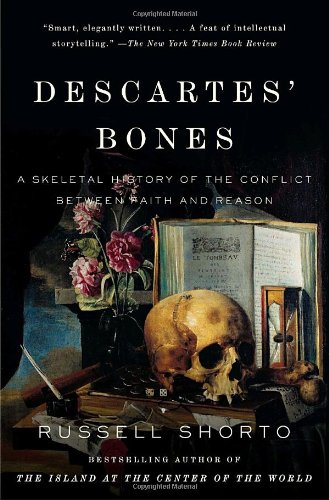
Descartes' Bones: A Skeletal History of the Conflict Between Faith...
Authors:
Russell Shorto
Publisher:
Vintage
Publication Date:
Not available
ISBN:
0307275663
A New York Times Notable BookSixteen years after René Descartes' death in Stockholm in 1650, a pious French ambassador exhumed the remains of the... controversial philosopher to transport them back to Paris. Thus began a 350-year saga that saw Descartes' bones traverse a continent, passing between kings, philosophers, poets, and painters. But as Russell Shorto shows in this deeply engaging book, Descartes' bones also played a role in some of the most momentous episodes in history, which are also part of the philosopher's metaphorical remains: the birth of science, the rise of democracy, and the earliest debates between reason and faith. Descartes' Bones is a flesh-and-blood story about the battle between religion and rationalism that rages to this day.
Descartes: Discourse On Method
Authors:
Rene Descartes
Publisher:
Pearson
Publication Date:
Not available
ISBN:
0023671602
Descartes: Discourse On Method and the Meditations
Authors:
Laurence J. Lafleur
Publisher:
Pearson
Publication Date:
Not available
ISBN:
0023672609
Two works from the father of modern philosophy. In Discourse on Method, he formulated a scientific approach comprising four principles, including to... accept only what reason recognizes as "clear and distinct." In Meditations, he explores the mind/body distinction, the nature of truth and error, the existence of God, and the essence of material things.
 '





