production
/viewbook/list/all/?page=3385
/
/static/
None

Developing Ecological Consciousness: Paths to a Sustainable Future
Authors:
Christopher Uhl
Publisher:
Rowman & Littlefield Publishers
Publication Date:
Not available
ISBN:
0742532917
Developing Ecological Consciousness offers an ecology-based, wonder-filled initiation to the Universe and the Planet Earth. It examines the ways in... which humans are damaging the Earth and their own bodies and spirits. The book presents paradigms, values, and tools essential for both planetary and personal transformation.
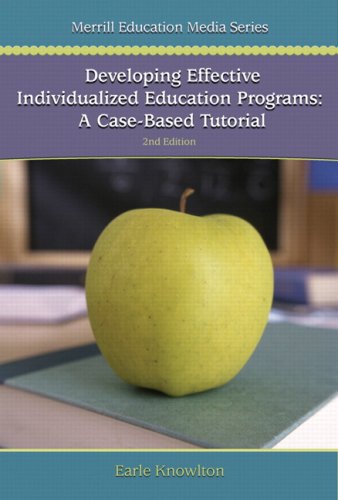
Developing Effective Individualized Education Programs: A Case...
Authors:
Earle Knowlton
Publisher:
Pearson
Publication Date:
Not available
ISBN:
0132216957
This unique CD-ROM provides a non-threatening environment where users can learn how to write an IEP and truly understand the IEP process. Through... videos, quizzes, tutorials, activities and resources, users learn how IEPs are created and gain valuable experience in doing so. Learning opportunities are diverse and include observing an IEP meeting, developing measurable goals and objectives for children featured on the CD-ROM, pinpointing a student's Present Level of Performance, creating IEPs for up to six students and more! Users also have the opportunity to respond to reflective assessments, reference pertinent forms, and discover resources and web links related to the IDEA Improvement Act of 2004.
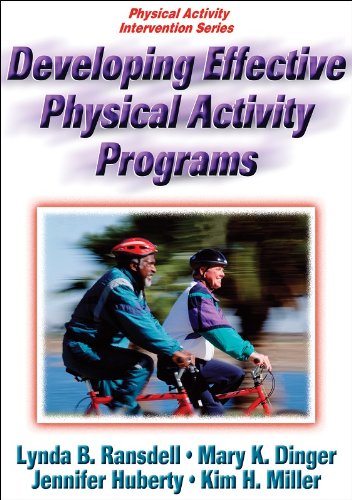
Developing Effective Physical Activity Programs (Physical Activity...
Authors:
Lynda Ransdell
Publisher:
Human Kinetics
Publication Date:
Not available
ISBN:
0736066934
Developing Effective Physical Activity Programs emphasizes the move away from a one-size-fits-all approach to physical activity interventions by... providing evidence-based recommendations for designing, implementing, and evaluating more effective and appropriate physical activity interventions for diverse populations. Part of Human Kinetics' Physical Activity Intervention series, the book provides research, methods, techniques, and support to health professionals seeking ways to promote physical activity programs that meet the specific needs of women, overweight and obese populations, older adults, and ethnically diverse populations—those shown as most likely to be sedentary and in need of the benefits of physical activity interventions.Developing Effective Physical Activity Programs offers background information to guide the planning process:-Physical activity recommendations for adults from various federal agencies and professional organizations, including the Centers for Disease Control and Prevention, the U.S. Department Health and Human Services, and the American College of Sports Medicine-An overview of scientific literature, which serves as a foundation for the physical activity recommendations-Detailed information regarding the four cornerstones of physical activity promotion: needs assessment, program planning, program implementation, and program evaluation -Descriptions of various physical activity measurement techniques and factors to consider when choosing one of these techniques The authors explain how careful consideration of the needs of specific populations can increase the success of physical activity interventions. They present evidence-based recommendations for working with various populations. Key considerations are discussed for each population, including the elements that make up the most successful interventions, unique barriers, and techniques for overcoming those barriers. Helpful tables summarize the barriers and solutions for each group, providing quick reference for designing programs. The final section of the text examines how the built environment, setting, and technology can influence intervention planning. You'll look at the ways in which neighborhood and community design can affect a person's physical activity levels. You'll also consider the various settings in which a program can be held, including homes, churches, and worksites, and how those settings will affect your program. This section also shows you how technology, such as Web- and phone-based interventions and podcasts, can be used to expand the reach of your program and positively influence the physical activity levels of participants.Throughout the book are summaries of current research studies examining physical activity interventions in various populations and settings along with descriptions and examples of successful programs and explanations for their success. In addition, each chapter concludes with helpful checklists that provide recommendations for developing and implementing physical activity interventions in various populations and settings. Unique in its comprehensive coverage of special populations, Developing Effective Physical Activity Programs shows practitioners how to answer the physical activity needs of each client or client group, address issues relevant to sedentary populations, and offer viable physical activity programs to improve the lives of the unique individuals they serve.Developing Effective Physical Activity Programs is part of the Physical Activity Intervention series. This timely series provides educational resources for professionals interested in promoting and implementing physical activity programs to a diverse and often resistant population.
Developing Effective Research Proposals
Authors:
Keith F Punch
Publisher:
Sage Publications Ltd
Publication Date:
Not available
ISBN:
1412921260
Successful research requires effective and thorough preparation. In this expanded and updated Second Edition of Developing Effective Research Proposals,... author Keith F. Punch offers an indispensable guide to the issues involved in proposal development and in presenting a well-considered plan for the execution of research. Dealing with both qualitative and quantitative approaches to empirical research across the social sciences, the Second Edition comprehensively covers the topics and concerns relevant to the subject and is organized around three central themes: What is a research proposal, who reads proposals and why; How can we go about developing a proposal?; and What might a finished proposal look like?
Developing Employee Capital
Authors:
David J. Kalamas
Publisher:
HRD Press, Inc
Publication Date:
Not available
ISBN:
0874257689
Make employees responsible for their own success Ready to take the next step in employee development? This innovative book provides guidelines for... helping managers create work environments where employees can develop themselves, without a great deal of direction. What’s in it for you and your organization? Employees who are skilled at the process of self-development are independent learners and thinkers who are more knowledgeable about the organization, less likely to exit, better able to respond to changing market conditions, and more positive about their jobs. Bottom line: They are more valuable to their organizations. A new way to approach employee and organization development Developing Employee Capital offers information about both organization development and individual developmental strategies. Designed to help you and your employees create developmental plans together, it covers everything from online learning and diversity management to job rotation and mentoring. The book is organized into nine chapters: Laying the foundation Career planning Training as a developmental tool Establishing and implementing mentoring programs Coaching and development Human resources and strategic plans Educational activities and self-development Environmental management Organization development Included are step-by-step instructions for designing, implementing, and evaluating a number of developmental strategies as well as reproducible assessment tools, lists of commercially available tools, process checklists, planning forms, ROI computation guides, a training design matrix, and basic job analysis forms.
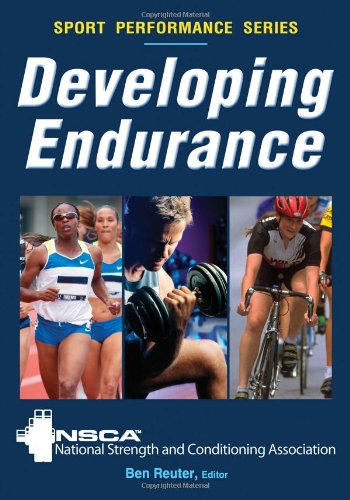
Developing Endurance (Sport Performance)
Authors:
Not Available
Publisher:
Human Kinetics
Publication Date:
Not available
ISBN:
0736083278
Runners, cyclists, swimmers, rowers, triathletes, and ultradistance athletes must sustain performance at a high level to come out on top.... Developing Endurance shows how to achieve optimal stamina to race your best through science-based aerobic, anaerobic, and resistance training. Written by 11 top experts in the National Strength and Conditioning Association, the top sport conditioning organization in the world, this guide provides both the background information and the exercises, drills, workouts, and programs for ultimate results. Athletes and coaches will appreciate the assessment tools, analyses, and instruction to define specific needs and establish effective training goals. Armed with these tools and information, you can create the ideal personalized training program for your sport and avoid lengthy plateaus while taking performance to the highest level.
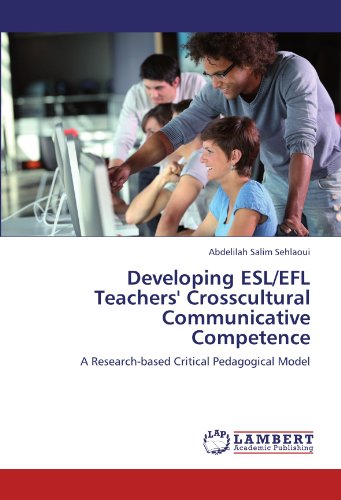
Developing ESL/EFL Teachers' Crosscultural Communicative...
Authors:
Abdelilah Salim Sehlaoui
Publisher:
Not available
Publication Date:
Not available
ISBN:
384543449X
The growing need for effective crosscultural communicative competence in TESOL professionals who possess a critical pedagogical competence has become... more evident due to the increasing number of ELLs and LCD students and the global socioeconomic, technological, and political developments. This trend is not unique to the USA, but is also occurring in many other countries. Lack of preparedness is corroborated through a needs assessment that emerged from more than twenty-five years of teaching experience and research which motivated the author to write this book. The book presents an in-depth, interdisciplinary, approach to developing a critical pedagogical and crosscultural communicative competence in pre-service and inservice ESL/EFL teachers. It offers a practical research-based model to develop this competence in teachers using a critical-incident pedagogical approach. The integration of Computer-Assisted Language Learning in this model makes it unique. The book includes classroom-tested activities, instructional resources and strategies, based on findings and insights gained from research as well as professional development workshops presented nationally and internationally.
Developing Essential Understanding of Addition and Subtraction for...
Authors:
Janet H. Caldwell
Publisher:
National Council of Teachers of Mathematics
Publication Date:
Not available
ISBN:
0873536649
What is the relationship between addition and subtraction? How do you know whether an algorithm will always work? Can you explain why order matters in... subraction but not in addition, or why it is false to assert that the sum of any two whole numbers is greater than either number?It is organized around two big ideas and supported by smaller, more specific, interconnected ideas (essential understandings). Gaining an understanding about addition and subtraction is essential as they are the foundation for students later learning of multiplication and division.

Developing Essential Understanding of Algebraic Thinking for...
Authors:
Maria Blanton
Publisher:
National Council of Teachers of Mathematics
Publication Date:
Not available
ISBN:
0873536681
Like algebra at any level, early algebra is a way to explore, analyze, represent, and generalize mathematical ideas and relationships. This book shows... that children can and do engage in generalizing about numbers and operations as their mathematical experiences expand. The authors identify and examine five big ideas and associated essential understandings for developing algebraic thinking in grades 3 5. The big ideas relate to the fundamental properties of number and operations, the use of the equals sign to represent equivalence, variables as efficient tools for representing mathematical ideas, quantitative reasoning as a way to understand mathematical relationships, and functional thinking to generalize relationships between covarying quantities. The book examines challenges in teaching, learning, and assessment and is interspersed with questions for teachers reflection.
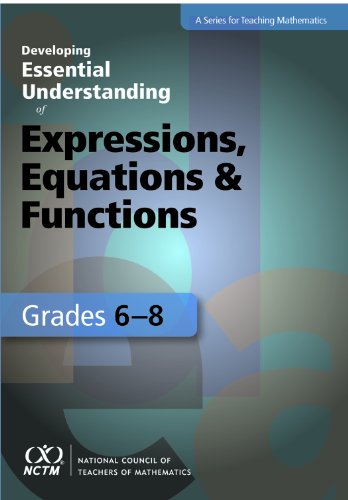
Developing Essential Understanding of Expressions, Equations &...
Authors:
Gwendolyn Lloyd
Publisher:
National Council of Teachers of Mathematics
Publication Date:
Not available
ISBN:
0873536703
Why do some equations have one solution, other two or even more solutions, and some no solutions? Why do we sometimes need switch the direction of an... inequality symbol in solving an inequality? What could you say if a student described a function as an equation? How much do you know...and how much do you need to know? Helping your students develop a robust understanding of expressions, equations, and functions requires that you understand this mathematics deeply. But what does that mean? This book focuses on essential knowledge for teachers about expressions, equations, and functions. It is organized around five big ideas, supported by multiple smaller, interconnected ideas essential understandings.Taking you beyond a simple introduction to expressions, equations, and functions, the book will broaden and deepen your mathematical understanding of one of the most challenging topics for students and teachers. It will help you engage your students, anticipate their perplexities, avoid pitfalls, and dispel misconceptions. You will also learn to develop appropriate tasks, techniques, and tools for assessing students' understanding of the topic. Focus on the ideas that you need to understand thoroughly to teach confidently.
Developing Essential Understanding of Functions for Teaching...
Authors:
Thomas J. Cooney
Publisher:
National Council of Teachers of Mathematics
Publication Date:
Not available
ISBN:
0873536231
Are sequences functions? What can t the popular vertical line test be applied in some cases to determine if a relation is a function? How does the idea... of rate of change connect with simpler ideas about proportionality as well as more advanced topics in calculus?How much do you know... and how much do you need to know?Helping your high school students develop a robust understanding of functions requires that you understand mathematics deeply. But what does that mean?This book focuses on essential knowledge for teachers about functions. It is organized around five big ideas, supported by multiple smaller, interconnected ideas essential understandings. Taking you beyond a simple introduction to functions, this book will broaden and deepen your mathematical understanding of one of the most challenging topics for students and teachers. It will help you engage your students, anticipate their perplexities, avoid pitfalls, and dispel misconceptions. You will also learn to develop appropriate tasks, techniques, and tools for assessing students understanding of the topic.Focus on the ideas that you need to understand thoroughly to teach confidently.
Developing Essential Understanding of Geometry for Teaching...
Authors:
Nathalie Sinclair
Publisher:
National Council of Teachers of Mathematics
Publication Date:
Not available
ISBN:
0873536916
Why are there so many formulas for area and volume, and why do some of them look alike? Why does one quadrilateral have no special name while another... has several, like square, rectangle, rhombus, and parallelogram and why are all these names useful?How much do you know ... and how much do you need to know? Helping your students develop a robust understanding of geometry requires that you understand this mathematics deeply. But what does that mean? This book focuses on essential knowledge for teachers about geometry. It is organized around four big ideas, supported by multiple smaller, interconnected ideas essential understandings. Taking you beyond a simple introduction to geometry, the book will broaden and deepen your mathematical understanding of one of the most challenging topics for students and teachers. It will help you engage your students, anticipate their perplexities, avoid pitfalls, and dispel misconceptions. You will also learn to develop appropriate tasks, techniques, and tools for assessing students understanding of the topic.About the Series: Focus on the ideas that you need to understand thoroughly to teach confidently. Move beyond the mathematics you expect your students to learn. Students who fail to get a solid grounding in pivotal concepts struggle in subsequent work in mathematics and related disciplines. By bringing a deeper understanding to your teaching, you can help students who don t get it the first time by presenting the mathematics in multiple ways. The Essential Understanding Series addresses topics in school mathematics that are critical to the mathematical development of students but are often difficult to teach. Each book in the series gives an overview of the topic, highlights the differences between what teachers and students need to know, examines the big ideas and related essential understandings, reconsiders the ideas presented in light of connections with other mathematical ideas, and includes questions for readers reflection.
Developing Essential Understanding Of Mathematical Reasoning For...
Authors:
Not Available
Publisher:
Not available
Publication Date:
Not available
ISBN:
Not available
Developing Essential Understanding of Number and Numeration for...
Authors:
Barbara J. Dougherty
Publisher:
National Council of Teachers of Mathematics
Publication Date:
Not available
ISBN:
0873536290
How do composing and decomposing numbers connect with the properties of addition? Focus on the ideas that you need to thoroughly understand in order to... teach with confidence. The mathematical content of this book focuses on essential knowledge for teachers about numbers and number systems. It is organized around one big idea and supported by smaller, more specific, interconnected ideas (essential understandings). Gaining this understanding is essential because numbers and numeration are building blocks for other mathematical concepts and for thinking quantitatively about the real-world. Essential Understanding Series topics: Number and Numeration for Grades Pre-K 2 Addition and Subtraction for Grades Pre-K 2 Geometry for Grades Pre-K 2 Reasoning and Proof for Grades Pre-K 8 Multiplication and Division for Grades 3 5 Rational Numbers for Grades 3 5 Algebraic Ideas and Readiness for Grades 3 5 Geometric Shapes and Solids for Grades 3 5 Ratio, Proportion, and Proportionality for Grades 6 8 Expressions and Equations for Grades 6 8 Measurement for Grades 6 8 Data Analysis and Statistics for Grades 6 8 Function for Grades 9 12 Geometric Relationships for Grades 9 12 Reasoning and Proof for Grades 9 12 Statistics for Grades 9 12
Developing Essential Understanding of Ratios, Proportions, and...
Authors:
Joanne Lobato
Publisher:
National Council of Teachers of Mathematics
Publication Date:
Not available
ISBN:
0873536223
How do you refute the erroneous claim that all ratios are fractions? This book goes beyond a simple introduction to ratios, proportions, and... proportional reasoning. It will help broaden and deepen your mathematical understanding of one of the most challenging topics for students and teachers to grasp. It will help you engage your students, anticipate their perplexities, help them avoid pitfalls, and dispel misconceptions. You will also learn to develop appropriate tasks, techniques, and tools for assessing your students understanding of the topic. Essential Understanding Series topics: Number and Numeration for Grades Pre-K 2 Addition and Subtraction for Grades Pre-K 2 Geometry for Grades Pre-K 2 Reasoning and Proof for Grades Pre-K 8 Multiplication and Division for Grades 3 5 Rational Numbers for Grades 3 5 Algebraic Ideas and Readiness for Grades 3 5 Geometric Shapes and Solids for Grades 3 5 Ratio, Proportion, and Proportionality for Grades 6 8 Expressions and Equations for Grades 6 8 Measurement for Grades 6 8 Data Analysis and Statistics for Grades 6 8 Function for Grades 9 12 Geometric Relationships for Grades 9 12 Reasoning and Proof for Grades 9 12 Statistics for Grades 9 12
 '





