production
/viewbook/list/all/?page=3442
/
/static/
None

DIFFERENTIAL DIAGNOSIS EBOOK OPTION
Authors:
Not Available
Publisher:
Not available
Publication Date:
Not available
ISBN:
Not available
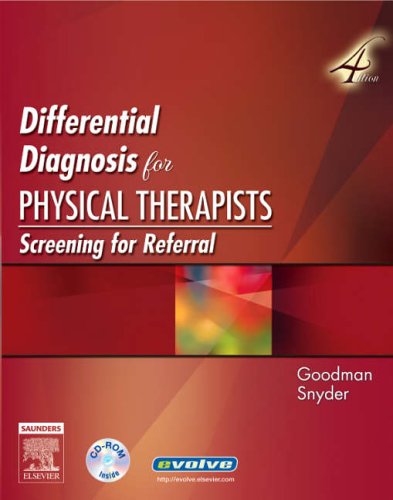
Differential Diagnosis for Physical Therapists: Screening for...
Authors:
Catherine C. Goodman MBA PT CBP
Publisher:
Saunders
Publication Date:
Not available
ISBN:
0721606199
Written by a leading expert in the field, this comprehensive reference text enables users to properly screen for medical disease to make an informed... diagnosis. The goal of this proven text is to teach the Physical Therapist how to determine if the patient has a true neuromuscular or musculoskeletal problem and to determine the specific dysfunction or impairment. Now with a new title that reflects a better understanding of the screening process as the first step in making a diagnosis, this text provides students, physical therapy clinicians and physical therapist assistants with a step-by-step approach to client evaluation, which follows the standards of competency established by the American Physical Therapy Association (APTA) related to conducting a screening examination.A systems-based approach to differential screening and diagnosis make it easy for Physical Therapists to find information and understand it in light of other systems issues.CD-ROM with screening tools provides Physical Therapists with forms and checklists they can use in the clinical setting.Case studies provide real-world examples.New chapter on how physical assessment provides baseline-screening information to better explain the progression of the screening process.Includes new information on musculoskeletal problems.A separate chapter on pain introduces the concept of pain as a screening tool.An entire section is devoted to systematic origins of pain to demonstrate how regional pain should be approached in screening for particular disorders.Introductory information on the newer medical screening concepts sets the stage for how screening is presented in the rest of the book.

Differential Diagnosis for Physical Therapists: Screening for...
Authors:
Catherine C. Goodman MBA PT CBP
Publisher:
Saunders
Publication Date:
Not available
ISBN:
1437725430
Following the standards for competency established by the American Physical Therapy Association (APTA) related to conducting a screening examination,... Differential Diagnosis for Physical Therapists, 5th Edition gives you a consistent way to screen for systemic diseases and medical conditions that can mimic neuromuscular and musculoskeletal problems. This comprehensive text centers on a 5-step screening model that covers past medical history, risk factor assessment, clinical presentation, associated signs and symptoms, and review of symptoms for each client.5-Step screening model for differential diagnosis includes past medical history, risk factor assessment, clinical presentation, associated signs and symptoms, and review of symptoms. Systems-based approach to the physical therapy screening interview provides a consistent way to screen for systemic disease and medical conditions that can mimic neuromuscular and musculoskeletal problems.Three sections of content present material in a logical way that covers: An introduction to the screening processViscerogenic causes of neuromusculoskeletal pain and dysfunctionSystem origins of neuromusculoskeletal pain and dysfunctionCognitive processing and reasoning orientation approach encourages you to gather and analyze data, pose and solve problems, infer, hypothesize, and make clinical judgments.Case examples and case studies give real-world examples of hot to integrate screening information into the diagnosis process.Screening tools in the book and on the Evolve companion website feature forms and checklists used in professional practice.Introductory information on medical screening concepts set the stage for how screening is presented in the rest of the book.Reference values for common clinical laboratory tests offer easy access to pertinent information references in a screening exam.Red flag histories, risk factors, clinical presentation, signs and symptoms, helpful screening clues, and guidelines for referral bring your attention to the important information a therapist needs to be aware of during the screening process. NEW! Full-color design, photos, and illustrations clearly demonstrate pathologies and processes.NEW and UPDATED! Evolve resources include printable screening tools and checklists, practice test questions, and more to enhance your learning.NEW! Hot topics keep you informed on rehabbing patients in the dawn or more current surgeries.

Differential Diagnosis in Dermatology
Authors:
Richard Ashton
Publisher:
Radcliffe Publishing
Publication Date:
Not available
ISBN:
1857756606
Royal Hospital Haslar, UK. Written to aid the diagnosis of an unknown rash or lesion. Factors of diagnosis such as site, erythematous or... non-erythematous, time frame, type of lesion, and color are given. Designed for use in patient examination. Abundant full-color images accompany skin conditions discussed. Softcover. Landscape format.

Differential Diagnosis in Primary Care
Authors:
R. Douglas Collins
Publisher:
Lippincott Williams & Wilkins
Publication Date:
Not available
ISBN:
1451118252
This text offers students, residents, and practitioners a systematic approach to differential diagnosis of symptoms and signs seen by primary care... physicians. The text is organized by symptoms and signs and into categories—pain, mass, bloody discharge, non-bloody discharge, functional changes, and abnormal laboratory results—and shows readers how to use their basic science knowledge to identify the possible causes of each symptom. The text provides information on the procedures and laboratory tests that need to be included in the workup.Features Include: Case presentations in quiz format New Appendix C which includes Tips for a more Comprehensive History and Physical Examination and Special Examination Techniques for Common Symptoms New section "Diseases within a Disease" (Stroke, Pneumonia, CHF, COPD, Cirrhosis, Peptic Ulcer, Pulmonary Fibrosis, Pericarditis, Myocardopathy, UTI, Renal Calculus, Gall Stones, Hemorrhoids, Thrombophlebitis, Malabsorption Syndrome, Fractures, Diabetes) Newer diagnostic tests such as Troponin for MI's and D-Dimer for Pulmonary Emboli Solution site containing fully searchable text

Differential Diagnosis of Common Complaints: with STUDENT CONSULT...
Authors:
Robert H. Seller MD
Publisher:
Saunders
Publication Date:
Not available
ISBN:
1455707724
Differential Diagnosis of Common Complaints, 6th Edition, by Drs. Robert H. Seller and Andrew B. Symons, helps you quickly and efficiently diagnose the... 36 most common symptoms reported by patients. Organized alphabetically by presenting symptom, each chapter mirrors the problem-solving process most physicians use to make a diagnosis. It's a practical, clinically oriented approach that can help you master the differential diagnosis of common symptoms and diagnose almost all the problems typically seen in your practice.Find the guidance you need quickly through an alphabetical organization by presenting symptom and a concise, consistent, user-friendly approach that mirrors the diagnostic decision-making process. Recognize skin problems more easily with full-color images in the dermatology chapter. Effectively diagnose your patients using an increased focus on evidence-based decision making, thoroughly updated material, and the latest results from clinical and diagnostic studies. Determine which imaging modalities and laboratory tests offer the greatest efficiencies and accuracy for a given set of symptoms. Get a fresh perspective from new co-author, Dr. Andrew B. Symons, who brings a strong background in education as Vice Chair of Medical Student Education at SUNY Buffalo. Search the entire text online and find links to self-assessment questions, case studies, and relevant content from other Student Consult titles at www.studentconsult.com. Be prepared to make a fast and efficient diagnosis with this valuable resource.

Differential Dynamical Systems (Monographs on Mathematical Modeling...
Authors:
James D. Meiss
Publisher:
Society for Industrial and Applied Mathematics
Publication Date:
Not available
ISBN:
0898716357
Differential equations are the basis for models of any physical systems that exhibit smooth change. This book combines much of the material found in a... traditional course on ordinary differential equations with an introduction to the more modern theory of dynamical systems. Applications of this theory to physics, biology, chemistry, and engineering are shown through examples in such areas as population modeling, fluid dynamics, electronics, and mechanics. Differential Dynamical Systems begins with coverage of linear systems, including matrix algebra; the focus then shifts to foundational material on nonlinear differential equations, making heavy use of the contraction-mapping theorem. Subsequent chapters deal specifically with dynamical systems concepts flow, stability, invariant manifolds, the phase plane, bifurcation, chaos, and Hamiltonian dynamics. Throughout the book, the author includes exercises to help students develop an analytical and geometrical understanding of dynamics. Many of the exercises and examples are based on applications and some involve computation; an appendix offers simple codes written in Maple®, Mathematica®, and MATLAB® software to give students practice with computation applied to dynamical systems problems. Audience This textbook is intended for senior undergraduates and first-year graduate students in pure and applied mathematics, engineering, and the physical sciences. Readers should be comfortable with elementary differential equations and linear algebra and should have had exposure to advanced calculus. Contents: List of Figures; Preface; Acknowledgments; Chapter 1: Introduction; Chapter 2: Linear Systems; Chapter 3: Existence and Uniqueness; Chapter 4: Dynamical Systems; Chapter 5: Invariant Manifolds; Chapter 6: The Phase Plane; Chapter 7: Chaotic Dynamics; Chapter 8: Bifurcation Theory; Chapter 9: Hamiltonian Dynamics; Appendix: Mathematical Software; Bibliography; Index

Differential Equations
Authors:
Not Available
Publisher:
BOOKS FOR DILLONS ONLY
Publication Date:
Not available
ISBN:
000000135X
Differential Equations
Authors:
Not Available
Publisher:
Cenage Learning
Publication Date:
Not available
ISBN:
0495634700

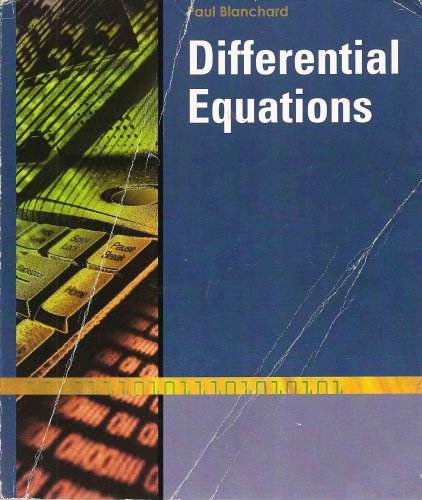
Differential Equations
Authors:
Paul (Paul Blanchard) Blanchard
Publisher:
Brooks Cole
Publication Date:
Not available
ISBN:
0495561983
Incorporating an innovative modeling approach, this book for a one-semester differential equations course emphasizes conceptual understanding to help... users relate information taught in the classroom to real-world experiences. Certain models reappear throughout the book as running themes to synthesize different concepts from multiple angles, and a dynamical systems focus emphasizes predicting the long-term behavior of these recurring models. Users will discover how to identify and harness the mathematics they will use in their careers, and apply it effectively outside the classroom.
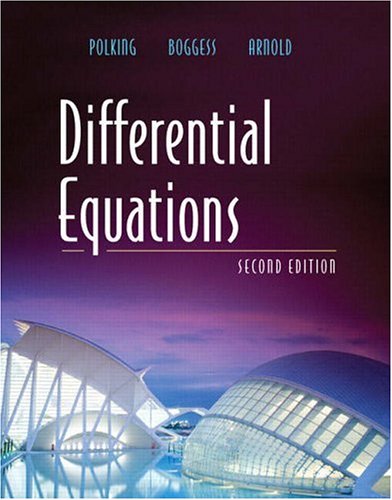
Differential Equations (2nd Edition)
Authors:
John Polking
Publisher:
Pearson
Publication Date:
Not available
ISBN:
0131437380
Combining traditional material with a modern systems approach, this handbook provides a thorough introduction to differential equations, tempering... its classic "pure math" approach with more practical applied aspects. Features up-to-date coverage of key topics such as first order equations, matrix algebra, systems, and phase plane portraits. Illustrates complex concepts through extensive detailed figures. Focuses on interpreting and solving problems through optional technology projects. For anyone interested in learning more about differential equations.
Differential Equations (2nd) (Loose-leaf)
Authors:
Not Available
Publisher:
Not available
Publication Date:
Not available
ISBN:
Not available

Differential Equations, 3rd Edition
Authors:
Shepley L. Ross
Publisher:
Wiley
Publication Date:
Not available
ISBN:
0471032948
This revised introduction to the basic methods, theory and applications of elementary differential equations employs a two part organization. Part I... includes all the basic material found in a one semester introductory course in ordinary differential equations. Part II introduces students to certain specialized and more advanced methods, as well as providing a systematic introduction to fundamental theory.

Differential Equations A First Course
Authors:
Martin M.Guterman
Publisher:
Indo American Books
Publication Date:
Not available
ISBN:
8189617206
Calculus Deconstructed is a thorough and mathematically rigorous exposition of single-variable calculus for readers with some previous exposure to... calculus techniques but not to methods of proof. This book is appropriate for a beginning Honors Calculus course assuming high school calculus or a "bridge course" using basica analysis to motivate and illustrate mathematical rigor. It can serve as a combination textbook and reference book for individual self-study. Standard topics and techniques in single-variable calculus are presented in context of a coherent logical structure, building on familiar properties of real numbers and teaching methods of proof by example along the way. Numerous examples reinforce both practical and theoretical understanding, and extensive historical notes explore the arguments of the originators of the subject. No previous experience with mathematical proof is assumed: rhetorical strategies and techniques of proof (reductio ad absurdum, induction, contrapositives, etc.) are introduced by example along the way. Between the text and exercises, proofs are available for all the basic results of calculus for functions of one real variable.
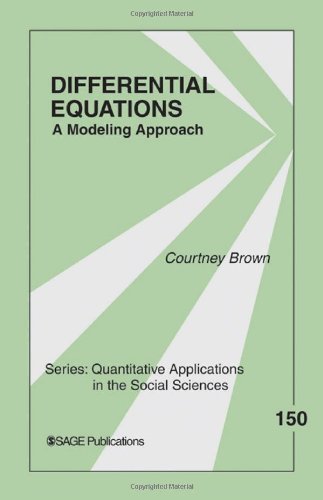
Differential Equations: A Modeling Approach (Quantitative...
Authors:
Courtney Brown
Publisher:
Sage Publications, Inc
Publication Date:
Not available
ISBN:
1412941083
"A reader with a strong background in mathematics, at least two semesters of calculus, and interest in the social sciences will find the book helpful in... learning how this area of mathematics can be used in different applications." -S.L. Sullivan, Catawba CollegeDifferential Equations: A Modeling Approach introduces differential equations and differential equation modeling to students and researchers in the social sciences. The text explains the mathematics and theory of differential equations. Graphical methods of analysis are emphasized over formal proofs, making the text even more accessible for newcomers to the subject matter. This volume introduces the subject of ordinary differential equations - as well as systems of such equations - to the social science audience. Social science examples are used extensively, and readers are guided through the most elementary models to much more advanced specifications. Emphasis is placed on easily applied and broadly applicable numerical methods for solving differential equations, thereby avoiding complicated mathematical “tricks” that often do not even work with more interesting nonlinear models. Also, graphical methods of analysis are introduced that allow social scientists to rapidly access the power of sophisticated model specifications. This volume also describes in clear language how to evaluate the stability of a system of differential equations (linear or nonlinear) by using the system’s eigenvalues. The mixture of nonlinearity with dynamical systems is a virtual trademark for this author’s approach to modeling, and this theme comes through clearly throughout this volume. This volume’s clarity of exposition encourages social science students of mathematical modeling to begin working with differential equation models that address complex and sophisticated social theories.Key Features:The text is accessibly written, so that students with minimal mathematical training can understand all of the basic concepts and techniques presented.The author uses social sciences examples to illustrate the relevance of differential equation modeling to readers.Readers can use graphical methods to produce penetrating analysis of differential equation systems. Linear and nonlinear model specifications are explained from a social science perspective. Most interesting differential equation models are nonlinear, and readers need to know how to specify and work with such models in the social sciences.
 '





