production
/viewbook/list/all/?page=3478
/
/static/
None

DIMENSIONS GUIDE ELEMENTARY K-3
Authors:
Not Available
Publisher:
Not available
Publication Date:
Not available
ISBN:
Not available

Dimensions In Human Sexuality
Authors:
Curtis O. Byer
Publisher:
McGraw-Hill Humanities/Social Sciences/Languages
Publication Date:
Not available
ISBN:
007241278X
The sixth edition of Dimensions of Human Sexuality reflects the latest research in human sexuality, with its organization and coverage streamlined to... meet the needs of today’s sexuality courses. In addition to a revised organization, the new edition features new end-of-chapter pedagogy geared to foster students’ critical thinking skills, and coverage of sexual orientation has been enhanced throughout the text.
Dimensions of Choice: Qualitative Approachs to Parks, Recreation,...
Authors:
Karla A. Henderson
Publisher:
Venture Publishing, Inc.
Publication Date:
Not available
ISBN:
1892132648
Applied Interpretation: Putting Research into Practice offers practitioners, managers, and students of interpretation a source for interpretive theory,... techniques, strategies, and experiences that have been shown, through research, to be successful in conveying interpretive messages. This resource is the product of 16 years of research that has evaluated traditional programs, school field trips, and visitor center and campfire programs. The findings, offered through vignettes and case studies, are the product of long-term assessments that range from three months to three years following an interpretive experience.

Dimensions of Ethics
Authors:
Wilfrid J. Waluchow
Publisher:
Broadview Press
Publication Date:
Not available
ISBN:
155111450X
The Dimensions of Ethics offers a concise but wide-ranging introduction to moral philosophy. In clear and engaging fashion, the author first examines... the scope of ethical theory, and explores central metaethical questions such as the issue of relativism, and the relationship between morality and religion. He then turns to an exploration of five theoretical approaches (utilitarianism, the deontological approach of Kant, the ethical pluralism of Ross, virtue ethics, and feminist ethics), in each case providing a consideration of various objections that have been advanced as well as a sympathetic exposition of the core principles of each approach. Throughout he uses a wide range of examples, and integrates references to issues in applied ethics with his discussions of ethical theory.

Dimensions of Food, Seventh Edition
Authors:
Vickie A. Vaclavik Ph.D.
Publisher:
CRC Press
Publication Date:
Not available
ISBN:
1439821674
Much like its popular predecessors, the seventh edition of Dimensions of Food encourages readers to become interactive participants in understanding the... physical, chemical, and functional and structural properties of food components, including the connection between conscientious food preparation and palatability and wholesome eating. With a wealth of questions, charts to complete, and practical exercises, this four part workbook allows readers to explore and develop a deeper understanding of food in ways that will maximize each of their own culinary experiences. Part One leads readers through an investigation of the economic, nutritional, palatability, sanitation, chemical, and processing dimensions of food. Part Two provides a number of demonstrations and participatory exercises that will help develop a basic understanding of the functional and structural properties of a variety of food groups that include starches, fruits and vegetables, eggs, dairy, meat, poultry, fish, fats and oils, and sugars and baked products. Part Three focuses an analytical eye on the modern convenience of microwave cookery, detailing effective procedures for cooking, reheating, and defrosting food. Part Four gives readers the opportunity to creatively apply the principles of food selection so as to prepare meals that that are personally satisfying, nutritious, and practical. Revised and updated to include new information and current trends, this resource: Offers an expanded discussion of food allergies and intolerances Includes sample scorecards for evaluating foods, as well as a sample nutrition facts label Accesses new website information on calibrating a thermometer Emphasizes how to preserve both the nutritional value and the palatability of food Adds new exercises and problems to facilitate the learning of key principles Provides18 detailed appendices that cover everything from foodborne illness, allergies, and cooking regulations, to dietary guidelines, cooking terms, buying guides, and dessert websites Designed with perforated pages, extra space for specialized lessons, and plenty of opportunity for user input, this book will allow each reader to create a personalized reference for their continued use and enjoyment.
Dimensions Of Human Behavior (Jumpbook 180 Days)
Authors:
Not Available
Publisher:
Not available
Publication Date:
Not available
ISBN:
Not available
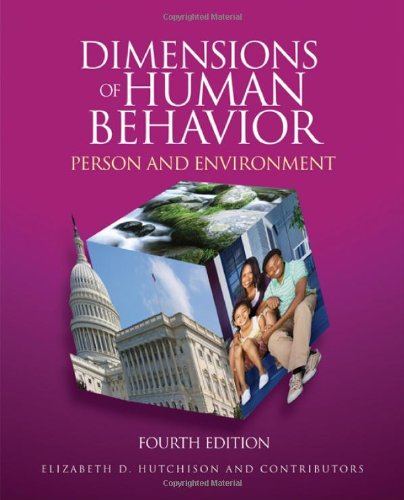
Dimensions of Human Behavior: Person and Environment
Authors:
Elizabeth D. Hutchison
Publisher:
Sage Publications, Inc
Publication Date:
Not available
ISBN:
1412988799
Author Elizabeth D. Hutchison's multidimensional framework (Person, Environment, and Time) for human behavior theory courses helps instructors organize... course material in a meaningful way for students. This EPAS-ready text provides students with a comprehensive and readable global perspective on the person and environment construct, weaving powerful case studies with recent innovations in theory and research.The companion text, Dimensions of Human Behavior: The Changing Life Course, covers the dimension of human behavior across time. Together, these two textbooks provide the most comprehensive coverage available for theory courses. Order the books together with bundle ISBN: 978-1-4129-8881-0.This core text is designed for advanced undergraduate and graduate Human Behavior and the Social Environment courses in departments of social work and psychology."Through its close-knit, and yet, broad and comprehensive treatment of all aspects of human behavior, Dimensions of Human Behavior: Person and Environment achieves its superiority over the one-paradigm human behavior books that run into unavoidable stereotypes of human behavior, and leave out necessary details about the investigated case, because of the limited scope of a single paradigm. It is indeed ‘a multidimensional approach for multifaceted social work’. It is strengthened further by its multicultural and global case studies, and state of the art developments in the social and behavioral sciences that have been added to the new edition composing another dimension in which the book casts human behavior. Therefore, I daresay, Dimensions of Human behavior: Person and Environment makes the fascinating subject of human behavior even more intriguing." - Alfred T. Kisubi, University of Wisconsin Oshkosh
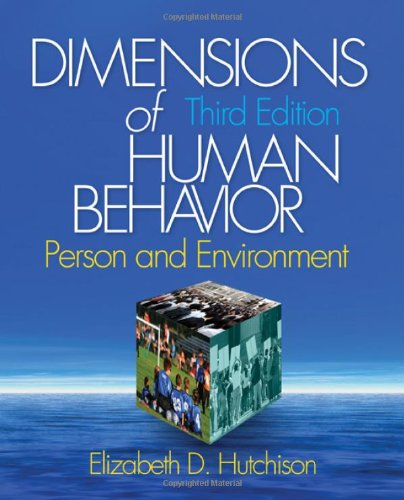
Dimensions of Human Behavior: Person and Environment (Series in...
Authors:
Elizabeth D. Hutchison
Publisher:
Sage Publications, Inc
Publication Date:
Not available
ISBN:
1412941253
In this text, you will meet social workers and clients from a variety of work settings and situations who bring the passion and power of social work to... life through engaging case studies found throughout the text. These case studies help apply the latest theory and research to real life practice situations. The Third Edition offers new case studies and is thoroughly updated and revised to reflect recent census data, developing trends, and cutting-edge research on human behavior.
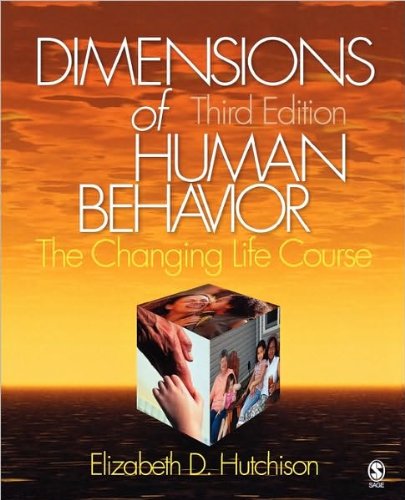
Dimensions of Human Behavior: The Changing Life Course
Authors:
Elizabeth D. Hutchison
Publisher:
Sage Publications, Inc
Publication Date:
Not available
ISBN:
1412941261
How do people change from conception to death? What patterns can we recognize in human behavior related to biological age, psychological age, and social... age norms? Why do people react to the same stressful situation in different ways? How can social workers help reduce risk and increase protective factors during various life stages? The Third Edition of this powerful text aims to examine the human life course in nine age-graded periods, which include: 1) conception, pregnancy, and childbirth 2) infancy and toddlerhood 3) early childhood 4) middle childhood 5) adolescence 6) young adulthood 7) middle adulthood 8) late adulthood and 9) very late adulthood. By examining each of these periods, the life course perspective can be understood as ever changing and marked by predictable and unpredictable twists and turns, which ultimately contribute to a unique life journey.
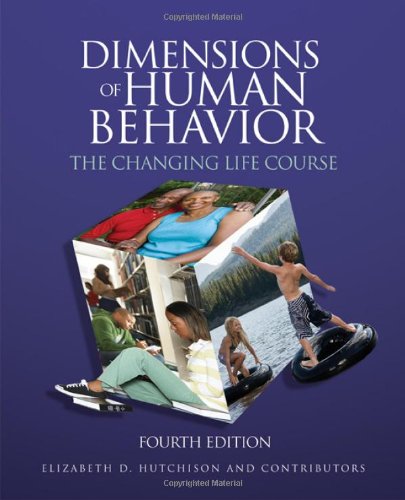
Dimensions of Human Behavior: The Changing Life Course
Authors:
Elizabeth D. Hutchison
Publisher:
Sage Publications, Inc
Publication Date:
Not available
ISBN:
1412976413
This EPAS-ready text is an in-depth, comprehensive examination of what shapes human behavior across all major developmental stages. Containing potent... case studies and the most current theory and research, the book includes greater emphasis on more stages than any other text. This core text is designed for advanced undergraduate and graduate Human Behavior and the Social Environment courses in departments of social work and psychology.

Dimensions of Informal Logic
Authors:
ROPER JAMES
Publisher:
Kendall Hunt Publishing
Publication Date:
Not available
ISBN:
0757585809
This is an EXACT reproduction of a book published before 1923. This IS NOT an OCR'd book with strange characters, introduced typographical errors, and... jumbled words. This book may have occasional imperfections such as missing or blurred pages, poor pictures, errant marks, etc. that were either part of the original artifact, or were introduced by the scanning process. We believe this work is culturally important, and despite the imperfections, have elected to bring it back into print as part of our continuing commitment to the preservation of printed works worldwide. We appreciate your understanding of the imperfections in the preservation process, and hope you enjoy this valuable book.
DIMENSIONS OF LEADERSHIP PROFILE
Authors:
Not Available
Publisher:
Not available
Publication Date:
Not available
ISBN:
Not available
DIMENSIONS OF LEADERSHIP PROFILE
Authors:
Not Available
Publisher:
Not available
Publication Date:
Not available
ISBN:
Not available

Dimensions of Learning: Teacher's Manual
Authors:
Robert J. Marzano
Publisher:
Association for Supervision & Curriculum Development
Publication Date:
Not available
ISBN:
1416608974
The premise of Dimensions of Learning--an instructional framework founded on the best of what researchers and theorists know about learning--is that... five types, or dimensions, of thinking are essential to successful learning. These are (1) positive attitudes and perceptions about learning, (2) thinking involved in acquiring and integrating knowledge, (3) thinking involved in extending and refining knowledge, (4) thinking involved in using knowledge meaningfully, and (5) productive habits of mind. Dimensions of Learning is a valuable tool for reorganizing curriculum, instruction, and assessment. The authors discuss each of the five dimensions in detail and describe hundreds of teaching strategies that support them--for example, how to help students construct meaning for declarative knowledge, internalize procedural knowledge, and see the relevance of what they are expected to learn. The authors provide many examples at the elementary and secondary classroom levels. Teachers of grades K-12 can use this information to improve teaching and learning in any content area. Educators consistently say that the most powerful reason for using Dimensions of Learning is that no matter what goal they are pursuing, the model helps them maintain a focus on learning. Anyone familiar with the first edition of the Teacher's Manual will notice a number of changes in the format of the second edition. The most notable is the addition of "marginalia." When appropriate, the text of the manual is supplemented with information in the margins, including references for books, articles, additional readings, or classroom materials relevant to the topic; quotes from teachers who have been using Dimensions of Learning in their classrooms; brief descriptions of schoolwide or districtwide efforts to implement various aspects of the model; relevant "quotable quotes" from well-known people; and visual representations of important information explained in the text. Heavy-duty tabs divide six sections of the manual, and an index makes it easy to find information on particular topics.
Dimensions of Learning Teacher's Manual, 2nd edition
Authors:
Robert J. Marzano
Publisher:
Association for Supervision & Curriculum Deve
Publication Date:
Not available
ISBN:
0871203219
The premise of Dimensions of Learning--an instructional framework founded on the best of what researchers and theorists know about learning--is that... five types, or dimensions, of thinking are essential to successful learning. These are (1) positive attitudes and perceptions about learning, (2) thinking involved in acquiring and integrating knowledge, (3) thinking involved in extending and refining knowledge, (4) thinking involved in using knowledge meaningfully, and (5) productive habits of mind. Dimensions of Learning is a valuable tool for reorganizing curriculum, instruction, and assessment. The authors discuss each of the five dimensions in detail and describe hundreds of teaching strategies that support them--for example, how to help students construct meaning for declarative knowledge, internalize procedural knowledge, and see the relevance of what they are expected to learn. The authors provide many examples at the elementary and secondary classroom levels. Teachers of grades K-12 can use this information to improve teaching and learning in any content area. Educators consistently say that the most powerful reason for using Dimensions of Learning is that no matter what goal they are pursuing, the model helps them maintain a focus on learning. Anyone familiar with the first edition of the Teacher's Manual will notice a number of changes in the format of the second edition. The most notable is the addition of "marginalia." When appropriate, the text of the manual is supplemented with information in the margins, including references for books, articles, additional readings, or classroom materials relevant to the topic; quotes from teachers who have been using Dimensions of Learning in their classrooms; brief descriptions of schoolwide or districtwide efforts to implement various aspects of the model; relevant "quotable quotes" from well-known people; and visual representations of important information explained in the text. Heavy-duty tabs divide six sections of the manual, and an index makes it easy to find information on particular topics.
 '





