production
/viewbook/list/all/?page=3486
/
/static/
None
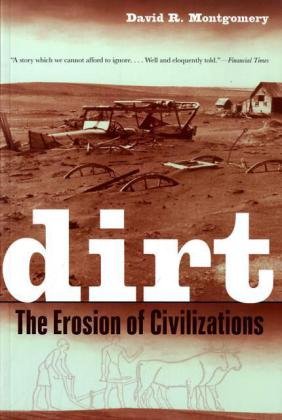
Dirt: The Erosion of Civilizations
Authors:
David R. Montgomery
Publisher:
University of California Press
Publication Date:
Not available
ISBN:
0520258061
Dirt, soil, call it what you want--it's everywhere we go. It is the root of our existence, supporting our feet, our farms, our cities. This fascinating... yet disquieting book finds, however, that we are running out of dirt, and it's no laughing matter. An engaging natural and cultural history of soil that sweeps from ancient civilizations to modern times, Dirt: The Erosion of Civilizations explores the compelling idea that we are--and have long been--using up Earth's soil. Once bare of protective vegetation and exposed to wind and rain, cultivated soils erode bit by bit, slowly enough to be ignored in a single lifetime but fast enough over centuries to limit the lifespan of civilizations. A rich mix of history, archaeology and geology, Dirt traces the role of soil use and abuse in the history of Mesopotamia, Ancient Greece, the Roman Empire, China, European colonialism, Central America, and the American push westward. We see how soil has shaped us and we have shaped soil--as society after society has risen, prospered, and plowed through a natural endowment of fertile dirt. David R. Montgomery sees in the recent rise of organic and no-till farming the hope for a new agricultural revolution that might help us avoid the fate of previous civilizations.
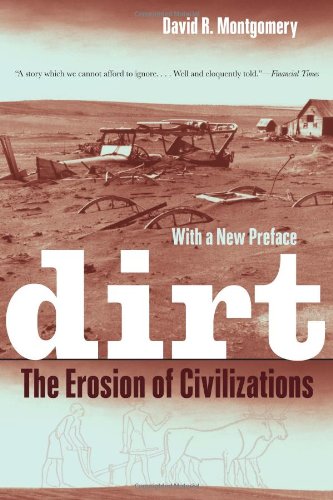
Dirt: The Erosion of Civilizations, With a New Preface
Authors:
David R. Montgomery
Publisher:
University of California Press
Publication Date:
Not available
ISBN:
0520272900
Dirt, soil, call it what you want--it's everywhere we go. It is the root of our existence, supporting our feet, our farms, our cities. This fascinating... yet disquieting book finds, however, that we are running out of dirt, and it's no laughing matter. An engaging natural and cultural history of soil that sweeps from ancient civilizations to modern times, Dirt: The Erosion of Civilizations explores the compelling idea that we are--and have long been--using up Earth's soil. Once bare of protective vegetation and exposed to wind and rain, cultivated soils erode bit by bit, slowly enough to be ignored in a single lifetime but fast enough over centuries to limit the lifespan of civilizations. A rich mix of history, archaeology and geology, Dirt traces the role of soil use and abuse in the history of Mesopotamia, Ancient Greece, the Roman Empire, China, European colonialism, Central America, and the American push westward. We see how soil has shaped us and we have shaped soil--as society after society has risen, prospered, and plowed through a natural endowment of fertile dirt. David R. Montgomery sees in the recent rise of organic and no-till farming the hope for a new agricultural revolution that might help us avoid the fate of previous civilizations.
Dirt Track Stock Car Technology
Authors:
Steve Smith
Publisher:
Steve Smith Autosports
Publication Date:
Not available
ISBN:
093683496X
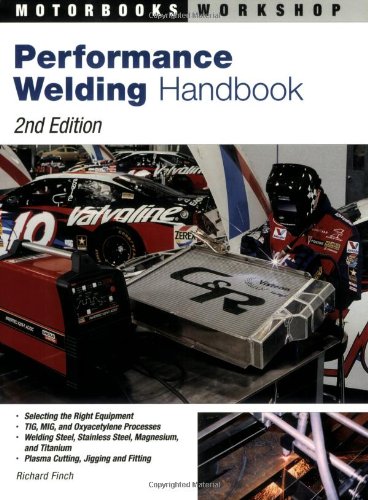
Richard Finch. Metal fabricators of every ilk, whether they're working on race cars, experimental aircraft, or custom motorcycles, will benefit from... this updated guide to top-quality welding. Performance Welding demonstrates the newest fabricating techniques and covers the latest in welding equipment. This complete guide written by NASA welding consultant Richard Finch helps a fabricator select the proper equipment, prepare jigs, and effectively weld 4130 steel, stainless steel, aluminum, and magnesium. It also covers plasma cutting, the technique used extensively on Monster Garage that has revolutionized metal working. 2nd ed.

Dirt, Undress, and Difference: Critical Perspectives on the Body's...
Authors:
Not Available
Publisher:
Indiana University Press
Publication Date:
Not available
ISBN:
0253217830
"A magnificent volume! It offers brand new perspectives on body politics and identity or subjectivity formation in the post-colonial world." —Dorothy... Ko, Barnard CollegeWhile there is widespread interest in dress and hygiene as vehicles of cultural, moral, and political value, little scholarly attention has been paid to cross-cultural understandings of dirt and undress, despite their equally important role in the fashioning of identity and difference. The essays in this absorbing and thought-provoking collection contribute new insights into the neglected topics of bodily treatments and transgressions. In detailed ethnographic studies from around the world, the contributors recast assumptions about filth and nakedness, exploring how various forms of transgression associated with the body's surface are drawn up into relations of power and inequality. They demonstrate imaginatively how body surfaces are powerfully mobilized in the making and unmaking of moral worlds.

Dirty: A Search for Answers Inside America's Teenage Drug Epidemic
Authors:
Meredith Maran
Publisher:
HarperOne
Publication Date:
Not available
ISBN:
0060730617
Venturing into uncharted territory, mother and award-winning journalist Meredith Maran takes us inside teenagers' hearts, minds, and central nervous... systems to explore the causes and consequences of our nation's drug crisis. In these pages we get to know the kids, the parents, the therapists, and the drug treatment programs at their best and worst. We're face-to-face with seventeen-year-old Mike, whose life revolves around selling, smoking, and snorting speed; fifteen-year-old Tristan -- the boy next door -- who can't get enough pot, pills, or vodka; and sixteen-year-old Zalika, a runaway, crack dealer, and prostitute since the age of twelve. Combining powerful on-the-street reporting and groundbreaking research, Dirty is essential reading for every parent and professional who works with or cares about children or teenagers.

Dirty Details
Authors:
Marion Cohen
Publisher:
Temple University Press
Publication Date:
Not available
ISBN:
1566394260
In 1977, at the age of 36, Jeffrey Cohen, a physicist at the University of Pennsylvania, was diagnosed with multiple sclerosis. But it wasn't until 10... years later that the 'dirty details' began, when the disease had progressed to the point where he could not transfer himself out of his wheelchair. That point is where his wife Marion begins her memoir of care giving: 'If I had to explain it in three words, those words would be 'nights,' 'lifting,' and 'toilet.' And then, if I were permitted to elaborate further, I would continue, 'nights' does not mean lying awake in fear listening for his breathing. 'Lifting' does not mean dragging him by the feet along the floor. And 'toilet' does not mean changing catheters. 'But dirty details', Marion Cohen teaches us, involves more than 'nights', 'lifting', and 'toilet'.There is the loss, anger, fear, and desperation that envelops the family. She reveals what it felt like to be consistently in 'dire straits' with no real help or understanding, what she characterizes as society's 'conspiracy of silence'. Chronicling their lives in the context of her husband's progressing disease, she discusses the raging emotions, the celebrations, the day-to-day routine, the arguments, the disappointments, and the moments of closeness.During the 15 years she cared for him at home, both continued to work on various projects, share in the rearing of their four children, and be very much in love. This powerful, honest narrative also delves into the process of making the 'nursing-home decision' and those decisions Cohen made to put her and her family's life together again. Marion Deutsche Cohen is actively involved in the Well Spouse community and has published many poems and articles on the subject and on home schooling that have appeared in such publications as the "American Poetry Review", "Disability Rag", and "Mothering". She currently teaches mathematics at Temple University.
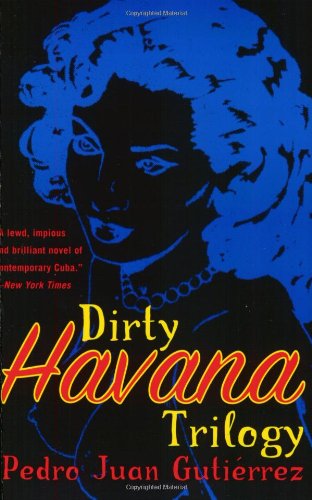
Dirty Havana Trilogy: A Novel in Stories
Authors:
Pedro Juan Gutierrez
Publisher:
Ecco Press
Publication Date:
Not available
ISBN:
0060006897
Banned in Cuba but celebrated throughout the Spanish-speaking world, this picaresque novel in stories chronicles the misadventures of Pedro Juan, a... former Cuban journalist living from hand to mouth in the squalor of contemporary Havana, half disgusted and half fascinated by the depths to which he has sunk. Like the lives of so many of his neighbors in the crumbling, once-elegant apartment houses that line Havana's waterfront, Pedro Juan's days and nights have been reduced by the so-called special times -- the harsh recession that followed the Soviet Union's collapse -- to the struggle of surviving the daily grit through the escapist pursuit of sex. Pedro Juan scrapes by under the shadow of hunger -- all the while observing his lovers and friends, strangers on the street, and their suffering with an unsentimental, mocking, yet sympathetic eye.
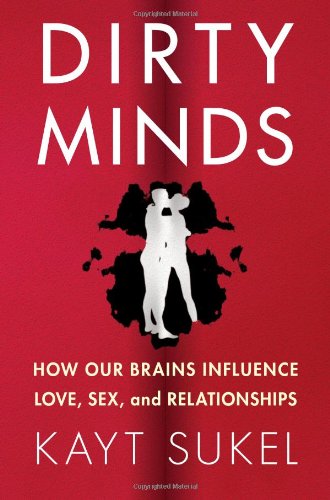
Dirty Minds: How Our Brains Influence Love, Sex, and Relationships
Authors:
Kayt Sukel
Publisher:
Free Press
Publication Date:
Not available
ISBN:
1451611552
Philosophers, theologians, artists, and boy bands have waxed poetic about the nature of love for centuries. But what does the brain have to say about... the way we carry our hearts? In the wake of a divorce, science writer and single mother Kayt Sukel made herself a guinea pig in the labs of some unusual love experts to find out. In each chapter of this edgy romp through the romantic brain, Sukel looks at a different aspect of love above the belt. What in your brain makes you love someone—or simply lust after them? (And is there really a difference?) Why do good girls like bad boys? Is monogamy practical? How thin is that line between love and hate? Do mothers have a stronger bond with their children than their fathers do? How do our childhood experiences affect our emotional control? Should you be taking an oxytocin supplement to improve your luck in love? Who is most at risk for love addiction? In her search for truth, Sukel also has an fMRI during orgasm, ponders a cure for heartbreak, and samples a pheromone spray called Boarmate. As science allows us a more focused examination on the intricate dance between the brain and our environments, we can use it to shed new light on humanity’s oldest question: What is love and why does it torture, delight, and transform us so? Fiercely honest and wonderfully funny, Sukel can offer no simple solutions for the curveballs love throws our way. But after reading this gimlet-eyed look at love, sex, and the brain, you’ll never look at romance the same way again.
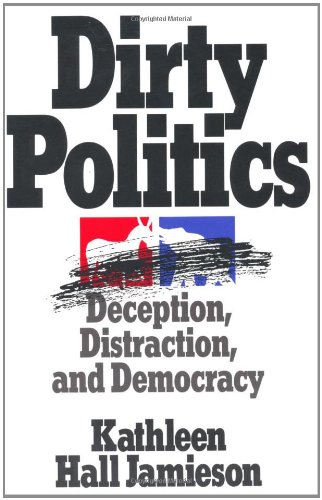
Dirty Politics: Deception, Distraction, and Democracy
Authors:
Kathleen Hall Jamieson
Publisher:
Oxford University Press, USA
Publication Date:
Not available
ISBN:
0195085531
Americans in recent years have become thoroughly disenchanted with our political campaigns, especially with campaign advertising and speeches. Each... year, as November approaches, we are bombarded with visceral appeals that bypass substance, that drape candidates in the American flag but tell us nothing about what they'll do if elected, that flood us with images of PT-109 or Willie Horton, while significant issues--such as Kennedy's Addison's Disease or the looming S&L catastrophe--are left unexamined. And the press--the supposed safeguard of democracy--focuses on campaign strategy over campaign substance, leaving us to decide where the truth lies. In Dirty Politics, campaign analyst Kathleen Hall Jamieson provides an eye-opening look at political ads and speeches, showing us how to read, listen to, and watch political campaigns. Jamieson provides a sophisticated (and often humorous) analysis of advertising technique, describing how television ads use soft focus, slow motion, lyrical or patriotic music (Reagan used "I'm Proud to be an American") to place a candidate in a positive light, or quick cuts, black and white, videotape, and ominous music (for instance, the theme from "Jaws") to portray the opposition. She shows how ads sometimes mimic news spots to add authenticity (Edwin Edwards, in his race against David Duke, actually used former NBC correspondent Peter Hackis, who would begin an ad saying "This is Peter Hackis in Baton Rouge"). And Jamieson points out that consultants create inflammatory ads hoping that the major networks will pick them up and run them as news, giving the ad millions of dollars of free air time. The most striking example would be the Willie Horton ad, which the press aired repeatedly (as an example of negative advertising) long after the ad had ceased running. (In fact, it never ran on the major networks as an ad, only as news.) From a colorful, compact history of negative campaigning from Eisenhower to the present, to an in-depth commentary on the Willie Horton ads, to an up-to-the-minute analysis of the Duke-Edwards campaign in Louisiana, Dirty Politics is both a fascinating look at underhanded campaigning as well as a compelling argument for fair, accurate, and substantive campaigns. It is a book that all voters should read before they vote again.
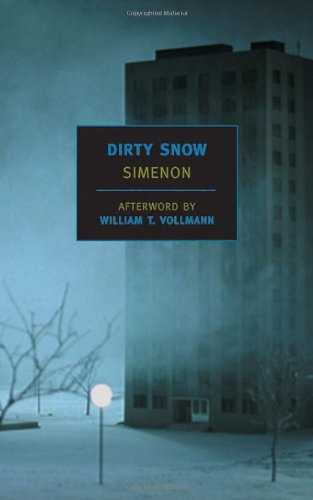
Dirty Snow (New York Review Books Classics)
Authors:
Georges Simenon
Publisher:
NYRB Classics
Publication Date:
Not available
ISBN:
1590170431
Nineteen-year-old Frank Friedmaier lives in a country under occupation. Most people struggle to get by; Frank takes it easy in his mother's whorehouse,... which caters to members of the occupying forces. But Frank is restless. He is a pimp, a thug, a petty thief, and, as Dirty Snow opens, he has just killed his first man. Through the unrelenting darkness and cold of an endless winter, Frank will pursue abjection until at last there is nowhere to go.Hans Koning has described Dirty Snow as "one of the very few novels to come out of German-occupied France that gets it exactly right." In a study of the criminal mind that is comparable to Jim Thompson's The Killer Inside Me, Simenon maps a no man's land of the spirit in which human nature is driven to destruction—and redemption, perhaps, as well—by forces beyond its control.
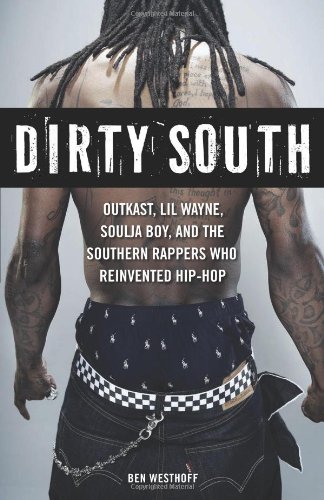
Dirty South: OutKast, Lil Wayne, Soulja Boy, and the Southern...
Authors:
Ben Westhoff
Publisher:
Chicago Review Press
Publication Date:
Not available
ISBN:
1569766061
Rap music from New York and Los Angeles once ruled the charts, but nowadays the southern sound thoroughly dominates the radio, Billboard, and MTV.... Coastal artists like Wu-Tang Clan, Nas, and Ice-T call southern rap “garbage,” but they’re probably just jealous, as artists like Lil Wayne and T.I. still move millions of copies, and OutKast has the bestselling rap album of all time.In Dirty South, author Ben Westhoff investigates the southern rap phenomenon, watching rappers “make it rain” in a Houston strip club and partying with the 2 Live Crew’s Luke Campbell. Westhoff visits the gritty neighborhoods where T.I. and Lil Wayne grew up, kicks it with Big Boi in Atlanta, and speaks with artists like DJ Smurf and Ms. Peachez, dance-craze originators accused of setting back the black race fifty years. Acting both as investigative journalist and irreverent critic, Westhoff probes the celebrated-but-dark history of Houston label Rap-A-Lot Records, details the lethal rivalry between Atlanta MCs Gucci Mane and Young Jeezy, and gets venerable rapper Scarface to open up about his time in a mental institution. Dirty South features exclusive interviews with the genre’s most colorful players.Westhoff has written a journalistic tour de force, the definitive account of the most vital musical culture of our time.
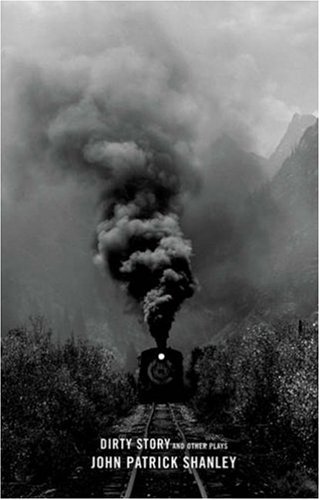
Dirty Story and Other Plays
Authors:
John Patrick Shanley
Publisher:
Theatre Communications Group
Publication Date:
Not available
ISBN:
1559362820
“In the appallingly entertaining Dirty Story . . . Mr. Shanley has expanded his focus from the intimate to the international to create one of the... liveliest, boldest and—against the odds—funniest studies ever of a subject that even hard-core satirists tend to approach on tiptoe.”—Ben Brantley, The New York TimesThree new works by Pulitzer Prize–winning author John Patrick Shanley, one of our country’s most politically current and theatrically elastic playwrights. In Dirty Story a couple of sadomasochistic writers fight over rights to their New York City loft, in this sexy satire of the Israeli-Palestinian conflict that is “astonishing,” says Tony Kushner, “The analysis of the Middle East in this play is dead on, exactly perfectly pitched.” In his dark comedy Where’s My Money? Shanley takes on marriage, infidelity and divorce lawyers in a play that is “so harsh, it’s funny—terrifying, but funny,” (The New York Times). And in his Sailor’s Song, love becomes an act of courage, in this seaside romance about the certainty of death, the brevity of youth, and the importance of now.John Patrick Shanley’s Doubt won the 2005 Pulitzer Prize for Drama and the Tony Award for Best Play, and was chosen as best play of the year by over 10 newspapers and magazines. His other plays include Danny and the Deep Blue Sea, Four Dogs and a Bone, Psychopathia Sexualis and Savage Limbo. He has written extensively for TV and film, including Moonstruck, for which he won an Academy Award for best screenplay.

Dirty Tale: A Narrative Journey of the IBD Body (Health Communication)
Authors:
Nicole Defenbaugh
Publisher:
Hampton Press Inc
Publication Date:
Not available
ISBN:
1572739959
Having a chronic illness is a daily journey. You never know where it will lead you; at least that is what the author discovered eight years ao when she... was disgnosed with Inflammatory Bowel Disease (IBD). With each page turn the reader journeys along with the author down the road of illness identity as she learns her patient role in health care, investigates the wonders of alternative medicine, interviews others with IBD, and puts her sick body on stage. You won't soon forget the experiences she's encountered without reflecting on your own body image and self-identity.

Dirty Tricks or Trump Cards: U.S. Covert Action and...
Authors:
Roy Godson
Publisher:
Transaction Publishers
Publication Date:
Not available
ISBN:
0765806991
Contrary to popular misconceptions and public branding as "dirty tricks," covert action and counterintelligence can have considerable value.... Democracies, while wary of these instruments, have benefited significantly from their use, saving lives, treasure, and gaining strategic advantage. As liberal democracies confront the post-Cold War mix of rogue states and non-state actors, such as criminals and terrorists, and weapons of mass destruction and mass disruption, these clandestine arts may prove to be important tools of statecraft, and perhaps trump cards in the twenty-first century. Godson defines covert action as influencing events in other parts of the world without attribution, and counterintelligence as identifying, neutralizing, and exploiting the secret activities of others. Together they provide the capability to resist manipulation and control others to advantage. Counterintelligence protects U.S. military, technological, and diplomatic secrets and turns adversary intelligence to U.S. advantage. Covert action enables the United States to weaken adversaries and to assist allies who may be hampered by open acknowledgment of foreign support. Drawing on contemporary and historical literature, broad-ranging contacts with senior intelligence officials in many countries, as well as his own research and experience as a longtime consultant to the U.S. government, Godson traces the history of U.S. covert action and counterintelligence since 1945, showing that covert action works well when it is part of a well-coordinated policy and when policy makers are committed to succeeding in the long-term. Godson argues that the best counterintelligence is an offensive defense. His exposition of the essential theoretical foundations of both covert action and counterintelligence, supported by historical examples, lays out the ideal conditions for their use, as well as demonstrating why they are so difficult to attain. This book will be of interest to students and general readers interested in political science, national security, foreign policy, and military policy.
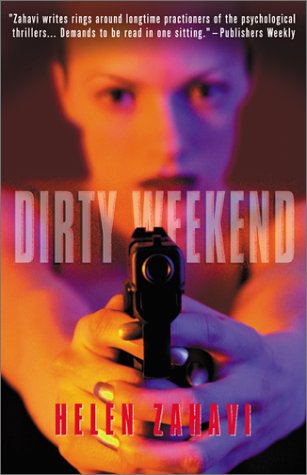
Dirty Weekend: A Novel of Revenge
Authors:
Helen Zahavi
Publisher:
Cleis Press
Publication Date:
Not available
ISBN:
1573440973
"Bella woke up one morning and realized she'd had enough." So begins the triumphant tale of one woman's personal vendetta against a world of peeping... toms, rapists, and obscene phone-callers.
 '





