production
/viewbook/list/all/?page=3494
/
/static/
None

Discipleship Counseling: The Complete Guide to Helping Others Walk...
Authors:
Neil T. Anderson
Publisher:
Regal
Publication Date:
Not available
ISBN:
0830732977
Building on the concepts found in "Victory over the Darkness" and "The Bondage Breaker", Neil Anderson's counseling ministry guide provides clear... information and excellent models to help you understand what discipleship counseling is all about. If you're a pastor, counselor or lay leader, this resource will make you more comfortable, confident and competent in your role as encourager. In turn, this will help you free people from their emotional pain and spiritual conflicts, as you guide them to a more complete understanding of who they are in Christ.

Discipleship (Dietrich Bonhoeffer Works, Vol. 4)
Authors:
Dietrich Bonhoeffer
Publisher:
Not available
Publication Date:
Not available
ISBN:
0800683242
"Cheap grace is the mortal enemy of our church. Our struggle today is for costly grace." And with that sharp warning to his own church, which was... engaged in bitter conflict with the official nazified state church, Dietrich Bonhoeffer began his book Discipleship (formerly entitled The Cost of Discipleship). Originally published in 1937, it soon became a classic exposition of what it means to follow Christ in a modern world beset by a dangerous and criminal government. At its center stands an interpretation of the Sermon on the Mount: what Jesus demanded of his followers-and how the life of discipleship is to be continued in all ages of the post- resurrection church. "Every call of Jesus is a call to death," Bonhoeffer wrote. His own life ended in martyrdom on April 9, 1945. Freshly translated from the German critical edition, Discipleship provides a more accurate rendering of the text and extensive aids and commentary to clarify the meaning, context, and reception of this work and its attempt to resist the Nazi ideology then infecting German Christian churches.

Disciples of All Nations: Pillars of World Christianity (Studies in...
Authors:
Lamin O. Sanneh
Publisher:
Oxford University Press, USA
Publication Date:
Not available
ISBN:
0195189612
Long the dominant religion of the West, Christianity is now rapidly becoming the principal faith in much of the postcolonial world--a development that... marks a momentous shift in the religion's very center of gravity. In this eye-opening book, Lamin Sanneh examines the roots of this "post-Western awakening" and the unparalleled richness and diversity, as well as the tension and conflict, it has brought to World Christianity. Tracing Christianity's rise from its birth on the edge of the Roman empire--when it proclaimed itself to be a religion for the entire world, not just for one people, one time, and one place--to its key role in Europe's maritime and colonial expansion, Sanneh sheds new light on the ways in which post-Western societies in Africa, Asia, and Latin America were drawn into the Christian orbit. Ultimately, he shows, these societies outgrew Christianity's colonial forms and restructured it through their own languages and idioms--a process that often occurred outside, and sometimes against, the lines of denominational control. The effect of such changes, Sanneh contends, has been profound, transforming not only worship, prayer, and the interpretation of Scripture, but also art, aesthetics, and music associated with the church. In exploring this story of Christianity's global expansion and its current resurgence in the non-Western world, Sanneh pays close attention to such issues as the faith's encounters with Islam and indigenous religions, as well as with secular ideologies such as Marxism and nationalism. He also considers the challenges that conservative, non-Western forms of Christianity pose to Western liberal values and Enlightenment ideas. Here then is a groundbreaking study of Christianity's role in cultural innovation and historical change--and must reading for all who are concerned with the present and future of the faith."I am lost in admiration for Lamin Sanneh's magnificent study of world Christianity, for the work's geographical scope and historical sweep, and for the breadth of the author's learning. Throughout, Sanneh asks the critical question: how can we reconceive Christianity in a way that frees it from its European and imperial contexts, permitting the faith to adapt to the kaleidoscopic realities of different societies around the globe. This is a splendid achievement." --Philip Jenkins, author of The Next Christendom
Disciples of Passion (Middle East Literature in Translation)
Authors:
Hoda Barakat
Publisher:
Syracuse University Press
Publication Date:
Not available
ISBN:
0815608330
A novel by a writer hailed by the critics as "the most important woman novelist in Lebanon and in the Middle East," interweaving an account of the... Lebanese civil war with a story of an illicit interfaith relationship. Disciples of Passion chronicles the civil war in Lebanon through the troubled and sometimes quasi-hallucinatory mind of a young man who has experienced kidnapping, hostage exchange, and hospital internment. As he recalls his village childhood and recounts his relationship with a woman of a different faith , his fragmented narrative probes the uncertainties of political testimonial and ascriptions of responsibility in wartime. Marilyn Booth's fluid translation brings to an English audience one of the Arabic language's finest contemporary novelists. Widely celebrated in France, where she currently lives in exile (from Lebanon), Hoda Barakat writes from personal experience: her novels focus on the civil war in Lebanon and how it shaped the lives of people marginalized by the conflict. Compelling scenarios of war and its aftermath of suffering and destruction are integrated into subtle psychological portraits - with protagonists often propelled into unexpected action.
Disciplinary Decadence: Living Thought in Trying Times (The Radical...
Authors:
Lewis R. Gordon
Publisher:
Paradigm Publishers
Publication Date:
Not available
ISBN:
1594512566
In this book, philosopher and social critic Lewis Gordon explores the ossification of disciplines, which he calls disciplinary decadence. In response,... he offers a theory of what he calls a teleological suspension of disciplinarity, in which he encourages scholars and lay intellectuals to pay attention to the openness of ideas and purposes on which their disciplines were born. Gordon builds his case through discussions of philosophy of education, problems of secularization in religious thought, obligations across generations, notions of invention in the study of ideas, decadence in development, colonial epistemologies, and the quest for a genuine postcolonial language. These topics are examined with the underlying diagnosis of the present political and academic environment as one in which it is indecent to think.

Disciplinary Discourses: Social Interactions in Academic Writing
Authors:
Ken Hyland
Publisher:
University of Michigan Press/ELT
Publication Date:
Not available
ISBN:
0472030248
Why do engineers "report" while philosophers "argue" and biologists"describe"? In the Michigan Classics Edition of Disciplinary Discourses: Social... Interactions in Academic Writing, Ken Hyland examines the relationships between the cultures of academic communities and their unique discourses. Drawing on discourse analysis, corpus linguistics, and the voices of professional insiders, Ken Hyland explores how academics use language to organize their professional lives, carry out intellectual tasks, and reach agreement on what will count as knowledge. In addition, Disciplinary Discourses presents a useful framework for understanding the interactions between writers and their readers in published academic writing. From this framework, Hyland provides practical teaching suggestions and points out opportunities for further research within the subject area.As issues of linguistic and rhetorical expression of disciplinary conventions are becoming more central to teachers, students, and researchers, the careful analysis and straightforward style of Disciplinary Discourses make it a remarkable asset.The Michigan Classics Edition features a new preface by the author and a new foreword by John M. Swales.
Disciplinary Literacy: Redefining Deep Understanding and Leadership...
Authors:
Thomas Piercy
Publisher:
Advanced Learning Press
Publication Date:
Not available
ISBN:
1935588060
Disciplinary Literacy addresses the practical issues of how teachers can help students engage in creativity, communication, and critical thinking, while... remaining true to the rigors of academic disciplines. The authors detail specific literacy actions to increase connections between the disciplines of mathematics, history, science, English language arts, music and student's lives. For teachers and administrators there are immediately transferable instructional models provided for different content areas, including aligned connections with Common Core Standards.

Discipline
Authors:
Dawn Lundy Martin
Publisher:
Nightboat
Publication Date:
Not available
ISBN:
0984459847
This stunning second collection engages the "disciplines" associated with regimes of powers and sadomasochism. The work interrogates the social and... linguistic space between regimes of power enacted on the body, and thereby the soul.

Discipline & Punish: The Birth of the Prison
Authors:
Michel Foucault
Publisher:
Vintage
Publication Date:
Not available
ISBN:
0679752552
In this brilliant work, the most influential philosopher since Sartre suggests that such vaunted reforms as the abolition of torture and the emergence... of the modern penitentiary have merely shifted the focus of punishment from the prisoner's body to his soul.

Discipline and Debate: The Language of Violence in a Tibetan...
Authors:
Michæl Lempert
Publisher:
University of California Press
Publication Date:
Not available
ISBN:
0520269470
The Dalai Lama has represented Buddhism as a religion of non-violence, compassion, and world peace, but this does not reflect how monks learn their... vocation. This book shows how monasteries use harsh methods to make monks of men, and how this tradition is changing as modernist reformers--like the Dalai Lama--adopt liberal and democratic ideals, such as natural rights and individual autonomy. In the first in-depth account of disciplinary practices at a Tibetan monastery in India, Michael Lempert looks closely at everyday education rites--from debate to reprimand and corporal punishment. His analysis explores how the idioms of violence inscribed in these socialization rites help produce educated, moral persons but in ways that trouble Tibetans who aspire to modernity. Bringing the study of language and social interaction to our understanding of Buddhism for the first time, Lempert shows and why liberal ideals are being acted out by monks in India, offering a provocative alternative view of liberalism as a globalizing discourse.

Discipline and Learn: Bodies, Pedagogy and Writing
Authors:
Megan Watkins
Publisher:
Sense Publishers
Publication Date:
Not available
ISBN:
946091697X
Discipline and Learn: Bodies, Pedagogy and Writing explores how discipline is typically construed as a form of subjection in contemporary educational... thought and in critical and cultural theory more broadly. It provides a critique of this emphasis on the repressive aspects of discipline highlighting its enabling potential and role in the development of dispositions to learning. The book engages with the work of a range of theorists: Foucault, Bourdieu, Merleau-Ponty, Mauss and Spinoza and considers their usefulness in theorizing embodiment and learning in the teaching of writing in the early years of school. Emphasis, however, is placed on the work of Bourdieu and his notion of habitus melding theory and practice in an ethnography of contemporary classrooms. This text is invaluable reading for students and academics across the social sciences and humanities interested in questions of embodiment, affect and their relation to learning. This is the most thought-provoking book to be published on pedagogy in a long, long time. Conceptually elegant and empirically rich, it undercuts conventional wisdom and potentially rearranges how we think about teaching, learning and writing. It argues that students' bodies not just their minds matter in learning, explaining how, in practice, the desire to learn is a mindful bodily disposition. And it shows how, through an enabling form of discipline, teachers can produce a scholarly habitus in all students, including the educationally disadvantaged and defiant. Jane Kenway, Professor of Education, Monash University Discipline and Learn: Bodies, Pedagogy and Writing an excellent book which makes an important contribution to our understanding of both pedagogy and the body and which is sure to spark debate in both fields. It is careful and judicious in its approach but still manages to be provocative and original. Nick Crossley, Professor of Sociology, University of Manchester
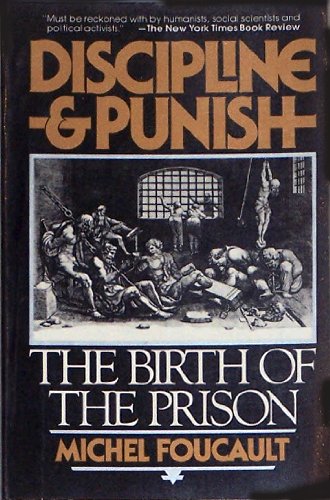
Discipline and Punish: The Birth of the Prison
Authors:
Michel Foucault
Publisher:
Vintage
Publication Date:
Not available
ISBN:
0394727673
In the Middle Ages there were gaols and dungeons, but punishment was for the most part a spectacle. The economic changes and growing popular dissent of... the 18th century made necessary a more systematic control over the individual members of society, and this in effect meant a change from punishment, which chastised the body, to reform, which touched the soul. Foucault shows the development of the Western system of prisons, police organizations, administrative and legal hierarchies for social control - and the growth of disciplinary society as a whole. He also reveals that between school, factories, barracks and hospitals all share a common organization, in which it is possible to control the use of an individual's time and space hour by hour.
Discipline-Based Art Education: A Curriculum Sampler
Authors:
Not Available
Publisher:
Getty Trust Publications: Getty Education Institut
Publication Date:
Not available
ISBN:
0892361719
Disciplined Dreaming: A Proven System to Drive Breakthrough Creativity
Authors:
Josh Linkner
Publisher:
Jossey-Bass
Publication Date:
Not available
ISBN:
0470922222
A 5-part process that will transform your organization — or your career — into a non-stop creativity juggernautWe live in an era when business... cycles are measured in months, not years. The only way to sustain long term innovation and growth is through creativity-at all levels of an organization. Disciplined Dreaming shows you how to create profitable new ideas, empower all your employees to be creative, and sustain your competitive advantage over the long term. Linkner distills his years of experience in business and jazz — as well as hundreds of interviews with CEOs, entrepreneurs, and artists — into a 5-step process that will make creativity easy for you and your organization. The methodology is simple, backed by proven results.Empowers individuals, teams, and organizations to meet creative challenges posed by the marketplaceTurns the mystery of creativity into a simple-to-use processShows how creativity can be used for everything from innovative, game-shifting breakthroughs to incremental advances and daily improvements to business processesOffers dozens of practical exercises, thought-starters, workouts to grow "creative muscles," and case studiesDisciplined Dreaming shows even the stuffiest corporate bureaucracies how to cultivate creativity in order to become more competitive in today's shifting marketplace.#8 New York Times Bestseller (Hardcover Business)#2 Wall Street Journal Bestseller (Hardcover Business)#9 Wall Street Journal Bestseller (Hardcover Nonfiction)#9 Washington Post Bestseller (Nonfiction Hardcover)#1 USA Today Bestseller (Money)#10 Publishers Weekly Bestseller (Nonfiction) Q&A with Author Josh Linkner Author Josh Linkner Why is creativity in the workplace so important? The world has dramatically changed in the last few years, and many of the competitive advantages of the past have become commoditized. With increased complexity, dizzying speed, and ruthless competition now commonplace in business, creativity and innovation have become the only true sustainable competitive advantage. Creativity is the one thing you can’t outsource. It’s the difference between game-changing companies and also-rans. Individuals may get hired based on their resumes, but they get promoted and succeed based on their creativity. Creativity has become the currency of success in the new era of business, and life. What is Disciplined Dreaming? Disciplined Dreaming is a five-part system to build, nurture, and manage creativity. It is based on my experience as a four-time entrepreneur, jazz musician, and venture capitalist, plus personal interviews I conducted with over 200 thought leaders--CEOs, entrepreneurs, artists, billionaires, nonprofit leaders. I developed Disciplined Dreaming by distilling the collective wisdom of this amazing group into a simple, easy-to-follow process that you can put to use immediately to drive your own creativity. An accomplished musician yourself, you compare creative riffs at work to jazz improvisation. How do the two relate? In jazz, 99 percent of the notes are improvised. Spontaneous creativity. However, that 1 percent that’s on the written page is incredibly important. It provides musicians with a framework to direct and enhance their creativity. Disciplined Dreaming is the business-world equivalent to that 1 percent. It provides a structure that enables creativity. In addition, jazz musicians use specific patterns and techniques as building blocks of innovation. I’ve been able to translate many of those concepts into the language of business, and I show readers how to inject them into their daily lives. These “riffs” can be applied to creative challenges of all sizes, and they help support the creative process. How can you start working creativity muscles with a team that has grown stagnant? The biggest inhibitor of creativity isn’t human potential, it is fear. While we enter the world with limitless creativity, our schools, organizations, and bureaucracies beat it out of us. We are so worried about saying the wrong thing, looking foolish, or having to take responsibility for a new idea that we govern our own imagination. Too often, corporate cultures stifle their most valuable natural resource—fresh ideas. This can be quickly fixed through using techniques in the book that deal with preparing your culture, physical environment, and mind-set to drive maximum creative output. Disciplined Dreaming includes new brainstorming techniques such as “RoleStorming,” “The Reese’s Peanut Butter Cup,” and “Stick-it-to-the-man,” which will get your creative muscles in shape in no time.

Disciplined Hearts: History, Identity, and Depression in an...
Authors:
Theresa DeLeane O'Nell
Publisher:
University of California Press
Publication Date:
Not available
ISBN:
0520214463
"This is a good place for your work. Depression is a big problem here. About 70-80% of our people are depressed." When she arrived at the Flathead... Reservation in Montana to start an ethnographic study of depression, medical anthropologist Theresa DeLeane O'Nell repeatedly encountered such statements. This astonishingly widespread concern propelled the author into the complex lives of these modern American Indian people and into the historical roots of their contemporary situation.In Disciplined Hearts, O'Nell draws on recent anthropological theory to locate Flathead depression in the culturally organized experiences of an oppressed people. According to O'Nell, Flathead narratives of depression are tales in which narrators use their demoralization as a guide for modern Indian life. Underlying their tales, she says, is the dramatic assertion that depression is the natural condition of "real Indians"--those who have "disciplined" their hearts by recasting their personal sadness into compassion for others.This rich account of family and community life describes the moral imagination with which Flathead Indian people weave together historical and personal loss, American Indian identity, and social responsibility. Based on her ethnographic and clinical work, O'Nell pinpoints American Indian depression within a complex interplay of cultural ideas of the self and the Indian family, emotion and ethnic identity, and historical relations between Indians and whites.
 '





