production
/viewbook/list/all/?page=3543
/
/static/
None
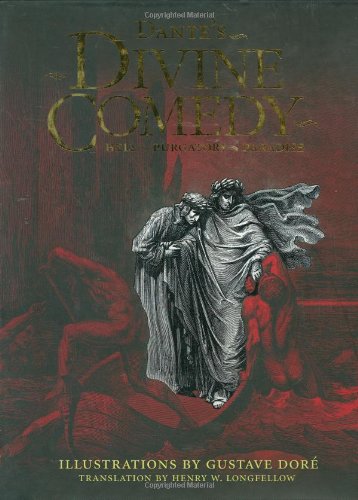
Divine Comedy
Authors:
Dante Alighieri
Publisher:
Chartwell Books, Inc.
Publication Date:
Not available
ISBN:
0785821201
Long narrative poem originally titled Commedia (about 1555 printed as La divina commedia) written about 1310-14 by Dante. The work is divided into three... major sections--Inferno, Purgatorio, and Paradiso--which trace the journey of a man from darkness and error to the revelation of the divine light, culminating in the beatific vision of God. It is usually held to be one of the world's greatest works of literature. The plot of The Divine Comedy is simple: a man is miraculously enabled to visit the souls in Hell, Purgatory, and Paradise. He has two guides: Virgil, who leads him through the Inferno and Purgatorio, and Beatrice, who introduces him to Paradiso. Through these fictional encounters taking place from Good Friday evening in 1300 through Easter Sunday and slightly beyond, Dante the character learns of the exile that is awaiting him (an actual exile that had already occurred at the time of writing). This device allowed Dante not only to create a story out of his exile but also to explain how he came to cope with personal calamity and to offer suggestions for the resolution of Italy's troubles as well.

Divine Comedy
Authors:
Dante Alighieri
Publisher:
Random House Inc
Publication Date:
Not available
ISBN:
0394701267
Divine Comedy 1: Hell
Authors:
Alighieri Dante
Publisher:
Penguin
Publication Date:
Not available
ISBN:
0140440062
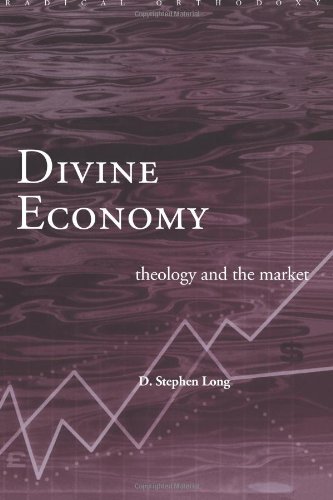
Divine Economy: Theology and the Market (Routledge Radical Orthodoxy)
Authors:
D. Stephen Long
Publisher:
Routledge
Publication Date:
Not available
ISBN:
0415226732
What has theology to do with economics? They are both sciences of human action, but have traditionally been treated as very separate disciplines. Divine... Economy is the first book to address the need for an active dialogue between the two.D. Stephen Long traces three strategies which have been used to bring theology to bear on economic questions: the dominant twentieth-century tradition, of Weber's fact-value distinction; an emergent tradition based on Marxist social analysis; and a residual tradition that draws on an ancient understanding of a functional economy. He concludes that the latter approach shows the greatest promise because it refuses to subordinate theological knowledge to autonomous social-scientific research.Divine Economy will be welcomed by those with an interest in how theology can inform economic debate.
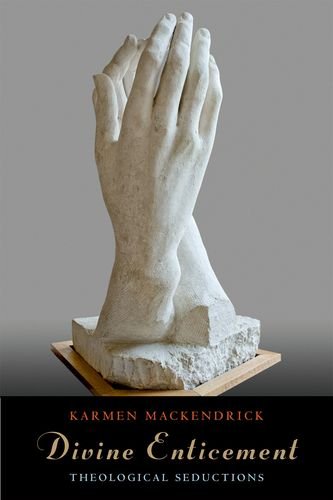
Divine Enticement: Theological Seductions
Authors:
Karmen Mackendrick
Publisher:
Fordham University Press
Publication Date:
Not available
ISBN:
0823242900
Theology usually appears to us to be dogmatic, judgmental, condescending, maybe therapeutic, or perhaps downright fantastical-but seldom enticing.... Divine Enticement takes as its starting point that the meanings of theological concepts are not so much logical, truth-valued propositions-affirmative or negative-as they are provocations and evocations. Thus it argues for the seductiveness of both theology and its subject-for, in fact, infinite seduction and enticement as the very sense of theological query. The divine name is one by which we are drawn toward the limits of thought, language, and flesh. The use of language in such conceptualization calls more than it designates. This is not a flaw or a result of vagueness or imprecision in theological language but rather marks the correspondence of such language to its subject: that which, outside of or at the limit of our thought, draws us as an enticement to desire, not least to intellectual desire. Central to the text is the strange semiotics of divine naming, as a call on that for which there cannot be a standard referent. The entanglement of sign and body, not least in interpretations of the Christian incarnation, both grounds and complicates the theological abstractions. A number of traditional notions in Christian theology are reconceived here as enticements, modes of drawing the desires of both body and mind: faith as "thinking with assent"; sacraments as "visible words" read in community; ethics as responsiveness to beauty; prayer as the language of address; scripture as the story of meaning-making. All of these culminate in a sense of a call to and from the purely possible, the open space into which we can be enticed, within which we can be divinely enticing.
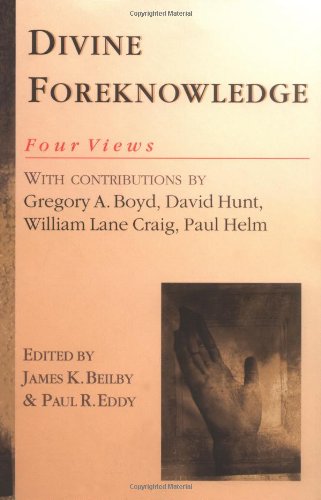
Divine Foreknowledge: Four Views
Authors:
Not Available
Publisher:
IVP Academic
Publication Date:
Not available
ISBN:
0830826521
The question of the nature of God's foreknowledge and how that relates to human freedom has been pondered and debated by Christian theologians at least... since the time of Augustine. And the issue will not go away. More recently, the terms of the debate have shifted, and the issue has taken on new urgency with the theological proposal known as the openness of God. This view maintains that God's knowledge, while perfect, is limited regarding the future inasmuch as the future is "open" and not settled. provides a venue for well-known proponents of four distinct views of divine foreknowledge to present their cases: Gregory A. Boyd of Bethel College presents the open-theism view, David Hunt of Whittier College weighs in on the simple-foreknowledge view, William Lane Craig of Talbot School of Theology takes the middle-knowledge view, and Paul Helm of Regent College, Vancouver, presents the Augustinian-Calvinist view. All four respond to each of the other essayists, noting points of agreement and disagreement. Editors James K. Beilby and Paul R. Eddy introduce the contemporary debate and also offer a conclusion that helps you evaluate the relative strengths and weaknesses of each view. The result is a unique opportunity to grapple with the issues and arguments and frame your own understanding of this important debate.
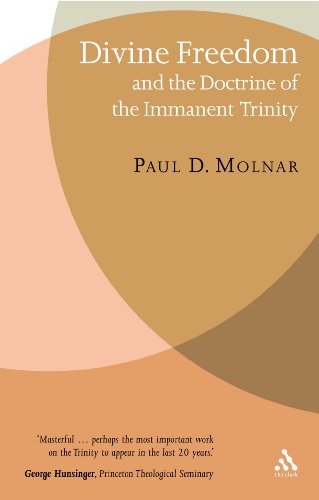
Divine Freedom and the Doctrine of the Immanent Trinity
Authors:
Paul Molnar
Publisher:
T&T Clark
Publication Date:
Not available
ISBN:
0567041344
In this book Paul Molnar seeks to set out a contemporary doctrine of the immanent Trinity and to address the issue of how we can know God according to... his true nature rather than create him in our own image. It is Paul Molnar's contention that any theology that starts with self-transcendence and not explicitly with God's self-revelation through his Word will result in a flawed perception of both divine and human freedom. He holds that while God is and remains incomprehensible even in his revelation, he can be known as a very definite object in faith and by grace. A sound doctrine of the immanent Trinity recognizes the freedom of God as the basis of our own human freedom and upholds God's distinction from his creation, thus avoiding the theological pitfalls of agnosticism, monism and dualism.'Molnar sets out to place the doctrine of the immanent Trinity firmly back on the agenda of the Christian doctrine of God, and does so to considerable effect. In conversation not only with Barth but with many contemporary proposals in trinitarian theology, he makes a persuasive case for the centrality of the doctrine and against the perils that attend its neglect. This is an essay in Christian dogmatics of a high order, learned, intellectually powerful and spiritually engaged; it deserves to be widely read and discussed. ' John Webster, Lady Margaret Professor of Divinity, University of Oxford>
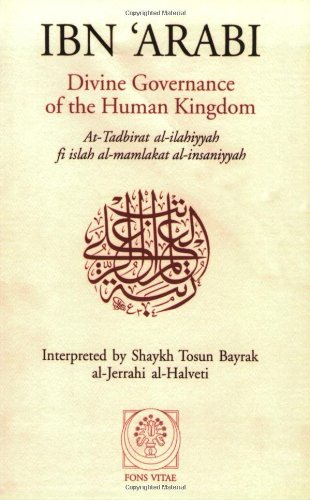
Divine Governance of the Human Kingdom: Including What the Seeker...
Authors:
Ibn Arabi
Publisher:
Fons Vitae
Publication Date:
Not available
ISBN:
1887752056
A powerful but little known work, this volume contains three mystical texts. 'Al-tadbirat,' the largest, is a fascinating treatise on the divine design... and management of the world, and the central role the human model plays in the creative and governing process. The other two are 'kitab kunh ma la budda minhu lil-murid' (or, "What the Seeker Needs"), a brief guide for those want to follow the Sufi path, and 'kitab al-ahadiyyah' (or, "The One Alone"), an esoteric essay on transcendental unity.
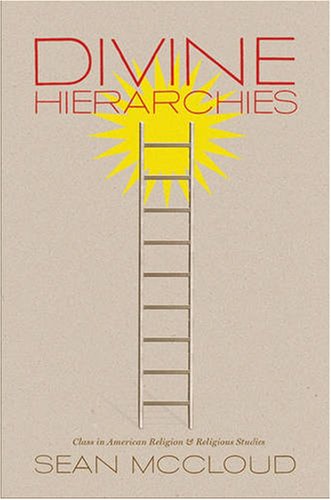
Divine Hierarchies: Class in American Religion and Religious Studies
Authors:
Sean McCloud
Publisher:
The University of North Carolina Press
Publication Date:
Not available
ISBN:
0807858498
Placing the neglected issue of class back into the study and understanding of religion, Sean McCloud reconsiders the meaning of class in today's world.... More than a status grounded in material conditions, says McCloud, class also entails relationships, identifications, boundaries, meanings, power, and our most ingrained habits of mind and body. He demonstrates that employing class as an analytical tool that cuts across variables such as creed, race, ethnicity, and gender can illuminate American religious life in unprecedented ways.
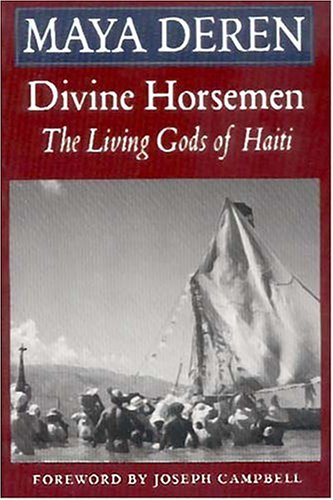
Divine Horsemen: The Living Gods of Haiti
Authors:
Maya Deren
Publisher:
McPherson
Publication Date:
Not available
ISBN:
0914232630
Includes photographs and drawings. Foreword by Joseph Campbell This is the classic, intimate study, movingly written with the special insight of... direct encounter, which was first published in 1953 by the fledgling Thames & Hudson firm in a series edited by Joseph Campbell. Maya Deren's Divine Horsemen is recognized throughout the world as a primary source book on the culture and spirituality of Haitian Voudoun. The work includes all the original photographs and illustrations, glossary, appendices and index. It includes the original Campbell foreword along with the foreword Campbell added to a later edition.
"Divine Madness": Plato's Case Against Secular Humanism
Authors:
Josef Pieper
Publisher:
Ignatius Press
Publication Date:
Not available
ISBN:
0898705576
The popular Thomistic philosopher and writer Josef Pieper focuses on the thesis of Plato, which at first sight appears strange and unrealistic, that... those experiences that advance human life to its true fullness are bestowed on us only during a "god-given" state of "being-beside-oneself". This thesis is then resolutely confronted with our contemporary and above all psychoanalytical knowledge of man's nature, as well as with the Christian conception of man's existence, thus revealing its amazing unexpected relevance. "Man's real spiritual patrimony is achieved and preserved only through a willingly accepted openness: openness for divine revelation, for the salutary pain of catharsis, for the recollecting power of the fine arts, for the emotional shock brought about by eros and caritas-in short, through the attitude rooted in the mysterious experience that Plato called theia mania." Josef Pieper
Divine order in the church
Authors:
French L Arrington
Publisher:
Pathway Press
Publication Date:
Not available
ISBN:
0871482533
The Pentateuch--Genesis, Exodus, Leviticus, Numbers, Deuteronomy--are the vital first books in the Bible. Understanding the scope, meaning, and events... of these five books is integral to understanding the whole of Scripture that follows.Old Testament expert Herbert Wolf provides layreaders and scholars alike with a strong undergirding of understanding and knowledge in this introduction that reveals both the seriousness and excitement of the Pentateuch. Readers will find Adam, Abraham, Joseph, Moses and Joshua in these pages, as well as terrible sin and glorious forgiveness, bloody sacrifices and battles, deadly betrayal and life-giving hope.Wolf first addresses the overarching themes that flow through the Pentateuch, with special attention given to Moses as author of the five books. He then addresses each book specifically, covering topics such as purpose and scope, and literary structure. He tailors additional study to each specific book. This book contributes significantly to a clear, deep understanding of the Bible's first five books.
Divine Right and Democracy: An Anthology of Political Writing in...
Authors:
Not Available
Publisher:
Hackett Pub Co Inc
Publication Date:
Not available
ISBN:
087220653X
An anthology of political thought drawn from England's 'century of revolution' that focuses on the writings of those English theorists, essayists,... speech writers, tract writers, and pamphleteers to whom Hobbes and Locke were immediately responding in their respective masterpieces of political theory.
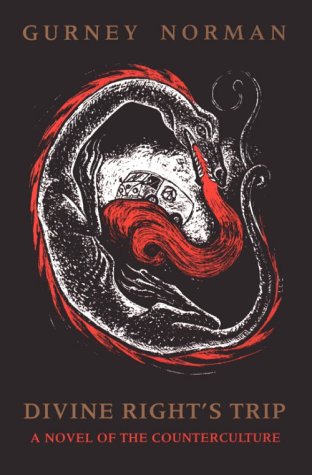
Divine Right's Trip : A Novel of the Counterculture
Authors:
Gurney Norman
Publisher:
Gnomon Press
Publication Date:
Not available
ISBN:
0917788427
Fiction. A "novel of the counterculture," Gurney Norman's DIVINE RIGHT'S TRIP elicited comparison to Salinger and Kerouac upon its publication in 1971.... "DIVINE RIGHT'S TRIP shows itself to be a subtly written and morally passionate epic of the counterculture, a fictional explication of the hopeful new consciousness come to birth.Divine Right is bigger than life, and in giving the story thus far of a segment of his generation, in prose nicely threaded between the vernacular and the symbolic, Gurney Norman has shown a noble reach and a healthy grasp." - John Updike

Divine Secrets of the Ya-ya Sisterhood
Authors:
Wells. Rebecca
Publisher:
HarperPerennial/ Harper Collins Paperbacks
Publication Date:
Not available
ISBN:
0060928336
When Siddalee Walker, oldest daughter of Vivi Abbott Walker, Ya-Ya extraordinaire, is interviewed in the New York Times about a hit play she's directed,... her mother gets described as a "tap-dancing child abuser." Enraged, Vivi disowns Sidda. Devastated, Sidda begs forgiveness, and postpones her upcoming wedding. All looks bleak until the Ya-Yas step in and convince Vivi to send Sidda a scrapbook of their girlhood mementos, called "Divine Secrets of the Ya-Ya Sisterhood." As Sidda struggles to analyze her mother, she comes face to face with the tangled beauty of imperfect love, and the fact that forgiveness, more than understanding, is often what the heart longs for. Divine Secrets of the Ya-Ya Sisterhood may call to mind Prince of Tides in its unearthing of family darkness; in its unforgettable heroines and irrepressible humor and female loyalty, it echoes Fannie Flagg's Fried Green Tomatoes at the Whistle Stop Cafe.
 '





