production
/viewbook/list/all/?page=3545
/
/static/
None

Dix Heures Et Demie Du Soir En Ete (Folio, No 1699)
Authors:
Marguerite Duras
Publisher:
Gallimard
Publication Date:
Not available
ISBN:
2070376990
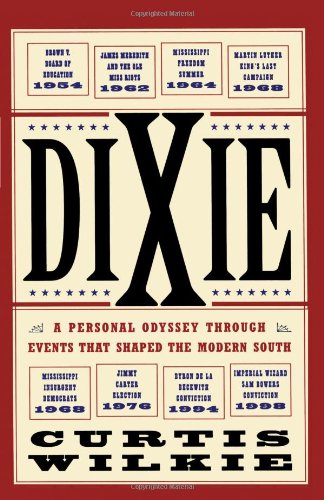
Dixie: A Personal Odyssey Through Events That Shaped the Modern South
Authors:
Curtis Wilkie
Publisher:
Scribner
Publication Date:
Not available
ISBN:
0684872862
In this riveting political and social history of the American South during the second half of the twentieth century, acclaimed journalist Curtis Wilkie... tells the story of a region and a man -- himself -- intimately transformed by racial and political upheavals. In 1969, in the wake of the violence surrounding the civil rights movement, Wilkie left the South and vowed never to live there again. But after traveling the world as a reporter, he returned in 1993, drawn by a deep-rooted affinity with the territory of his youth. Here, he endeavors to make sense of the enormous changes that have convulsed the South for more than four decades. Through vivid recollections of landmark events, Dixie becomes both a striking eyewitness account of history and an unconventional tale of redemption full of beauty, humor, and pathos.
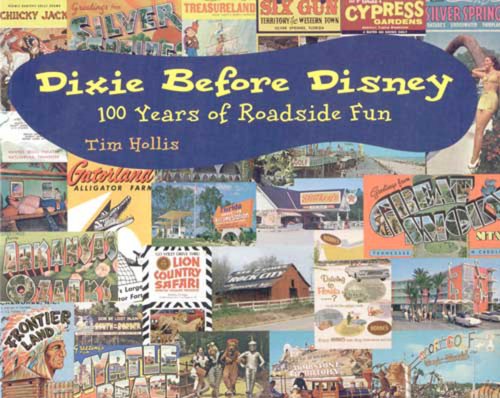
Dixie Before Disney: 100 Years of Roadside Fun
Authors:
Tim Hollis
Publisher:
University Press of Mississippi
Publication Date:
Not available
ISBN:
1578061180
Before Walt Disney built his mammoth theme park, there were the Fairyland Caverns of Rock City Gardens, the glass-bottomed boats of Silver Springs, and... Stuckey's Restaurants around each bend. From the Smoky Mountains to the Ozarks, from the Florida coast to the Mississippi gulf, the Southern roadside was a string of attractions--some based on history, some on pure imagination. Dixie Before Disney chronicles the wonderful and wacky history of these tourist spots. Tourism rose in Dixie just after the Civil War, when Northern millionaires discovered the joys of spending the winter months in balmy Florida. Locales such as St. Augustine, Daytona Beach, and Miami Beach became snowbird playgrounds. Soon the roadsides were alive with eateries like Kentucky Fried Chicken and Horne's, and motels with names like Big Bear Cottages and the Sea Dip Motel. Later, jungle parks, nature sites, and Wild West towns began drawing funseekers. Then, in 1971, Walt Disney World in Orlando eclipsed them all. For three decades Tim Hollis gathered family memorabilia and met with collectors nationwide. Lavishly illustrated with his findings--vintage photographs, brochures, advertisements, and postcards--Dixie Before Disney will bring back a torrent of memories for anyone who grew up traveling the South. Tim Hollis is also the author of Cousin Cliff: 40 Magical Years in Television and of articles in the National Lum & Abner Society's The Jot 'Em Down Journal and the Society of Commercial Archaeologists' News-Journal.

Dixie Dharma: Inside a Buddhist Temple in the American South
Authors:
Jeff Wilson
Publisher:
The University of North Carolina Press
Publication Date:
Not available
ISBN:
0807835455
Buddhism in the United States is often viewed in connection with practitioners in the Northeast and on the West Coast, but in fact, it has been... spreading and evolving throughout the United States since the mid-nineteenth century. In Dixie Dharma, Jeff Wilson argues that region is crucial to understanding American Buddhism. Through the lens of a multidenominational Buddhist temple in Richmond, Virginia, Wilson explores how Buddhists are adapting to life in the conservative evangelical Christian culture of the South, and how traditional Southerners are adjusting to these newer members on the religious landscape. Introducing a host of overlooked characters, including Buddhist circuit riders, modernist Pure Land priests, and pluralistic Buddhists, Wilson shows how regional specificity manifests itself through such practices as meditation vigils to heal the wounds of the slave trade. He argues that southern Buddhists at once use bodily practices, iconography, and meditation tools to enact distinct sectarian identities even as they enjoy a creative hybridity.

Dixie Emporium: Tourism, Foodways, and Consumer Culture in the...
Authors:
Anthony J. Stanonis
Publisher:
University of Georgia Press
Publication Date:
Not available
ISBN:
0820331694
This collection of ten essays focuses on how southerners have marketed themselves to outsiders. The cultural ironies and contradictions that have arisen... from southerners' efforts to commodify their identity reveal regional anxieties about consumerism, tourism, and memory.The book's first section looks at southern souvenirs as abstractions of regional culture. Essays on such topics as Confederate imagery on consumer goods and the tacky figurine known as the Horny Hillbilly unpack the often incongruous meanings bestowed on souvenirs by their owners. Locales like Branson, Missouri, and the South of the Border tourist complex in South Carolina are discussed in the second section's essays, which consider how tourist sites can both exploit and depend on local culture. Recognizing the deep cultural meanings associated with food and eating, the final group of essays looks at the Krispy Kreme donut franchise, the themed Baltimore eatery Cafe Hon, and other manifestations of southern foodways.Viewing a region often at odds with itself on matters like race and religion, Dixie Emporium identifies spaces, services, and products that construct various Souths that exaggerate, refute, or self-consciously safeguard elements of southernness.

Dixie Looks Abroad: The South and U.S. Foreign Relations, 1789-1973...
Authors:
Joseph A. Fry
Publisher:
Louisiana State Univ Pr
Publication Date:
Not available
ISBN:
0807127450
As America's most self-conscious section, the South has exercised an important and often decisive influence on U.S. foreign relations, but the extent of... this influence has been largely unexplored by historians. In this groundbreaking study, Joseph A. Fry provides a comprehensive overview of the South's role in U.S. international involvement from 1789 to 1973, revealing the enormous impact of southern pressure on broader national interests. In a gracefully written and engaging narrative, Fry chronicles the South's numerous foreign policy opinions over time, including its opposition to closer relations with Great Britain and war with France in the 1790's, its leadership in the War of 1812, its flawed diplomatic attempts during the years of the Confederacy, and its fifty-year protest against the increasingly assertive Republican-dominated political agenda following the Civil War. With the election of Woodrow Wilson, Fry shows, the South reversed its tendency toward isolationism and consistently supported Wilson's activist foreign policies. The South sustained this interventionist mind-set into the 1970s, ardently supporting cold war containment policy. Fry is careful to note that southerners seldom presented a completely united front on foreign affairs. Yet even while disagreeing among themselves, he argues, they consistently viewed the world through a distinctly southern lens and acted on a variety of perceived common interests, including a dedication to honor and patriotism, a determination to protect slavery, a proclivity for personal violence, a commitment to partisan politics, a concern for economics, and a preoccupation with race. Though the South's foreign policy opinions varied widely through the years, Fry's extraordinary work affirms that Dixie has always held considerable clout on the world stage.

Dixie's Daughters: The United Daughters of the Confederacy and the...
Authors:
Karen L. Cox
Publisher:
University Press of Florida
Publication Date:
Not available
ISBN:
0813028124
Even without the right to vote, members of the United Daughters of the Confederacy proved to have enormous social and political influence throughout the... South--all in the name of preserving Confederate culture. Karen L. Cox's history of the UDC, an organization founded in 1894 to vindicate the Confederate generation and honor the Lost Cause, shows why myths surrounding the Confederacy continue to endure. The Daughters, as UDC members were popularly known, were literally daughters of the Confederate generation. While southern women had long been leaders in efforts to memorialize the Confederacy, UDC members made the Lost Cause a movement about vindication as well as memorialization. They erected monuments, monitored history for "truthfulness," and sought to educate coming generations of white southerners about an idyllic past and a just cause--states' rights. Soldiers' and widows' homes, perpetuation of the mythology of the antebellum South, and pro-southern textbooks in the region's white public schools were all integral to their mission of creating the New South in the image of the Old. UDC members aspired to transform military defeat into a political and cultural victory, in which states' rights and white supremacy remained intact. To the extent they were successful, the Daughters helped to preserve and perpetuate an agenda for the New South that included maintaining the social status quo. Placing the organization's activities in the context of the postwar and Progressive-Era South, Cox describes in detail the UDC's origins and early development, its efforts to collect and preserve manuscripts and artifacts and to build monuments, and its later role in the peace movement and World War I. This remarkable history of the organization presents a portrait of two generations of southern women whose efforts helped shape the social and political culture of the New South. It also offers a new historical perspective on the subject of Confederate memory and the role southern women played in its development.

Dixmont
Authors:
Rick Campbell
Publisher:
Black Bay Books
Publication Date:
Not available
ISBN:
0962487856
DIXON 4 CT. PRESHARPENED PENCILS
Authors:
Not Available
Publisher:
Not available
Publication Date:
Not available
ISBN:
Not available
Dixon v. Providential Life Insurance Co: Courtroom Technology Case...
Authors:
Edward R. Stein
Publisher:
National Institute for Trial Advocacy
Publication Date:
Not available
ISBN:
1556817193
D.I.Y.: Design It Yourself (Design Handbooks)
Authors:
Ellen Lupton
Publisher:
Princeton Architectural Press
Publication Date:
Not available
ISBN:
1568985525
Not satisfied with the new T-shirts on sale at the local mall? Maybe you'd like a wedding invitation that expresses your own vision, not your party... planner's? How about some personalized stationery? An upgrade to your website? A business card? A poster for your political campaign? A CD package for your band? Sound good? Then get up off your couch and Design It Yourself! Avoid graphic identity theft: build your own. Ellen Lupton, bestselling author of Thinking with Type, will show you how. DIY: Design It Yourself, provides you with all the tools you'll need to create your own projects, from conception through production. Here you will find: - simple ideas on how you can "think like a designer" - clear and coherent explanations of design technologies, from silk-screening to web development - what materials you'll need to get your job done - where to find and buy them - how much time and experience your project demands - diagrams that show how to handle complex tasks - basic typographic dos and don'ts - the history and theory of the DIY design movement - hundreds of innovative and beautiful projects for inspiration No more excuses. With this book, virtually any design task is within your grasp. Just do it (yourself)!
DIY Media in the Classroom: New Literacies Across Content Areas...
Authors:
Barbara J. Guzzetti
Publisher:
Teachers College Press
Publication Date:
Not available
ISBN:
0807750794
This book shows teachers how to bring students' Do-It-Yourself media practices into the classroom (Grades 6-12). In one accessible resource, the authors... explain DIY media, identify their appealing features for content area instruction, and describe the literacy skills and strategies they promote. Chapters address: Adolescents' DIY Media as New Literacies; Blogs; Social Networking and Social Media Sites; Video Games, Machinima, and Virtual Worlds; YouTube and Video Sharing Sites; Informational Wikis and Online Resources; Fan Fiction, Fan Art and Web Comics; Zines and Indie Music; DIY Media, Assessment, Ethics, and Achievement. Providing a compelling rationale and framework for using DIY media in the classroom, this book: addresses both print-based and digital DIY media (one of the first professional education books to do so) and provides teaching strategies for using DIY media across the curriculum, including English/language arts, math, social studies, science, art, and music.
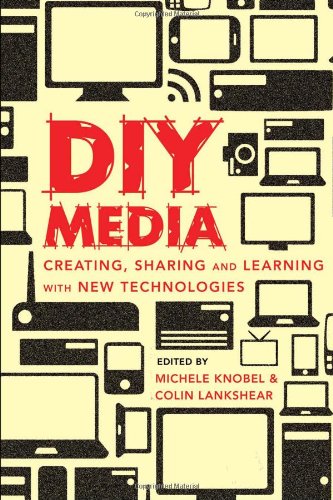
DIY Media (New Literacies and Digital Epistemologies)
Authors:
Colin Lankshear
Publisher:
Peter Lang Publishing
Publication Date:
Not available
ISBN:
1433106353
Schools remain notorious for co-opting digital technologies to business as usual approaches to teaching new literacies. DIY Media addresses this issue... head-on, and describes expansive and creative practices of digital literacy that are increasingly influential and popular in contexts beyond the school, and whose educational potential is not yet being tapped to any significant degree in classrooms. This book is very much concerned with engaging students in do-it-yourself digitally mediated meaning-making practices. As such, it is organized around three broad areas of digital media: moving media, still media, and audio media. Specific DIY media practices addressed in the chapters include machinima, anime music videos, digital photography, podcasting, and music remixing. Each chapter opens with an overview of a specific DIY media practice, includes a practical how-to tutorial section, and closes with suggested applications for classroom settings. This collection will appeal not only to educators, but to anyone invested in better understandingand perhaps participating inthe significant shift towards everyday people producing their own digital media.

DIY U: Edupunks, Edupreneurs, and the Coming Transformation of...
Authors:
Anya Kamenetz
Publisher:
Chelsea Green Publishing
Publication Date:
Not available
ISBN:
1603582347
The price of college tuition has increased more than any other major good or service for the last twenty years. Nine out of ten American high school... seniors aspire to go to college, yet the United States has fallen from world leader to only the tenth most educated nation. Almost half of college students don't graduate; those who do have unprecedented levels of federal and private student loan debt, which constitutes a credit bubble similar to the mortgage crisis.The system particularly fails the first-generation, the low-income, and students of color who predominate in coming generations. What we need to know is changing more quickly than ever, and a rising tide of information threatens to swamp knowledge and wisdom. America cannot regain its economic and cultural leadership with an increasingly ignorant population. Our choice is clear: Radically change the way higher education is delivered, or resign ourselves to never having enough of it.The roots of the words "university" and "college" both mean community. In the age of constant connectedness and social media, it's time for the monolithic, millennium-old, ivy-covered walls to undergo a phase change into something much lighter, more permeable, and fluid.The future lies in personal learning networks and paths, learning that blends experiential and digital approaches, and free and open-source educational models. Increasingly, you will decide what, when, where, and with whom you want to learn, and you will learn by doing. The university is the cathedral of modernity and rationality, and with our whole civilization in crisis, we are poised on the brink of Reformation.

Dizionario grammaticale. Dizionario pratico di grammatica e...
Authors:
Vincenzo Ceppellini
Publisher:
De Agostini
Publication Date:
Not available
ISBN:
8841836652
Could an Indian woman love an African man? How would Indians have described the crossing from India to Africa? The Indian community in South Africa has... been largely ignored by writers and historians. In these stories, Agnes Sam has given vivid and imaginative life to the "hidden history." She explores the Indians' struggle with vastly differing cultures -- African, Indians, and European -- frequently focusing on the experience of women, who also must contend with a male-dominated society. Agnes Sam's South African childhood and her Indian past provide the inspiration for this collection of bright, vibrant, humorous, and compassionate short stories.
 '





