production
/viewbook/list/all/?page=3557
/
/static/
None

Documents Supplement to International Intellectual Property:...
Authors:
Daniel C. K. Chow
Publisher:
West
Publication Date:
Not available
ISBN:
0314284796
This Supplement accompanies Chow and Lee's International Intellectual Property: Problems, Cases, and Materials. The new edition has been thoroughly... updated.
DocuNotes: Clinical Pocket Guide to Effective Charting
Authors:
Cherie, R.N. Rebar
Publisher:
F A Davis Co 2009-05-22
Publication Date:
Not available
ISBN:
0803620926
Cover shows some wear, but in great condition. Covers and corners may show little wear. . No International orders!! Quick shipping with delivery... confirmation standard. Used books do not contain access codes, and CD's/DVD's may not be present. Satisfaction guaranteed!
Do, Die, or Get Along: A Tale of Two Appalachian Towns
Authors:
Peter Crow
Publisher:
University of Georgia Press
Publication Date:
Not available
ISBN:
0820328715
Do, Die, or Get Along weaves together voices of twenty-six people who have intimate connections to two neighboring towns in the southwestern Virginia... coal country. Filled with evidence of a new kind of local outlook on the widespread challenge of small community survival, the book tells how a confrontational "do-or-die" past has given way to a "get-along" present built on coalition and guarded hope. St. Paul and Dante are six miles apart; measured in other ways, the distance can be greater. Dante, for decades a company town controlled at all levels by the mine owners, has only a recent history of civic initiative. In St. Paul, which arose at a railroad junction, public debate, entrepreneurship, and education found a more receptive home.The speakers are men and women, wealthy and poor, black and white, old-timers and newcomers. Their concerns and interests range widely, including the battle over strip mining, efforts to control flooding, the 1989-90 Pittston strike, the nationally acclaimed Wetlands Estonoa Project, and the grassroots revitalization of both towns led by the St. Paul Tomorrow and Dante Lives On organizations. Their talk of the past often invokes an ethos, rooted in the hand-to-mouth pioneer era, of short-term gain. Just as frequently, however, talk turns to more recent times, when community leaders, corporations, unions, the federal government, and environmental groups have begun to seek accord based on what will be best, in the long run, for the towns.The story of Dante and St. Paul, Crow writes, "gives twenty-first-century meaning to the idea of the good fight." This is an absorbing account of persistence, resourcefulness, and eclectic redefinition of success and community revival, with ramifications well beyond Appalachia.
Does American Democracy Still Work? (The Future of American...
Authors:
Alan Wolfe
Publisher:
Yale University Press
Publication Date:
Not available
ISBN:
0300126107
The past few decades have brought a shift in the nature of American democracyan alarming shift that threatens such liberal democratic values as... respect for pluralism, acceptance of the separation of powers, and recognition of the rights of opposition parties. In this insightful book, political scientist Alan Wolfe identifies the current political conditions that endanger the quality of our democracy. He describes how politics has changed, and he calls for a democracy protection movement designed to preserve our political traditions not unlike the environmental protection movement’s efforts to safeguard the natural world.Voters who know little about issues, leaders who bend rules with little fear of reprisal, and political parties that are losing the ability to mobilize citizens have all contributed to a worrisome new politics of democracy, Wolfe argues. He offers a brilliant analysis of how religion and morality have replaced political and economic self-interest as guiding principles, and how a dangerous populism promotes a radical form of elitism. Without laying blame on one party or ideology and without claiming that matters will improve with one party or the other in office, Wolfe instead suggests that Americans need to understand the danger their own indifference poses and take political matters more seriously.
Does Conquest Pay? The Exploitation of Occupied Industrial Societies
Authors:
Peter Liberman
Publisher:
Princeton University Press
Publication Date:
Not available
ISBN:
0691002428
Can foreign invaders successfully exploit industrial economies? Since control over economic resources is a key source of power, the answer affects the... likelihood of aggression and how strenuously states should counter it. The resurgence of nationalism has led many policymakers and scholars to doubt that conquest still pays. But, until now, the "cumulativity" of industrial resources has never been subjected to systematic analysis.Does Conquest Pay? demonstrates that expansion can, in fact, provide rewards to aggressor nations. Peter Liberman argues that invaders can exploit industrial societies for short periods of time and can maintain control and economic performance over the long term. This is because modern societies are uniquely vulnerable to coercion and repression. Hence, by wielding a gun in one hand and offering food with the other, determined conquerors can compel collaboration and suppress resistance. Liberman's argument is supported by several historical case studies: Germany's capture of Belgium and Luxembourg during World War I and of nearly all of Europe during World War II; France's seizure of the Ruhr in 1923-24; the Japanese Empire during 1910-45; and Soviet hegemony over Eastern Europe in 1945-89.Does Conquest Pay? suggests that the international system is more war-prone than many optimists claim. Liberman's findings also contribute to debates about the stability of empires and other authoritarian regimes, the effectiveness of national resistance strategies, and the sources of rebellious collective action.

Does David Still Play Before You?: Israeli Poetry and the Bible
Authors:
David C. Jacobson
Publisher:
Wayne State Univ Pr
Publication Date:
Not available
ISBN:
0814326234
In a fresh approach to an age-old discussion, an esteemed editor of the Atlantic Monthly collects twenty-five dazzling short stories by eminent writers... about spiritual experiences of all sorts. With works by John Updike, Philip Roth, Louise Erdrich, James Joyce, Flannery O'Connor, James Baldwin, Alice Munro, and more, God: Stories offers insight, solace, and pleasure not only to the faithful but to seekers -- and to those who simply love fine stories. "Challenging the mind and exhilarating the soul . . . [this] rare and precious collection" (Susannah Heschel) explores the human dimensions of spirituality from the comic to the passionate, the skeptical to the mystical and beyond.
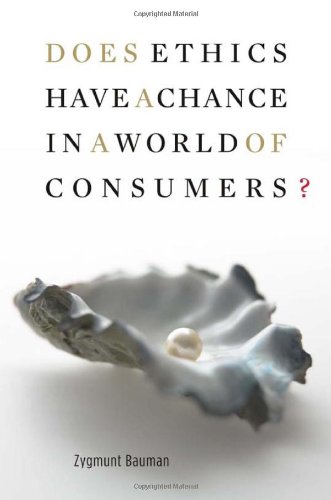
Does Ethics Have a Chance in a World of Consumers? (Institute for...
Authors:
Zygmunt Bauman
Publisher:
Harvard University Press
Publication Date:
Not available
ISBN:
0674033515
Zygmunt Bauman is one of the most admired social thinkers of our time. Once a Marxist sociologist, he has surrendered the narrowness of both Marxism... and sociology, and dares to write in language that ordinary people can understand—about problems they feel ill equipped to solve. This book is no dry treatise but is instead what Bauman calls “a report from a battlefield,” part of the struggle to find new and adequate ways of thinking about the world in which we live. Rather than searching for solutions to what are perhaps the insoluble problems of the modern world, Bauman proposes that we reframe the way we think about these problems. In an era of routine travel, where most people circulate widely, the inherited beliefs that aid our thinking about the world have become an obstacle. Bauman seeks to liberate us from the thinking that renders us hopeless in the face of our own domineering governments and threats from unknown forces abroad. He shows us we can give up belief in a hierarchical arrangement of states and powers. He challenges members of the “knowledge class” to overcome their estrangement from the rest of society. Gracefully, provocatively, Bauman urges us to think in new ways about a newly flexible, newly challenging modern world. As Bauman notes, quoting Vaclav Havel, “hope is not a prognostication.” It is, rather, alongside courage and will, a mundane, common weapon that is too seldom used.
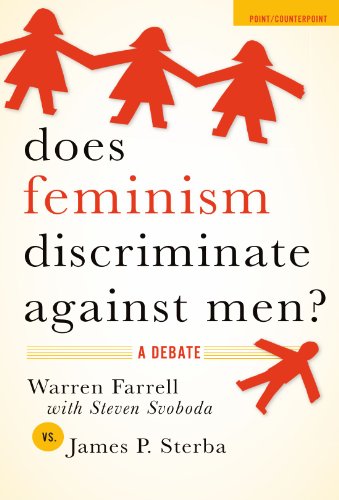
Does Feminism Discriminate Against Men?: A Debate...
Authors:
Warren Farrell
Publisher:
Oxford University Press, USA
Publication Date:
Not available
ISBN:
019531283X
Does feminism give a much-needed voice to women in a patriarchal world? Or is the world not really patriarchal? Has feminism begun to level the playing... field in a world in which women are more often paid less at work and abused at home? Or are women paid equally for the same work and not abused more at home? Does feminism support equality in education and in the military, or does it discriminate against men by ignoring such issues as male-only draft registration and boys lagging behind in school? The only book of its kind, this volume offers a sharp, lively, and provocative debate on the impact of feminism on men. Warren Farrell--an international best-selling author and leader in both the early women's and current men's movements--praises feminism for opening options for women but criticizes it for demonizing men, distorting data, and undervaluing the family. In response, James P. Sterba--an acclaimed philosopher and ardent advocate of feminism--maintains that the feminist movement gives a long-neglected voice to women in a male-dominated world and that men are not an oppressed gender in today's America. Their wide-ranging debate covers personal issues, from love, sex, dating, and rape to domestic violence, divorce, and child custody. Farrell and Sterba also look through their contrasting lenses at systemic issues, from the school system to the criminal justice system; from the media to the military; and from health care to the workplace. A perfect book to get students thinking and debating, Does Feminism Discriminate Against Men? A Debate is ideal for courses in gender studies, sociology, psychology, economics, feminist philosophy, and contemporary moral issues. It is also compelling reading for anyone interested in the future of men and women.
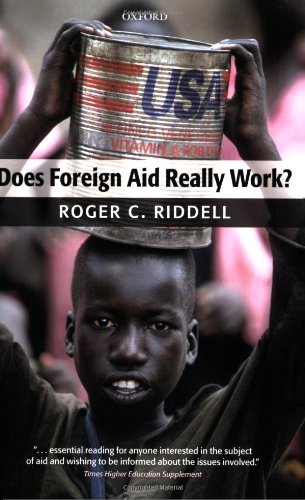
Does Foreign Aid Really Work?
Authors:
Roger C. Riddell
Publisher:
Oxford University Press, USA
Publication Date:
Not available
ISBN:
0199544468
Foreign aid is now a $100bn business and is expanding more rapidly today than it has for a generation. But does it work? Indeed, is it needed at all?... Other attempts to answer these important questions have been dominated by a focus on the impact of official aid provided by governments. But today possibly as much as 30 percent of aid is provided by Non-Governmental Organizations (NGOs), and over 10 percent is provided as emergency assistance. In this first-ever attempt to provide an overall assessment of aid, Roger Riddell presents a rigorous but highly readable account of aid, warts and all. oes Foreign Aid Really Work? sets out the evidence and exposes the instances where aid has failed and explains why. The book also examines the way that politics distorts aid, and disentangles the moral and ethical assumptions that lie behind the belief that aid does good. The book concludes by detailing the practical ways that aid needs to change if it is to be the effective force for good that its providers claim it is.
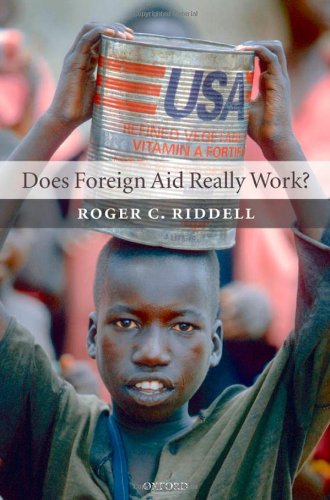
Does Foreign Aid Really Work?
Authors:
Roger C. Riddell
Publisher:
Oxford University Press, USA
Publication Date:
Not available
ISBN:
0199295654
Foreign aid is now a $100bn business and is expanding more rapidly today than it has for a generation. But does it work? Indeed, is it needed at all? ... Other attempts to answer this important question have been dominated by a focus on the impact of official aid provided by governments. But today possibly as much as 30 percent of aid is provided by Non-Governmental Organizations (NGOs), and over 10 percent is provided as emergency assistance. In this first-ever attempt to provide an overall assessment of aid, Roger Riddell presents a rigorous but highly readable account of aid, warts and all. Does Foreign Aid Really Work? sets out the evidence and exposes the instances where aid has failed and explains why. The book also examines the way that politics distorts aid, and disentangles the moral and ethical assumptions that lie behind the belief that aid does good. The book concludes by detailing the practical ways that aid needs to change if it is to be the effective force for good that its providers claim it is.
Does God Belong in Public Schools?
Authors:
Kent Greenawalt
Publisher:
Princeton University Press
Publication Date:
Not available
ISBN:
0691130655
Controversial Supreme Court decisions have barred organized school prayer, but neither the Court nor public policy exclude religion from schools... altogether. In this book, one of America's leading constitutional scholars asks what role religion ought to play in public schools. Kent Greenawalt explores many of the most divisive issues in educational debate, including teaching about the origins of life, sex education, and when--or whether--students can opt out of school activities for religious reasons.Using these and other case studies, Greenawalt considers how to balance the country's constitutional commitment to personal freedoms and to the separation of church and state with the vital role that religion has always played in American society. Do we risk distorting students' understanding of America's past and present by ignoring religion in public-school curricula? When does teaching about religion cross the line into the promotion of religion?Tracing the historical development of religion within public schools and considering every major Supreme Court case, Greenawalt concludes that the bans on school prayer and the teaching of creationism are justified, and that the court should more closely examine such activities as the singing of religious songs and student papers on religious topics. He also argues that students ought to be taught more about religion--both its contributions and shortcomings--especially in courses in history. To do otherwise, he writes, is to present a seriously distorted picture of society and indirectly to be other than neutral in presenting secularism and religion.Written with exemplary clarity and even-handedness, this is a major book about some of the most pressing and contentious issues in educational policy and constitutional law today.
Does God Exist?: A Dialogue
Authors:
Todd C. Moody
Publisher:
Hackett Pub Co
Publication Date:
Not available
ISBN:
0872203433
Moody maps the spectrum of philosophical arguments and counterarguments for the existence of God. By structuring the participants' colloquial... conversations along classical lines. Moody presents an accessible and concrete display of the concerns central to theist and atheist thinking, including consecutive discussions on the burden of proof, the first cause, a necessary being, the natural order, suffering, miracles, experience as knowledge, and rationality without proof.
Does God Make a Difference?: Taking Religion Seriously in Our...
Authors:
Warren Nord
Publisher:
Oxford University Press, USA
Publication Date:
Not available
ISBN:
0199766886
In this provocative book Warren A. Nord argues that public schools and universities leave the vast majority of students religiously illiterate. Such... education is not religiously neutral, a matter of constitutional importance; indeed, it borders on secular indoctrination when measured against the requirements of a good liberal education and the demands of critical thinking. Nord also argues that religious perspectives must be included in courses that address morality and those Big Questions that a good education cannot ignore. He outlines a variety of civic reasons for studying religion, and argues that the Establishment Clause doesn't just permit, but requires, taking religion seriously. While acknowledging the difficulty of taking religion seriously in schools and universities, Nord makes a cogent case for requiring both high school and undergraduate students to take a year long course in religious studies, and for discussing religion in any course that deals with religiously controversial material. The final chapters address how religion might best be addressed in history, literature, economics, and (perhaps most controversially) science courses. He also discusses Bible courses, and the relevance of religion to moral education and ethics courses.While his position will be taken by some as radical, he argues that he is advocating a "middle way" in our culture wars. Public schools and universities can neither promote religion nor ignore it. Does God Make a Difference? increases our understanding of a long and heated cultural conflict; it also proposes a solution to the problem that is philosophically sound and, in the long run, eminently practical.
Does God Need the Church?: Toward a Theology of the People of God...
Authors:
Gerhard Lohfink
Publisher:
Michael Glazier Books
Publication Date:
Not available
ISBN:
0814659284
Father Luigi Gambero, internationally-known expert on early Christianity, presents a comprehensive survey of the development of Marian doctrine and... devotion during the first eight centuries. Focusing on the lives and works of over thirty of the most famous Church Fathers and early Christian writers, Fr. Gambero has produced a clear and readable summary of the richness of the patristic age's theological and devotional approach to the Mother of God. The book contains numerous citations from the works of those men who developed the defining Christological and Mariological positions that have constituted the foundational doctrinal teaching of the Church. Each chapter concludes with an extended reading from the works of the patristic authors. A number of these texts have never before been published in English. The thought of the Fathers and early Christian writers continues to fascinate readers today. Their theological acuity and spiritual depth led them faithfully into the mysteries of Sacred Scripture. Their vast experience made them reliable and trustworthy witnesses to the faith of the people of God.
Does Human Rights Need God? (Eerdmans Religion, Ethics, &...
Authors:
Barbra Barnett
Publisher:
Wm. B. Eerdmans Publishing Co.
Publication Date:
Not available
ISBN:
0802829058
When the Universal Declaration of Human Rights was drafted in 1945, French Catholic philosopher Jacques Maritain observed, "We agree on these... rights, providing we are not asked why. With the 'why,' the dispute begins." The world since then has continued to agree to disagree, fearing that an open discussion of the divergent rationales for human rights would undermine the consensus of the Declaration. Is it possible, however, that current failures to protect human rights may stem from this tacit agreement to avoid addressing the underpinnings of human rights? This consequential volume presents leading scholars, activists, and officials from four continents who dare to discuss the "why" behind human rights. Appraising the current situation from diverse religious perspectives -- Jewish, Protestant, Orthodox, Muslim, Confucian, and secular humanist -- the contributors openly address the question whether God is a necessary part of human rights. Despite their widely varying commitments and approaches, the authors affirm that an investigation into the "why" of human rights need not devolve into irreconcilable conflict. Contributors: Khaled Abou El FadlBarbra BarnettElizabeth M. BucarJean Bethke ElshtainRobert P. GeorgeVigen GuroianLouis HenkinCourtney W. HowlandDavid NovakSari NusseibehMartin PaloušRobert A. SeipleMax L. StackhouseCharles Villa-VicencioAnthony C. Yu
 '





