production
/viewbook/list/all/?page=3579
/
/static/
None
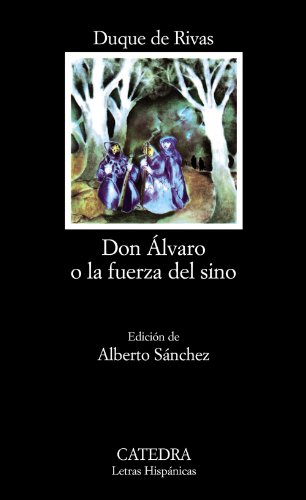
Don Alvaro o la fuerza del sino (COLECCION LETRAS HISPANICAS)...
Authors:
Duque de Rivas
Publisher:
Catedra
Publication Date:
Not available
ISBN:
843760057X
El argumento central de Abel Sanchez es el tema de la envidia, tema sobre el que ya Unamuno, en el esplendor de su gloria literaria, habia meditado... abundamentemente [...] En ese tema ve Unamuno el nervio de la conflictividad historica y social que ha vivido nuestro pais de forma continua y apasionada, aunque no deje de reflejar el fondo universal de la humana convivencia. [...] Esta envidia es expresion del conflicto exterior e interior que don Miguel vivio intensamente a lo largo de su existencia, conflicto que alcanza su maxima expresion simbolica y paradigmatica en la guerra civil.

Don Alvaro o la Fuerza del Sino (Large Print Edition) (Spanish...
Authors:
ngel de Saavedra Rivas
Publisher:
BiblioLife
Publication Date:
Not available
ISBN:
0554287722
This is a pre-1923 historical reproduction that was curated for quality. Quality assurance was conducted on each of these books in an attempt to remove... books with imperfections introduced by the digitization process. Though we have made best efforts - the books may have occasional errors that do not impede the reading experience. We believe this work is culturally important and have elected to bring the book back into print as part of our continuing commitment to the preservation of printed works worldwide.
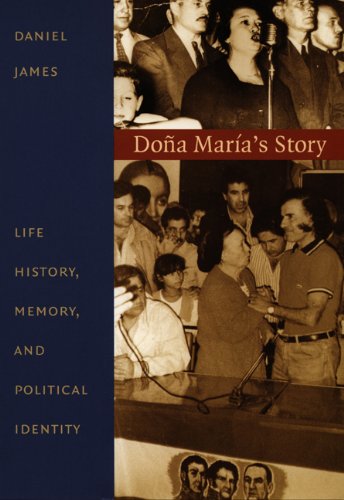
Dona Maria's Story: Life History, Memory, and Political Identity
Authors:
Daniel James
Publisher:
Duke University Press Books
Publication Date:
Not available
ISBN:
082232492X
In this remarkable book historian Daniel James presents the gripping, poignant life-story of Doña María Roldán, a woman who lived and worked for six... decades in the meatpacking community of Berisso, Argentina. A union activist and fervent supporter of Juan and Eva Perón, Doña María’s evocative testimony prompts James to analyze the promise and problematic nature of using oral sources for historical research. The book thus becomes both fascinating narrative and methodological inquiry. Doña María’s testimony is grounded in both the local context (based on the author’s thirteen years of historical and ethnographic research in Berisso) and a broader national narrative. In this way, it differs from the dominant genre of women’s testimonial literature, and much recent ethnographic work in Latin America, which have often neglected historical and communal contextualization in order to celebrate individual agency and self-construction. James examines in particular the ways that gender influences Doña María’s representation of her story. He is careful to acknowledge that oral history challenges the historian to sort through complicated sets of motivations and desires—the historian’s own wish to uncover “the truth” of an informant’s life and the interviewee’s hope to make sense of her or his past and encode it with myths of the self. This work is thus James’s effort to present his research and his relationship with Doña María with both theoretical sophistication and recognition of their mutual affection. While written by a historian, Doña María’s Story also engages with concerns drawn from such disciplines as anthropology, cultural studies, and literary criticism. It will be especially appreciated by those involved in oral, Latin American, and working-class history.
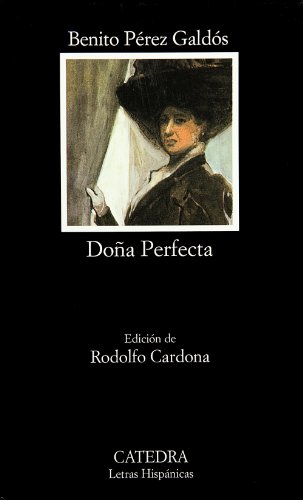
Dona Perfecta
Authors:
Perez Galdos
Publisher:
Catedra
Publication Date:
Not available
ISBN:
8437603722

Doña Perfecta
Authors:
Benito Perez Galdos
Publisher:
Stockcero
Publication Date:
Not available
ISBN:
9871136137
In Spanish, annotated edition. Witness to the devastating effect of the religious problem in Spain -more acute during the first years of the the... Bourbon Restoration (1875)- and the terrible clash between the Europeanized, liberal, egalitarian spirit and the traditionalist, provincial spirit, that opposed with ferocious fanaticism any new ideas that might challenge their cherished beliefs, Benito Perez Galdos believed that religiousness exceeded the personal questions and was tearing apart families, not to mention the entire nation. He thus set to write Doña Perfecta: a warning cry about a theocratical and mummified society in which the self-interest of the Church (Don Inocencio) caused it to work with the feudal landowners (Doña Perfecta) to stir up local political bosses and guerrilla leaders (Caballuco), who in turn lead the labradores and peasants (el tío Paso Largo, Frasquito González, José Esteban Romanero) to slaughter. If Juan Valera's Pepita Jiménez can be considered the epitome of the idealistic Spanish XIX century novel, Doña Perfecta seems to be Perez Galdos' answer or rebuttal.

Dona Perfecta & Misericordia
Authors:
Benito Perez Galdos
Publisher:
Porrua Editorial S.A. De C.V.
Publication Date:
Not available
ISBN:
9684320949
Dona Perfecta (BIBLIOTECA PEREZ GALDOS) (El Libro De Bolsillo)...
Authors:
Perez Galdos
Publisher:
Alianza
Publication Date:
Not available
ISBN:
8420638080
This volume explores the cinema of the former Soviet Union and contemporary Russia, ranging from the pre-Revolution-ary period to the present day. It... offers an insight into the development of Soviet film, from 'the most important of all arts' as a propaganda tool to a means of entertainment in the Stalin era, from the rise of its 'dissident' art-house cinema in the 1960s through the glasnost era with its broken taboos to recent Russian blockbusters. Films have been chosen to represent both the classics of Russian and Soviet cinema as well as those films that had a more localised success and remain to date part of Russia's cultural reference system. The volume also covers a range of national film industries of the former Soviet Union in chapters on the greatest films and directors of Ukrainian, Kazakh, Georgian and Armenian cinematography. Films discussed include Strike (1925), Earth (1930), Ivan's Childhood (1962), Mother and Son (1997) and Brother (1997). (Nov. 2007)
Dona Perfecta (El Libro de bolsillo) (Spanish Edition)
Authors:
Benito Perez Galdos
Publisher:
Alianza
Publication Date:
Not available
ISBN:
8420699772
While many books hype the latest fad, here at last (!) is a ?realist's' toolbox designed for public administrators who need to know the costs as well as... the benefits of managerial theories and technologies.-- Mel Dubnick, Department of Public Administration at Rutgers University and former Managing Editor of the Public Administration ReviewToday's public administrators must be more than the effective managers of their agencies' internal operations. In order to manage a complex set of interorganizational relationships spanning governments, nonprofit organizations and private firms in a complex global economy, they and their organizations must be capable of great agility and change. Effectiveness is a necessary but not sufficient condition for success: Today's public managers must reach beyond competence to be creative innovators and agents of change.This book introduces public sector professionals to a set of innovation tools: Strategic Planning, Reengineering, Total Quality Management, Benchmarking, Performance Measurement and Management, Team Management, Privatization. It shows how to understand them, use them and integrate them into any organization, and how they will take public managers beyond competence to be creative innovators.The creative public manager must continually look for new tools and new approaches. Tools for Innovators will help in this search, and in meeting and surmounting the challenges of a changing public sector.
Doña Perfecta (Spanish Edition)
Authors:
Benito Perez Galdos
Publisher:
Juan de la Cuesta
Publication Date:
Not available
ISBN:
158977017X
"Requiem per un campesino espanol" was first published under the title Mosen Millan in Coleccion Aquelarre,Mexico, 1953. The present text follows the... first Spanish edition published by Destino, Barcelona, 1974, which bears a few minor variants, mainly in paragraph structure. It has been reprinted a number of times and translated into many languages and is one of the most widely read Spanish texts in the 20th century. This edition is aimed primarily at sixth-formers and university undergraduates and the introduction and notes have been compiled in the light of recent socio-politial topic-based syllabuses and communication studies courses. The inclusion in the introduction of a substantial section on the now out-of-print "Contraataque" (1937), the wartime narrative which contains the germ of the post-war novel, is intended to provide the student with a context for the study of the process in Sender's writing inspired by the Civil War - from explicit militant propaganda penned in the heat of battle to implicit poetic parable, historical emotion recollected in the comparative tranquillity and distance of exile. It is hoped that such a juxtaposition will illuminate both the content and literary achievement of "Requiem".
Dona Rosita la soltera o El lenguaje de las flores. Los suenos de...
Authors:
Garcia Lorca
Publisher:
Alianza
Publication Date:
Not available
ISBN:
8420633569
El miembro mas conocido de la generación del 27, Garía Lorca cometió la audacia de acercarse a la literatura popular para incorporarla al proyecto... del grupo de escritores españoles que se habían dado a la tarea de fortalecer y hacer más rica la poesía y el ensayo. Romancero gitano es una particular visión de una épica y un sentimiento del pueblo más libre, más romántico y más aventurero.
Donatist Martyr Stories: The Church in Conflict in Roman North...
Authors:
Maureen A (translated & edited) Tilley
Publisher:
Liverpool University Press
Publication Date:
Not available
ISBN:
0853239312
With this volume, Donatism regains its voice and its hagiography is available in English for the first time. The stories included provide a unique... opportunity to glimpse the daily life of the church which for over a century was the faith of the majority of North African Christians. The narratives represent the lives and deaths of Christians who carried on pre-Constantine traditions from the fourth century to the advent of Islam.
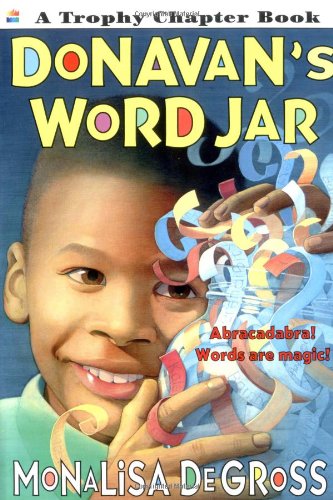
Donavan's Word Jar (Trophy Chapter Book)
Authors:
Monalisa DeGross
Publisher:
Amistad
Publication Date:
Not available
ISBN:
0064420892
Donavan is fascinated by words. They seem to leap out at him from books, signs, even the back of cereal boxes. He savors each word as he learns to say... it and discovers its meaning. He keeps the words he collects on slips of paper in a big glass jar. But one day the jar is almost full and Donavan has a dilemma. How can he make room for new words without giving up all the terrific words already in his jar? A visit to his grandmother provides the unexpected solution in this heartwarming story about how important words can be.
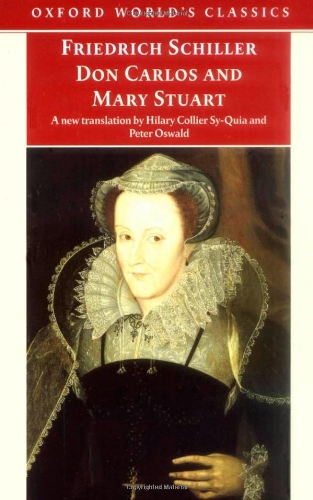
Don Carlos and Mary Stuart (Oxford World's Classics)
Authors:
Friedrich Schiller
Publisher:
Oxford University Press, USA
Publication Date:
Not available
ISBN:
0192839853
Don Carlos and Mary Stuart, two of German literature's greatest dramas, deal with the timeless issues of power, freedom, and justice. Dating from 1787... and 1800 respectively, one play was written before the French Revolution, the other in its aftermath. Both dramatize periods of crisis in sixteenth-century Europe, and in doing so reflect Schiller's passionate engagement with the great themes of his own age - justice, power, freedom of conscience, legitimacy of government. A youthful work, Don Carlos shows the victory of the forces of reaction over the representatives of a new age. Mary Stuart shows the struggle of the Scottish queen in her last days of her life, not only for her freedom, but also for peace with her conscience, and that of her English rival, Elizabeth I, with the challenge of ruling justly. A vivid imaginative experience when read, these plays, with their starkly contrasting characters and thrilling confrontations, also demonstrate Schiller's brilliant stagecraft. These new translations into blank verse are accurate, elegant, and playable.The introduction, notes, and chronology set the plays in their cultural and intellectual background, while a family tree explains the historical relationship bewteen Don Carlos and Mary Stuart.
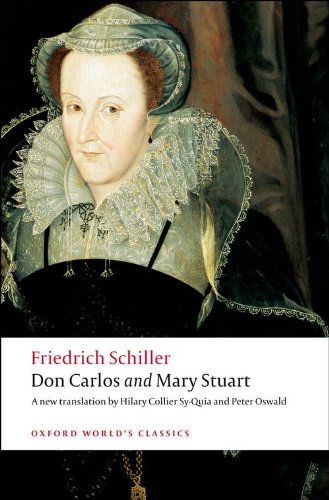
Don Carlos and Mary Stuart (Oxford World's Classics)
Authors:
Friedrich Schiller
Publisher:
Oxford University Press, USA
Publication Date:
Not available
ISBN:
0199540748
Don Carlos and Mary Stuart, two of German literature's greatest historical dramas, deal with the timeless issues of power, freedom, and justice. Dating... from 1787 and 1800 respectively, one play was written immediately before the French Revolution, the other in its aftermath. These new translations into blank verse are accurate, elegant, and playable. The Introduction, Notes, and Chronology set the plays in their cultural and intellectual background, while a family tree explains the historical relationship between Don Carlos and Mary Stuart.About the Series: For over 100 years Oxford World's Classics has made available the broadest spectrum of literature from around the globe. Each affordable volume reflects Oxford's commitment to scholarship, providing the most accurate text plus a wealth of other valuable features, including expert introductions by leading authorities, voluminous notes to clarify the text, up-to-date bibliographies for further study, and much more.
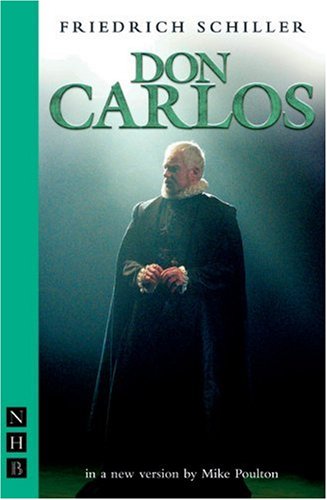
Don Carlos (Classics in Translation)
Authors:
Friedrich Schiller
Publisher:
Nick Hern Books
Publication Date:
Not available
ISBN:
1854598570
“Magnificent . . . leaves no doubt that you are watching a classic. . . . In Mike Poulton’s fleet and vivid translation . . . the story of a... tyrannical King Philip II of Spain and his abused, love-tormented son, Don Carlos, has all the deftly plotted twists and turns of a thriller. You lean forward in your seat, desperate to discover what happens next . . . an absolutely spellbinding production of a masterpiece”—Daily Telegraph
 '





