production
/viewbook/list/all/?page=3584
/
/static/
None
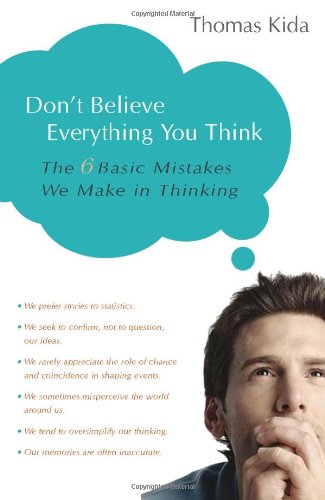
Don't Believe Everything You Think: The 6 Basic Mistakes We Make in...
Authors:
Thomas E. Kida
Publisher:
Prometheus Books
Publication Date:
Not available
ISBN:
1591024080
Kida vividly illustrates these tendencies with numerous examples that demonstrate how easily we can be fooled into believing something that isn't true.... In a complex society where success - in all facets of life - often requires the ability to evaluate the validity of many conflicting claims, the critical-thinking skills examined in this informative and engaging book will prove invaluable.
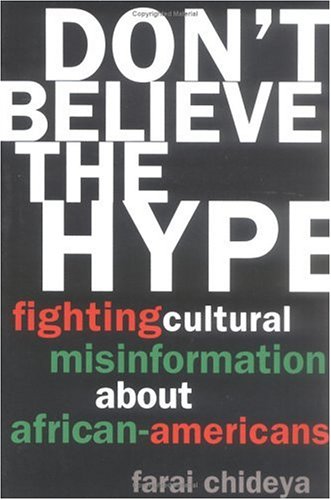
Don't Believe the Hype: Fighting Cultural Misinformation About...
Authors:
Farai Chideya
Publisher:
Plume
Publication Date:
Not available
ISBN:
0452270960
For those wishing to fight ignorance with intelligence and racism with facts, information from government sources and published studies point out... discrepancies in assumed beliefs--such as that blacks are the main welfare recipients and drug users--and major fallacies.

Don't Be Such a Scientist: Talking Substance in an Age of Style
Authors:
Randy Olson
Publisher:
Island Press
Publication Date:
Not available
ISBN:
1597265632
"You think too much! You mother F@$#%&* think too much! You're nothing but an arrogant, pointy-headed intellectual — I want you out of my... classroom and off the premises in five minutes or I'm calling the police and having you arrested for trespassing." — Hollywood acting teacher to Randy Olson, former scientist After nearly a decade on the defensive, the world of science is about to be restored to its rightful place. But is the American public really ready for science? And is the world of science ready for the American public? Scientists wear ragged clothes, forget to comb their hair, and speak in a language that even they don't understand. Or so people think. Most scientists don't care how they are perceived, but in our media-dominated age, style points count. Enter Randy Olson. Fifteen years ago, Olson bid farewell to the science world and shipped off to Hollywood ready to change the world. With films like Flock of Dodos: The Evolution-Intelligent Design Circus (Tribeca '06, Showtime) and Sizzle: A Global Warming Comedy (Outfest '08), he has tried to bridge the cultural divide that has too often left science on the outside looking in. Now, in his first book, Olson, with a Harvard Ph.D. and formerly a tenured professor of marine biology at the University of New Hampshire, recounts the lessons from his own hilarious-and at times humiliating-evolution from science professor to Hollywood filmmaker. In Don't Be Such a Scientist, he shares the secrets of talking substance in an age of style. The key, he argues, is to stay true to the facts while tapping into something more primordial, more irrational, and ultimately more human. In a book enlivened by a profane acting teacher who made Olson realize that "nobody wants to watch you think," he offers up serious insights and poignant stories. You'll laugh, you may cry, and as a communicator you'll certainly learn the importance of not only knowing how to fulfill, but also how to arouse.

Don't Bet on the Prince: Contemporary Feminist Fairy Tales in North...
Authors:
Not Available
Publisher:
Routledge
Publication Date:
Not available
ISBN:
0415902630
This anthology of feminist fairy tales and critical essays acts as an example of how the literature of fantasy and imagination can be harnessed to... create a new view of the world. It demonstrates how recent writers have changed the aesthetic constructs and social content of fairy tales to reflect cultural change since the 1960s in area of gender roles, socialization and education. It includes selected works from such writers as Angela Carter, Margaret Atwood and Jay Williams, and critical essays from Marcia Lieberman and Sandra Gilbert.
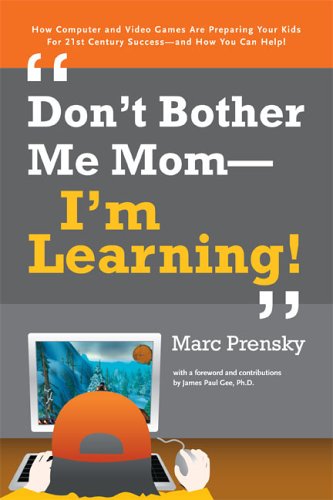
Don't Bother Me Mom--I'm Learning!
Authors:
Marc Prensky
Publisher:
Paragon House
Publication Date:
Not available
ISBN:
1557788588
The POSITIVE Guide for Parents Concerned About Their Kids' Video and Computer Game Playing"Marc knows it all depends on how we use our games. He knows... that if parents place good video games into a learning system in their homes they can reap major benefits for their children and themselves. They can accelerate their children's language and cognitive growth." —James Paul Gee, Tashia Mogridge Professor of Reading, University of Wisconsin-MadisonMarc Prensky presents the case—profoundly counter-cultural but true nevertheless—that video and computer game playing, within limits, is actually very beneficial to today's "Digital Native" kids, who are using them to prepare themselves for life in the 21st century. The reason kids are so attracted to these games, Prensky says, is that they are learning about important "future" things, from collaboration, to prudent risk taking, to strategy formulation and execution, to complex moral and ethical decisions. Prensky's arguments are backed up by university PhD's studying not just violence, but games in their totality, as well as studies of gamers who have become successful corporate workers, entrepreneurs, leaders, doctors, lawyers, scientists and other professionals.Because most adults (including the critics) can't play the modern complex games themselves (and discount the opinions of the kids who do play them) they rely on secondhand sources of information, most of whom are sadly misinformed about both the putative harm and the true benefits of game-playing. This book is the antidote to those misinformed, bombastic sources, in the press and elsewhere. Full of common sense and practical information, it provides parents with a large number of techniques approaches they can use—both over time and right away—to improve both their understanding of games and their relationships with their kids. What You Will Learn The aim of this book is to give you a peek into the hidden world into which your kids disappear when they are playing games, and to help you as an adult—especially if you are a concerned parent or teacher—understand and appreciate just how much your kids are learning that is POSITIVE from their video and computer games.In the few short hours it takes to read this book, you will learn: What it feels like to be in the world of computer and video games; How to appreciate the breadth and depth of modern computer and video games and the ways they make your kids learn; How to understand the various USEFUL skills your game-playing your kids are acquiring; How to understand your own kids better and build better relationships using games as a base; And, most importantly, How to augment and improve what your kids are learning by HAVING CONVERSATIONS THAT THEY WANT TO HAVE about their games.

Dont Call Me Boss: David L. Lawrence, Pittsburgh's Renaissance...
Authors:
Michael Weber
Publisher:
University of Pittsburgh Press
Publication Date:
Not available
ISBN:
0822953978
The death of David Leo Lawrence in 1966 ended a fifty-year career of major influence in American politics. In a front-page obituary, the New York... Times noted that Lawrence, the longtime mayor of Pittsburgh, governor of Pennsylvania, and power in Democratic national politics, disliked being called Boss. But, the Times noted, “he was one anyway.”Certainly Lawrence was a consumate politician. Born in a poor, working-class neighborhood, in the present-day Golden Triange of Pittsburgh, he was from boyhood an astute student of politics and a devoted Democrat. Paying minute attention to every detail at the ward and precinct level, he revived the moribund Democratic party of Pittsburgh and fashioned a machine that upset the long-entrenched Republican organization in 1932.When “Davy” Lawrence, as he was affectionately known, won the gubernatorial election in 1958, he became the first Roman Catholic governor of Pennsylvania and the oldest. But he achieved his greatest public recognition as mayor of Pittsburgh. Taking office in 1945, at the close of World War II, this stalwart Democrat formed an alliance with the predominantly Republican business community to bring about the much acclaimed Pittsburgh Renaissance, transforming the downtown business district and persuading many large corporations to retain their national headquarters in Pittsburgh. In 1958 the editors of Fortune magazine name Pittsburgh as one of the eight best administered cities in America.Don’t Call Me Boss examines the lengthy career of this remarkable politician. Using over one hundred interviews, as well as extensive archival material, Michael Weber demonstrates how Lawrence was able to balance his intense political drive and devotion to the Democratic party with the larger needs of his city and state. Although his administration was not free of controversy, as indicated by the city’s police and free work scandals. Lawrence showed that it was possible to make the transition from nineteenth-century political boss to modern municipal manager. He was one of the few politicians of the century to do so. When the undisputed bosses of other American cities - the Curleys, Pendergasts, and Hagues - were out of power and disgraced, Lawrence was elected governor of Pennsylvania.More than twenty years after his death, David L. Lawrence and his success in rebuilding the city of Pittsburgh continue to serve as an example of effective urban leadership.
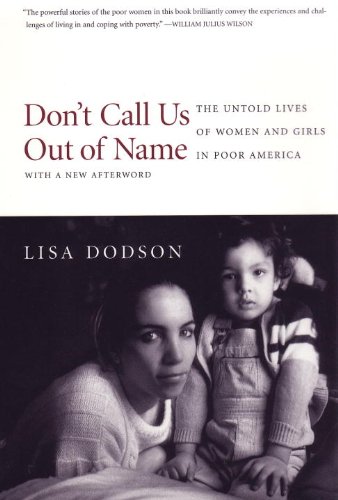
Don't Call Us Out of Name: The Untold Lives of Women and Girls in...
Authors:
Lisa Dodson
Publisher:
Beacon Press
Publication Date:
Not available
ISBN:
0807042099
A radically new vision of women and girls living below the poverty line; Lisa Dodson makes a frontal assault on conventional attitudes and stereotypes... of women in poor America and the seriously misguided "welfare reform" policies of the end of the century."I hear Odessa, a thirty-two-year-old woman, speak at a forum on welfare reform. I ask her about the phrase she used, 'Don't call me out of name,' for it seemed to speak for a whole nation of people. Odessa tells me that women who have no money and no one to stand up for them get put into a bad position and they get misnamed. Most often they get called 'welfare mothers' or 'recipients,' words she will no longer acknowledge. With millions alongside her, Odessa has emerged by her own strength and some opportunity, and now she insists upon naming herself."While Lisa Dodson was working in a Charlestown factory twenty years ago, the stories of the women she worked with daily captivated her; she listened to them speak about harsh lives and their deep commitment to family and community. It was the beginning of Dodson's desire to learn the truth and write it down.For over eight years, Dodson has been documenting the lives of girls and women-hundreds of white, African-American, Latino, Haitian, Irish, and other women in personal interviews, focus groups, surveys, and Life-History Studies. This book is a crossing--a class crossing--taking readers into fellowship with people who are seldom invited to speak but who have powerful stories to tell and who force us to abandon common myths that have been fed to us by the media about school dropouts, teen pregnancy, and welfare "cheats." Don't Call Us Out of Name delves deeply into the realities of their lives, often with surprising and uplifting stories of commonplace courage, unimaginable strength, and resourcefulness. Lisa Dodson does not simply give us the truth about women living in poverty but offers realistic hope for meaningful policy reform based on the experience and analysis of the women we have seen so far only in stereotype and whose voices we have not truly heard. These women emerge as critical contributors to the creation of sound, humane public policy.

Don't Deny My Name: Words and Music and the Black Intellectual...
Authors:
Lorenzo Thomas
Publisher:
University of Michigan Press
Publication Date:
Not available
ISBN:
047206892X
Black musical forms profoundly influenced the work of American poet and leading literary figure Lorenzo Thomas, and he wrote about them with keen... insight---and obvious pleasure. This book, begun by Thomas before his death in 2005, collects more than a dozen of his savvy yet engagingly personal essays that probe the links between African American music, literature, and popular culture, from the Harlem Renaissance to the present.Don't Deny My Name (which takes its title from a blues song by Jelly Roll Morton) begins by laying out the case that the blues is a body of literature that captured the experience of African American migrants to the urban North and newer territories to the West. The essays that follow collectively provide a tour of the movement through classic jazz, bop, and the explosions of the free jazz era, followed by a section on R&B and soul. The penultimate essay is a meditation on rap music that attempts to bring together the extremes of emotion that hip hop elicits, and the collection ends with an unfinished preface to the volume.

Don't Eat This Book: Fast Food and the Supersizing of America
Authors:
Morgan Spurlock
Publisher:
Berkley Trade
Publication Date:
Not available
ISBN:
0425210235
For thirty days, Morgan Spurlock ate nothing but McDonald’s as part of an investigation into the effects of fast food on American health. The... resulting documentary earned him an Academy Award nomination and broke box-office records worldwide. But there’s more to the story, and in Don’t Eat This Book, Spurlock examines everything from school lunch programs and the marketing of fast food to the decline of physical education. He looks at why fast food is so tasty, cheap, and ultimately seductive—and interviews experts from surgeons general and kids to marketing gurus and lawmakers, who share their research and opinions on what we can do to offset a health crisis of supersized proportions. Don’t eat this groundbreaking, hilarious book—but if you care about your country’s health, your children’s, and your own, you better read it.
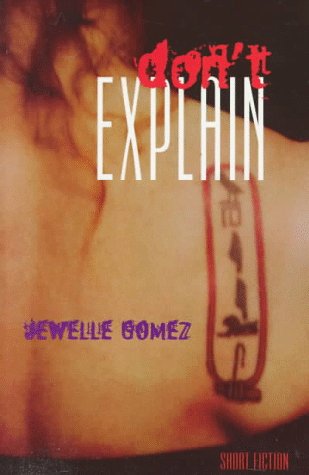
Don't Explain: Short Fiction
Authors:
Jewelle Gomez
Publisher:
Firebrand Books
Publication Date:
Not available
ISBN:
156341094X

Don't Fall Off the Bicycle: Balancing Chaos and Order in Our Lives
Authors:
Cheryl A. Chatfield
Publisher:
AuthorHouse
Publication Date:
Not available
ISBN:
1403321892
What if we accepted chaos as natural and beneficial? What if we understood order as not always desirable? Would our lives improve?In the human body, our... heart beats in a steady or orderly fashion. An irregular beat means trouble. We cannot survive without this order. Our brain, however, has a chaotic pattern. This is the opposite of how the heart behaves. Within our bodies, chaos and order exist. We usually try to quell any disruption in our daily routine. If that happened in our brain, the result would be disastrous. If both chaos and order exist in our bodies, can theycoexist in our lives?Perhaps our lives require the balance of riding a bicycle, a dynamic balance of constantly shifting weight and attention from chaos to order and back again. This book presents a way to do that.
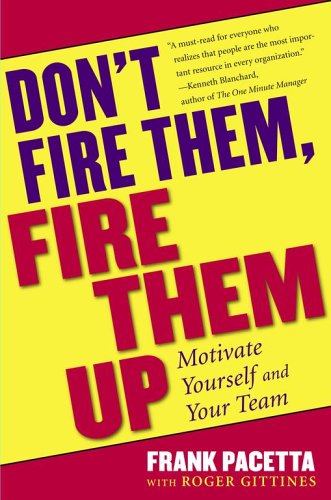
Don't Fire Them, Fire Them Up: Motivate Yourself and Your Team
Authors:
Frank Pacetta
Publisher:
Simon & Schuster
Publication Date:
Not available
ISBN:
0684800500
Don't Fire Them, Fire Them Up is a real-world story of winning in business by motivating employees in the most positive way possible -- nurturing them,... showing that you value their accomplishments, and giving them the skills and the responsibility to become winners. Frank Pacetta, the hard-working man who engineered the drastic performance turnarounds of Xerox's Cleveland and Columbos sales staffs, gives the reader the same techniques he uses to build a winning business team: * How to develop trust and create loyalty * How to generate enthusiasm and excitement * How to establish feedback and accountability * How to rebuild an organization, and then lead and energize it * How to put the organization on top and keep it there year after year This book is check-full of practical, proven tips on leadership and management, everything from motivation to communication to all the nuts and bolts of selling successfully. And Pacetta has included his Top Ten Tips (and created Ten More Top Tips), which were featured in The Wall Street Journal and which have been copied and posted on office bulletin boards across the country.

DON'T FRET THE FRETS
Authors:
Not Available
Publisher:
Not available
Publication Date:
Not available
ISBN:
Not available
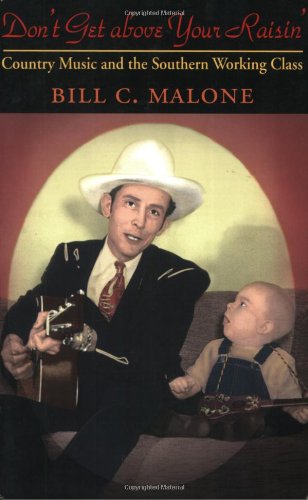
Don't Get above Your Raisin': Country Music and the Southern...
Authors:
Bill C Malone
Publisher:
University of Illinois Press
Publication Date:
Not available
ISBN:
0252073665
Combining a high-spirited history of country music's roots with vivid portraits of its primary performers, "Don't Get above Your Raisin'" examines the... close relationship between "America's truest music" and the working-class culture that has constituted its principal source, nurtured its development, and provided its most dedicated supporters. Widely recognized as country music's ranking senior authority, Bill C. Malone explores how the music's defining themes (home and family, religion, rambling, frolic, humor, and politics) have emerged out of the particularities of working people's day-to-day lives. He traces the many contradictory voices and messages of a music that simultaneously extols the virtues of home and the joys of rambling, the assurances of the Christian life and the ecstasies of hedonism, the strength of working-class life and the material lure of middle-class aspirations. The resulting tensions, Malone argues, are a major reason for the music's enduring appeal.

Don't Give Up the Ship!: Myths of the War of 1812
Authors:
Donald R. Hickey
Publisher:
University of Illinois Press
Publication Date:
Not available
ISBN:
0252074947
 '





