production
/viewbook/list/all/?page=3745
/
/static/
None
Ecology of Freshwater and Estuarine Wetlands
Authors:
Not Available
Publisher:
University of California Press
Publication Date:
Not available
ISBN:
0520247779
Designed as a textbook, this volume is an important, up-to-date, authoritative, and accessible survey in ecology of freshwater and estuarine wetlands.... Prominent wetland scholars address the physical environment, geomorphology, biogeochemistry, soils, and hydrology of both freshwater and estuarine wetlands. Careful syntheses review how hydrology and chemistry constrain wetlands plants and animals. In addition, contributors document the strategies employed by plants, animals, and bacteria to cope with stress. Focusing on the ecology of key organisms, each chapter is relevant to wetland regulation and assessment, wetland restoration, how flood pulses control the ecology of most wetland complexes, and how human regulation of flood pulses threatens wetland biotic integrity. Ideal for the classroom, this book is a fundamental resource for anyone interested in the current state of our wetlands.
Ecology of Fresh Waters: A View for the Twenty-First Century
Authors:
Brian R. Moss
Publisher:
Wiley-Blackwell
Publication Date:
Not available
ISBN:
1405113324
This new edition of an established textbook provides a comprehensive and stimulating introduction to rivers, lakes and wetlands, and was written as the... basis for a complete course on freshwater ecology. Designed for undergraduate and early postgraduate students who wish to gain an overall view of this vast subject area, this accessible guide to freshwater ecosystems and man's activities will also be invaluable to anyone interested in the integrated management of freshwaters. The author maintains the tradition of clarity and conciseness set by previous editions, and the text is extensively illustrated with photographs and diagrams. Examples are drawn from the author's experience in many parts of the world, and the author continues to stress the human influence. The scientific content of the text has been fully revised and updated, making use of the wealth of data available since publication of the last edition. Professor Brian Moss is a lecturer in Applied Ecology at the University of Liverpool, and has written three previous editions of this well-established textbook.
Ecology of Insects: Concepts and Applications
Authors:
Martin R. Speight
Publisher:
Wiley-Blackwell
Publication Date:
Not available
ISBN:
1405131144
Fully revised and updated to include new topical study areas, the second edition of the successful text the Ecology of Insects provides a balanced... treatment of the theory and practice of pure and applied insect ecology.Includes new topical areas of insect ecology and provides greater coverage of physiological, genetic, molecular, and ecosystem aspects of insect ecology Concepts include the foundations of evolutionary ecology and population dynamics in ecosystem science as they are applied to topics such as climate change, conservation and biodiversity, epidemiology and pest management Fully updated and revised throughout, this new edition refers to primary literature and real world examples.To access the artwork from the book, please visit: http://www.blackwellpublishing.com/speightinsects.
Ecology of Teleost Fishes
Authors:
R.J. Wootton
Publisher:
Springer
Publication Date:
Not available
ISBN:
041264200X
Teleost fishes account for nearly half of all known vertebrate species. They have representatives in virtually all aquatic systems and an enormous... variety in the ways they live. Moreover, teleost fishes support subsistence and commercial fisheries and aquaculture systems throughout the world. The second edition of this highly respected book retains the aims and structure of the first edition, emphasizing the responses of individual fish to their environment and the consequences of these responses for the population and community to which the individuals belong. Fully updated and rewritten, this new edition of Ecology of Teleost Fishes offers a thorough and integrated approach to the area and is essential reading for all students of fish biology and ecology, fisheries science and aquaculture. Fish biologists, fisheries scientists, ecologists and researchers in fish population studies, genetics and aquaculture will also find this book to be an invaluable reference source.
Ecology of Weeds and Invasive Plants: Relationship to Agriculture...
Authors:
Steven R. Radosevich
Publisher:
Wiley-Interscience
Publication Date:
Not available
ISBN:
0471767794
The classic reference on weeds and invasive plants has been revised and updated.The Third Edition of this authoritative reference provides an in-depth... understanding of how weeds and invasive plants develop and interact in the environment so you can manage and control them more effectively. The guide includes an introduction to weeds and invasive plants in various environments and an overview of their ecology and evolution. With extensive examples, this book: Focuses on the biological features of weeds and invasive plants, especially as they exist in agriculture, forests, rangelands, and natural ecosystems. Includes coverage of exotic invasive plants. Discusses a variety of methods and tools for managing weeds and invasive plants, including physical, cultural, biological, and chemical approaches. Examines systems approaches for management, including modern Integrated Pest Management. Addresses future challenges for scientists, farmers, and land managers.This is the definitive, hands-on reference if you're a land manager or professional in plant sciences, agronomy, weed science, and horticulture. The book is also an excellent textbook for senior undergraduate or graduate students studying agriculture, ecology, natural resources management, environmental management, or related fields.
Ecology of World Vegetation
Authors:
O.W. Archibold
Publisher:
Springer
Publication Date:
Not available
ISBN:
0412443007
This striking book provides a handy summary of the ecology of the world's vegetation. The introductory chapters provide a basic back-drop to the... subject. The subsequent chapters examine sequentially the form and function of each major biome throughout the world.
Ecology on Campus
Authors:
Robert Kingsolver
Publisher:
Benjamin Cummings
Publication Date:
Not available
ISBN:
0805382143
Key Benefit: This flexible laboratory manual contains nearly 60 exercises involving small-scale ecological systems that can be conducted within a... weekly lab period right on campus, regardless of weather or resources available. Each chapter explains a fundamental concept, and then gives three separate hands-on exercises that can involve outdoor observation and measurements on campus, laboratory systems, library research, biological collections, or computer resources. Additionally, calculation pages accompanying each lab walk readers through standard mathematical modeling or statistical tools commonly used by ecologists to address the question at hand, building readers' quantitative and critical thinking skills. All calculations and statistical analyses can be completed by readers using simple calculators. Key Topics: PREFACE: TEACHING AND LEARNING ECOLOGY IN A CAMPUS ENVIRONMENT, DESCRIBING A POPULATION, ALLOMETRIC RELATIONSHIPS, ESTIMATING POPULATION SIZE, POPULATION GROWTH, DEMOGRAPHY, POPULATION GENETICS, SPATIAL DISTRIBUTION OF POPULATIONS, THE NICHE, THE CONCEPT OF THE COMMUNITY, COMPETITION,PREDATION AND PARASITISM, MUTUALISM, BIODIVERSITY, ECOLOGICAL SUCCESSION, PHYSICAL AND CHEMICAL ATTRIBUTES OF SOILS, AQUATIC SYSTEMS, ENERGY FLOW, ISLAND BIOGEOGRAPHY Market Description: For those interested in learning the basics of ecology on campus
Ecology: Principles and Applications
Authors:
J. L. Chapman
Publisher:
Cambridge University Press
Publication Date:
Not available
ISBN:
0521588022
Ecology: Principles and Applications is a comprehensive textbook for A-level students and first-year undergraduates taking courses in biology, geography... and Earth sciences, who require an introduction to ecology. Studies of human ecology are integrated into the text, and the links to related disciplines are emphasised. The text begins with the ecology of individual organisms and moves on, through communities and ecosystems, to global considerations of biogeography, co-evolution and conservation. Case histories, historical perspectives, controversial theories and extension material are highlighted throughout the book. The second edition has been brought up to date with current syllabuses by the addition of further material on the key issue of conservation, giving excellent coverage of the principles of conservation and using case studies to provide examples of conservation policies in practice. The authors are experienced teachers of ecology at sixth form and undergraduate level.
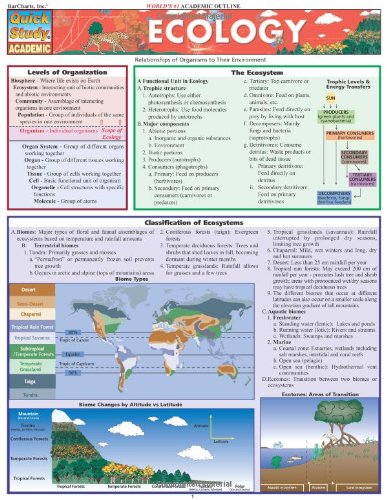
Ecology (Quickstudy: Academic)
Authors:
Inc. BarCharts
Publisher:
QuickStudy
Publication Date:
Not available
ISBN:
1572228733
Covers the study of relationships of organisms to their environment. Great for students in biology at any level, general or physical science, or any... science that includes life and geographic relationships. 6-page laminated guide includes: • levels of organization • the ecosystem • classification of ecosystems • stability of ecosystems • energy flow in ecosystems • energy capture in an ecosystem • food chains & webs • nutrient cycling in ecosystems • limiting factors & the environment • population dynamics in communities • community structure
Ecology (Second Edition)
Authors:
Carolyn Merchant
Publisher:
Humanity Books
Publication Date:
Not available
ISBN:
1591025788
As we survey the negative effects of modernism - environmental destruction, the net consumption of irreplaceable natural resources, the ever-widening... gulf between first and third worlds - we are forced to grapple with the consequences of the domination of nature by human beings. Clearly, for the earth and its people to survive, new ways of thinking about the human relationship to nature are needed. The readings gathered in this popular reader join these issues with critical theory to examine the ongoing struggle to rediscover the nature within human beings and to reconnect it with external nature. A critical theory of the environment offers both an analysis of current problems of the domination of people and nature and ways of attaining sustainability in the future. Distinguished environmental scholar Carolyn Merchant has brought together some of the foremost environmental thinkers of the twenty-first century. They present new philosophies, theories of justice, spiritual relations, and scientific thought. This second edition contains new material on globalisation, natural capitalism, the ecofeminist and environmental justice movements, feminist green socialism, conservation and third world peoples, and the ecology of order and chaos, while retaining many of the most provocative selections from the first edition. The conclusion presents the 'Principles of Environmental Justice', adopted by the First National People of Colour Environmental Leadership Summit. Scholars, teachers, and anyone concerned about the future of the planet will find in this excellent collection an array of new directions, ideas, and possibilities for healing the wounds of the past.
Ecology: The Experimental Analysis of Distribution and Abundance...
Authors:
Charles J. Krebs
Publisher:
Benjamin Cummings
Publication Date:
Not available
ISBN:
0321507436
This best-selling majors-level book, by Charles Krebs, approaches ecology as a series of problems, which are best understood by evaluating... empirical evidence through data analysis and application of quantitative reasoning. No otherbook presents analytical, quantitative, and statistical ecological information in an equally accessible style for students. Reflecting the way ecologists actually practice, the new edition emphasizes the role of experiments in testing ecological ideas and discusses many contemporary and controversial problems related to distribution and abundance. Introduction to the Science of Ecology, Evolution and Ecology, Behavioral Ecology, Analyzing Geographic Distributions,Factors That Limit Distributions I: Biotic, Factors That Limit Distributions II: Abiotic, Distribution and Abundance, Population Parameters and Demographic Techniques, Population Growth, Species Interactions I: Competition, Species Interactions II: Predation, Species Interactions III: Herbivory and Mutualism, Species Interactions IV: Disease and Parasitism, Regulation of Population Size, Applied Problems I: Harvesting Populations, Applied Problems II: Pest Control, Applied Problems III: Conservation Biology, Community Structure, Community Dynamics I: Biodiversity, Community Dynamics II: Predation and Competition, Community Dynamics III: Nonequilibrium Communities, Ecosystem Metabolism I: Primary Production, Ecosystem Metabolism II: Secondary Production, Ecosystem Metabolism III: Nutrient Cycles, Ecosystem Dynamics under Changing Climates, Ecosystem Health: Human Impacts. Intended for those interested in learning the basics of ecology
Ecology w/bind in OLC card
Authors:
Manuel C Molles
Publisher:
McGraw-Hill Science/Engineering/Math
Publication Date:
Not available
ISBN:
0072951710
This introductory general ecology text features a strong emphasis on helping students grasp the main concepts of ecology while keeping the presentation... more applied than theoretical. An evolutionary perspective forms the foundation of the entire discussion. The book begins with the natural history of the planet, considers portions of the whole in the middle chapters, and ends with another perspective of the entire planet in the concluding chapter. It's unique organization of focusing only on several key concepts in each chapter sets it apart from the competition.

ECOLOGY W/ CONNECT PLUS ]CUSTOM[
Authors:
Not Available
Publisher:
Not available
Publication Date:
Not available
ISBN:
Not available
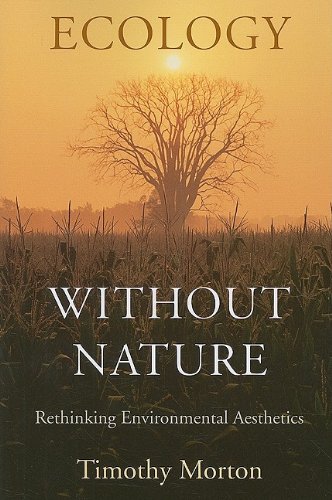
Ecology without Nature: Rethinking Environmental Aesthetics
Authors:
Timothy Morton
Publisher:
Harvard University Press
Publication Date:
Not available
ISBN:
0674034856
In Ecology without Nature, Timothy Morton argues that the chief stumbling block to environmental thinking is the image of nature itself. Ecological... writers propose a new worldview, but their very zeal to preserve the natural world leads them away from the "nature" they revere. The problem is a symptom of the ecological catastrophe in which we are living. Morton sets out a seeming paradox: to have a properly ecological view, we must relinquish the idea of nature once and for all. Ecology without Nature investigates our ecological assumptions in a way that is provocative and deeply engaging. Ranging widely in eighteenth-century through contemporary philosophy, culture, and history, he explores the value of art in imagining environmental projects for the future. Morton develops a fresh vocabulary for reading "environmentality" in artistic form as well as content, and traces the contexts of ecological constructs through the history of capitalism. From John Clare to John Cage, from Kierkegaard to Kristeva, from The Lord of the Rings to electronic life forms, Ecology without Nature widens our view of ecological criticism, and deepens our understanding of ecology itself. Instead of trying to use an idea of nature to heal what society has damaged, Morton sets out a radical new form of ecological criticism: "dark ecology."
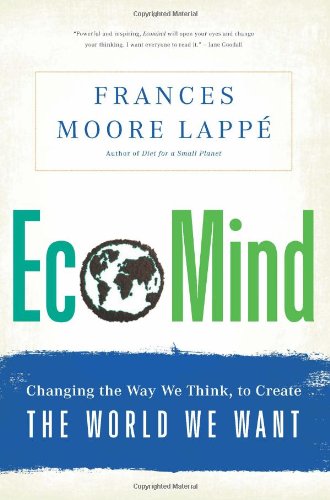
EcoMind: Changing the Way We Think, to Create the World We Want
Authors:
Frances Moore Lappe
Publisher:
Nation Books
Publication Date:
Not available
ISBN:
1568586833
In EcoMind, Frances Moore Lappéa giant of the environmental movementconfronts accepted wisdom of environmentalism. Drawing on the latest research... from anthropology to neuroscience and her own field experience, she argues that the biggest challenge to human survival isn’t our fossil fuel dependency, melting glaciers, or other calamities. Rather, it’s our faulty way of thinking about these environmental crises that robs us of power. Lappé dismantles seven common thought traps”from limits to growth to the failings of democracy that belie what we now know about nature, including our own, and offers contrasting thought leaps” that reveal our hidden power. Like her Diet for a Small Planet classic, EcoMind is challenging, controversial and empowering.
 '





