production
/viewbook/list/all/?page=3807
/
/static/
None

EDUCATION NORTH CAROLINA STATE CUSTOM POD Ed: 1ST
Authors:
Not Available
Publisher:
Not available
Publication Date:
Not available
ISBN:
Not available
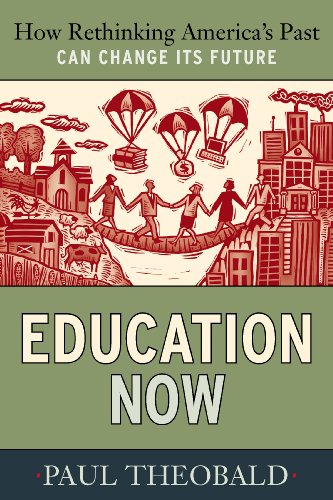
Education Now: How Rethinking America's Past Can Change Its Future
Authors:
Paul Theobald
Publisher:
Paradigm Publishers
Publication Date:
Not available
ISBN:
1594516243
Education Now is a clear and persuasive account of the way in which popular seventeenth- and eighteenth-century theories about the human condition... formed the basis for America s choices in the realms of politics, economics, and education. Theobald chronicles the fate of alternative, less popular ideas about the human condition ideas that would have led to vastly different political, economic, and educational landscapes than those we experience today. This book exposes the flaws among prevalent theories and the strength of those alternatives that were dismissed or ignored. In so doing, Theobald points the way toward substantive changes across three dimensions ubiquitous to human life: politics, economics, and education.
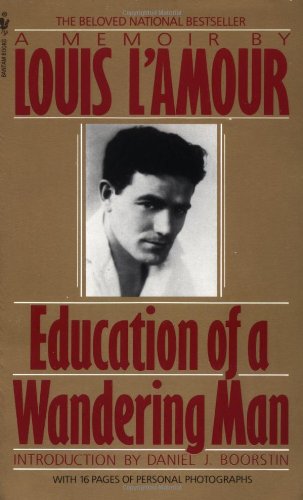
Education of a Wandering Man
Authors:
Louis L'Amour
Publisher:
Bantam
Publication Date:
Not available
ISBN:
0553286528
From his decision to leave school at fifteen to roam the world, to his recollections of life as a hobo on the Southern Pacific Railroad, as a cattle... skinner in Texas, as a merchant seaman in Singapore and the West Indies, and as an itinerant bare-knuckled prizefighter across small-town America, here is Louis L'Amour's memoir of his lifelong love affair with learning--from books, from yondering, and from some remarkable men and women--that shaped him as a storyteller and as a man. Like classic L'Amour fiction, Education of a Wandering Man mixes authentic frontier drama--such as the author's desperate efforts to survive a sudden two-day trek across the blazing Mojave desert--with true-life characters like Shanghai waterfront toughs, desert prospectors, and cowboys whom Louis L'Amour met while traveling the globe. At last, in his own words, this is a story of a one-of-a-kind life lived to the fullest . . . a life that inspired the books that will forever enable us to relive our glorious frontier heritage.

EDUCATION OF A WHITE PARENT
Authors:
Not Available
Publisher:
Levellers Press
Publication Date:
Not available
ISBN:
193714612X
Soon after enrolling her older son in a Boston public elementary school, Susan Naimark began to see that opportunities offered to her kids were often... unavailable to their classmates of color. In The Education of a White Parent Naimark candidly describes her sometimes faltering efforts to create change in the school system, tracing what turns out to be the gradual transformation of a dismayed parent into a parent leader, school board member, and advocate for equal opportunities for all students. She acknowledges that the problem of racial privilege is overwhelmingly complex and freighted with awkwardness and frustration, but she asserts with humble confidence that it is not intractable. Alongside compelling stories about her experiences, Naimark discusses numerous national studies, identifying the pattern of inequities in public schools and some signs of progress. In a clear, conversational tone, Naimark shares what she has learned about navigating school bureaucracies, collaborating across race, and achieving results that benefit all kids.
Education of Exceptional Learners
Authors:
Frank M. Hewett
Publisher:
Allyn & Bacon
Publication Date:
Not available
ISBN:
0205057292
"Waters's elegant language suggests that there is grace to be found in facing and speaking of our sorrows. . . . His use of humor creates a tension... between the profane and the sublime."—Arts & Letters Among the survivors of the DonnerParty—idiom's black sense of humor—Who developed a secret taste for fleshFlaked between the fluted bones of the wrist? In his tenth poetry collection, Michael Waters tackles the dual (and dueling) natures of our humanity: sin and transgression, isolation and atrocity, love and darkness, and the desire for a language that can illuminate such ordinary yet disturbing spaces.
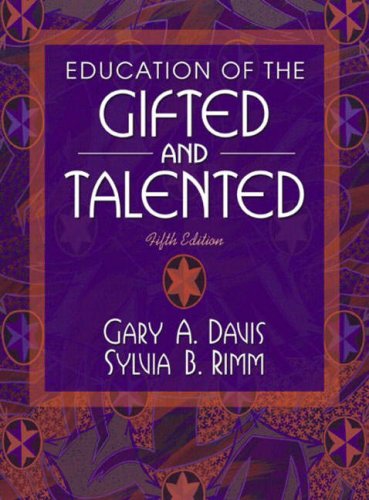
Education of the Gifted and Talented (5th Edition)
Authors:
Gary A. Davis
Publisher:
Allyn & Bacon
Publication Date:
Not available
ISBN:
0205388507
This comprehensive text by leaders in the field presents the best practices in gifted education. After a brief overview of current issues in the field,... Education of the Gifted and Talented discusses the characteristics of gifted students as well as challenges of parenting and the understanding and counseling of gifted children. The authors address crucial topics in the field, including strategies for identifying gifted students, considerations in planning a sound gifted and talented program, contemporary program models, problems of minority, disabled and female students, and the evaluation of gifted programs.
Education of the Gifted and Talented (6th Edition)
Authors:
Gary A. Davis
Publisher:
Pearson
Publication Date:
Not available
ISBN:
0135056071
This top-selling comprehensive book, written by leaders in the field, presents a thorough review of the entire field of gifted education with... best-practices. After a brief overview of current issues in the field, the book discusses crucial topics in the field, including the characteristics of gifted students, strategies for identification, considerations in planning sound gifted and talented programs, contemporary program models, varieties of acceleration, differentiated curriculum models, problems of underachievement of disadvantaged, twice-exceptional, and female gifted students, and the evaluation of gifted programs. The authors also address affective needs, leadership, and counseling. A chapter on parenting gifted children includes a section on advocating for gifted education and communication with schools. The sixth edition has been thoroughly revised, most notably with the latest research on acceleration, curriculum models, underachievement, culturally and economically disadvantaged students, gender issues, and dual exceptionalities. The content is further supported and enhanced by the inclusion of numerous practical strategies that can be implemented in the classroom, case studies that help teachers identify student needs, summaries of research on effective programs, emphasis on pedagogy and on social-emotional needs, heightened awareness of less visible sub-groups within gifted populations, and an amusing, witty writing style that adds to the appeal of this best-selling book.
Education of the Senses: The Bourgeois Experience, Victoria to...
Authors:
Peter Gay
Publisher:
W. W. Norton & Company, Inc.
Publication Date:
Not available
ISBN:
0393319040
In this work, Peter Gay draws on an array of primary sources to re-examine 19th-century sexual behaviour, overturning a number of stereotypes,... especially about women and sexuality.
EDUCATION PENN STATE BERKS CUSTOM BOOK
Authors:
Not Available
Publisher:
Not available
Publication Date:
Not available
ISBN:
Not available
Education-Pluralistic Society, EDFI 4080, Bowling Green State...
Authors:
Not Available
Publisher:
Create/McGraw Hill
Publication Date:
Not available
ISBN:
0390309850
EDUCATION PLYMOUTH STATE UNIVERSITY
Authors:
Not Available
Publisher:
Not available
Publication Date:
Not available
ISBN:
Not available
Education Policy: Globalization, Citizenship and Democracy
Authors:
Mark Olssen
Publisher:
Sage Publications Ltd
Publication Date:
Not available
ISBN:
0761974709
`Education policy is now a global matter and all the more complex for that. Mark Olssen, John Codd and Ann-Marie O'Neill do us an invaluable service in... producing a carefully theorised guide to current issues and key concerns - this is an important, erudite and very practical book' - Stephen J Ball, Education Policy Research Unit, University of London `Given the global reach of neoliberal policies, we need cogent books that enable us to better understand the major effects such tendencies have. Education Policy is such a book. It is insightful and well written--and should be read by all of us who care deeply about what is happening in education in international contexts' - Michael W Apple, Author of 'Educating the "Right" Way and John Bascom Professor of Education University of Wisconsin, Madison `I really am taken with the book, the range and depth of analysis are truly impressive. This book is a magnum opus and everyone in the area should read it'- Hugh Lauder, University of Bath `In their insightful and comprehensive book on education policy Mark Olssen, John Codd and Anne-Marie O'Neill wrestle with the big questions of citizenship and democracy in an age of globalization. They argue that ducation policy in the 21st century is the key to security, sustainability and survival. The book, anchored in the poststructuralist perspective of Michel Foucault, traverses the whole territory of education policy not only methods and approaches of policy analysis and the dominant political perspectives that influence policy-classical liberalism, social democracy and neo-liberalism--but also those policy areas that require the closest scrutiny: markets, trust, professionalism, choice, diversity, and finally, community, citizenship and democracy. This is the new policy bible for educationalists - it is at once systematic, provocative and instructive' - Michael A Peters, Research Professor, University of Glasgow This book provides an international perspective on education policy, and of the role and function of education in the global economy. The authors present a Foucauldian perspective on the politics of liberal education, within a theoretical framework necessary for the critical analysis of education policy. The authors set out the analyses necessary for understanding the restructuring in education and social policy that has occurred in many countries affected by the resurgence of neo-liberal political theory. They examine education policy in relation to globalization, citizenship and democracy. The authors argue that globalization is an extension of neoliberalism and is destructive of the nation state, community and democracy. They show the importance of education in building strong democratic nation states and global communities based on cultural identity and inter-cultural awareness. This book is essential reading for students of education policy studies and social policy analysis.
EDUCATION (RDG 413) SHIPPENSBURG UNIVERSITY
Authors:
Not Available
Publisher:
Not available
Publication Date:
Not available
ISBN:
Not available
Education Reform and the Limits of Policy: Lessons from Michigan
Authors:
Micheal F. Addonizio
Publisher:
W.E. Upjohn Institute
Publication Date:
Not available
ISBN:
0880993871
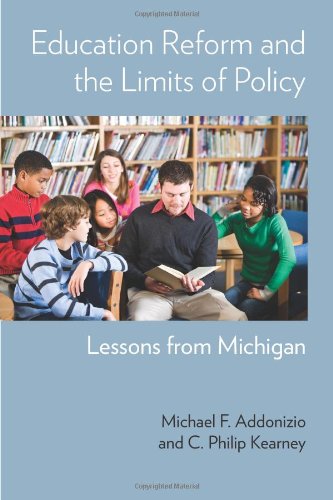
During the last 20 years, the United States has experienced more attempts at education reform than at any other time in its history. Efforts to reform... financing, the assessment of student performance, accountability and equity, and school choice have all been implemented with varying levels of success. Michael F. Addonizio and C. Philip Kearney use Michigan as a laboratory to examine a set of commonly implemented reforms in an attempt to answer three key questions: 1) What is the nature of these reforms? 2) What do they hope to accomplish? and 3) How successful have they been? The authors begin by examining one of the most contentious issues facing education money and schools. Does more money make schools better? They review existing evidence on the link between money and schools and then examine financing reforms resulting from the passage in 1994 of Michigan s Proposal A. Next, they examine accountability systems for Michigan s schools and whether they meet the federal directives of No Child Left Behind. Related to the issue of accountability are the key assessment programs i.e., the Michigan Educational Assessment Program (MEAP) and the National Assessment of Educational Progress (NAEP) that are used to measure academic achievement and how Michigan students performance ranks compared to students in other states. Addonizio and Kearney also address the growing trend of school choice, in terms of the options parents have to select charter schools for their children to attend or to send them out-of-district via a school of choice program. Charters are a fast-growing movement that, as the authors point out, present somewhat mixed hopes for the future. They also identify the benefits and potential pitfalls of the school of choice program. Finally, possibly no other school district in the country has suffered the decline that the Detroit Public Schools have. The authors discuss the many reasons for the district s problems, efforts including state oversight to right the ship, and where they see the district headed as it adapts to the splintering of the city s neighborhoods and the loss of population to the suburbs. The book concludes with a discussion of what has been gleaned from the successes and failures of various reform efforts and, based on the authors observations and analysis, their thoughts and ideas for the future of education reform.

Education Reform in Japan: A Case of Immobilist Politics (Nissan...
Authors:
Leonard James Schoppa
Publisher:
Routledge
Publication Date:
Not available
ISBN:
0415096006
The Japanese education system, while widely praised in western countries, is subject to heavy criticism within Japan. Education Reform in Japan analyses... this criticism, and explains why proposed reforms have failed. The author shows how the Japanese policy-making process can become paralysed when there is disagreement, and argues that this `immobilism' can affect other areas of Japanese policy-making.
 '





