production
/viewbook/list/all/?page=3838
/
/static/
None
Einhard Vita Karoli Magni
Authors:
Einhard
Publisher:
Bryn Mawr Commentaries
Publication Date:
Not available
ISBN:
092952439X

Ein Kutzweilig Lesen Von Dil Ulenspiegel (German Edition)
Authors:
Not Available
Publisher:
Philipp Reclam Jun Verlag GmbH
Publication Date:
Not available
ISBN:
3150016878
Dieses Werk ist Teil der Buchreihe TREDITION CLASSICS. tredition veröffentlicht mit den TREDITION CLASSICS Werke aus zwei Jahrtausenden, die zu einem... Großteil vergriffen oder nur noch antiquarisch erhältlich sind, wieder als gedruckte Bücher. Mit den TREDITION CLASSICS verfolgt tredition das Ziel, 100.000 Klassiker der Weltliteratur verschiedener Sprachen wieder als gedruckte Bücher in den Buchhandel zu bringen - und das weltweit! Die Inhalte für die Buchreihe erhält tredition von größtenteils gemeinnützigen Literaturprojekten, deren Arbeit finanziell aus Buchverkäufen unterstützt wird.

Einmal Hans mit scharfer Soße
Authors:
Hatice Akyün
Publisher:
Goldmann Wilhelm GmbH
Publication Date:
Not available
ISBN:
3442154391

Ein Mann Zuviel (Easy Reader Series Level 1) (German Edition)
Authors:
Mendelssohn Felix
Publisher:
Langenscheidt Pub Inc
Publication Date:
Not available
ISBN:
3468496826
A fast-paced mystery for beginning German students featuring Berlin-based private detective Helmut Müller. A death threat, heroin traffic, and a... picture unknowingly taken by a visiting Hamburg journalist involve Müller in one of his most dangerous escapades yet. Level one difficulty.

Ein springender Brunnen.
Authors:
Martin Walser
Publisher:
Suhrkamp
Publication Date:
Not available
ISBN:
3518396005
Montauk ist ein indianischer Name, er bezeichnet die nördliche Spitze von Long Island, hundertzehn Meilen von Manhattan entfernt; dort findet das... Wochenende statt, das erzählt wird.
Einstein and Our World, Second Edition (Control of Nature)
Authors:
David C. Cassidy
Publisher:
Humanity Books
Publication Date:
Not available
ISBN:
1591022568
While most available works on Einstein trace the origins and evolution of Einstein's views and theories, "Einstein and Our World", by award-winning... science historian, educator, and Einstein scholar David C Cassidy, provides a fascinating account of the impact of Einstein's work and outlook upon contemporary culture and upon the scientific enterprise itself. This new edition, besides updating and revising the content of the first edition, includes a number of important new topics that could not be included in the original edition: more on Einstein's personal life in the light of recent revelations; a new section on Einstein and peace; and an assessment of Einstein's role in the post-September 11 era.

Einstein and Religion: Physics and Theology
Authors:
Max Jammer
Publisher:
Princeton University Press
Publication Date:
Not available
ISBN:
069110297X
The philosophy of religion and the quest for spiritual truth preoccupied Albert Einstein--so much that it has been said "one might suspect he was a... disguised theologian." Nevertheless, the literature on the life and work of Einstein, extensive as it is, does not provide an adequate account of his religious conception and sentiments. Only fragmentarily known, Einstein's ideas about religion have been often distorted both by atheists and by religious groups eager to claim him as one of their own. But what exactly was Einstein's religious credo? In this fascinating book, the distinguished physicist and philosopher Max Jammer offers an unbiased and well-documented answer to this question.The book begins with a discussion of Einstein's childhood religious education and the religious atmosphere--or its absence--among his family and friends. It then reconstructs, step by step, the intellectual development that led Einstein to the conceptions of a cosmic religion and an impersonal God, akin to "the God of Spinoza." Jammer explores Einstein's writings and lectures on religion and its role in society, and how far they have been accepted by the general public and by professional theologians like Paul Tillich or Frederick Ferré. He also analyzes the precise meaning of Einstein's famous dictum "Science without religion is lame, religion without science is blind," and why this statement can serve as an epitome of Einstein's philosophy of religion. The last chapter deals with the controversial question of whether Einstein's scientific work, and in particular his theory of relativity, has theologically significant implications, a problem important for those who are interested in the relation between science and religion. Both thought-provoking and engaging, this book aims to introduce readers, without proselytizing, to Einstein's religion.
Einstein: His Life and Universe
Authors:
Walter Isaacson
Publisher:
Simon & Schuster
Publication Date:
Not available
ISBN:
0743264746
By the author of the acclaimed bestseller Benjamin Franklin, this is the first full biography of Albert Einstein since all of his papers have become... available. How did his mind work? What made him a genius? Isaacson's biography shows how his scientific imagination sprang from the rebellious nature of his personality. His fascinating story is a testament to the connection between creativity and freedom. Based on newly released personal letters of Einstein, this book explores how an imaginative, impertinent patent clerk -- a struggling father in a difficult marriage who couldn't get a teaching job or a doctorate -- became the mind reader of the creator of the cosmos, the locksmith of the mysteries of the atom and the universe. His success came from questioning conventional wisdom and marveling at mysteries that struck others as mundane. This led him to embrace a morality and politics based on respect for free minds, free spirits, and free individuals. These traits are just as vital for this new century of globalization, in which our success will depend on our creativity, as they were for the beginning of the last century, when Einstein helped usher in the modern age.
Einstein Never Used Flashcards: How Our Children Really Learn--and...
Authors:
Roberta Michnick Golinkoff
Publisher:
Rodale Books
Publication Date:
Not available
ISBN:
1594860688
Now Available in Paperback!In this book two highly credentialed child psychologists offer a compelling indictment of the growing trend toward... accelerated learning. It's a message that stressed-out parents are craving to hear: Letting tots learn through play is not only okay-it's better than drilling academics!Drawing on overwhelming scientific evidence from their own studies and the collective research results of child development experts, and addressing the key areas of development-math, reading, verbal communication, science, self-awareness, and social skills-the authors explain the process of learning from a child's point of view. They then offer parents 40 age-appropriate games for creative play. These simple, fun--yet powerful exercises work as well or better than expensive high-tech gadgets to teach a child what his ever-active, playful mind is craving to learn.
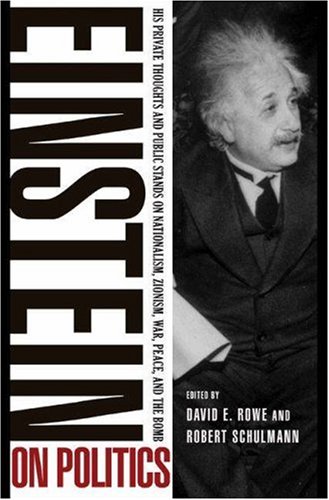
Einstein on Politics: His Private Thoughts and Public Stands on...
Authors:
Not Available
Publisher:
Princeton University Press
Publication Date:
Not available
ISBN:
0691120943
The most famous scientist of the twentieth century, Albert Einstein was also one of the century's most outspoken political activists. Deeply engaged... with the events of his tumultuous times, from the two world wars and the Holocaust, to the atomic bomb and the Cold War, to the effort to establish a Jewish homeland, Einstein was a remarkably prolific political writer, someone who took courageous and often unpopular stands against nationalism, militarism, anti-Semitism, racism, and McCarthyism. In Einstein on Politics, leading Einstein scholars David Rowe and Robert Schulmann gather Einstein's most important public and private political writings and put them into historical context. The book reveals a little-known Einstein--not the ineffectual and naïve idealist of popular imagination, but a principled, shrewd pragmatist whose stands on political issues reflected the depth of his humanity.Nothing encapsulates Einstein's profound involvement in twentieth-century politics like the atomic bomb. Here we read the former militant pacifist's 1939 letter to President Franklin D. Roosevelt warning that Germany might try to develop an atomic bomb. But the book also documents how Einstein tried to explain this action to Japanese pacifists after the United States used atomic weapons to destroy Hiroshima and Nagasaki, events that spurred Einstein to call for international control of nuclear technology.A vivid firsthand view of how one of the twentieth century's greatest minds responded to the greatest political challenges of his day, Einstein on Politics will forever change our picture of Einstein's public activism and private motivations.ON PACIFISM"When those who are bound together by pacifist ideals hold a meeting they are always consorting with their own kind only. They are like sheep huddled together while the wolves wait outside. I think pacifist speakers have this difficulty: they usually reach their own crowd, who are pacifists already. The sheep's voice does not get beyond this circle and therefore is ineffective. . . . Real pacifists, those who are not up in the clouds but who think and count realities, must fearlessly try to do things of practical value to the cause and not merely speak about pacifism. Deeds are needed. Mere words do not get pacifists anywhere."--Two Percent Speech, New York, 1930ON HITLER"Hitler appeared, a man with limited intellectual abilities and unfit for any useful work, bursting with envy and bitterness against all whom circumstance and nature had favored over him. Springing from the lower middle class, he had just enough class conceit to hate even the working class which was struggling for greater equality in living standards. But it was the culture and education which had been denied him forever that he hated most of all. In his desperate ambition for power he discovered that his speeches, confused and pervaded with hate as they were, received wild acclaim by those whose situa-tion and orientation resembled his own. He picked up this human flotsam on the streets and in the taverns and organized them around himself. This is the way he launched his political career."--On Hitler, 1935ON ZIONISM"Just one more personal word on the question of partition. I should much rath-er see reasonable agreement with the Arabs on the basis of living together in peace than the creation of a Jewish state. Apart from practical consideration, my awareness of the essential nature of Judaism resists the idea of a Jewish state with borders, an army, and a measure of temporal power no matter how modest. I am afraid of the inner damage Judaism will sustain--especially from the development of a narrow nationalism within our own ranks, against which we have already had to fight strongly, even without a Jewish state."-- Our Debt to Zionism, 1938ON MILITARISM"I must frankly confess that the foreign policy of the United States since the termination of hostilities has reminded me, sometimes irresistibly, of the attitude of Germany under Kaiser Wilhelm II. . . . It is characteristic of the military mentality that non-human factors (atom bombs, strategic bases, weapons of all sorts, the possession of raw materials, etc.) are held essential, while the human being, his desires and thought--in short, the psychological factors--are considered as unimportant and secondary. . . . The general inse-curity that goes hand in hand with this results in the sacrifice of the citizen's civil rights to the supposed welfare of the state. Political witch-hunting, controls of all sorts (e.g., control of teaching and research, of the press, and so forth) appear inevitable, and for this reason do not encounter that popular resistance, which, were it not for the military mentality, would provide a protection."--The Military Mentality, 1947

Einstein on Race and Racism
Authors:
Prof. Fred Jerome
Publisher:
Rutgers University Press
Publication Date:
Not available
ISBN:
0813539528
Nearly fifty years after his death, Albert Einstein remains one of America’s foremost cultural icons. A thicket of materials, ranging from scholarly... to popular, have been written, compiled, produced, and published about his life and his teachings. Among the ocean of Einsteinia—scientific monographs, biographies, anthologies, bibliographies, calendars, postcards, posters, and Hollywood films—however, there is a peculiar void when it comes to the connection that the brilliant scientist had with the African American community. Virtually nowhere is there any mention of his relationship with Paul Robeson, despite Einstein’s close friendship with him, or W.E.B. Du Bois, despite Einstein’s support for him. This unique book is the first to bring together a wealth of writings by Einstein on the topic of race. Although his activism in this area is less well known than his efforts on behalf of international peace and scientific cooperation, he spoke out vigorously against racism both in the United States and around the world. Combining the scientist’s letters, speeches, and articles with an engaging narrative that places his public statements in the context of his life and times, this important collection not only brings attention to Einstein’s antiracist public activities, but also provides insight into antiracist struggles in America.

Einstein, Picasso: Space, Time, and the Beauty That Causes Havoc
Authors:
Arthur I. Miller
Publisher:
Basic Books
Publication Date:
Not available
ISBN:
0465018602
The most important scientist of the twentieth century and the most important artist had their periods of greatest creativity almost simultaneously and... in remarkably similar circumstances. This fascinating parallel biography of Albert Einstein and Pablo Picasso as young men examines their greatest creations-Picasso's Les Demoiselles d'Avignon and Einstein's special theory of relativity. Miller shows how these breakthroughs arose not only from within their respective fields but from larger currents in the intellectual culture of the times. Ultimately, Miller shows how Einstein and Picasso, in a deep and important sense, were both working on the same problem.
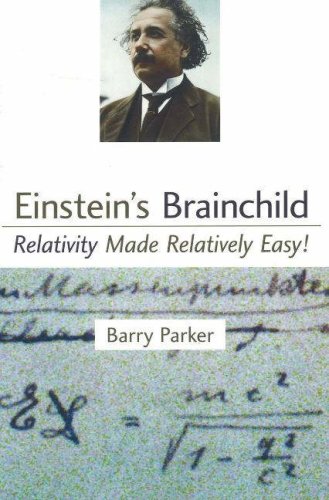
Einstein's Brainchild: Relativity Made Relatively Easy!
Authors:
Barry R. Parker
Publisher:
Prometheus Books
Publication Date:
Not available
ISBN:
1591025222
Through his eloquence, eye for detail, and clever use of Einsteinian cartoons and vivid illustrations, physicist and popular science writer Barry Parker... enables the reader to see and appreciate for perhaps the first time, the full meaning of Einstein's Special and General Theory of Relativity, black holes, curved spacetime, and the possibility of time travel. Parker's incomparable gift for language captures Einstein's singular brilliance and stunning theories. The clarity of the writing coupled with the many illustrations will drive home the point why so many consider Einstein to be the greatest scientist who ever lived and "Time" magazine named Albert Einstein 'Person of the Century'.
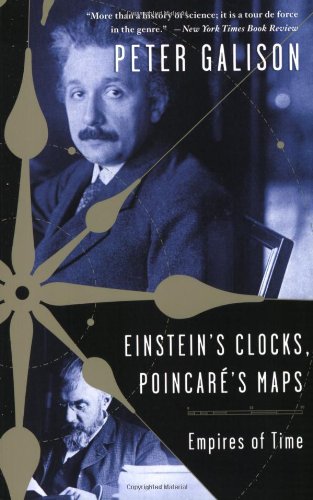
Einstein's Clocks, Poincare's Maps: Empires of Time
Authors:
Peter Galison
Publisher:
W. W. Norton & Company
Publication Date:
Not available
ISBN:
0393326047
"More than a history of science; it is a tour de force in the genre."—New York Times Book ReviewA dramatic new account of the parallel quests to... harness time that culminated in the revolutionary science of relativity, Einstein's Clocks, Poincaré's Maps is "part history, part science, part adventure, part biography, part meditation on the meaning of modernity....In Galison's telling of science, the meters and wires and epoxy and solder come alive as characters, along with physicists, engineers, technicians and others....Galison has unearthed fascinating material" (New York Times). Clocks and trains, telegraphs and colonial conquest: the challenges of the late nineteenth century were an indispensable real-world background to the enormous theoretical breakthrough of relativity. And two giants at the foundations of modern science were converging, step-by-step, on the answer: Albert Einstein, an young, obscure German physicist experimenting with measuring time using telegraph networks and with the coordination of clocks at train stations; and the renowned mathematician Henri Poincaré, president of the French Bureau of Longitude, mapping time coordinates across continents. Each found that to understand the newly global world, he had to determine whether there existed a pure time in which simultaneity was absolute or whether time was relative. Esteemed historian of science Peter Galison has culled new information from rarely seen photographs, forgotten patents, and unexplored archives to tell the fascinating story of two scientists whose concrete, professional preoccupations engaged them in a silent race toward a theory that would conquer the empire of time. 40 b/w illustrations
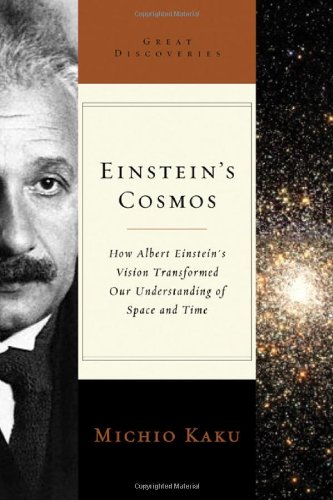
Einstein's Cosmos: How Albert Einstein's Vision Transformed Our...
Authors:
Michio Kaku
Publisher:
W. W. Norton & Company
Publication Date:
Not available
ISBN:
0393327000
In paperback for the centenary of the discovery of relativity, "a fresh and highly visual tour through Einstein's astonishing legacy" (Brian... Greene).The year 2005 marks the 100th anniversary of the publication of the paper that launched Einstein's career, made E=mc2 famous, and ushered in a revolution in science—the paper that announced the theory of special relativity. And there's no better short book that explains just what Einstein did than Einstein's Cosmos. Keying Einstein's crucial discoveries to the simple mental images that inspired them, Michio Kaku finds a revealing new way to discuss these ideas, and delivers an appealing and always accessible introduction to Einstein's work.
 '





