production
/viewbook/list/all/?page=3863
/
/static/
None
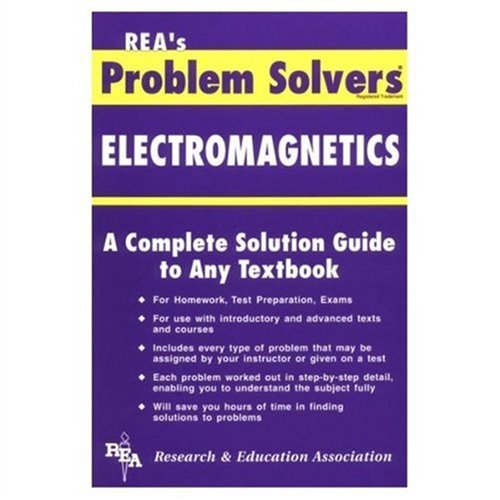
Electromagnetics Problem Solver (Problem Solvers Solution Guides)
Authors:
Editors of REA
Publisher:
Research & Education Association
Publication Date:
Not available
ISBN:
0878915508
Each Problem Solver is an insightful and essential study and solution guide chock-full of clear, concise problem-solving gems. All your questions can be... found in one convenient source from one of the most trusted names in reference solution guides. More useful, more practical, and more informative, these study aids are the best review books and textbook companions available. Nothing remotely as comprehensive or as helpful exists in their subject anywhere. Perfect for undergraduate and graduate studies.Here in this highly useful reference is the finest overview of electromagnetics currently available, with hundreds of electromagnetics problems that cover everything from dielectrics and magnetic fields to plane waves and transmission lines. Each problem is clearly solved with step-by-step detailed solutions.DETAILS- The PROBLEM SOLVERS are unique - the ultimate in study guides.- They are ideal for helping students cope with the toughest subjects.- They greatly simplify study and learning tasks.- They enable students to come to grips with difficult problems by showing them the way, step-by-step, toward solving problems. As a result, they save hours of frustration and time spent on groping for answers and understanding.- They cover material ranging from the elementary to the advanced in each subject.- They work exceptionally well with any text in its field.- PROBLEM SOLVERS are available in 41 subjects.- Each PROBLEM SOLVER is prepared by supremely knowledgeable experts.- Most are over 1000 pages.- PROBLEM SOLVERS are not meant to be read cover to cover. They offer whatever may be needed at a given time. An excellent index helps to locate specific problems rapidly.TABLE OF CONTENTSIntroductionSECTION IChapter 1: Vector AnalysisScalars and VectorsGradient, Divergence, and CurlLine, Surface, and Volume IntegralsStoke's TheoremChapter 2: Electric ChargesCharge Densities and DistributionsCoulomb's LawElectric FieldChapter 3: Electric Field IntensityElectric FluxGauss's LawChargesChapter 4: PotentialWorkPotentialPotential and GradientMotion in Electric FieldEnergyChapter 5: DielectricsCurrent DensityResistancePolarizationBoundary ConditionsDielectricsChapter 6: CapacitanceCapacitanceParallel Plate CapacitorsCoaxial and Concentric CapacitorsMultiple Dielectric Capacitors, Series and Parallel CombinationsPotentialStored Energy and Force in CapacitorsChapter 7: Poisson's and Laplace EquationsLaplace's EquationPoisson's EquationIteration MethodImagesChapter 8: Steady Magnetic FieldsBiot-Savart's LawAmpere's LawMagnetic Flux and Flux DensityVector Magnetic PotentialH-FieldChapter 9: Forces in Steady Magnetic FieldsForces on Moving ChargesForces on Differential Current ElementsForces on Conductors Carrying CurrentsMagnetizationMagnetic Boundary ConditionsPotential Energy of Magnetic FieldsChapter 10: Magnetic CircuitsReluctance and PermeanceDetermination of Ampere-TurnsFlux Produced by a Given mmfSelf and Mutual InductanceForce and Torque in Magnetic CircuitsChapter 11: Time - Varying Fields and Maxwell's EquationsFaraday's LawMaxwell's EquationsDisplacement CurrentGeneratorsChapter 12: Plane WavesEnergy and the Poynting VectorNormal IncidenceBoundary ConditionsPlane Waves in Conducting Dielectric MediaPlane Waves in Free SpacePlane Waves and Current DensityChapter 13: Transmission LinesEquations of Transmission LinesInput ImpedancesSmith ChartMatchingReflection CoefficientChapter 14: Wave Guides and AntennasCutoff Frequencies for TE and TM ModesPropagation and Attenuation ConstantsField Components in Wave-GuidesAbsorbed and Transmitted PowerCharacteristics of AntennasRadiated and Absorbed Power of AntennasSECTION II - Summary of Electromagnetic Propagation in Conducting MediaII-1 Basic Equations and TheoremsMaxwell's EquationAuxiliary PotentialsHarmonic Time VariationParticular Solutions for an Unbounded Homogenous Region with SourcesPoynting VectorReciprocity TheoremBoundary ConditionsUniqueness TheoremsTM and TE Field AnalysisII-2 Plane WavesUniform Plane WavesNonuniform Plane WavesReflection and Refraction at a Plane SurfaceRefraction in a Conducting MediumSurface WavesPlane Waves in Layered MediaImpedance Boundary ConditionsPropogation into a conductor with a Rough SurfaceII-3 Electromagnetic Field of Dipole SourcesInfinite Homogenous Conducting MediumSemi-Infinite Homogenous Conducting MediumStatic Electric DipoleHarmonic Dipole SourcesFar FieldNear FieldQuasi-Static FieldLayered Conducting Half SpaceII-4 Electromagnetic Field of Long Line Sources and Finite Length Electric AntennasInfinite Homogenous Conducting MediumLong Line SourceFinite Length Electric AntennaSemi-Infinite Homogenous Conducting MediumLong Line SourceFinite Length Electric AntennaLayered Conducting Half SpaceLong Line SourceFinite Length Electric AntennaAppendixParameters of Conducting MediaDipole Approximation ScatteringAntenna ImpedanceELF and VLF Atmospheric NoiseIndexWHAT THIS BOOK IS FORStudents have generally found electromagnetics a difficult subject to understand and learn. Despite the publication of hundreds of textbooks in this field, each one intended to provide an improvement over previous textbooks, students of electromagnetics continue to remain perplexed as a result of numerous subject areas that must be remembered and correlated when solving problems. Various interpretations of electromagnetics terms also contribute to the difficulties of mastering the subject.In a study of electromagnetics, REA found the following basic reasons underlying the inherent difficulties of electromagnetics:No systematic rules of analysis were ever developed to follow in a step-by-step manner to solve typically encountered problems. This results from numerous different conditions and principles involved in a problem which leads to many possible different solution methods. To prescribe a set of rules for each of the possible variations would involve an enormous number of additional steps, making this task more burdensome than solving the problem directly due to the expectation of much trial and error.Current textbooks normally explain a given principle in a few pages written by an electromagnetics professional who has insight into the subject matter not shared by others. These explanations are often written in an abstract manner that causes confusion as to the principle's use and application. Explanations then are often not sufficiently detailed or extensive enough to make the reader aware of the wide range of applications and different aspects of the principle being studied. The numerous possible variations of principles and their applications are usually not discussed, and it is left to the reader to discover this while doing exercises. Accordingly, the average student is expected to rediscover that which has long been established and practiced, but not always published or adequately explained.The examples typically following the explanation of a topic are too few in number and too simple to enable the student to obtain a thorough grasp of the involved principles. The explanations do not provide sufficient basis to solve problems that may be assigned for homework or given on examinations.Poorly solved examples such as these can be presented in abbreviated form which leaves out much explanatory material between steps, and as a result requires the reader to figure out the missing information. This leaves the reader with an impression that the problems and even the subject are hard to learn - completely the opposite of what an example is supposed to do.Poor examples are often worded in a confusing or obscure way. They might not state the nature of the problem or they present a solution, which appears to have no direct relation to the problem. These problems usually offer an overly general discussion - never revealing how or what is to be solved.Many examples do not include accompanying diagrams or graphs, denying the reader the exposure necessary for drawing good diagrams and graphs. Such practice only strengthens understanding by simplifying and organizing electromagnetics processes.Students can learn the subject only by doing the exercises themselves and reviewing them in class, obtaining experience in applying the principles with their different ramifications.In doing the exercises by themselves, students find that they are required to devote considerable more time to electromagnetics than to other subjects, because they are uncertain with regard to the selection and application of the theorems and principles involved. It is also often necessary for students to discover those "tricks" not revealed in their texts (or review books) that make it possible to solve problems easily. Students must usually resort to methods of trial and error to discover these "tricks," therefore finding out that they may sometimes spend several hours to solve a single problem.When reviewing the exercises in classrooms, instructors usually request students to take turns in writing solutions on the boards and explaining them to the class. Students often find it difficult to explain in a manner that holds the interest of the class, and enables the remaining students to follow the material written on the boards. The remaining students in the class are thus too occupied with copying the material off the boards to follow the professor's expla...
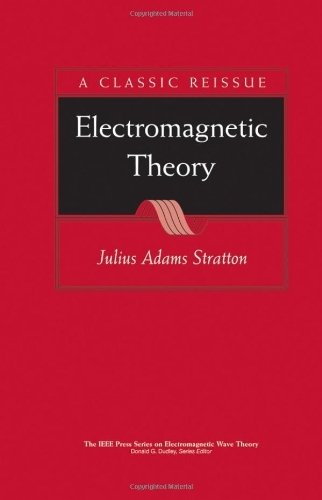
Electromagnetic Theory (IEEE Press Series on Electromagnetic Wave...
Authors:
Julius Adams Stratton
Publisher:
Wiley-IEEE Press
Publication Date:
Not available
ISBN:
0470131535
This book is an electromagnetics classic. Originally published in 1941, it has been used by many generations of students, teachers, and researchers ever... since. Since it is classic electromagnetics, every chapter continues to be referenced to this day.This classic reissue contains the entire, original edition first published in 1941. Additionally, two new forewords by Dr. Paul E. Gray (former MIT President and colleague of Dr. Stratton) and another by Dr. Donald G. Dudley, Editor of the IEEE Press Series on E/M Waves on the significance of the book's contribution to the field of Electromagnetics.
Electromagnetic Vibrations, Waves, and Radiation
Authors:
George Bekefi
Publisher:
The MIT Press
Publication Date:
Not available
ISBN:
0262520478
This text was developed over a five-year period during which its authors were teaching the subject. It is the culmination of successful editions of... class notes and preliminary texts prepared for their one-semester course at MIT designed for sophomores majoring in physics but taken by students from other departments as well.The book describes the features that vibrations and waves of all sorts have in common and includes examples of mechanical, acoustical, and optical manifestations of these phenomena that unite various parts of physics. The main emphasis, however, is on the oscillatory aspects of the electromagnetic field -- that is, on the vibrations, waves, radiation, and the interaction of electromagnetic waves with matter. The content is designed primarily for the use of second or third year students of physics who have had a semester of mechanics and a semester of electricity and magnetism. The aim throughout is to provide a mathematically unsophisticated treatment of the subject, but one that stresses modern applications of the principles involved. Descriptions of devices that embody such principles -- such as seismometers, magnetrons, thermo-nuclear fusion experimental configurations, and lasers -- are introduced at appropriate points in the text to illustrate the theoretical concepts. Many illustrations from astrophysics are also included.
Electromagnetic Wave Propagation, Radiation, and Scattering
Authors:
Akira Ishimaru
Publisher:
Prentice Hall
Publication Date:
Not available
ISBN:
0132490536
Electromagnetic Waves
Authors:
Umran S. Inan
Publisher:
Prentice Hall
Publication Date:
Not available
ISBN:
0201361795
Demonstrates how electromagnetic concepts are important to modern electrical engineering applications. Detailed examples, selected application... examples, abundant illustrations, and numerous end-of-chapter problems emphasizing practical applications. For electrical engineers interested in electromagnetics.
Electromagnetic Waves
Authors:
David H. Staelin
Publisher:
Prentice Hall
Publication Date:
Not available
ISBN:
0132258714
This introduction to electromagnetic waves emphasizes concepts, examples, and problem-solving techniques having wide applicability, and relies only... on basic physics and mathematics — rather than electrostatics, magnetostatics, and quasitatics. The focus is on generic problem-solving techniques — both mathematical and physically-intuitive, and the presentation of basic electromagnetic theorems — Poynting, energy, uniqueness, and reciprocity — explained from a physical perspective. Progresses from simple wave propagation in unbounded free space to antenna and resonator design. Presents the fundamental concepts of plane waves, phasors, polarization, energy, power, and force early — and repeatedly applies them throughout the text to problems with progressively more complex boundary conditions. For students and practicing engineers interested in electromagnetic wave phenomena.
Electromagnetism
Authors:
Gerald Pollack
Publisher:
Addison-Wesley
Publication Date:
Not available
ISBN:
0805385673
Electromagnetism sets a new standard in physics education. Throughout the book, the theory is illustrated with real-life applications in modern... technology. It also includes detailed work examples and step-by-step explanations to help readers develop their problem-solving strategies and skills and consolidate their understanding. In addition to a meticulous development of thse traditional, analytical mathematical approaches, readers are also introduced to a range of techniques required for solving problems using computers. Electromagnetism provides an ideal preparation for readers who plan advanced studies in electrodynamics as well as those moving into industry or engineering .
Electromagnetism, 2E
Authors:
I. S. Grant
Publisher:
Wiley
Publication Date:
Not available
ISBN:
0471927120
The Manchester Physics Series General Editors: D. J. Sandiford; F. Mandl; A. C. Phillips Department of Physics and Astronomy, University of Manchester... Properties of Matter B. H. Flowers and E. Mendoza Optics Second Edition F. G. Smith and J. H. Thomson Statistical Physics Second Edition F. Mandl Electromagnetism Second Edition I. S. Grant and W. R. Phillips Statistics R. J. Barlow Solid State Physics Second Edition J. R. Hook and H. E. Hall Quantum Mechanics F. Mandl Particle Physics Second Edition B. R. Martin and G. Shaw the Physics of Stars Second Edition A. C. Phillips Computing for Scientists R. J. Barlow and A. R. Barnett Electromagnetism, Second Edition is suitable for a first course in electromagnetism, whilst also covering many topics frequently encountered in later courses. The material has been carefully arranged and allows for flexi-bility in its use for courses of different length and structure. A knowledge of calculus and an elementary knowledge of vectors is assumed, but the mathematical properties of the differential vector operators are described in sufficient detail for an introductory course, and their physical significance in the context of electromagnetism is emphasised. In this Second Edition the authors give a fuller treatment of circuit analysis and include a discussion of the dispersion of electromagnetic waves. Electromagnetism, Second Edition features:The application of the laws of electromagnetism to practical problems such as the behaviour of antennas, transmission lines and transformers.Sets of problems at the end of each chapter to help student understanding, with hints and solutions to the problems given at the end of the book.Optional "starred" sections containing more specialised and advanced material for the more ambitious reader.An Appendix with a thorough discussion of electromagnetic standards and units.Recommended by many institutions. Electromagnetism. Second Edition has also been adopted by the Open University as the course book for its third level course on electromagnetism.
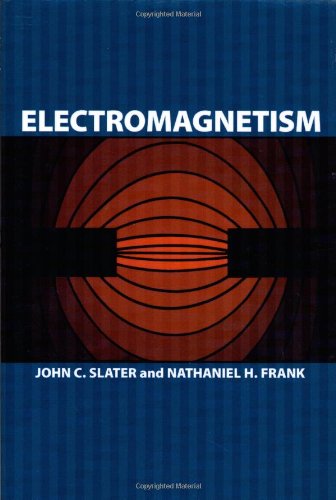
Electromagnetism (Dover Books on Physics)
Authors:
John C. Slater
Publisher:
Dover Publications
Publication Date:
Not available
ISBN:
0486622630
This basic introduction to electromagnetism by two famous physicist supplies the fundamentals of electrostatics and magnetostatics and offers a... thorough investigation of electromagnetic theory. Numerous problems and references appear at the end of each chapter. Prerequisites include a background in calculus and differential equations. Helpful appendixes develop more advanced mathematics. 1947 edition.
Electromechanical Energy Devices and Power Systems
Authors:
Zia A. Yamayee
Publisher:
Wiley
Publication Date:
Not available
ISBN:
0471572179
A thorough and understandable treatment of the topic, it introduces different energy sources and various electric energy conversion techniques. Presents... an overview of the electric power system and its components. Reviews circuit and power concepts in electrical circuits. Covers magnetic circuits and transformers, fundamentals of rotating machines, theory and application of three-phase and single-phase induction motors, different power flow solution methods, the abnormal operating conditions of power systems including fault studies, system protection and power system stability. Contains scores of problems, examples, illustrations and diagrams.

ELECTROMECH ENERGY CONVERSION (FALL 2011)
Authors:
Not Available
Publisher:
Not available
Publication Date:
Not available
ISBN:
Not available
ELECTROMECH ENERGY CONVERSION (REVISED FALL 2009)(EE 381)
Authors:
Not Available
Publisher:
Not available
Publication Date:
Not available
ISBN:
Not available

Electron Beam Analysis of Materials
Authors:
Michael Loretto
Publisher:
Chapman & Hall
Publication Date:
Not available
ISBN:
0412477904
The second edition of Electron Beam Analysis of Materials provides a concise and up-to-date overview of the most widely used electron beam ... instruments and techniques of microstructural analysis available today.

Electron Flow in Organic Chemistry
Authors:
Paul H. Scudder
Publisher:
Wiley
Publication Date:
Not available
ISBN:
0471613819
With the goal of helping students develop a good intuition for organic chemistry, it approaches the material from a mechanistic viewpoint. Presents... twenty electron flow pathways as the building blocks of all the common mechanistic processes. Thus, students deal with a smaller number of reactant classes instead of studying each reaction as a separate case. Uses physical models such as energy surfaces to aid the decision-making process; includes a unique chapter that teaches students how to make a multivariable decision; and contains advanced explanations using interaction diagrams and molecular orbital theory.
Electronic and Computer Music
Authors:
Peter Manning
Publisher:
Oxford University Press, USA
Publication Date:
Not available
ISBN:
0195170857
In this revised and expanded third edition of the classic text on the history and evolution of electronic and computer music, Peter Manning provides the... definitive account of the medium from its birth to the present day.After explaining the antecedents of electronic music from the turn of the century to the Second World War, Manning discusses the emergence of early "classical" studios of the 1950s. He goes on to chronicle the upsurge of creative activity during the 1960s and 70s in the analog domain, as well as with live electronic music and the early use of electronics in rock and pop music. This edition contains new information about software innovations, digital media and the essential features of digital and audio control, the MIDI synthesizer and its many derivatives, and the evolution of computer workstations and multimedia personal computers.Manning offers a critical perspective of the medium both in terms of its musical output and the philosophical and technical features that have shaped its growth. Emphasizing the functional characteristics of emerging technologies and their influence on the creative development of the medium, Manning covers key developments in both commercial and the non-commercial sectors to provide readers with the most comprehensive resource available on this ever-evolving subject.
 '





