production
/viewbook/list/all/?page=3867
/
/static/
None
Electronic Health Records and Nursing and Online Student Resources...
Authors:
Richard Gartee
Publisher:
Prentice Hall
Publication Date:
Not available
ISBN:
0132885522
For use in any nursing course that covers electronic health records, in universities, community colleges, and private nursing schools offering... associate or baccalaureate nursing degrees; as well as in LPN/LVN programs. Also for nursing informatics students who have not yet used EHRs; and for licensed nurses learning EHR technology in continuing education settings. This is the complete “learn by doing” text for every nurse and nursing student who must use an electronic health records system. In support of federal mandates and the profession’s commitment to transition to EHR systems, this book thoroughly explains both EHR tasks and functional benefits, integrating EHR history, theory, and benefits with hands-on opportunities to experience actual EHR environments. Reflecting current EHR rules, regulations, and innovations, it contains comprehensive guided and critical thinking exercises utilizing actual EHR software, standardized EHR nomenclature, and the Nursing Process. To gain a firm foundation of understanding, students apply EHR in inpatient and outpatient nursing, home care, nursing home, pediatric, hypertension clinic, and other practice settings. This text also contains a full chapter on electronic nursing care plans. Visit this demo link to learn more about the companion software for this product and how to use it. Click here to view demo.
Electronic Health Records for Allied Health Careers w/Student CD-ROM
Authors:
Susan Sanderson
Publisher:
McGraw-Hill
Publication Date:
Not available
ISBN:
0073309788
Technology is changing the qualifications required to perform both clinical and administrative allied health duties. Students entering the job market... today must be familiar with the ways in which technology is used to perform on-the-job tasks. In particular, the understanding of electronic health records is essential. This text integrates the presentation of concepts with the opportunity to gain hands-on experience working with a simulated EHR software, Practice Partner. The subject matter is presented in a logical order, proceeding from introductory material to coverage of specific features and functions of EHRs. After describing the need for EHRs, the text explains the basic purpose and content of an EHR system. With that knowledge in place, the subject moves to the topic of the information technology used in EHR systems. The need to ensure the privacy and security of the information in an EHR is emphasized.
Electronic Health Records, Fourth Edition
Authors:
Margret K. Amatayakul
Publisher:
American Health Information Management Association
Publication Date:
Not available
ISBN:
1584262192
Electronic Health Records, Second Edition
Authors:
Jerome H. Carter
Publisher:
American College of Physicians
Publication Date:
Not available
ISBN:
1930513976
The leading resource for evaluating, purchasing, implementing, and using an electronic health records (EHR) system, this fully revised new edition... continues to help even the most technology challenged reader master key concepts. Electronic Health Records, Second Edition is a user-friendly guide, presenting information in a clear and precise manner, providing readers with a solid understanding of what electronic health records are and do. This new edition features a new section on implementation planning, new chapters on decision support, informatics standards, and project management, clear advice on evaluating and selecting systems, and easy to use tables, diagrams, and figures which allow for easy access to information. Divided into two major sections, the first section of the book serves as a tutorial on technological, business, and legal aspects of EHRs. Using a hands-on workbook approach, the second section focuses on the implementation and management of the EHR system. Also included is the latest information on resources, websites, services, and vendors. Written by authors with extensive EHR implementation experience, Electronic Health Records, Second Edition is the most practical and authoritative guide to understanding the many different aspects of an EHR system.
Electronic Health Records: Understanding and Using Computerized...
Authors:
Richard Gartee
Publisher:
Prentice Hall
Publication Date:
Not available
ISBN:
013261927X
This package contains the book and the access code card for MyHealthProfessionsKit.com. Students will need access to the MyKit in order to download... the Medcin EHR software to complete the exercises in the book. ELECTRONIC HEALTH RECORDS: UNDERSTANDING AND USING COMPUTERIZED MEDICAL RECORDS, 2/e is the complete “learn by doing” text for everyone who must use an electronic health records system, including doctors, nurses, medical assistants, physician assistants, and other medical office staff. It provides a thorough understanding of EHR tasks and functional benefits that is continuously reinforced by actual EHR experiences. Updated to reflect the latest EHR rules, regulations, and innovations, this new edition also contains 50% more hands-on guided and critical thinking exercises utilizing real EHR software. Improvements also include a full chapter on electronic orders and results; new workflow examples; shorter chapters that more easily accommodate 12-week courses; and a revised, clarified discussion of E&M billing codes.
Electronic Health Records: Understanding and Using Computerized...
Authors:
Richard Gartee
Publisher:
Prentice Hall
Publication Date:
Not available
ISBN:
0132499762
ELECTRONIC HEALTH RECORDS: UNDERSTANDING AND USING COMPUTERIZED MEDICAL RECORDS, 2/e is the complete “learn by doing” text for everyone who... must use an electronic health records system, including doctors, nurses, medical assistants, physician assistants, and other medical office staff. It provides a thorough understanding of EHR tasks and functional benefits that is continuously reinforced by actual EHR experiences. Updated to reflect the latest EHR rules, regulations, and innovations, this new edition also contains 50% more hands-on guided and critical thinking exercises utilizing real EHR software. Improvements also include a full chapter on electronic orders and results; new workflow examples; shorter chapters that more easily accommodate 12-week courses; and a revised, clarified discussion of E&M billing codes. Visit this demo link to learn more about this product and how to use it: http://www.pearsonhighered.com/garteedemo/

Electronic Health Records (W/Cd Only)
Authors:
Not Available
Publisher:
Not available
Publication Date:
Not available
ISBN:
Not available
Electronic Hearth: Creating an American Television Culture
Authors:
Cecelia Tichi
Publisher:
Oxford University Press, USA
Publication Date:
Not available
ISBN:
0195079140
We all talk about the "tube" or "box," as if television were simply another appliance like the refrigerator or toaster oven. But Cecilia Tichi argues... that TV is actually an environment--a pervasive screen-world that saturates almost every aspect of modern life. In Electronic Hearth, she looks at how that environment evolved, and how it, in turn, has shaped the American experience. Tichi explores almost fifty years of writing about television--in novels, cartoons, journalism, advertising, and critical books and articles--to define the role of television in the American consciousness. She examines early TV advertising to show how the industry tried to position the new device as not just a gadget but a prestigious new piece of furniture, a highly prized addition to the home. The television set, she writes, has emerged as a new electronic hearth--the center of family activity. John Updike described this "primitive appeal of the hearth" in Roger's Version: "Television is--its irresistible charm--a fire. Entering an empty room, we turn it on, and a talking face flares into being." Sitting in front of the TV, Americans exist in a safety zone, free from the hostility and violence of the outside world. She also discusses long-standing suspicions of TV viewing: its often solitary, almost autoerotic character, its supposed numbing of the minds and imagination of children, and assertions that watching television drugs the minds of Americans. Television has been seen as treacherous territory for public figures, from generals to presidents, where satire and broadcast journalism often deflate their authority. And the print culture of journalism and book publishing has waged a decades-long war of survival against it--only to see new TV generations embrace both the box and the book as a part of their cultural world. In today's culture, she writes, we have become "teleconscious"--seeing, for example, real life being certified through television ("as seen on TV"), and television constantly ratified through its universal presence in art, movies, music, comic strips, fabric prints, and even references to TV on TV. Ranging far beyond the bounds of the broadcast industry, Tichi provides a history of contemporary American culture, a culture defined by the television environment. Intensively researched and insightfully written, The Electronic Hearth offers a new understanding of a critical, but much-maligned, aspect of modern life.
Electronic Imaging in Astronomy: Detectors and Instrumentation...
Authors:
Ian S. McLean
Publisher:
Springer
Publication Date:
Not available
ISBN:
3642095321
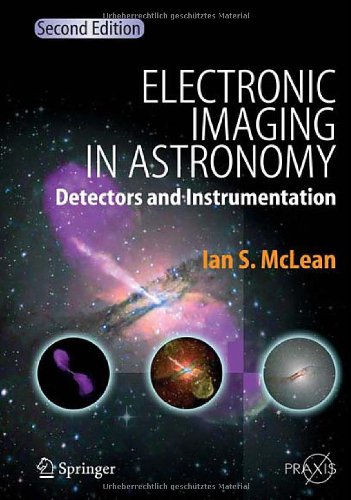
The second edition of Electronic Imaging in Astronomy: Detectors and Instrumentation describes the remarkable developments that have taken place in... astronomical detectors and instrumentation in recent years – from the invention of the charge-coupled device (CCD) in 1970 to the current era of very large telescopes, such as the Keck 10-meter telescopes in Hawaii with their laser guide-star adaptive optics which rival the image quality of the Hubble Space Telescope. Authored by one of the world’s foremost experts on the design and development of electronic imaging systems for astronomy, this book has been written on several levels to appeal to a broad readership. Mathematical expositions are designed to encourage a wider audience, especially among the growing community of amateur astronomers with small telescopes with CCD cameras. The book can be used at the college level for an introductory course on modern astronomical detectors and instruments, and as a supplement for a practical or laboratory class.
Electronic Imaging in Astronomy: Detectors and Instrumentation...
Authors:
Ian S. McLean
Publisher:
Springer
Publication Date:
Not available
ISBN:
3540765824
The second edition of Electronic Imaging in Astronomy: Detectors and Instrumentation describes the remarkable developments that have taken place in... astronomical detectors and instrumentation in recent years – from the invention of the charge-coupled device (CCD) in 1970 to the current era of very large telescopes, such as the Keck 10-meter telescopes in Hawaii with their laser guide-star adaptive optics which rival the image quality of the Hubble Space Telescope. Authored by one of the world’s foremost experts on the design and development of electronic imaging systems for astronomy, this book has been written on several levels to appeal to a broad readership. Mathematical expositions are designed to encourage a wider audience, especially among the growing community of amateur astronomers with small telescopes with CCD cameras. The book can be used at the college level for an introductory course on modern astronomical detectors and instruments, and as a supplement for a practical or laboratory class.
Electronic Legal Research: An Integrated Approach
Authors:
Stephanie Delaney
Publisher:
Delmar Cengage Learning
Publication Date:
Not available
ISBN:
1418080888
Electronic Legal Research: An Integrated Approach, second edition, is dedicated to fully explaining the rationale of legal research, guiding readers... through the individual steps necessary to develop their own research strategies. Through exploration into the topic of legal database searching with substance and depth, Electronic Legal Research facilitates long-term learning. Since new products are introduced every day and the market leaders constantly change, this text takes the approach of one set of skills, Boolean searching. This approach will enable the beginning researcher to do research in nearly any electronic database, specifically training students to research paid legal databases and the Internet. Electronic Legal Research: An Integrated Approach, second edition, is based on the concept of critical thinking allowing for intelligent decisions about how to find information through effective resource selection and query construction. Rather than a traditional how-to book, Electronic Legal Research: An Integrated Approach truly facilitates learning by presenting up to date information and challenging exercises that focus on critical thinking skills and practical skill implementation. This practical approach is a useful research guide for both students and working professionals, in both paralegal and attorney roles.
Electronic Literature: New Horizons for the Literary (WARD PHILLIPS...
Authors:
N. Katherine Hayles
Publisher:
University of Notre Dame Press
Publication Date:
Not available
ISBN:
0268030855
A visible presence for some two decades, electronic literature has already produced many works that deserve the rigorous scrutiny critics have long... practiced with print literature. Only now, however, with Electronic Literature by N. Katherine Hayles, do we have the first systematic survey of the field and an analysis of its importance, breadth, and wide-ranging implications for literary study.Hayles’s book is designed to help electronic literature move into the classroom. Her systematic survey of the field addresses its major genres, the challenges it poses to traditional literary theory, and the complex and compelling issues at stake. She develops a theoretical framework for understanding how electronic literature both draws on the print tradition and requires new reading and interpretive strategies. Grounding her approach in the evolutionary dynamic between humans and technology, Hayles argues that neither the body nor the machine should be given absolute theoretical priority. Rather, she focuses on the interconnections between embodied writers and users and the intelligent machines that perform electronic texts. Through close readings of important works, Hayles demonstrates that a new mode of narration is emerging that differs significantly from previous models. Key to her argument is the observation that almost all contemporary literature has its genesis as electronic files, so that print becomes a specific mode for electronic text rather than an entirely different medium. Hayles illustrates the implications of this condition with three contemporary novels that bear the mark of the digital. Included with the book is a CD, The Electronic Literature Collection, Volume 1, containing sixty new and recent works of electronic literature with keyword index, authors’ notes, and editorial headnotes. Representing multiple modalities of electronic writing—hypertext fiction, kinetic poetry, generative and combinatory forms, network writing, codework, 3D, narrative animations, installation pieces, and Flash poetry—the ELC 1 encompasses comparatively low-tech work alongside heavily coded pieces. Complementing the text and the CD-ROM is a website offering resources for teachers and students, including sample syllabi, original essays, author biographies, and useful links. Together, the three elements provide an exceptional pedagogical opportunity. “In Electronic Literature, N. Katherine Hayles has delivered a wonderfully structured synthetic overview of writers, texts, critics, and publication venues for the field of electronic literature. In it, she has managed to articulate a non-canonical canon, a body of work and set of ideas that are flexible rather than fixed, inclusive rather than exclusive.” —Rita Raley, University of California, Santa Barbara “Kate Hayles has been there since the beginning. She helped formulate the field of digital literature. All readers will be charmed by her new book; high school and college literature and art teachers, in particular, will find this book (and the CD) immediately helpful to introducing students to creative writing in a new media mode.” —Thom Swiss, University of Minnesota "Kate Hayles stays with a text, whether electronic or otherwise, like almost no other reader or player, inhabiting each work with care and caring, transforming its material specificity to embodied sense and sensuality rather than a hollow category. In the course of defining a field she has set it abloom and in the process refreshed our imagination." —Michael Joyce, Vassar College “No critic, save N. Katherine Hayles, has the wide grasp of literary criticism, new media history and technology, cyberculture and its philosophical implications, and the interplay between electronic and print imaginative writing. Now, in the five straightforward, readable chapters of Electronic Literature, she supplies the tools and builds the contexts necessary for everyone to grasp the importance of her topic and integrate it into her or his own knowledge base. Her book and CD package will be snapped up by scholars and students alike.” —Dee Morris, University of Iowa
Electronic, Magnetic, and Optical Materials (Advanced Materials and...
Authors:
Pradeep Fulay
Publisher:
CRC Press
Publication Date:
Not available
ISBN:
084939564X
More than ever before, technological developments are blurring the boundaries shared by various areas of engineering (such as electrical, chemical,... mechanical, and biomedical), materials science, physics, and chemistry. In response to this increased interdisciplinarity and interdependency of different engineering and science fields, Electronic, Magnetic, and Optical Materials takes a necessarily critical, all-encompassing approach to introducing the fundamentals of electronic, magnetic, and optical properties of materials to students of science and engineering. Weaving together science and engineering aspects, this book maintains a careful balance between fundamentals (i.e., underlying physics-related concepts) and technological aspects (e.g., manufacturing of devices, materials processing, etc.) to cover applications for a variety of fields, including: Nanoscience Electromagnetics Semiconductors Optoelectronics Fiber optics Microelectronic circuit design Photovoltaics Dielectric ceramics Ferroelectrics, piezoelectrics, and pyroelectrics Magnetic materials Building upon his twenty years of experience as a professor, Fulay integrates engineering concepts with technological aspects of materials used in the electronics, magnetics, and photonics industries. This introductory book concentrates on fundamental topics and discusses applications to numerous real-world technological examples—from computers to credit cards to optic fibers—that will appeal to readers at any level of understanding. Gain the knowledge to understand how electronic, optical, and magnetic materials and devices work and how novel devices can be made that can compete with or enhance silicon-based electronics. Where most books on the subject are geared toward specialists (e.g., those working in semiconductors), this long overdue text is a more wide-ranging overview that offers insight into the steadily fading distinction between devices and materials. It is well-suited to the needs of senior-level undergraduate and first-year graduate students or anyone working in industry, regardless of their background or level of experience.
Electronic Materials Science: For Integrated Circuits in SI and GaAs
Authors:
James W. Mayer
Publisher:
Prentice Hall
Publication Date:
Not available
ISBN:
0023781408
Electronic Media and Technoculture (Rutgers Depth of Field Series)
Authors:
Not Available
Publisher:
Rutgers University Press
Publication Date:
Not available
ISBN:
0813527333
Never before has the future been so systematically envisioned, aggressively analyzed, and grandly theorized as in the present rush to cyberspace and... digitalization. In the mid-twentieth century, questions about media technologies and society first emerged as scholarly hand-wringing about the deleterious sweep of electronic media and information technologies in mass culture. Now, questions about new technologies and their social and cultural impact are no longer limited to intellectual soothsayers in the academy but are pervasive parts of day-to-day discourses in newspapers, magazines, television, and film.Electronic Media and Technoculture anchors contemporary discussion of the digital future within a critical tradition about the media arts, society, and culture. The collection examines a range of phenomena, from boutique cyber-practices to the growing ubiquity of e-commerce and the internet. The essays chart a critical field in media studies, providing a historical perspective on theories of new media. The contributors place discussions of producing technologies in dialogue with consuming technologies, new media in relation to old media, and argue that digital media should not be restricted to the constraining public discourses of either the computer, broadcast, motion-picture, or internet industries. The collection charts a range of theoretical positions to assist readers interested in new media and to enable them to weather the cycles of hardware obsolescence and theoretical volatility that characterize the present rush toward digital technologies.Contributors include Ien Ang, John Caldwell, Cynthia Cockburn, Helen Cunningham, Hans Magnus Enzensberger, Guillermo G=mez-Pe±a, Arthur Kroker, Bill Nichols, Andrew Ross, Ellen Seiter, Vivian Sobchack, AllucquFre Rosanne Stone, Ravi Sundaram, Michael A. Weinstein, Raymond Williams, and Brian Winston.John Thornton Caldwell is chair of the film and television department at the University of California at Los Angeles. He is a filmmaker and media artist and author of Televisuality: Style, Crisis, and Authority in American Television (also from Rutgers University Press).
 '





