production
/viewbook/list/all/?page=3939
/
/static/
None
Embedded System Design
Authors:
Peter Marwedel
Publisher:
Springer
Publication Date:
Not available
ISBN:
0387292373
Until the late eighties, information processing was associated with large mainframe computers and huge tape drives. During the nineties, this trend... shifted towards information processing with personal computers, or PCs. The trend towards miniaturization continues. In the future, most of the information processing systems will be quite small and embedded into larger products such as transportation and fabrication equipment. Hence, these kinds of systems are called embedded systems. It is expected that the total market volume of embedded systems will be significantly larger than that of traditional information processing systems such as PCs and mainframes. Embedded systems share a number of common characteristics. For example, they must be dependable, efficient, meet real-time constraints and require customized user interfaces (instead of generic keyboard and mouse interfaces). Therefore, it makes sense to consider common principles of embedded system design. Embedded System Design starts with an introduction into the area and a survey of specification languages for embedded systems. A brief overview is provided of hardware devices used for embedded systems and also presents the essentials of software design for embedded systems. Real-time operating systems and real-time scheduling are covered briefly. Techniques for implementing embedded systems are also discussed, using hardware/software codesign. It closes with a survey on validation techniques. Embedded System Design can be used as a text book for courses on embedded systems and as a source which provides pointers to relevant material in the area for PhD students and teachers. The book assumes a basic knowledge of information processing hardware and software.
Embedded System Design: A Unified Hardware/Software Introduction
Authors:
Frank Vahid
Publisher:
Wiley
Publication Date:
Not available
ISBN:
0471386782
This book introduces a modern approach to embedded system design, presenting software design and hardware design in a unified manner. It covers trends... and challenges, introduces the design and use of single-purpose processors ("hardware") and general-purpose processors ("software"), describes memories and buses, illustrates hardware/software tradeoffs using a digital camera example, and discusses advanced computation models, controls systems, chip technologies, and modern design tools. For courses found in EE, CS and other engineering departments.
Embedded System Design: Embedded Systems Foundations of...
Authors:
Peter Marwedel
Publisher:
Springer
Publication Date:
Not available
ISBN:
9400702566
Until the late 1980s, information processing was associated with large mainframe computers and huge tape drives. During the 1990s, this trend shifted... toward information processing with personal computers, or PCs. The trend toward miniaturization continues and in the future the majority of information processing systems will be small mobile computers, many of which will be embedded into larger products and interfaced to the physical environment. Hence, these kinds of systems are called embedded systems. Embedded systems together with their physical environment are called cyber-physical systems. Examples include systems such as transportation and fabrication equipment. It is expected that the total market volume of embedded systems will be significantly larger than that of traditional information processing systems such as PCs and mainframes. Embedded systems share a number of common characteristics. For example, they must be dependable, efficient, meet real-time constraints and require customized user interfaces (instead of generic keyboard and mouse interfaces). Therefore, it makes sense to consider common principles of embedded system design. Embedded System Design starts with an introduction into the area and a survey of specification models and languages for embedded and cyber-physical systems. It provides a brief overview of hardware devices used for such systems and presents the essentials of system software for embedded systems, like real-time operating systems. The book also discusses evaluation and validation techniques for embedded systems. Furthermore, the book presents an overview of techniques for mapping applications to execution platforms. Due to the importance of resource efficiency, the book also contains a selected set of optimization techniques for embedded systems, including special compilation techniques. The book closes with a brief survey on testing. Embedded System Design can be used as a text book for courses on embedded systems and as a source which provides pointers to relevant material in the area for PhD students and teachers. It assumes a basic knowledge of information processing hardware and software. Courseware related to this book is available at http://ls12-www.cs.tu-dortmund.de/~marwedel.
Embedded System Design: Modeling, Synthesis and Verification
Authors:
Daniel D. Gajski
Publisher:
Springer
Publication Date:
Not available
ISBN:
1441905030
Embedded System Design: Modeling, Synthesis and Verification introduces a model-based approach to system level design. It presents modeling techniques... for both computation and communication at different levels of abstraction, such as specification, transaction level and cycle-accurate level. It discusses synthesis methods for system level architectures, embedded software and hardware components. Using these methods, designers can develop applications with high level models, which are automatically translatable to low level implementations. This book, furthermore, describes simulation-based and formal verification methods that are essential for achieving design confidence. The book concludes with an overview of existing tools along with a design case study outlining the practice of embedded system design. Specifically, this book addresses the following topics in detail: . System modeling at different abstraction levels . Model-based system design . Hardware/Software codesign . Software and Hardware component synthesis . System verification This book is for groups within the embedded system community: students in courses on embedded systems, embedded application developers, system designers and managers, CAD tool developers, design automation, and system engineering.
Embedded System Design with C8051
Authors:
Han-Way Huang
Publisher:
CL Engineering
Publication Date:
Not available
ISBN:
0495471747
This book provides a broad and systematic introduction to microcontrollers. Through focusing on the 8051 8-bit microcontroller and its variants, the... text aims at helping students learn about modern microcontroller interfacing and applications. For use with design projects, this book also provides numerous more complicated examples to explore the functions and applications of the 8051.
Embedded Systems: A Contemporary Design Tool
Authors:
James K. Peckol
Publisher:
Wiley
Publication Date:
Not available
ISBN:
0471721808
Embedded systems exposed!From operating our cars, to controlling the elevators we ride, to doing our laundry or cooking our dinner, the special... computers we call embedded systems are quietly and unobtrusively doing their jobs. Embedded systems give us the ability to put increasingly large amounts of capability into ever-smaller devices. Embedded Systems: A Contemporary Design Tool introduces you to the theoretical and software foundations of these systems, and shows you how to apply embedded systems concepts to design practical applications that solve real-world challenges.Taking the user's problem and needs as your starting point, you'll delve into each of the key theoretical and practical aspects to consider when designing an application. Author James Peckol walks you through the formal hardware and software development process, covering:* How to break the problem down into major functional blocks* Planning the digital and software architecture of the system* Designing the physical world interface to external analog and digital signals* Debugging and testing throughout the development cycle* Improving performanceStressing the importance of safety and reliability in the design and development of embedded systems and providing a balance treatment of both the hardware and software aspects of embedded systems, Embedded Systems gives you the right tools for developing safe, reliable, and robust solutions in a wide range of embedded applications.
Embedded Systems, An Introduction Using the Renesas RX62N...
Authors:
James M. Conrad
Publisher:
Micrium
Publication Date:
Not available
ISBN:
1935772996
Billions of microcontrollers are sold each year to create embedded systems for a wide range of products. An embedded system is an application-specific... computer system which is built into a larger system or device. Using a computer system offers many benefits such as sophisticated control, precise timing, low unit cost, low development cost, high flexibility, small size, and low weight. These basic characteristics can be used to improve the overall system or device in various ways: • Improved performance • More functions and features • Reduced cost • Increased dependability This book uses the Renesas RX62N family of processors to demonstrate concepts with hands-on examples complete with source code targeting the YRDKRX62N evaluation board. The 32-bit RX processor core provides remarkable instruction throughput, with high clock rates and hardware support for floating-point and digital-signal processing instructions. The core is also quite agile, responding to fast interrupts in 5 clock cycles. These processors offer a wide range of sophisticated peripherals to simplify interfacing with and controlling external devices.
Embedded Systems: Design and Applications with the 68HC12 and HCS12
Authors:
Steven F Barrett
Publisher:
Prentice Hall
Publication Date:
Not available
ISBN:
0131401416
This guide helps readers acquire fundamental microcontroller-associated programming skills using both the C programming language and assembly... language. Explains the functional hardware components of a microcontroller and helps readers gain the skills needed to interface various external devices with microcontrollers. Demonstrates the basics of system level programming through the advanced topics of real-time operating systems to distributed processing. Utilizes extensive tutorial information and numerous examples. Introduces structured systems design concepts early in the book. Reviews the C programming language, structured programming languages, and the 68HC12 microprocessor. Includes a detailed discussion of RTOS issues and multiprocessor systems. A useful reference for practicing engineers.
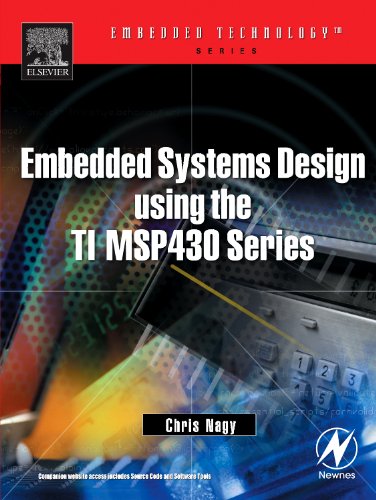
Embedded Systems Design Using the TI MSP430 Series (Embedded...
Authors:
Chris Nagy
Publisher:
Newnes
Publication Date:
Not available
ISBN:
075067623X
Learn about designing, programming, and developing with the popular new Texas Instruments family of microcontrollers, the MSP430 series with this new... book from Chris Nagy. This product line is experiencing explosive growth due to its low-power consumption and powerful features, but very little design and application information is available other than what is offered by the manufacturer. The book fills a gap in the technical literature for embedded systems engineers by offering a more complete combination of technical data, example code, and descriptive prose than is available from the manufacturer reference information, and is useful to both professionals and hobbyists. Intended for embedded engineers who are new to the embedded field, or for the thousands of engineers who have experience with other microcontrollers (such as PICs, 8051s, or Motorola HC0x devices) but are new to the MSP430 line, Chris Nagy offers a thorough and practical description of the device features, gives development guidelines, and provides design examples. Code examples are used in virtually every chapter and area also included on the companion CD-ROM, and/or online. The book is divided into three sections: the first section provides detailed descriptions of the devices themselves; the second describes hardware/firmware development for the devices; the third is designed to incorporate information from the first two, and provide guidelines and examples of designs. * Get up-to-speed on the TI MSP430 product family's features and idiosyncrasies* A 'hand-holding' reference to help get started on designs* Accompanying CD-ROM includes code examples
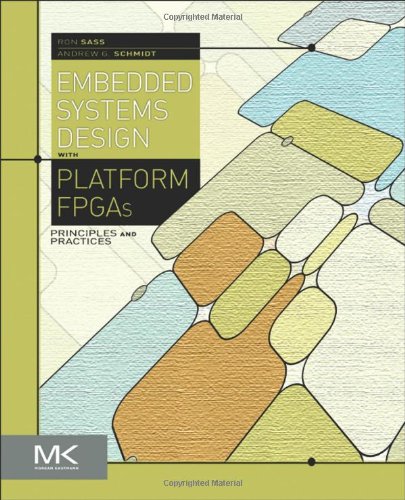
Embedded Systems Design with Platform FPGAs: Principles and Practices
Authors:
Ronald Sass
Publisher:
Morgan Kaufmann
Publication Date:
Not available
ISBN:
0123743338
This book will introduce professional engineers and students alike to system development using Platform FPGAs. The focus is on embedded systems but it... also serves as a general guide to building custom computing systems. The text describes the fundamental technology in terms of hardware, software, and a set of principles to guide the development of Platform FPGA systems. The goal is to show how to systematically and creatively apply these principles to the construction of application-specific embedded system architectures. There is a strong focus on using free and open source software to increase productivity. The organization of each chapter in the book includes two parts. The white pages describe concepts, principles, and general knowledge. The gray pages include a technical rendition of the main issues of the chapter and show the concepts applied in practice. This includes step-by-step details for a specific development board and tool chain so that the reader can carry out the same steps on their own. Rather than try to demonstrate the concepts on a broad set of tools and boards, the text uses a single set of tools (Xilinx Platform Studio, Linux, and GNU) throughout and uses a single developer board (Xilinx ML-510) for the examples.Explains how to use the Platform FPGA to meet complex design requirements and improve product performancePresents both fundamental concepts together with pragmatic, step-by-step instructions for building a system on a Platform FPGAIncludes detailed case studies, extended real-world examples, and lab exercises

EMBEDDED SYSTEMS DIGITAL BOOK
Authors:
Not Available
Publisher:
Not available
Publication Date:
Not available
ISBN:
Not available
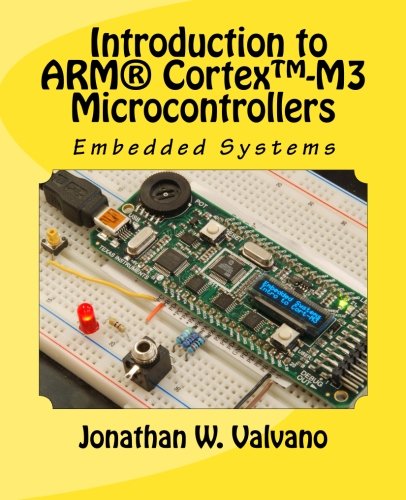
Embedded Systems: Introduction to Arm® Cortex(TM)-M3...
Authors:
Jonathan W Valvano
Publisher:
CreateSpace Independent Publishing Platform
Publication Date:
Not available
ISBN:
1477508996
This book is the first in a series of three books that teach the fundamentals of embedded systems as applied to ARM® Cortex™-M3 microcontrollers. The... first volume, now in its 2nd Edition, is an introduction to computers and interfacing focusing on assembly language and C programming. The second volume focuses on hardware/software interfacing and the design of embedded systems. The third volume focuses on real-time operating systems, digital signal processing, and digital control systems. This first volume is an introductory book that could be used at the college level with little or no prerequisites. An embedded system is a system that performs a specific task and has a computer embedded inside. A system is comprised of components and interfaces connected together for a common purpose. This book is an introduction to embedded systems. Specific topics include microcontrollers, fixed-point numbers, the design of software in assembly language and C, elementary data structures, programming input/output including interrupts, analog to digital conversion, digital to analog conversion. This book employs many approaches to learning. It will not include an exhaustive recapitulation of the information in data sheets. First, it begins with basic fundamentals, which allows the reader to solve new problems with new technology. Second, the book presents many detailed design examples. These examples illustrate the process of design. There are multiple structural components that assist learning. Checkpoints, with answers in the back, are short easy to answer questions providing immediate feedback while reading. Simple homework, with answers to the odd questions on the web, provides more detailed learning opportunities. The book includes an index and a glossary so that information can be searched. The most important learning experiences in a class like this are of course the laboratories. Each chapter has suggested lab assignments. More detailed lab descriptions are available on the web. Specifically for this volume, look at the lab assignments for EE319K. For Volume 2 refer to the EE445L labs, and for Volume 3, look at the lab assignments for EE345M/EE380L.6. There is a web site accompanying this book http://users.ece.utexas.edu/~valvano/arm. Posted here are Keil™ uVision® and Texas Instruments Code Composer Studio™ projects for each of the example programs in the book. You will also find data sheets and Excel spreadsheets relevant to the material in this book. The book will cover embedded systems for ARM® Cortex™-M3 microcontrollers with specific details on the LM3S811, LM3S1968, and LM3S8962. Most of the topics can be run on the simple LM3S811. In this book the term LM3Sxxx family will refer to any of the Texas Instruments Stellaris® ARM® Cortex™-M3-based microcontrollers. Although the solutions are specific for the LM3Sxxx family, it will be possible to use this book for other ARM derivatives.
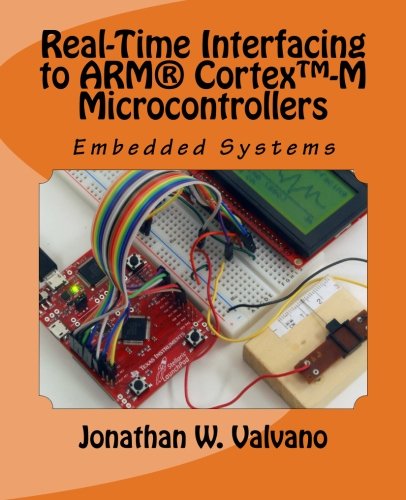
Embedded Systems: Real-Time Interfacing to the Arm® Cortex(TM)-M3
Authors:
Jonathan W. Valvano
Publisher:
CreateSpace Independent Publishing Platform
Publication Date:
Not available
ISBN:
1463590156
This book, now in its second edition, is the second in a series of three books that teach the fundamentals of embedded systems as applied to ARM®... Cortex™-M microcontrollers. The three books are primarily written for undergraduate electrical and computer engineering students. They could also be used for professionals learning the ARM platform. The first book Embedded Systems: Introduction to ARM® Cortex™-M Microcontrollers is an introduction to computers and interfacing focusing on assembly language and C programming. This second book focuses on interfacing and the design of embedded systems. The third book Embedded Systems: Real-Time Operating Systems for ARM® Cortex™-M Microcontrollers is an advanced book focusing on operating systems, high-speed interfacing, control systems, and robotics. An embedded system is a system that performs a specific task and has a computer embedded inside. Topics include microcontrollers, design, verification, hardware/software synchronization, interfacing devices to the computer, timing diagrams, real-time systems, data collection and processing, motor control, analog filters, digital filters, and real-time signal processing. In general, the area of embedded systems is an important and growing discipline within electrical and computer engineering. The educational market of embedded system is dominated by simple microcontrollers like the PIC, 9S12, and 8051. This is because of their market share, low cost, and historical dominance. However, as problems become more complex, so must the systems that solve them. A number of embedded system paradigms must shift in order to accommodate this growth in complexity. First, the number of calculation per second will increase from about 1 million/sec to 1 billion/sec. Similarly, the number of lines of software code will also increase from 1000’s to 10 to 100 million. Thirdly, systems will involve multiple microcontrollers supporting many simultaneous operations. Lastly, the need for system verification will continue to grow as these systems are deployed into safety critical applications. These changes are more than a simple growth in size and bandwidth. These systems must employ parallel programming, DMA synchronization, real-time operating systems, fault tolerant design, priority interrupt handling, and networking. Consequently, it will be important to provide our students with these types of design experiences. The ARM platform is both low cost and provides the high performance features required in future embedded systems. The ARM market share is currently large and growing. Furthermore, students trained on the ARM will be equipped to design systems across the complete spectrum from simple to complex. The purpose of writing this book at this time is to bring engineering education into the 21st century. This book employs many approaches to learning. It will not include an exhaustive recapitulation of the information in data sheets. First, it begins with basic fundamentals, which allows the reader to solve new problems with new technology. Second, the book presents many detailed design examples. These examples illustrate the process of design. There are multiple structural components that assist learning. Checkpoints, with answers in the back, are short easy to answer questions providing immediate feedback while reading. Simple homework, with answers to the odd questions on the web, provide more detailed learning opportunities. The book includes an index and a glossary so that information can be searched. The most important learning experience in a class like this are of course the laboratories. Each chapter has suggested lab assignments. More detailed lab descriptions are available on the web. The book will cover embedded systems for the ARM® Cortex™-M with specific details on the LM3S811, LM3S1968, LM3S8962, and LM4F120. Although the solutions are specific for the Stellaris LM3S and LM4F, it will be possible to use this book for other ARM derivatives.

Originally published in 1942 and now rediscovered to international acclaim, this taut and exquisitely structured novel by the Hungarian master Sandor... Marai conjures the melancholy glamour of a decaying empire and the disillusioned wisdom of its last heirs. In a secluded woodland castle an old General prepares to receive a rare visitor, a man who was once his closest friend but who he has not seen in forty-one years. Over the ensuing hours host and guest will fight a duel of words and silences, accusations and evasions. They will exhume the memory of their friendship and that of the General’s beautiful, long-dead wife. And they will return to the time the three of them last sat together following a hunt in the nearby forest--a hunt in which no game was taken but during which something was lost forever. Embers is a classic of modern European literature, a work whose poignant evocation of the past also seems like a prophetic glimpse into the moral abyss of the present

Embodied Cognition (New Problems of Philosophy)
Authors:
Lawrence Shapiro
Publisher:
Routledge
Publication Date:
Not available
ISBN:
0415773415
Embodied cognition often challenges standard cognitive science. In this outstanding introduction, Lawrence Shapiro sets out the central themes and... debates surrounding embodied cognition, explaining and assessing the work of many of the key figures in the field, including George Lakoff, Alva Noë, Andy Clark, and Arthur Glenberg. Beginning with an outline of the theoretical and methodological commitments of standard cognitive science, Shapiro then examines philosophical and empirical arguments surrounding the traditional perspective. He introduces topics such as dynamic systems theory, ecological psychology, robotics, and connectionism, before addressing core issues in philosophy of mind such as mental representation and extended cognition. Including helpful chapter summaries and annotated further reading at the end of each chapter, Embodied Cognition is essential reading for all students of philosophy of mind, psychology, and cognitive science.
 '





